 Science in Madagascar
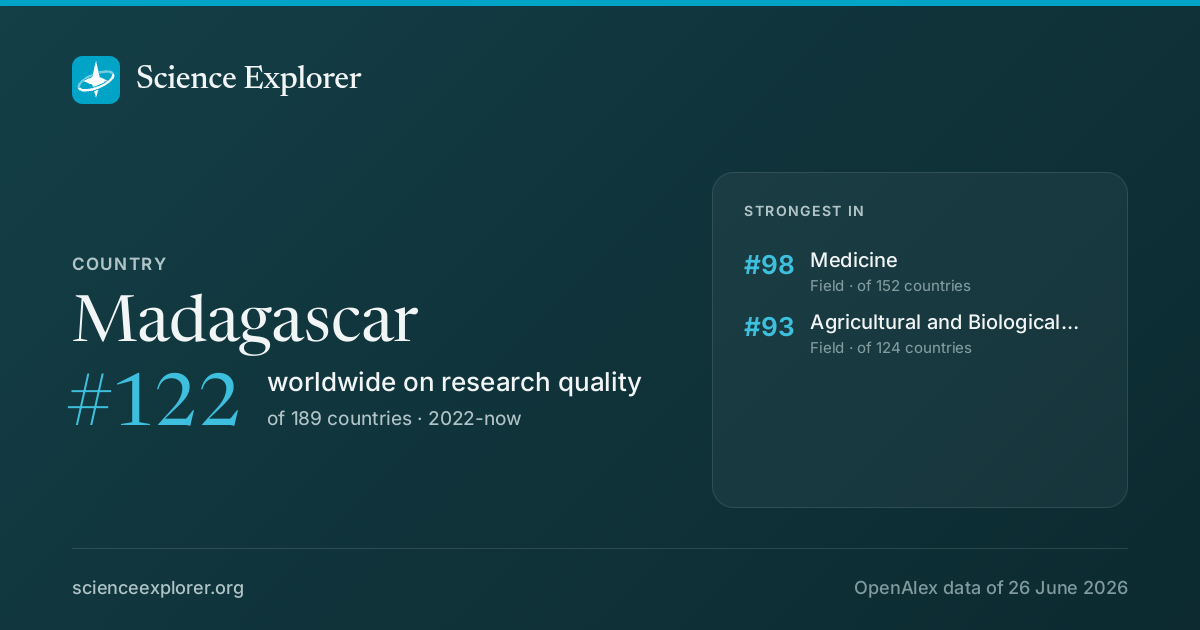
Madagascar ranks #122 of 189 countries on research quality in 2022-now (#123 all time), with 1.6k research works and 4.9% of them in the world's top 10%.
- World rank, 2022-now
- #122 of 189 · #123 all time
- Works, 2022-now
- 1.6k ▲ 24% vs 2018-21
- Citations
- 63k 10.3 per fractional work, all time
- Top-10% rate
- 4.9% all institutions 10.0%
- vs its own fields
- 0.67× 1.00× is exactly expected
- In the world top 100
- 0 0 in the top 1,000
- Open access
- 65% world 40%
- International
- 42% world 18%
MadagascarWhat is Madagascar strongest at in science?
On research quality in 2022-now, Madagascar ranks highest in Medicine (#98 of 152) and Agricultural and Biological Sciences (#93 of 124). Relative to its size it is most specialised in Horticulture, Developmental Biology and Forestry.
| Field | World rank | Where that sits | Top-10% rate | Works | All time | Institutions |
|---|---|---|---|---|---|---|
| MedicineField | #98 of 152 | 4.0% | 440 | #113 | Institutions | |
| Agricultural and Biological SciencesField | #93 of 124 | 6.7% | 208 | #100 | Institutions |
Where its research is concentrated
Location quotient: how much more (or less) of each node it does than its size predicts. Drawn around 1×, where "twice the world share" and "half of it" are the same distance apart in opposite directions. A volume reading, which on a country axis is largely population and industrial structure.
- HorticultureSubfield · 3.8 works · #76 of 178 active here14×
- Developmental BiologySubfield · 5.8 works · #68 of 195 active here13×
- ForestrySubfield · 20.9 works · #89 of 204 active here10×
- Drug DiscoverySubfield · 1.7 works · #64 of 152 active here10×
- Ecology, Evolution, Behavior and SystematicsSubfield · 80.9 works · #94 of 223 active here8.7×
- ParasitologySubfield · 15.3 works · #103 of 211 active here7.3×
- AnthropologySubfield · 29.9 works · #106 of 213 active here5.3×
- Ecological ModelingSubfield · 6.1 works · #98 of 210 active here4.0×
The whole field profile
All 26 fields at once. A specialist and a generalist produce the same ranked list and a completely different shape.
Rings at 0.5×, 1× and 2×. Widest outward: Agricultural and Biological Sciences, 2.6×. Every wedge is a field page.
All 26 fields, with their numbers
- Agricultural and Biological Sciences2.65×250 works
- Nursing2.18×21 works
- Environmental Science2.12×209 works
- Immunology and Microbiology1.78×36 works
- Pharmacology, Toxicology and Pharmaceutics1.36×10 works
- Medicine1.36×518 works
- Economics, Econometrics and Finance1.09×46 works
- Health Professions1.07×56 works
- Biochemistry, Genetics and Molecular Biology1.04×110 works
- Mathematics0.98×23 works
- Earth and Planetary Sciences0.92×29 works
- Business, Management and Accounting0.91×58 works
- Arts and Humanities0.83×48 works
- Social Sciences0.83×208 works
- Psychology0.78×47 works
- Dentistry0.73×7 works
- Energy0.68×12 works
- Decision Sciences0.56×11 works
- Computer Science0.52×80 works
- Chemistry0.49×15 works
- Engineering0.46×137 works
- Physics and Astronomy0.43×19 works
- Neuroscience0.40×13 works
- Materials Science0.31×21 works
- Veterinary0.24×1 works
- Chemical Engineering0.21×1 works
Which fields of science does Madagascar work in?
In 2022-now, 30% of research in Madagascar is in Health Sciences, 28% in Physical Sciences. Its largest fields are Medicine (26%), Agricultural and Biological Sciences (13%), Environmental Science (11%). It does 1.6× the world's share of Life Sciences.
Each ring splits the one inside it: the four domains of science, their fields, their subfields. Size is fractional works in 2022-now. Every slice is a page; the interactive view zooms down to single topics and colours each by how much more of it this country does than the world.
Its 4 domains and 26 fields, with their numbers
- Health Sciences60330.4%
- Medicine51826.1%
- Health Professions562.8%
- Nursing211.1%
- Dentistry70.4%
- Veterinary10.0%
- Physical Sciences54727.6%
- Environmental Science20910.5%
- Engineering1376.9%
- Computer Science804.0%
- Earth and Planetary Sciences291.4%
- Mathematics231.2%
- Materials Science211.1%
- Physics and Astronomy191.0%
- Chemistry150.8%
- Energy120.6%
- Chemical Engineering10.1%
- Life Sciences41821.1%
- Social Sciences41721.0%
- Social Sciences20810.5%
- Business, Management and Accounting582.9%
- Arts and Humanities482.4%
- Psychology472.4%
- Economics, Econometrics and Finance462.3%
- Decision Sciences110.5%
Which keywords describe research in Madagascar?
By fractional works in 2022-now, weighted toward what it does more of than the world: Climate Change, Epidemiology, Smallholder Farmers, Adaptation, Population Dynamics, Biodiversity, Evolution and Biodiversity Conservation.
- Nutritional Value
- Primates
- Cooperation
- Cognition
- Agroforestry
- Altruism
- Vaccine Development
- Work Organization
- Agricultural Development
- Habitat Fragmentation
- Invasive Species
- Global Burden
- Diversity
- Evolution
- Adaptation
- Diagnosis
- Sustainable Development
- Biodiversity
- Smallholder Farmers
- Climate Change
- Epidemiology
- Sustainability
- Public Health
- Environmental Impact
- Treatment
- Biodiversity Conservation
- Population Dynamics
- Immune Response
- Genetic Diversity
- Agroecology
- Livestock Farming
- Vaccine
- Multifunctionality
- Conservation
- Sustainable Agriculture
- Conservation Biology
- Biodiversity Loss
- Social Behavior
- Intelligence
- Climate Resilience
Size is fractional works in 2022-now in the topics tagged with each word; colour is the word's share of this country's work against its share of the world's. The 40 words are chosen for being large and distinctive. Each links to the topic it comes from most.
All 40 words, with their numbers
- Epidemiology174▲ 2.2×117 topics
- Climate Change162▲ 3.0×81 topics
- Sustainability85▲ 1.76×71 topics
- Smallholder Farmers62▲ 15×6 topics
- Public Health61▲ 2.1×46 topics
- Biodiversity57▲ 3.8×31 topics
- Environmental Impact53▲ 1.58×49 topics
- Sustainable Development49▲ 1.57×47 topics
- Treatment47▲ 1.96×39 topics
- Diagnosis46▲ 2.5×36 topics
- Biodiversity Conservation45▲ 6.1×14 topics
- Adaptation44▲ 7.5×10 topics
- Population Dynamics43▲ 8.4×12 topics
- Evolution41▲ 7.7×16 topics
- Immune Response38▲ 3.4×18 topics
- Diversity38▲ 11×6 topics
- Genetic Diversity38▲ 4.4×21 topics
- Global Burden37▲ 3.4×12 topics
- Agroecology36▲ 13×4 topics
- Invasive Species35▲ 4.2×20 topics
- Livestock Farming35▲ 30×3 topics
- Habitat Fragmentation34▲ 8.0×5 topics
- Vaccine33▲ 4.2×11 topics
- Agricultural Development33▲ 11×3 topics
- Multifunctionality33▲ 36×2 topics
- Work Organization33▲ 43×1 topic
- Conservation32▲ 3.8×18 topics
- Vaccine Development32▲ 6.3×11 topics
- Sustainable Agriculture31▲ 5.1×10 topics
- Altruism30▲ 18×5 topics
- Conservation Biology28▲ 13×4 topics
- Agroforestry24▲ 18×4 topics
- Biodiversity Loss23▲ 21×3 topics
- Cognition22▲ 7.8×2 topics
- Social Behavior22▲ 19×2 topics
- Cooperation22▲ 17×3 topics
- Intelligence22▲ 26×1 topic
- Primates22▲ 57×1 topic
- Climate Resilience22▲ 18×3 topics
- Nutritional Value21▲ 9.6×4 topics
Which research topics does Madagascar publish the most in?
Its largest topics in 2022-now are Agriculture and Rural Development Research, Primate Behavior and Ecology, African Botany and Ecology Studies.
Area is fractional works in 2022-now; colour is the subfield each topic belongs to. Every tile is a topic page.
- 1 Agriculture and Rural Development Research Ecology, Evolution, Behavior and Systematics 33 works
- 2 Primate Behavior and Ecology Social Psychology 22 works
- 3 African Botany and Ecology Studies Forestry 19 works
- 4 Amphibian and Reptile Biology Global and Planetary Change 16 works
- 5 Global Maternal and Child Health Pediatrics, Perinatology and Child Health 16 works
- 6 Child Nutrition and Water Access Nutrition and Dietetics 15 works
- 7 Global Maritime and Colonial Histories Anthropology 14 works
- 8 Malaria Research and Control Public Health, Environmental and Occupational Health 14 works
- 9 Mosquito-borne diseases and control Public Health, Environmental and Occupational Health 13 works
- 10 Conservation, Biodiversity, and Resource Management Global and Planetary Change 13 works
- 11 Tuberculosis Research and Epidemiology Infectious Diseases 11 works
- 12 French Urban and Social Studies Sociology and Political Science 11 works
Which universities in Madagascar lead research?
University of Antananarivo, Université de Fianarantsoa and Université de Mahajanga rank highest in Madagascar on research quality in 2022-now.
One dot per institution in the list below. The upper left is the interesting corner.
- 1University of AntananarivoUniversity · Antananarivo · #6,509 worldwide3.7% top 10% · 680 works
- 2Université de FianarantsoaUniversity · Fianarantsoa · #13,415 worldwide2.0% top 10% · 126 works
- 3Université de MahajangaUniversity · Mahajanga · #14,231 worldwide3.3% top 10% · 106 works
- 4University of ToliaraUniversity · Toliara · #17,031 worldwide4.7% top 10% · 80 works
- 5Centre National de la Recherche Appliquée au Developpement RuralResearch facility · Antananarivo · #17,511 worldwide9.8% top 10% · 71 works
- 6Université d’AntsirananaUniversity · Antsiranana · #17,773 worldwide2.5% top 10% · 64 works
- 7Association VahatraInstitution · Antananarivo · #18,544 worldwide5.5% top 10% · 84 works

The track on each row is its top-10% rate; the tick is the average of all institutions, 10.0% (how it is set): teal above it, red below.
All ranked institutions in MadagascarWho are the top researchers in Madagascar?
O. Sarobidy Rakotonarivo, Chantal Radimilahy and Jonah Ratsimbazafy rank highest among researchers based in Madagascar.
- 1 O. Sarobidy Rakotonarivo #151,541 worldwide 1.7k citations · 59 works
- 2 Chantal Radimilahy #278,586 worldwide 2.1k citations · 51 works
- 3 Jonah Ratsimbazafy #334,732 worldwide 4k citations · 112 works
- 4 Jean‐Michel Héraud #497,740 worldwide 7.2k citations · 222 works
- 5 Patrice Piola #621,069 worldwide 3.7k citations · 128 works
- 6 Tantely Razafimbelo #631,310 worldwide 2.9k citations · 139 works
- 7 Luc Hervé Samison #646,531 worldwide 1.8k citations · 67 works
- 8 Rodin M. Rasoloarison #650,391 worldwide 1.5k citations · 33 works
- 9 Fanjandrainy Rasoaherinomenjanahary #696,092 worldwide 2k citations · 43 works
- 10 Richard K. B. Jenkins #708,721 worldwide 7k citations · 98 works
How open and international is Madagascar's research?
65% of its research is openly available (world: 40%), and 42% is written with international co-authors (world: 18%).
World: 40% of research is openly available.
World: 18% is written across borders.
In 2022-now, 82% of its research is openly available (world 63%) and 43% is written with co-authors abroad (world 22%). Against what its own mix of topics predicts, that is 1.19× the expected open access and 1.63× the expected international share, which puts it #29 of 173 countries on openness.
How has Madagascar's research grown?
Output in 2022-2025 was 24% higher than in 2018-2021.
The same series as a ribbon: one cell per year, darker for more. The line above answers how much; this answers when.
Its share of all research
Growing output can still be a shrinking share: all of science grows. This is Madagascar as a percentage of every work published that year, 0.0071% in 2024.
Fractional works of Madagascar over all fractional works that year. How the balance of science has shifted.
How much of it reaches the world top 10%
Over the whole record, 5.8% of its 6.1k works since 1950 reached the world top 10% for their field and year.
Of each year's output, the share that reached the world's 10% most cited for its field and year. Peak 11.7% in 1993.
Which countries have research most like Madagascar's?
Democratic Republic of the Congo is Madagascar's closest research twin: of all countries, its research is spread across the fields most like Madagascar's, with both strong in Agricultural and Biological Sciences.
- 1
 Democratic Republic of the CongoBoth strong in Agricultural and Biological Sciences, Nursing, Immunology and Microbiology
0.80 Compare
- 2
 NigerBoth strong in Agricultural and Biological Sciences, Nursing, Immunology and Microbiology
0.77 Compare
- 3
 Republic of the CongoBoth strong in Agricultural and Biological Sciences, Nursing, Immunology and Microbiology
0.75 Compare
- 4
 MalawiBoth strong in Agricultural and Biological Sciences, Nursing, Environmental Science
0.75 Compare
- 5
 HaitiBoth strong in Agricultural and Biological Sciences, Nursing, Medicine
0.73 Compare
Similarity is the correlation of each side's location quotients across every field it publishes in, on a log scale: 1 is the same shape of research, 0 is unrelated. It ignores size. How it is measured.
Compare Madagascar with
 Uzbekistan
 Maldives
 Georgia
 Bahrain
 North Macedonia
 Papua New Guinea
Share Madagascar's ranking
Badges for a website1Each links back here and updates with every snapshot

Research fields in Madagascar
Discussion
Ask a question or share a note about Madagascar. Posts are plain text and can be reported.