Science Explorer Back to mapMap
Discussion
Company · Deerfield · United States

Baxter (United States)

In research, Baxter (United States) stands highest in Health Sciences (#1,521 of 16,688 worldwide), Medicine (#1,634 of 14,558 worldwide) and Life Sciences (#1,321 of 11,023 worldwide), over all time.

World rank, 2022-now
#10,039
of 22,385 · #2,352 all time
Rank in United States
#1,375
of 3,332
Research works
2.1k
▼ 40% vs 2018-21
Citations
84k
41.0 per fractional work
Top-10% rate
13.1%
all institutions 10.0%
vs its own fields
1.08×
1.00× is exactly expected
Open access
25%
world 40%
International
17%
world 18%

What is Baxter (United States) known for in research?

The fields where it stands highest, over all time, ranked among every institution above the floor in each field.

FieldWorld rankWhere that sitsTop-10% rateWorks
Health SciencesDomain #1,521 of 16,688 10.9%996
MedicineField #1,634 of 14,558 10.9%847
Life SciencesDomain #1,321 of 11,023 13.8%424
Biochemistry, Genetics and Molecular BiologyField #955 of 5,801 15.0%251
Molecular BiologySubfield #995 of 3,729 15.6%141
EngineeringField #4,125 of 9,532 8.8%182
NephrologySubfield #193 of 422 10.9%170
Physical SciencesDomain #8,332 of 17,446 8.4%461
Social SciencesDomain #9,641 of 14,833 10.4%175

Each strip is that field's whole ranked pool, with the notch where Baxter (United States) sits in it, in the colour of the band that rank falls in. The track under the rate is the rate itself: it carries no average mark, because the average differs by field (from about 6% in Dentistry to 21% in Economics).

Which fields of science does Baxter (United States) work in?

In 2022-now, 59% of research at Baxter (United States) is in Health Sciences, 16% in Life Sciences. Its largest fields are Medicine (49%), Biochemistry, Genetics and Molecular Biology (10%), Health Professions (8%). It does 2.3× the world's share of Health Sciences.

Health Sciences: 50 fractional works · 59.0% of its workMedicine: 42 fractional works · 49.2% of its workNephrology: 9 fractional works · 10.7% of its workSurgery: 5 fractional works · 6.1% of its workPulmonary and Respiratory Medicine: 4 fractional works · 4.6% of its workCardiology and Cardiovascular Medicine: 3 fractional works · 3.5% of its workPublic Health, Environmental and Occupational Health: 2 fractional works · 2.5% of its workEpidemiology: 2 fractional works · 2.3% of its workCritical Care and Intensive Care Medicine: 2 fractional works · 2.3% of its workHematology: 1 fractional works · 1.8% of its workPharmacology: 1 fractional works · 1.6% of its workPathology and Forensic Medicine: 1 fractional works · 1.4% of its workPhysiology: 1 fractional works · 1.4% of its workEmergency Medicine: 1 fractional works · 1.0% of its workInfectious Diseases: 1 fractional works · 1.0% of its workPediatrics, Perinatology and Child Health: 1 fractional works · 0.9% of its workRadiology, Nuclear Medicine and Imaging: 1 fractional works · 0.8% of its workGenetics: 1 fractional works · 0.7% of its workBiochemistry: 1 fractional works · 0.7% of its workPsychiatry and Mental health: 0 fractional works · 0.5% of its workOrthopedics and Sports Medicine: 0 fractional works · 0.5% of its workRehabilitation: 0 fractional works · 0.5% of its workEndocrinology, Diabetes and Metabolism: 0 fractional works · 0.5% of its workComplementary and alternative medicine: 0 fractional works · 0.5% of its workOncology: 0 fractional works · 0.4% of its workGeriatrics and Gerontology: 0 fractional works · 0.4% of its workDermatology: 0 fractional works · 0.4% of its workNeurology: 0 fractional works · 0.4% of its workGastroenterology: 0 fractional works · 0.3% of its workRheumatology: 0 fractional works · 0.3% of its workFamily Practice: 0 fractional works · 0.2% of its workOphthalmology: 0 fractional works · 0.2% of its workSmaller subfields together: 1 fractional works · 0.6% of its workHealth Professions: 7 fractional works · 8.5% of its workEmergency Medical Services: 2 fractional works · 2.7% of its workMedical Laboratory Technology: 2 fractional works · 2.0% of its workHealth Information Management: 1 fractional works · 1.2% of its workGeneral Health Professions: 1 fractional works · 1.1% of its workPharmacy: 0 fractional works · 0.5% of its workOccupational Therapy: 0 fractional works · 0.5% of its workRadiological and Ultrasound Technology: 0 fractional works · 0.3% of its workSmaller subfields together: 0 fractional works · 0.3% of its workNursing: 1 fractional works · 0.8% of its workNutrition and Dietetics: 1 fractional works · 0.8% of its workDentistry: 0 fractional works · 0.4% of its workOral Surgery: 0 fractional works · 0.4% of its workVeterinary: 0 fractional works · 0.1% of its workLife Sciences: 13 fractional works · 15.8% of its workBiochemistry, Genetics and Molecular Biology: 9 fractional works · 10.1% of its workMolecular Biology: 6 fractional works · 6.5% of its workGenetics: 1 fractional works · 1.1% of its workCell Biology: 1 fractional works · 1.0% of its workCancer Research: 0 fractional works · 0.4% of its workClinical Biochemistry: 0 fractional works · 0.4% of its workBiochemistry: 0 fractional works · 0.3% of its workBiophysics: 0 fractional works · 0.3% of its workSmaller subfields together: 0 fractional works · 0.2% of its workNeuroscience: 2 fractional works · 2.0% of its workCognitive Neuroscience: 1 fractional works · 1.6% of its workCellular and Molecular Neuroscience: 0 fractional works · 0.2% of its workSmaller subfields together: 0 fractional works · 0.2% of its workImmunology and Microbiology: 2 fractional works · 1.9% of its workImmunology: 1 fractional works · 1.2% of its workMicrobiology: 0 fractional works · 0.4% of its workSmaller subfields together: 0 fractional works · 0.2% of its workAgricultural and Biological Sciences: 1 fractional works · 1.5% of its workFood Science: 0 fractional works · 0.5% of its workPlant Science: 0 fractional works · 0.4% of its workAquatic Science: 0 fractional works · 0.3% of its workSmaller subfields together: 0 fractional works · 0.3% of its workPharmacology, Toxicology and Pharmaceutics: 0 fractional works · 0.3% of its workPharmaceutical Science: 0 fractional works · 0.2% of its workSmaller subfields together: 0 fractional works · 0.1% of its workPhysical Sciences: 12 fractional works · 13.9% of its workEngineering: 5 fractional works · 5.9% of its workBiomedical Engineering: 2 fractional works · 2.0% of its workBuilding and Construction: 1 fractional works · 1.0% of its workElectrical and Electronic Engineering: 1 fractional works · 0.7% of its workMechanics of Materials: 0 fractional works · 0.6% of its workAutomotive Engineering: 0 fractional works · 0.5% of its workComputational Mechanics: 0 fractional works · 0.3% of its workSafety, Risk, Reliability and Quality: 0 fractional works · 0.2% of its workSmaller subfields together: 1 fractional works · 0.6% of its workComputer Science: 3 fractional works · 3.3% of its workComputer Networks and Communications: 1 fractional works · 0.8% of its workInformation Systems: 1 fractional works · 0.7% of its workComputer Science Applications: 0 fractional works · 0.6% of its workComputational Theory and Mathematics: 0 fractional works · 0.4% of its workArtificial Intelligence: 0 fractional works · 0.3% of its workComputer Vision and Pattern Recognition: 0 fractional works · 0.3% of its workSmaller subfields together: 0 fractional works · 0.3% of its workEnvironmental Science: 2 fractional works · 2.0% of its workGlobal and Planetary Change: 1 fractional works · 0.7% of its workNature and Landscape Conservation: 0 fractional works · 0.5% of its workHealth, Toxicology and Mutagenesis: 0 fractional works · 0.4% of its workWater Science and Technology: 0 fractional works · 0.3% of its workSmaller subfields together: 0 fractional works · 0.1% of its workChemistry: 1 fractional works · 0.9% of its workSpectroscopy: 1 fractional works · 0.7% of its workSmaller subfields together: 0 fractional works · 0.2% of its workEnergy: 1 fractional works · 0.8% of its workRenewable Energy, Sustainability and the Environment: 1 fractional works · 0.8% of its workMaterials Science: 0 fractional works · 0.4% of its workMaterials Chemistry: 0 fractional works · 0.3% of its workSmaller subfields together: 0 fractional works · 0.1% of its workEarth and Planetary Sciences: 0 fractional works · 0.4% of its workChemical Engineering: 0 fractional works · 0.1% of its workPhysics and Astronomy: 0 fractional works · 0.0% of its workSocial Sciences: 10 fractional works · 11.3% of its workSocial Sciences: 5 fractional works · 5.4% of its workEducation: 2 fractional works · 2.4% of its workSociology and Political Science: 1 fractional works · 1.5% of its workCommunication: 0 fractional works · 0.6% of its workSafety Research: 0 fractional works · 0.4% of its workGender Studies: 0 fractional works · 0.3% of its workSmaller subfields together: 0 fractional works · 0.2% of its workPsychology: 2 fractional works · 2.3% of its workSocial Psychology: 1 fractional works · 1.6% of its workExperimental and Cognitive Psychology: 0 fractional works · 0.5% of its workSmaller subfields together: 0 fractional works · 0.1% of its workEconomics, Econometrics and Finance: 2 fractional works · 2.0% of its workEconomics and Econometrics: 2 fractional works · 2.0% of its workBusiness, Management and Accounting: 1 fractional works · 0.8% of its workOrganizational Behavior and Human Resource Management: 1 fractional works · 0.7% of its workSmaller subfields together: 0 fractional works · 0.1% of its workDecision Sciences: 1 fractional works · 0.8% of its workManagement Science and Operations Research: 0 fractional works · 0.5% of its workSmaller subfields together: 0 fractional works · 0.3% of its workALL ITS WORKBaxter (UnitedStates)85fractional works, 2022-now
Life Sciences16%Physical Sciences14%Health Sciences59%Social Sciences11%

Each ring splits the one inside it: the four domains of science, their fields, their subfields. Size is fractional works in 2022-now. Every slice is a page; the interactive view zooms down to single topics and colours each by how much more of it this institution does than the world.

Its 4 domains and 24 fields, with their numbers
    1. Medicine4249.2%
    2. Health Professions78.5%
    3. Nursing10.8%
    4. Dentistry00.4%
    5. Veterinary00.1%
    1. Biochemistry, Genetics and Molecular Biology910.1%
    2. Neuroscience22.0%
    3. Immunology and Microbiology21.9%
    4. Agricultural and Biological Sciences11.5%
    5. Pharmacology, Toxicology and Pharmaceutics00.3%
    1. Engineering55.9%
    2. Computer Science33.3%
    3. Environmental Science22.0%
    4. Chemistry10.9%
    5. Energy10.8%
    6. Materials Science00.4%
    7. Earth and Planetary Sciences00.4%
    8. Chemical Engineering00.1%
    9. Physics and Astronomy00.0%
    1. Social Sciences55.4%
    2. Psychology22.3%
    3. Economics, Econometrics and Finance22.0%
    4. Business, Management and Accounting10.8%
    5. Decision Sciences10.8%
All of science, and how each field's share has moved since 1950: the Science domain explorer

Field profile

Location quotient across every field it publishes in: outside the ring is more than an institution of this size would be expected to publish, inside it is less.

Agricultural and Biological Sciences: 0.32× its world share, 1 worksAgricultural and Bio…Biochemistry, Genetics and Molecular Biology: 1.90× its world share, 9 worksBiochemistry, Geneti…Immunology and Microbiology: 1.85× its world share, 2 worksImmunology and Micro…Neuroscience: 1.25× its world share, 2 worksNeurosciencePharmacology, Toxicology and Pharmaceutics: 0.90× its world share, 0 worksPharmacology, Toxico…Chemical Engineering: 0.19× its world share, 0 worksChemical EngineeringChemistry: 0.57× its world share, 1 worksChemistryComputer Science: 0.43× its world share, 3 worksComputer ScienceEarth and Planetary Sciences: 0.23× its world share, 0 worksEarth and Planetary …Energy: 0.85× its world share, 1 worksEnergyEngineering: 0.40× its world share, 5 worksEngineeringEnvironmental Science: 0.41× its world share, 2 worksEnvironmental ScienceMaterials Science: 0.13× its world share, 0 worksMaterials SciencePhysics and Astronomy: 0.01× its world share, 0 worksPhysics and AstronomyDentistry: 0.81× its world share, 0 worksDentistryHealth Professions: 3.22× its world share, 7 worksHealth ProfessionsMedicine: 2.56× its world share, 42 worksMedicineNursing: 1.66× its world share, 1 worksNursingVeterinary: 0.96× its world share, 0 worksVeterinaryBusiness, Management and Accounting: 0.26× its world share, 1 worksBusiness, Management…Decision Sciences: 0.83× its world share, 1 worksDecision SciencesEconomics, Econometrics and Finance: 0.95× its world share, 2 worksEconomics, Econometr…Psychology: 0.74× its world share, 2 worksPsychologySocial Sciences: 0.42× its world share, 5 worksSocial Sciences1×world share
more than its size predictsabout as predictedless

Rings at 0.5×, 1× and 2×. Widest outward: Health Professions, 3.2×. Every wedge is a field page.

All 24 fields, with their numbers
  1. Health Professions3.22×7 works
  2. Medicine2.56×42 works
  3. Biochemistry, Genetics and Molecular Biology1.90×9 works
  4. Immunology and Microbiology1.85×2 works
  5. Nursing1.66×1 works
  6. Neuroscience1.25×2 works
  7. Veterinary0.96×0 works
  8. Economics, Econometrics and Finance0.95×2 works
  9. Pharmacology, Toxicology and Pharmaceutics0.90×0 works
  10. Energy0.85×1 works
  11. Decision Sciences0.83×1 works
  12. Dentistry0.81×0 works
  13. Psychology0.74×2 works
  14. Chemistry0.57×1 works
  15. Computer Science0.43×3 works
  16. Social Sciences0.42×5 works
  17. Environmental Science0.41×2 works
  18. Engineering0.40×5 works
  19. Agricultural and Biological Sciences0.32×1 works
  20. Business, Management and Accounting0.26×1 works
  21. Earth and Planetary Sciences0.23×0 works
  22. Chemical Engineering0.19×0 works
  23. Materials Science0.13×0 works
  24. Physics and Astronomy0.01×0 works

Who are the top researchers at Baxter (United States)?

Ranked on the quality score, Edward F. Vonesh, Bruce M. Ewenstein and John K. Moran lead among researchers whose main affiliation is Baxter (United States).

  1. 1 Edward F. Vonesh United States · #67,939 worldwide 12k citations · 121 works
  2. 2 Bruce M. Ewenstein United States · #293,300 worldwide 9k citations · 181 works
  3. 3 John K. Moran United States · #341,274 worldwide 3k citations · 30 works
  4. 4 Barrett E. Rabinow United States · #486,555 worldwide 3.5k citations · 37 works
  5. 5 Prakash Keshaviah United States · #511,105 worldwide 4.3k citations · 88 works
  6. 6 James A. Sloand United States · #673,316 worldwide 3.7k citations · 123 works
  7. 7 Mahesh V. Chaubal United States · #720,933 worldwide 1.9k citations · 34 works
  8. 8 P Schroth United States · #735,351 worldwide 2.1k citations · 21 works
  9. 9 Kenneth O. Story United States · #767,071 worldwide 2.1k citations · 35 works
  10. 10 Edwin G. Moore United States · #787,089 worldwide 1.5k citations · 30 works
All ranked researchers at Baxter (United States)

What are the most cited papers from Baxter (United States)?

The most cited paper from Baxter (United States) is "Dermatologist-level classification of skin cancer with deep neural networks" (Andre Esteva, Brett Kuprel, Roberto A. Novoa et al., 2017), with 14,423 citations. Next come "A Concordance Correlation Coefficient to Evaluate Reproducibility" (8,920) and "Synthetic biomaterials as instructive extracellular microenvironments for morphogenesis in tissue engineering" (4,561).

Most cited papers
#PaperReleasedCitations
1 Dermatologist-level classification of skin cancer with deep neural networks Andre Esteva, Brett Kuprel, Roberto A. Novoa et al. · Nature Open access 25 Jan 2017 14,423
2 A Concordance Correlation Coefficient to Evaluate Reproducibility Lawrence I-Kuei Lin · Biometrics Mar 1989 8,920
3 Synthetic biomaterials as instructive extracellular microenvironments for morphogenesis in tissue engineering Matthias P. Lütolf, Jeffrey A. Hubbell · Nature Biotechnology Open access 2005 4,561
4 Data-Driven Phenotypic Dissection of AML Reveals Progenitor-like Cells that Correlate with Prognosis Jacob Levine, Erin F. Simonds, Sean C. Bendall et al. · Cell Open access 18 Jun 2015 2,629
5 Single-Cell Mass Cytometry of Differential Immune and Drug Responses Across a Human Hematopoietic Continuum Sean C. Bendall, Erin F. Simonds, Peng Qiu et al. · Science Open access 5 May 2011 2,388
All 60 most cited papers, with filters and sorting

Which keywords describe research at Baxter (United States)?

By fractional works in 2022-now, weighted toward what it does more of than the world: Chronic Kidney Disease, Hemodialysis, Quality of Life, Cardiovascular Disease, Mortality, Inflammation, Nutrition and Dialysis.

▲ more of its work than of the world's◆ about the world's share▼ less than the world's

Size is fractional works in 2022-now in the topics tagged with each word; colour is the word's share of this institution's work against its share of the world's. The 40 words are chosen for being large and distinctive. Each links to the topic it comes from most.

All 40 words, with their numbers
  1. Chronic Kidney Disease10▲ 45×8 topics
  2. Inflammation8▲ 4.6×23 topics
  3. Quality of Life8▲ 6.2×14 topics
  4. Hemodialysis7▲ 105×2 topics
  5. Cardiovascular Disease7▲ 7.2×6 topics
  6. Mortality6▲ 14×5 topics
  7. Nutrition6▲ 17×6 topics
  8. Dialysis6▲ 128×1 topic
  9. Peritoneal Dialysis6▲ 128×1 topic
  10. Epidemiology5▲ 1.36×24 topics
  11. Sepsis4▲ 25×3 topics
  12. Management4▲ 5.5×11 topics
  13. Critical Care3▲ 16×6 topics
  14. Biomarkers3▲ 4.7×6 topics
  15. Diagnosis2▲ 3.1×12 topics
  16. Prognosis2▲ 8.4×4 topics
  17. Global Burden2▲ 4.7×4 topics
  18. Treatment2▲ 2.1×13 topics
  19. Risk Factors2▲ 2.2×8 topics
  20. Acute Kidney Injury2▲ 44×2 topics
  21. Renal Failure2▲ 50×2 topics
  22. Classification2▲ 5.0×2 topics
  23. Contrast-Induced Nephropathy2▲ 68×1 topic
  24. Hemorrhage2▲ 32×2 topics
  25. Nephrotoxicity2▲ 48×1 topic
  26. Arrhythmia Detection2▲ 46×1 topic
  27. ECG Signal2▲ 46×1 topic
  28. Ethical Considerations2▲ 5.1×5 topics
  29. Infectious Diseases2▲ 5.4×4 topics
  30. Low Back Pain2▲ 10×2 topics
  31. Resuscitation2▲ 13×2 topics
  32. Biomechanics1▲ 5.3×6 topics
  33. Coagulopathy1▲ 20×1 topic
  34. Stem Cells1▲ 6.2×7 topics
  35. Trauma1▲ 8.0×1 topic
  36. Maintenance1▲ 19×1 topic
  37. Medical Equipment1▲ 74×1 topic
  38. Psychological Factors1▲ 6.7×3 topics
  39. Disability1▲ 12×2 topics
  40. Patient Safety1▲ 8.3×2 topics

Which research topics does Baxter (United States) publish most on?

By volume in 2022-now: Dialysis and Renal Disease Management, Acute Kidney Injury Research, ECG Monitoring and Analysis and Trauma, Hemostasis, Coagulopathy, Resuscitation.

  1. 1 Dialysis and Renal Disease Management Nephrology 6 works
  2. 2 Acute Kidney Injury Research Nephrology 2 works
  3. 3 ECG Monitoring and Analysis Cardiology and Cardiovascular Medicine 2 works
  4. 4 Trauma, Hemostasis, Coagulopathy, Resuscitation Critical Care and Intensive Care Medicine 1 works
  5. 5 Quality and Safety in Healthcare Medical Laboratory Technology 1 works
  6. 6 Musculoskeletal pain and rehabilitation Pharmacology 1 works
  7. 7 Pharmaceutical Quality and Counterfeiting Public Health, Environmental and Occupational Health 1 works
  8. 8 Disaster Response and Management Emergency Medical Services 1 works
  9. 9 Hemostasis and retained surgical items Hematology 1 works
  10. 10 Hemodynamic Monitoring and Therapy Surgery 1 works

How open and international is its research?

Against the world's own shares: the tick on each track. Both are shares of its output, so they sit on one scale and can be read against each other as well as against the world.

openly available24.8%not open75.2%

World: 40% of research is openly available.

with international co-authors17.3%domestic only82.7%

World: 18% is written across borders.

How has Baxter (United States)'s research output changed?

Output in 2022-2025 was 40% lower than in 2018-2021.

still counting1990200020102020
grewheldshrank

The same series as a ribbon: one cell per year, darker for more. The line above answers how much; this answers when.

Its share of all research

Growing output can still be a shrinking share: all of science grows. This is Baxter (United States) as a percentage of every work published that year, 0.00038% in 2024.

still counting0.0050%0.010%Baxter (United States)0.00026% in 202519801990200020102020

Fractional works of Baxter (United States) over all fractional works that year. How the balance of science has shifted.

How much of it reaches the world top 10%

Year by year, against all institutions in the same year.

10%20%30%all institutions10.0% in 2024Baxter (United States)8.0% in 2024200020102020

Of each year's output, the share that reached the world's 10% most cited for its field and year. Peak 21.0% in 2018.

Other research institutions in Deerfield

All research institutions in Deerfield

Share Baxter (United States)'s ranking
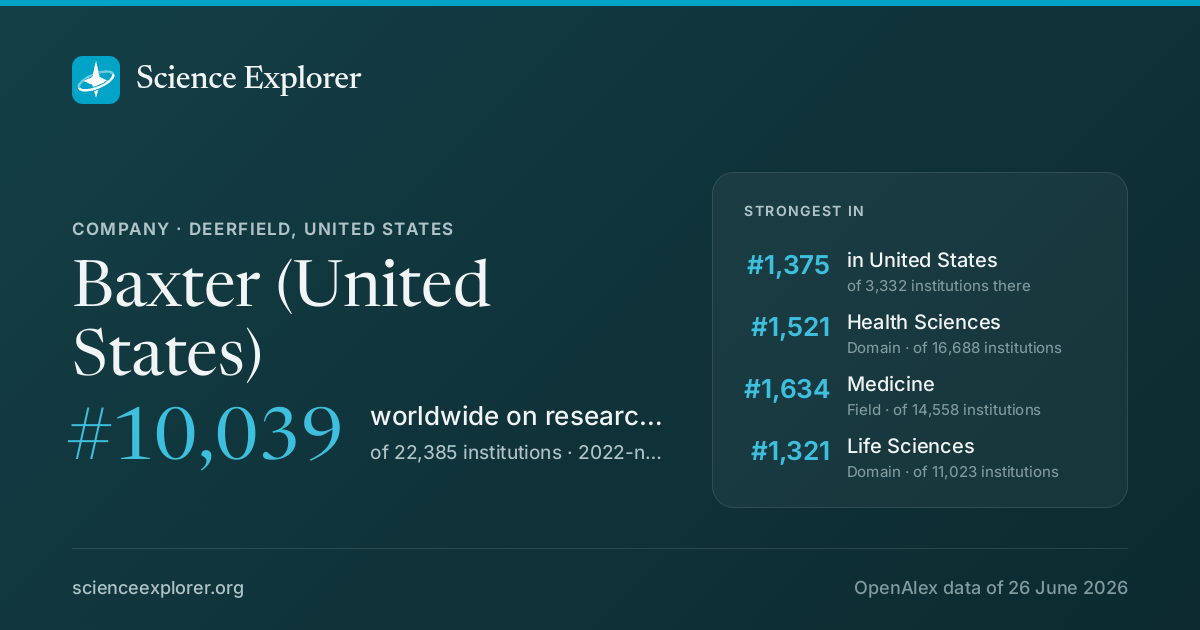
Baxter (United States) on Science Explorer

A card with Baxter (United States)'s standing and the fields it leads in, for a post or a slide. A link to this page previews as the same card.

Download the card

1200 × 630 PNG, sized for social posts, drawn from the latest snapshot.

Badges for a website2Each links back here and updates with every snapshot

Its overall standing, then the domains, fields and subfields where Baxter (United States) is in the world's top ten or its top 1%. Each has an image of its own.

Overall

Domains

Research measures only: rankings here say nothing about teaching, admissions or student experience. Comparable institutions and collaboration partners have tabs of their own, above.

Discussion

Ask a question or share a note about Baxter (United States). Keep it to the research: no personal attacks, advertising or links. Any reader can report a post, which collapses it for everyone until it is opened.

