Bedford College
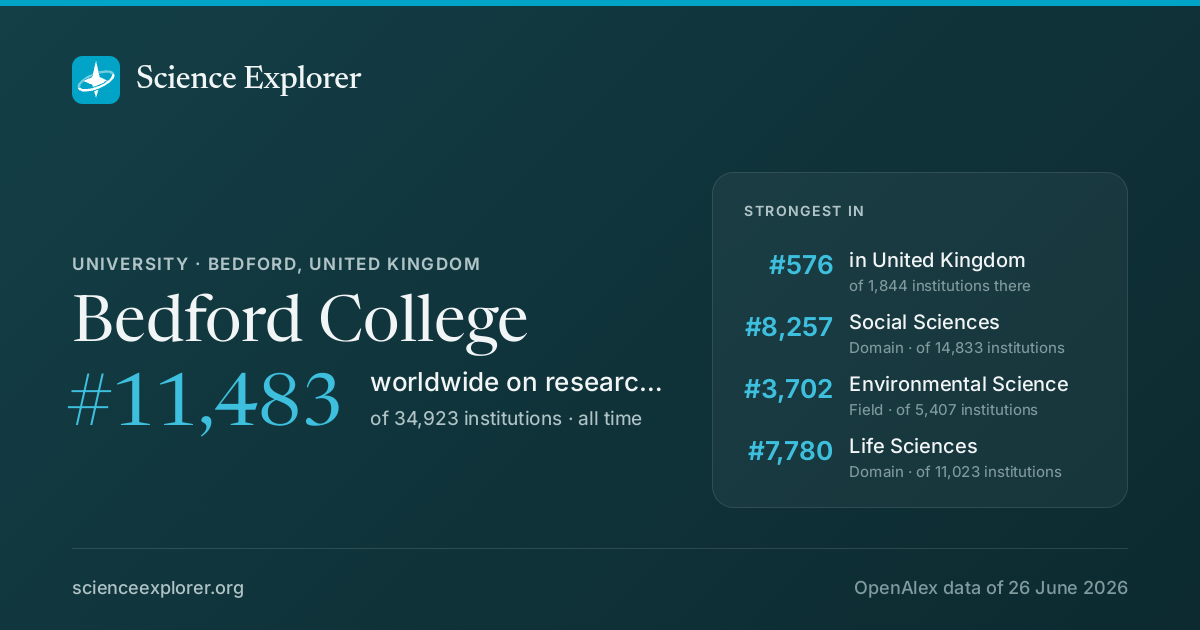
In research, Bedford College stands highest in Social Sciences (#8,257 of 14,833 worldwide), Social Sciences (#5,993 of 9,330 worldwide) and Environmental Science (#3,702 of 5,407 worldwide), over all time.
- World rank, all time
- #11,483 of 34,923
- Rank in United Kingdom
- #576 of 1,844
- Research works
- 2.1k ▲ 212% vs 2018-21
- Citations
- 50k 23.7 per fractional work
- Top-10% rate
- 19.7% all institutions 10.0%
- vs its own fields
- 0.87× 1.00× is exactly expected
- Open access
- 10% world 40%
- International
- 8% world 18%
What is Bedford College known for in research?
The fields where it stands highest, over all time, ranked among every institution above the floor in each field.
| Field | World rank | Where that sits | Top-10% rate | Works |
|---|---|---|---|---|
| Social SciencesDomain | #8,257 of 14,833 | 13.7% | 885 | |
| Social SciencesField | #5,993 of 9,330 | 13.4% | 390 | |
| Environmental ScienceField | #3,702 of 5,407 | 11.6% | 133 | |
| Life SciencesDomain | #7,780 of 11,023 | 7.1% | 306 | |
| Agricultural and Biological SciencesField | #3,625 of 5,126 | 7.0% | 152 | |
| MathematicsField | #1,566 of 2,114 | 7.9% | 141 | |
| Physics and AstronomyField | #2,415 of 2,917 | 7.6% | 129 | |
| Arts and HumanitiesField | #3,065 of 3,511 | 14.3% | 324 | |
| Physical SciencesDomain | #15,714 of 17,446 | 8.6% | 796 |
Each strip is that field's whole ranked pool, with the notch where Bedford College sits in it, in the colour of the band that rank falls in. The track under the rate is the rate itself: it carries no average mark, because the average differs by field (from about 6% in Dentistry to 21% in Economics).
Which fields of science does Bedford College work in?
In 2022-now, 72% of research at Bedford College is in Social Sciences, 14% in Physical Sciences. Its largest fields are Social Sciences (40%), Psychology (15%), Arts and Humanities (10%). It does 2.6× the world's share of Social Sciences.
Each ring splits the one inside it: the four domains of science, their fields, their subfields. Size is fractional works in 2022-now. Every slice is a page; the interactive view zooms down to single topics and colours each by how much more of it this institution does than the world.
Its 4 domains and 21 fields, with their numbers
- Social Sciences4871.5%
- Social Sciences2740.0%
- Psychology1014.8%
- Arts and Humanities79.8%
- Business, Management and Accounting34.4%
- Decision Sciences12.2%
- Economics, Econometrics and Finance00.4%
- Physical Sciences1014.3%
- Computer Science34.7%
- Engineering23.3%
- Environmental Science22.7%
- Mathematics11.6%
- Physics and Astronomy11.6%
- Materials Science00.2%
- Chemistry00.1%
- Energy00.1%
- Life Sciences69.0%
- Health Sciences35.1%
- Medicine34.1%
- Health Professions10.8%
- Nursing00.2%
Field profile
Location quotient across every field it publishes in: outside the ring is more than an institution of this size would be expected to publish, inside it is less.
Rings at 0.5×, 1× and 2×. Widest outward: Psychology, 4.8×. Every wedge is a field page.
All 21 fields, with their numbers
- Psychology4.85×10 works
- Neuroscience3.47×4 works
- Arts and Humanities3.38×7 works
- Social Sciences3.16×27 works
- Decision Sciences2.27×2 works
- Business, Management and Accounting1.37×3 works
- Mathematics1.35×1 works
- Physics and Astronomy0.71×1 works
- Computer Science0.61×3 works
- Environmental Science0.54×2 works
- Agricultural and Biological Sciences0.52×2 works
- Nursing0.34×0 works
- Health Professions0.32×1 works
- Engineering0.22×2 works
- Medicine0.21×3 works
- Biochemistry, Genetics and Molecular Biology0.17×1 works
- Economics, Econometrics and Finance0.17×0 works
- Energy0.08×0 works
- Materials Science0.07×0 works
- Immunology and Microbiology0.06×0 works
- Chemistry0.05×0 works
- Psychology 4.8×
- Neuroscience 3.5×
- Arts and Humanities 3.4×
- Social Sciences 3.2×
- Decision Sciences 2.3×
- Business, Management and Accounting 1.4×
- Mathematics 1.4×
- Physics and Astronomy 0.7×
- Computer Science 0.6×
- Environmental Science 0.5×
- Agricultural and Biological Sciences 0.5×
- Nursing 0.3×
- Health Professions 0.3×
- Engineering 0.2×
- Medicine 0.2×
- Biochemistry, Genetics and Molecular Biology 0.2×
- Economics, Econometrics and Finance 0.2×
- Energy 0.1×
- Materials Science 0.1×
- Immunology and Microbiology 0.1×
- Chemistry 0.1×
Who are the top researchers at Bedford College?
Ranked on the quality score, Alan Cameron, G. F. Marriner and Barbara Wootton lead among researchers whose main affiliation is Bedford College.
- 1
Alan Cameron
 United Kingdom · #183,878 worldwide
7.8k citations · 298 works
- 2
G. F. Marriner
United Kingdom · #898,528 worldwide
2.4k citations · 25 works
- 3
Barbara Wootton
United Kingdom · #1,494,606 worldwide
3.9k citations · 211 works
- 4
Martin Litchfield West
United Kingdom · #1,601,138 worldwide
6.8k citations · 355 works
- 5
M. L. West
United Kingdom · #1,806,647 worldwide
1.1k citations · 21 works
- 6
Barbara M. Gilchrist
United Kingdom · #1,926,691 worldwide
1.1k citations · 24 works
- 7
Michael Rand Hoare
United Kingdom · #2,152,954 worldwide
3k citations · 70 works
- 8
W. N. Bailey
United Kingdom · #2,175,281 worldwide
3.3k citations · 73 works
- 9
L. J. AUDUS
United Kingdom · #2,205,803 worldwide
4.5k citations · 92 works
- 10
W. Stephenson
United Kingdom · #2,483,129 worldwide
791 citations · 45 works
Which keywords describe research at Bedford College?
By fractional works in 2022-now, weighted toward what it does more of than the world: Higher Education, Student Engagement, Globalization, Bilingual Education, Language Policy, Multilingualism, Student Perceptions and Informal Learning.
- Student-Staff Partnerships
- Co-Creation of Curriculum
- Professional Development
- Experiential Learning
- Cosmopolitanism
- Emotion Regulation
- Translanguaging
- Student Motivation
- Neoliberalism
- Cultural Sustaining Pedagogy
- Student Participation
- Anxiety
- Financial Distress
- Teacher Education
- Training Pathways
- Informal Learning
- Corporate Governance
- Language Policy
- Education
- Globalization
- Higher Education
- Student Engagement
- Bilingual Education
- Multilingualism
- Student Perceptions
- Teacher Preparation
- Vocational Education
- Bankruptcy Law
- Lifelong Learning
- Sociolinguistics
- Social Cognition
- Diversity
- Neural Mechanisms
- Teaching Strategies
- Vygotsky
- Activity Theory
- Education Policy
- Genocide
- Workplace Learning
- Reflective Practice
Size is fractional works in 2022-now in the topics tagged with each word; colour is the word's share of this institution's work against its share of the world's. The 40 words are chosen for being large and distinctive. Each links to the topic it comes from most.
All 40 words, with their numbers
- Higher Education4▲ 13×10 topics
- Globalization4▲ 3.0×10 topics
- Student Engagement3▲ 12×8 topics
- Education3▲ 2.6×11 topics
- Bilingual Education2▲ 33×3 topics
- Language Policy2▲ 27×3 topics
- Multilingualism2▲ 22×2 topics
- Corporate Governance2▲ 4.6×5 topics
- Student Perceptions2▲ 19×3 topics
- Informal Learning2▲ 26×4 topics
- Teacher Preparation2▲ 41×3 topics
- Training Pathways2▲ 129×1 topic
- Vocational Education2▲ 36×1 topic
- Teacher Education2▲ 22×4 topics
- Bankruptcy Law2▲ 270×1 topic
- Financial Distress2▲ 55×1 topic
- Lifelong Learning2▲ 12×5 topics
- Anxiety2▲ 5.0×7 topics
- Sociolinguistics2▲ 13×2 topics
- Student Participation2▲ 75×2 topics
- Social Cognition2▲ 12×7 topics
- Cultural Sustaining Pedagogy1▲ 47×1 topic
- Diversity1▲ 12×4 topics
- Neoliberalism1▲ 5.7×4 topics
- Neural Mechanisms1▲ 20×4 topics
- Student Motivation1▲ 11×2 topics
- Teaching Strategies1▲ 7.5×2 topics
- Translanguaging1▲ 47×1 topic
- Vygotsky1▲ 113×2 topics
- Emotion Regulation1▲ 6.2×5 topics
- Activity Theory1▲ 138×1 topic
- Cosmopolitanism1▲ 16×2 topics
- Education Policy1▲ 27×3 topics
- Experiential Learning1▲ 34×3 topics
- Genocide1▲ 33×2 topics
- Professional Development1▲ 9.0×4 topics
- Workplace Learning1▲ 81×1 topic
- Co-Creation of Curriculum1▲ 108×1 topic
- Reflective Practice1▲ 8.8×3 topics
- Student-Staff Partnerships1▲ 108×1 topic
Which research topics does Bedford College publish most on?
By volume in 2022-now: Education Systems and Policy, Corporate Insolvency and Governance, Multilingual Education and Policy and Innovative Education and Learning Practices.
Area is fractional works; colour is the subfield each topic belongs to.
- 1 Education Systems and Policy Education 2 works
- 2 Corporate Insolvency and Governance Accounting 2 works
- 3 Multilingual Education and Policy Linguistics and Language 1 works
- 4 Innovative Education and Learning Practices Human Factors and Ergonomics 1 works
- 5 Higher Education Practises and Engagement Education 1 works
- 6 Global Peace and Security Dynamics Political Science and International Relations 1 works
- 7 Second Language Learning and Teaching Literature and Literary Theory 1 works
- 8 Global Education and Multiculturalism Education 1 works
- 9 Diverse Educational Innovations Studies General Agricultural and Biological Sciences 1 works
- 10 Online Learning and Analytics Computer Science Applications 1 works
How open and international is its research?
Against the world's own shares: the tick on each track. Both are shares of its output, so they sit on one scale and can be read against each other as well as against the world.
World: 40% of research is openly available.
World: 18% is written across borders.
How has Bedford College's research output changed?
Output in 2022-2025 was 212% higher than in 2018-2021.
The same series as a ribbon: one cell per year, darker for more. The line above answers how much; this answers when.
Its share of all research
Growing output can still be a shrinking share: all of science grows. This is Bedford College as a percentage of every work published that year, 0.00032% in 2024.
Fractional works of Bedford College over all fractional works that year. How the balance of science has shifted.
Other research institutions in Bedford
- Bedford Hospital
- Chartered Society of Physiotherapy
- Bedford Hospital NHS Trust
- Aircraft Research Association
- Richard Carter and Associates (United Kingdom)
- Hybrid Air Vehicles (United Kingdom)
- British Society of Soil Science
- Fujifilm (United Kingdom)
Share Bedford College's ranking
Badges for a website1Each links back here and updates with every snapshot

Research measures only: rankings here say nothing about teaching, admissions or student experience. Comparable institutions and collaboration partners have tabs of their own, above.
Discussion
Ask a question or share a note about Bedford College. Keep it to the research: no personal attacks, advertising or links. Any reader can report a post, which collapses it for everyone until it is opened.