Science Explorer Back to mapMap
Discussion
University · Beppu · Japan

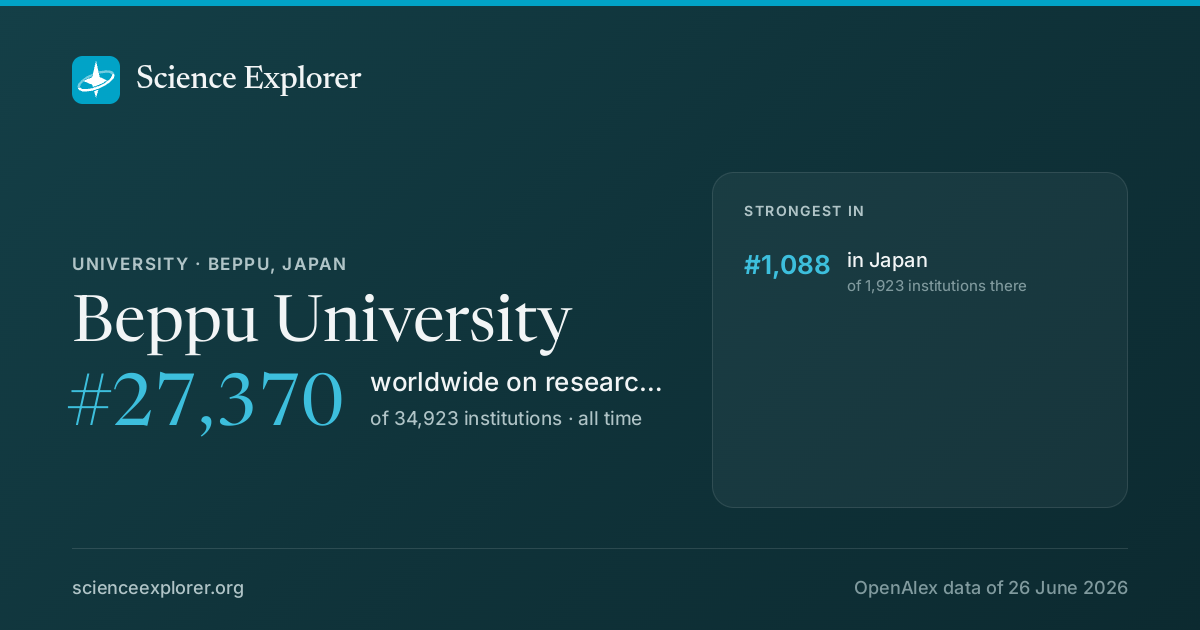
Beppu University

World rank, all time
#27,370
of 34,923
Rank in Japan
#1,088
of 1,923
Research works
183
▼ 40% vs 2018-21
Citations
2.3k
12.3 per fractional work
Top-10% rate
6.4%
all institutions 10.0%
vs its own fields
0.84×
1.00× is exactly expected
Open access
61%
world 40%
International
13%
world 18%

Which fields of science does Beppu University work in?

In 2022-now, 33% of research at Beppu University is in Physical Sciences, 26% in Social Sciences. Its largest fields are Medicine (18%), Psychology (14%), Earth and Planetary Sciences (13%).

Physical Sciences: 7 fractional works · 33.0% of its workEarth and Planetary Sciences: 3 fractional works · 13.2% of its workGeophysics: 2 fractional works · 9.4% of its workAtmospheric Science: 0 fractional works · 2.1% of its workGeochemistry and Petrology: 0 fractional works · 0.8% of its workOceanography: 0 fractional works · 0.4% of its workGeology: 0 fractional works · 0.3% of its workSpace and Planetary Science: 0 fractional works · 0.3% of its workMathematics: 2 fractional works · 7.8% of its workAlgebra and Number Theory: 1 fractional works · 4.5% of its workMathematical Physics: 1 fractional works · 3.3% of its workEnvironmental Science: 2 fractional works · 6.9% of its workEnvironmental Engineering: 1 fractional works · 4.8% of its workEcology: 0 fractional works · 1.0% of its workManagement, Monitoring, Policy and Law: 0 fractional works · 0.6% of its workPollution: 0 fractional works · 0.5% of its workEngineering: 1 fractional works · 2.5% of its workAerospace Engineering: 0 fractional works · 1.5% of its workOcean Engineering: 0 fractional works · 0.7% of its workMechanics of Materials: 0 fractional works · 0.4% of its workSmaller subfields together: 0 fractional works · 0.0% of its workComputer Science: 0 fractional works · 1.5% of its workInformation Systems: 0 fractional works · 1.5% of its workPhysics and Astronomy: 0 fractional works · 0.4% of its workAstronomy and Astrophysics: 0 fractional works · 0.3% of its workSmaller subfields together: 0 fractional works · 0.1% of its workEnergy: 0 fractional works · 0.4% of its workRenewable Energy, Sustainability and the Environment: 0 fractional works · 0.4% of its workMaterials Science: 0 fractional works · 0.2% of its workBiomaterials: 0 fractional works · 0.2% of its workSocial Sciences: 6 fractional works · 25.6% of its workPsychology: 3 fractional works · 14.1% of its workSocial Psychology: 2 fractional works · 6.9% of its workClinical Psychology: 1 fractional works · 5.5% of its workApplied Psychology: 0 fractional works · 0.9% of its workDevelopmental and Educational Psychology: 0 fractional works · 0.5% of its workExperimental and Cognitive Psychology: 0 fractional works · 0.3% of its workEconomics, Econometrics and Finance: 1 fractional works · 5.9% of its workEconomics and Econometrics: 1 fractional works · 3.0% of its workGeneral Economics, Econometrics and Finance: 1 fractional works · 3.0% of its workSocial Sciences: 1 fractional works · 5.6% of its workSociology and Political Science: 1 fractional works · 3.9% of its workTransportation: 0 fractional works · 1.5% of its workSmaller subfields together: 0 fractional works · 0.2% of its workHealth Sciences: 5 fractional works · 23.6% of its workMedicine: 4 fractional works · 17.6% of its workPublic Health, Environmental and Occupational Health: 1 fractional works · 3.1% of its workPsychiatry and Mental health: 0 fractional works · 2.2% of its workReproductive Medicine: 0 fractional works · 2.1% of its workCardiology and Cardiovascular Medicine: 0 fractional works · 1.5% of its workEndocrinology, Diabetes and Metabolism: 0 fractional works · 1.4% of its workPhysiology: 0 fractional works · 1.4% of its workEpidemiology: 0 fractional works · 1.1% of its workDermatology: 0 fractional works · 0.8% of its workImmunology and Allergy: 0 fractional works · 0.6% of its workNeurology: 0 fractional works · 0.5% of its workPharmacology: 0 fractional works · 0.5% of its workRehabilitation: 0 fractional works · 0.5% of its workRheumatology: 0 fractional works · 0.4% of its workPathology and Forensic Medicine: 0 fractional works · 0.4% of its workTransplantation: 0 fractional works · 0.3% of its workGenetics: 0 fractional works · 0.2% of its workObstetrics and Gynecology: 0 fractional works · 0.2% of its workSmaller subfields together: 0 fractional works · 0.3% of its workHealth Professions: 1 fractional works · 3.7% of its workGeneral Health Professions: 1 fractional works · 2.7% of its workComplementary and Manual Therapy: 0 fractional works · 0.4% of its workRadiological and Ultrasound Technology: 0 fractional works · 0.3% of its workSmaller subfields together: 0 fractional works · 0.3% of its workDentistry: 1 fractional works · 2.3% of its workPeriodontics: 0 fractional works · 1.6% of its workOrthodontics: 0 fractional works · 0.8% of its workLife Sciences: 4 fractional works · 17.8% of its workBiochemistry, Genetics and Molecular Biology: 2 fractional works · 8.3% of its workMolecular Biology: 1 fractional works · 4.2% of its workGenetics: 0 fractional works · 2.2% of its workCell Biology: 0 fractional works · 1.3% of its workClinical Biochemistry: 0 fractional works · 0.5% of its workSmaller subfields together: 0 fractional works · 0.1% of its workNeuroscience: 1 fractional works · 5.0% of its workBehavioral Neuroscience: 0 fractional works · 2.2% of its workCellular and Molecular Neuroscience: 0 fractional works · 1.5% of its workSensory Systems: 0 fractional works · 0.8% of its workEndocrine and Autonomic Systems: 0 fractional works · 0.5% of its workAgricultural and Biological Sciences: 0 fractional works · 2.1% of its workFood Science: 0 fractional works · 1.5% of its workAquatic Science: 0 fractional works · 0.4% of its workEcology, Evolution, Behavior and Systematics: 0 fractional works · 0.2% of its workPharmacology, Toxicology and Pharmaceutics: 0 fractional works · 1.5% of its workPharmacology: 0 fractional works · 1.5% of its workImmunology and Microbiology: 0 fractional works · 1.0% of its workImmunology: 0 fractional works · 1.0% of its workALL ITS WORKBeppu University22fractional works, 2022-now
Life Sciences18%Physical Sciences33%Health Sciences24%Social Sciences26%

Each ring splits the one inside it: the four domains of science, their fields, their subfields. Size is fractional works in 2022-now. Every slice is a page; the interactive view zooms down to single topics and colours each by how much more of it this institution does than the world.

Its 4 domains and 19 fields, with their numbers
    1. Earth and Planetary Sciences313.2%
    2. Mathematics27.8%
    3. Environmental Science26.9%
    4. Engineering12.5%
    5. Computer Science01.5%
    6. Physics and Astronomy00.4%
    7. Energy00.4%
    8. Materials Science00.2%
    1. Psychology314.1%
    2. Economics, Econometrics and Finance15.9%
    3. Social Sciences15.6%
    1. Medicine417.6%
    2. Health Professions13.7%
    3. Dentistry12.3%
    1. Biochemistry, Genetics and Molecular Biology28.3%
    2. Neuroscience15.0%
    3. Agricultural and Biological Sciences02.1%
    4. Pharmacology, Toxicology and Pharmaceutics01.5%
    5. Immunology and Microbiology01.0%
All of science, and how each field's share has moved since 1950: the Science domain explorer

Field profile

Location quotient across every field it publishes in: outside the ring is more than an institution of this size would be expected to publish, inside it is less.

Agricultural and Biological Sciences: 0.44× its world share, 0 worksAgricultural and Bio…Biochemistry, Genetics and Molecular Biology: 1.54× its world share, 2 worksBiochemistry, Geneti…Immunology and Microbiology: 1.00× its world share, 0 worksImmunology and Micro…Neuroscience: 3.07× its world share, 1 worksNeurosciencePharmacology, Toxicology and Pharmaceutics: 4.22× its world share, 0 worksPharmacology, Toxico…Computer Science: 0.19× its world share, 0 worksComputer ScienceEarth and Planetary Sciences: 8.42× its world share, 3 worksEarth and Planetary …Energy: 0.40× its world share, 0 worksEnergyEngineering: 0.17× its world share, 1 worksEngineeringEnvironmental Science: 1.39× its world share, 2 worksEnvironmental ScienceMaterials Science: 0.06× its world share, 0 worksMaterials ScienceMathematics: 6.64× its world share, 2 worksMathematicsPhysics and Astronomy: 0.18× its world share, 0 worksPhysics and AstronomyDentistry: 4.82× its world share, 0 worksDentistryHealth Professions: 1.40× its world share, 1 worksHealth ProfessionsMedicine: 0.91× its world share, 4 worksMedicineEconomics, Econometrics and Finance: 2.78× its world share, 1 worksEconomics, Econometr…Psychology: 4.63× its world share, 3 worksPsychologySocial Sciences: 0.44× its world share, 1 worksSocial Sciences1×world share
more than its size predictsabout as predictedless

Rings at 0.5×, 1× and 2×. Widest outward: Earth and Planetary Sciences, 8.4×. Every wedge is a field page.

All 19 fields, with their numbers
  1. Earth and Planetary Sciences8.42×3 works
  2. Mathematics6.64×2 works
  3. Dentistry4.82×0 works
  4. Psychology4.63×3 works
  5. Pharmacology, Toxicology and Pharmaceutics4.22×0 works
  6. Neuroscience3.07×1 works
  7. Economics, Econometrics and Finance2.78×1 works
  8. Biochemistry, Genetics and Molecular Biology1.54×2 works
  9. Health Professions1.40×1 works
  10. Environmental Science1.39×2 works
  11. Immunology and Microbiology1.00×0 works
  12. Medicine0.91×4 works
  13. Agricultural and Biological Sciences0.44×0 works
  14. Social Sciences0.44×1 works
  15. Energy0.40×0 works
  16. Computer Science0.19×0 works
  17. Physics and Astronomy0.18×0 works
  18. Engineering0.17×1 works
  19. Materials Science0.06×0 works

Who are the top researchers at Beppu University?

Ranked on the quality score, Jumpei Yajima, 美香 松田 and 秀吉 長尾 lead among researchers whose main affiliation is Beppu University.

  1. 1 Jumpei Yajima Japan · #3,246,139 worldwide 236 citations · 47 works
  2. 2 美香 松田 Japan · #4,122,532 worldwide 0 citations · 17 works
  3. 3 秀吉 長尾 Japan · #4,262,743 worldwide 0 citations · 22 works
  4. 4 まり子 仲嶺 Japan · #4,372,491 worldwide 0 citations · 23 works
  5. 5 Hajime Takeyasu Japan · #4,579,349 worldwide 15 citations · 17 works
  6. 6 亮二 田原 Japan · #4,789,219 worldwide 0 citations · 22 works
  7. 7 Hidehiko Fujihara Japan · #4,842,801 worldwide 502 citations · 28 works
  8. 8 友美 谷川 Japan · #4,869,547 worldwide 0 citations · 18 works
  9. 9 Nobue Takamatsu Japan · #4,895,323 worldwide 111 citations · 16 works
  10. 10 竜太 藤岡 Japan · #4,990,143 worldwide 0 citations · 16 works
All ranked researchers at Beppu University

What are the most cited papers from Beppu University?

The most cited paper from Beppu University is "Regulation of Toll/IL-1-receptor-mediated gene expression by the inducible nuclear protein IκBζ" (Masahiro Yamamoto, Soh Yamazaki, Satoshi Uematsu et al., 2004), with 492 citations. Next come "Hair follicle aging is driven by transepidermal elimination of stem cells via COL17A1 proteolysis" (414) and "Contribution of slab melting and slab dehydration to magmatism in the NE Japan arc for the last 25 Myr: Constraints from geochemistry" (279).

Most cited papers
#PaperReleasedCitations
1 Regulation of Toll/IL-1-receptor-mediated gene expression by the inducible nuclear protein IκBζ Masahiro Yamamoto, Soh Yamazaki, Satoshi Uematsu et al. · Nature Jul 2004 492
2 Hair follicle aging is driven by transepidermal elimination of stem cells via COL17A1 proteolysis Hiroyuki Matsumura, Yasuaki Mohri, Nguyễn Thanh Bình et al. · Science 4 Feb 2016 414
3 Contribution of slab melting and slab dehydration to magmatism in the NE Japan arc for the last 25 Myr: Constraints from geochemistry Takeshi Hanyu, Yoshiyuki Tatsumi, Shun’ichi Nakai et al. · Geochemistry Geophysics Geosystems Aug 2006 279
4 Identification and correlation of visible tephras in the Lake Suigetsu SG06 sedimentary archive, Japan: chronostratigraphic markers for synchronising of east Asian/west Pacific palaeoclimatic records across the last 150 ka Vicki Smith, Richard A. Staff, Simon P. E. Blockley et al. · Quaternary Science Reviews 5 Mar 2013 277
5 Structure–activity relationship of alginate oligosaccharides in the induction of cytokine production from RAW264.7 cells Mami Iwamoto, Maki Kurachi, Takuji Nakashima et al. · FEBS Letters Open access 20 Jul 2005 273
All 61 most cited papers, with filters and sorting

Which keywords describe research at Beppu University?

By fractional works in 2022-now, weighted toward what it does more of than the world: Number Theory, Quality of Life, Social Support, Emotion Regulation, Well-being, Mental Health, Stress and L-Functions.

▲ more of its work than of the world's◆ about the world's share▼ less than the world's

Size is fractional works in 2022-now in the topics tagged with each word; colour is the word's share of this institution's work against its share of the world's. The 12 words are chosen for being large and distinctive. Each links to the topic it comes from most.

All 12 words, with their numbers
  1. Quality of Life2▲ 6.0×12 topics
  2. Number Theory2▲ 323×2 topics
  3. Mental Health2▲ 5.0×8 topics
  4. Social Support1▲ 11×4 topics
  5. Emotion Regulation1▲ 19×3 topics
  6. Well-being1▲ 15×7 topics
  7. Oxidative Stress1▲ 3.3×9 topics
  8. Depression1▲ 5.4×4 topics
  9. Stress1▲ 13×4 topics
  10. Innovation1▲ 4.3×2 topics
  11. L-Functions1▲ 161×1 topic
  12. Primes1▲ 405×1 topic

Which research topics does Beppu University publish most on?

By volume in 2022-now: Analytic Number Theory Research, Advanced Mathematical Theories, Global trade and economics and Environmental Impact and Sustainability.

  1. 1 Analytic Number Theory Research Algebra and Number Theory 1 works
  2. 2 Advanced Mathematical Theories Mathematical Physics 1 works
  3. 3 Global trade and economics General Economics, Econometrics and Finance 1 works
  4. 4 Environmental Impact and Sustainability Environmental Engineering 1 works
  5. 5 Attachment and Relationship Dynamics Social Psychology 1 works
  6. 6 Geophysical and Geoelectrical Methods Geophysics 1 works
  7. 7 Stress Responses and Cortisol Behavioral Neuroscience 0 works
  8. 8 Seismic Waves and Analysis Geophysics 0 works
  9. 9 Seismic Imaging and Inversion Techniques Geophysics 0 works
  10. 10 Geological and Geochemical Analysis Geophysics 0 works

How open and international is its research?

Against the world's own shares: the tick on each track. Both are shares of its output, so they sit on one scale and can be read against each other as well as against the world.

openly available61.0%not open39.0%

World: 40% of research is openly available.

with international co-authors13.0%domestic only87.0%

World: 18% is written across borders.

How has Beppu University's research output changed?

Output in 2022-2025 was 40% lower than in 2018-2021.

still counting1990200020102020
grewheldshrank

The same series as a ribbon: one cell per year, darker for more. The line above answers how much; this answers when.

Its share of all research

Growing output can still be a shrinking share: all of science grows. This is Beppu University as a percentage of every work published that year, 0.000036% in 2024.

still counting0.00020%0.00040%0.00060%Beppu University0.00011% in 202519801990200020102020

Fractional works of Beppu University over all fractional works that year. How the balance of science has shifted.

Other research institutions in Beppu

All research institutions in Beppu

Share Beppu University's ranking

Beppu University on Science Explorer

A card with Beppu University's standing and the fields it leads in, for a post or a slide. A link to this page previews as the same card.

Download the card

1200 × 630 PNG, sized for social posts, drawn from the latest snapshot.

Badges for a website1Each links back here and updates with every snapshot

Research measures only: rankings here say nothing about teaching, admissions or student experience. Comparable institutions and collaboration partners have tabs of their own, above.

Discussion

Ask a question or share a note about Beppu University. Posts are plain text and can be reported.

