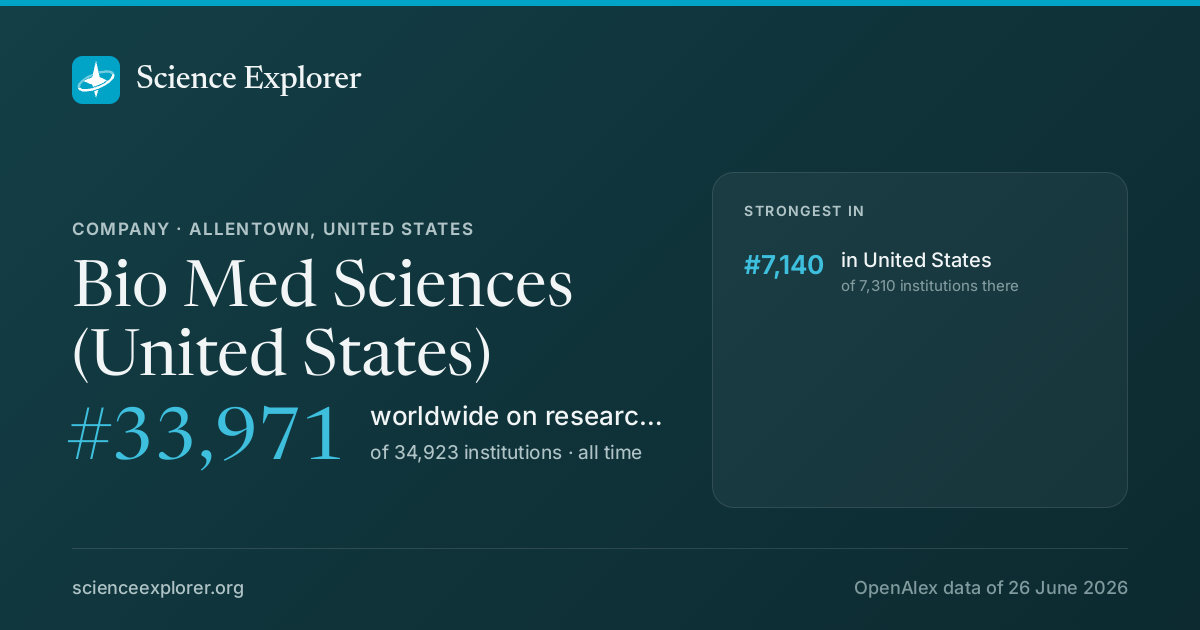
- World rank, all time
- #33,971 of 34,923
- Rank in United States
- #7,140 of 7,310
- Research works
- 135 ▼ 79% vs 2018-21
- Citations
- 1.2k 9.1 per fractional work
- Top-10% rate
- 7.4% all institutions 10.0%
- vs its own fields
- 0.85× 1.00× is exactly expected
- Open access
- 7% world 40%
- International
- 6% world 18%
Which fields of science does Bio Med Sciences (United States) work in?
In all years, 49% of research at Bio Med Sciences (United States) is in Physical Sciences, 30% in Life Sciences. Its largest fields are Engineering (33%), Biochemistry, Genetics and Molecular Biology (20%), Medicine (17%). It does 1.9× the world's share of Life Sciences.
Each ring splits the one inside it: the four domains of science, their fields, their subfields. Size is fractional works in all years. Every slice is a page; the interactive view zooms down to single topics and colours each by how much more of it this institution does than the world.
Its 4 domains and 22 fields, with their numbers
- Physical Sciences6649.3%
- Engineering4533.1%
- Materials Science86.1%
- Physics and Astronomy64.3%
- Computer Science21.7%
- Mathematics21.2%
- Chemistry10.8%
- Environmental Science10.7%
- Chemical Engineering10.5%
- Energy10.5%
- Earth and Planetary Sciences00.2%
- Life Sciences4130.5%
- Health Sciences2417.5%
- Medicine2316.8%
- Health Professions10.8%
- Social Sciences42.7%
Field profile
Location quotient across every field it publishes in: outside the ring is more than an institution of this size would be expected to publish, inside it is less.
Rings at 0.5×, 1× and 2×. Widest outward: Immunology and Microbiology, 13.6×. Every wedge is a field page.
All 7 fields, with their numbers
- Immunology and Microbiology13.64×0 works
- Pharmacology, Toxicology and Pharmaceutics6.49×0 works
- Medicine2.93×1 works
- Biochemistry, Genetics and Molecular Biology2.23×0 works
- Agricultural and Biological Sciences1.16×0 works
- Engineering0.46×0 works
- Computer Science0.44×0 works
Which keywords describe research at Bio Med Sciences (United States)?
By fractional works in all years, weighted toward what it does more of than the world: Atomic Layer Deposition, High-k Dielectrics, Process Variation, Integrated Circuits, Solar Cells, Nanowire Transistors, Tunnel Field-Effect Transistors and Thin Films.
- Metal-Semiconductor Contacts
- Electrical Properties
- Nanoindentation
- Acoustic Wave Biosensors
- Autoimmunity
- Natural Killer Cells
- Efficiency
- Nanowires
- Precision Medicine
- Electromigration
- X-ray Photoelectron Spectroscopy
- Photon Emission Microscopy
- Angiogenesis
- Transcriptional Regulation
- Failure Analysis
- Tunnel Field-Effect Transistors
- Solar Cells
- Process Variation
- Epidemiology
- Cancer
- Inflammation
- Atomic Layer Deposition
- High-k Dielectrics
- Integrated Circuits
- Nanowire Transistors
- Thin Films
- Aging
- Cancer Therapy
- Laser Voltage Probing
- Stem Cells
- Cancer Progression
- Extracellular Matrix
- High-Temperature Electronics
- Cell Migration
- NK Cell Recognition
- Epitaxial Growth
- Thermal Management
- Coatings
- Thin Film Resonators
- Mechanotransduction
Size is fractional works in all years in the topics tagged with each word; colour is the word's share of this institution's work against its share of the world's. The 40 words are chosen for being large and distinctive. Each links to the topic it comes from most.
All 40 words, with their numbers
- Inflammation8▲ 2.5×18 topics
- Cancer7▲ 3.5×16 topics
- Atomic Layer Deposition6▲ 35×1 topic
- Epidemiology6▲ 1.17×21 topics
- High-k Dielectrics6▲ 35×1 topic
- Process Variation5▲ 40×2 topics
- Integrated Circuits5▲ 16×3 topics
- Solar Cells5▲ 12×4 topics
- Nanowire Transistors5▲ 56×1 topic
- Tunnel Field-Effect Transistors5▲ 56×1 topic
- Thin Films5▲ 13×5 topics
- Failure Analysis4▲ 20×2 topics
- Aging4▲ 5.0×6 topics
- Transcriptional Regulation3▲ 10×7 topics
- Cancer Therapy3▲ 3.9×4 topics
- Angiogenesis3▲ 5.8×5 topics
- Laser Voltage Probing3▲ 46×1 topic
- Photon Emission Microscopy3▲ 46×1 topic
- Stem Cells3▲ 7.9×4 topics
- X-ray Photoelectron Spectroscopy3▲ 16×2 topics
- Cancer Progression3▲ 9.7×3 topics
- Electromigration3▲ 42×2 topics
- Extracellular Matrix3▲ 9.2×4 topics
- Precision Medicine3▲ 6.9×3 topics
- High-Temperature Electronics3▲ 29×2 topics
- Nanowires3▲ 8.9×3 topics
- Cell Migration3▲ 23×2 topics
- Efficiency2▲ 7.1×2 topics
- NK Cell Recognition2▲ 18×1 topic
- Natural Killer Cells2▲ 18×1 topic
- Epitaxial Growth2▲ 22×2 topics
- Autoimmunity2▲ 8.4×3 topics
- Thermal Management2▲ 6.0×2 topics
- Acoustic Wave Biosensors2▲ 32×1 topic
- Coatings2▲ 18×1 topic
- Nanoindentation2▲ 19×1 topic
- Thin Film Resonators2▲ 32×1 topic
- Electrical Properties2▲ 9.9×2 topics
- Mechanotransduction2▲ 15×2 topics
- Metal-Semiconductor Contacts2▲ 29×1 topic
Which research topics does Bio Med Sciences (United States) publish most on?
By volume in 2022-now: Burn Injury Management and Outcomes, Medical Device Sterilization and Disinfection, Ferroptosis and cancer prognosis and Sensor Technology and Measurement Systems.
Area is fractional works; colour is the subfield each topic belongs to.
- 1 Burn Injury Management and Outcomes Epidemiology 1 works
- 2 Medical Device Sterilization and Disinfection Microbiology 0 works
- 3 Ferroptosis and cancer prognosis Pulmonary and Respiratory Medicine 0 works
- 4 Sensor Technology and Measurement Systems Computer Networks and Communications 0 works
- 5 MicroRNA in disease regulation Cancer Research 0 works
- 6 Cancer, Hypoxia, and Metabolism Cancer Research 0 works
- 7 Agriculture, Soil, Plant Science Ecology, Evolution, Behavior and Systematics 0 works
- 8 Advanced Sensor Technologies Research Biomedical Engineering 0 works
- 9 Cancer-related molecular mechanisms research Cancer Research 0 works
- 10 Food Quality and Safety Studies Food Science 0 works
How open and international is its research?
Against the world's own shares: the tick on each track. Both are shares of its output, so they sit on one scale and can be read against each other as well as against the world.
World: 40% of research is openly available.
World: 18% is written across borders.
How has Bio Med Sciences (United States)'s research output changed?
Output in 2022-2025 was 79% lower than in 2018-2021.
The same series as a ribbon: one cell per year, darker for more. The line above answers how much; this answers when.
Its share of all research
Growing output can still be a shrinking share: all of science grows. This is Bio Med Sciences (United States) as a percentage of every work published that year, 0.0000060% in 2024.
Fractional works of Bio Med Sciences (United States) over all fractional works that year. How the balance of science has shifted.
Other research institutions in Allentown
- Air Products (United States)
- Lehigh Valley Health Network
- Muhlenberg College
- Institute for Female Pelvic Medicine and Reconstructive Surgery
- Cedar Crest College
- Sacred Heart Hospital
- Good Shepherd Rehabilitation
- Aesculap (United States)
Share Bio Med Sciences (United States)'s ranking
Badges for a website1Each links back here and updates with every snapshot

Research measures only: rankings here say nothing about teaching, admissions or student experience. Comparable institutions and collaboration partners have tabs of their own, above.
Discussion
Ask a question or share a note about Bio Med Sciences (United States). Keep it to the research: no personal attacks, advertising or links. Any reader can report a post, which collapses it for everyone until it is opened.