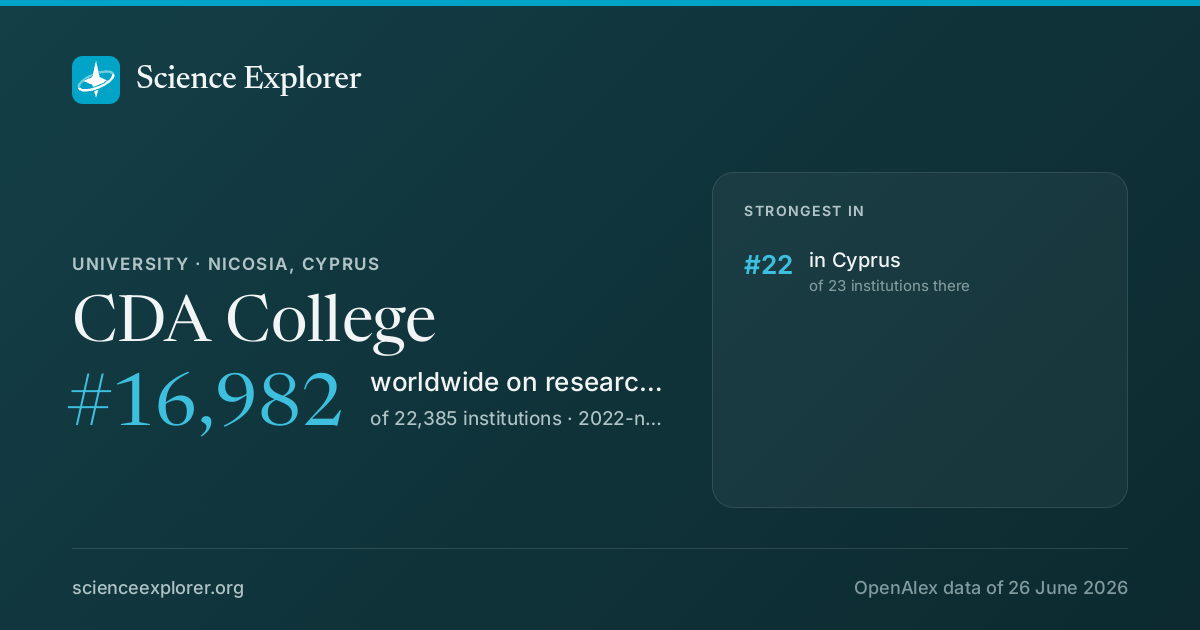
World rank, 2022-now #16,982
of 22,385 · #26,449 all time
Rank in Cyprus #22
of 23 Research works 173
▲ 177% vs 2018-21
Citations 387 2.2 per fractional work
Top-10% rate 8.3%
all institutions 10.0%
vs its own fields 0.93×
1.00× is exactly expected
Open access 58%
world 40%
International 47%
world 18%
Which fields of science does CDA College work in?
In 2022-now, 36% of research at CDA College is in Physical Sciences , 32% in Life Sciences . Its largest fields are Medicine (17%), Biochemistry, Genetics and Molecular Biology (12%), Agricultural and Biological Sciences (9%). It does 2.2× the world's share of Life Sciences.
Physical Sciences: 44 fractional works · 36.2% of its work Engineering: 11 fractional works · 8.6% of its work Biomedical Engineering: 3 fractional works · 2.6% of its work Electrical and Electronic Engineering: 2 fractional works · 1.3% of its work Civil and Structural Engineering: 1 fractional works · 1.1% of its work Control and Systems Engineering: 1 fractional works · 1.0% of its work Automotive Engineering: 1 fractional works · 0.8% of its work Building and Construction: 1 fractional works · 0.8% of its work Industrial and Manufacturing Engineering: 0 fractional works · 0.3% of its work Mechanics of Materials: 0 fractional works · 0.2% of its work Smaller subfields together: 1 fractional works · 0.5% of its work Computer Science: 9 fractional works · 7.5% of its work Computer Vision and Pattern Recognition: 3 fractional works · 2.2% of its work Computational Theory and Mathematics: 2 fractional works · 1.4% of its work Information Systems: 1 fractional works · 1.1% of its work Signal Processing: 1 fractional works · 1.1% of its work Artificial Intelligence: 1 fractional works · 0.9% of its work Computer Networks and Communications: 0 fractional works · 0.3% of its work Computer Science Applications: 0 fractional works · 0.3% of its work Human-Computer Interaction: 0 fractional works · 0.2% of its work Materials Science: 7 fractional works · 5.8% of its work Materials Chemistry: 3 fractional works · 2.6% of its work Biomaterials: 3 fractional works · 2.4% of its work Polymers and Plastics: 1 fractional works · 0.8% of its work Smaller subfields together: 0 fractional works · 0.1% of its work Chemistry: 5 fractional works · 4.2% of its work Organic Chemistry: 4 fractional works · 2.9% of its work Spectroscopy: 1 fractional works · 0.7% of its work Analytical Chemistry: 0 fractional works · 0.3% of its work Inorganic Chemistry: 0 fractional works · 0.3% of its work Environmental Science: 5 fractional works · 3.8% of its work Pollution: 1 fractional works · 1.0% of its work Environmental Chemistry: 1 fractional works · 0.7% of its work Global and Planetary Change: 1 fractional works · 0.4% of its work Management, Monitoring, Policy and Law: 0 fractional works · 0.4% of its work Water Science and Technology: 0 fractional works · 0.4% of its work Health, Toxicology and Mutagenesis: 0 fractional works · 0.2% of its work Industrial and Manufacturing Engineering: 0 fractional works · 0.2% of its work Smaller subfields together: 1 fractional works · 0.5% of its work Mathematics: 3 fractional works · 2.7% of its work Algebra and Number Theory: 2 fractional works · 1.2% of its work Geometry and Topology: 1 fractional works · 0.7% of its work Mathematical Physics: 0 fractional works · 0.2% of its work Smaller subfields together: 1 fractional works · 0.5% of its work Physics and Astronomy: 3 fractional works · 2.1% of its work Nuclear and High Energy Physics: 1 fractional works · 1.1% of its work Astronomy and Astrophysics: 1 fractional works · 0.6% of its work Atomic and Molecular Physics, and Optics: 0 fractional works · 0.2% of its work Smaller subfields together: 0 fractional works · 0.2% of its work Earth and Planetary Sciences: 1 fractional works · 0.8% of its work Oceanography: 0 fractional works · 0.3% of its work Paleontology: 0 fractional works · 0.2% of its work Smaller subfields together: 0 fractional works · 0.3% of its work Chemical Engineering: 1 fractional works · 0.6% of its work Bioengineering: 1 fractional works · 0.5% of its work Smaller subfields together: 0 fractional works · 0.1% of its work Energy: 0 fractional works · 0.1% of its work Life Sciences: 39 fractional works · 31.9% of its work Biochemistry, Genetics and Molecular Biology: 15 fractional works · 12.4% of its work Molecular Biology: 10 fractional works · 8.4% of its work Biotechnology: 2 fractional works · 1.3% of its work Molecular Medicine: 1 fractional works · 0.8% of its work Cancer Research: 0 fractional works · 0.4% of its work Genetics: 0 fractional works · 0.4% of its work Aging: 0 fractional works · 0.3% of its work Endocrinology: 0 fractional works · 0.2% of its work Smaller subfields together: 1 fractional works · 0.5% of its work Agricultural and Biological Sciences: 12 fractional works · 9.5% of its work Plant Science: 7 fractional works · 5.6% of its work Food Science: 3 fractional works · 2.7% of its work Ecology, Evolution, Behavior and Systematics: 1 fractional works · 0.5% of its work Aquatic Science: 0 fractional works · 0.4% of its work Smaller subfields together: 0 fractional works · 0.2% of its work Pharmacology, Toxicology and Pharmaceutics: 8 fractional works · 6.8% of its work Pharmaceutical Science: 5 fractional works · 4.2% of its work Pharmacology: 3 fractional works · 2.4% of its work Smaller subfields together: 0 fractional works · 0.2% of its work Neuroscience: 3 fractional works · 2.1% of its work Cellular and Molecular Neuroscience: 1 fractional works · 0.8% of its work Sensory Systems: 0 fractional works · 0.4% of its work Neurology: 0 fractional works · 0.3% of its work Cognitive Neuroscience: 0 fractional works · 0.3% of its work Smaller subfields together: 0 fractional works · 0.3% of its work Immunology and Microbiology: 1 fractional works · 1.2% of its work Immunology: 1 fractional works · 0.9% of its work Applied Microbiology and Biotechnology: 0 fractional works · 0.2% of its work Smaller subfields together: 0 fractional works · 0.1% of its work Health Sciences: 24 fractional works · 19.9% of its work Medicine: 21 fractional works · 17.1% of its work Endocrinology, Diabetes and Metabolism: 4 fractional works · 2.9% of its work Complementary and alternative medicine: 2 fractional works · 1.8% of its work Oncology: 2 fractional works · 1.4% of its work Pharmacology: 2 fractional works · 1.4% of its work Physiology: 1 fractional works · 0.8% of its work Infectious Diseases: 1 fractional works · 0.8% of its work Biochemistry: 1 fractional works · 0.8% of its work Public Health, Environmental and Occupational Health: 1 fractional works · 0.8% of its work Neurology: 1 fractional works · 0.7% of its work Epidemiology: 1 fractional works · 0.6% of its work Nephrology: 1 fractional works · 0.5% of its work Surgery: 1 fractional works · 0.5% of its work Cardiology and Cardiovascular Medicine: 1 fractional works · 0.5% of its work Pulmonary and Respiratory Medicine: 1 fractional works · 0.5% of its work Health Informatics: 0 fractional works · 0.4% of its work Rehabilitation: 0 fractional works · 0.4% of its work Psychiatry and Mental health: 0 fractional works · 0.3% of its work Hematology: 0 fractional works · 0.3% of its work Geriatrics and Gerontology: 0 fractional works · 0.3% of its work Dermatology: 0 fractional works · 0.2% of its work Smaller subfields together: 1 fractional works · 1.1% of its work Nursing: 2 fractional works · 1.4% of its work Nutrition and Dietetics: 2 fractional works · 1.4% of its work Health Professions: 2 fractional works · 1.3% of its work General Health Professions: 1 fractional works · 0.6% of its work Health Information Management: 1 fractional works · 0.5% of its work Smaller subfields together: 0 fractional works · 0.2% of its work Veterinary: 0 fractional works · 0.1% of its work Dentistry: 0 fractional works · 0.1% of its work Social Sciences: 15 fractional works · 12.0% of its work Social Sciences: 8 fractional works · 6.7% of its work Sociology and Political Science: 4 fractional works · 3.0% of its work Political Science and International Relations: 1 fractional works · 0.8% of its work Demography: 1 fractional works · 0.5% of its work Gender Studies: 1 fractional works · 0.5% of its work Transportation: 1 fractional works · 0.5% of its work Communication: 0 fractional works · 0.3% of its work Cultural Studies: 0 fractional works · 0.3% of its work Safety Research: 0 fractional works · 0.3% of its work Anthropology: 0 fractional works · 0.2% of its work Smaller subfields together: 0 fractional works · 0.2% of its work Arts and Humanities: 2 fractional works · 1.5% of its work Philosophy: 1 fractional works · 0.7% of its work History: 0 fractional works · 0.3% of its work Literature and Literary Theory: 0 fractional works · 0.3% of its work Religious studies: 0 fractional works · 0.3% of its work Economics, Econometrics and Finance: 1 fractional works · 1.2% of its work Economics and Econometrics: 1 fractional works · 1.2% of its work Decision Sciences: 1 fractional works · 1.1% of its work Management Science and Operations Research: 1 fractional works · 1.0% of its work Smaller subfields together: 0 fractional works · 0.1% of its work Business, Management and Accounting: 1 fractional works · 1.1% of its work Organizational Behavior and Human Resource Management: 0 fractional works · 0.3% of its work Marketing: 0 fractional works · 0.2% of its work Strategy and Management: 0 fractional works · 0.2% of its work Smaller subfields together: 0 fractional works · 0.3% of its work Psychology: 1 fractional works · 0.6% of its work Social Psychology: 0 fractional works · 0.4% of its work Smaller subfields together: 0 fractional works · 0.2% of its work Physical Sciences Engineering Computer Science Materials Science Chemistry Environme… Mathemati… Physics a… Life Sciences Biochemistry Agricultural an… Pharmacolo… Neuroscie… Health Sciences Medicine Social Sciences Social Sciences Arts and… ALL ITS WORK CDA College 122 fractional works, 2022-now 32% 36% 20% 12%
Each ring splits the one inside it: the four domains of science, their fields, their subfields. Size is fractional works in 2022-now. Every slice is a page; the interactive view zooms down to single topics and colours each by how much more of it this institution does than the world.
Its 4 domains and 26 fields, with their numbers 11 8.6% 9 7.5% 7 5.8% 5 4.2% 5 3.8% 3 2.7% 3 2.1% 1 0.8% 1 0.6% 0 0.1% 15 12.4% 12 9.5% 8 6.8% 3 2.1% 1 1.2% 21 17.1% 2 1.4% 2 1.3% 0 0.1% 0 0.1% 8 6.7% 2 1.5% 1 1.2% 1 1.1% 1 1.1% 1 0.6% All of science, and how each field's share has moved since 1950: the Science domain explorer
Field profile
Location quotient across every field it publishes in: outside the ring is more than an institution of this size would be expected to publish, inside it is less.
Agricultural and Biological Sciences: 1.99× its world share, 12 works Agricultural and Bio… Biochemistry, Genetics and Molecular Biology: 2.32× its world share, 15 works Biochemistry, Geneti… Immunology and Microbiology: 1.17× its world share, 1 works Immunology and Micro… Neuroscience: 1.28× its world share, 2 works Neuroscience Pharmacology, Toxicology and Pharmaceutics: 19.42× its world share, 8 works Pharmacology, Toxico… Chemical Engineering: 1.75× its world share, 1 works Chemical Engineering Chemistry: 2.66× its world share, 5 works Chemistry Computer Science: 0.96× its world share, 9 works Computer Science Earth and Planetary Sciences: 0.50× its world share, 1 works Earth and Planetary … Energy: 0.10× its world share, 0 works Energy Engineering: 0.58× its world share, 11 works Engineering Environmental Science: 0.76× its world share, 5 works Environmental Science Materials Science: 1.67× its world share, 7 works Materials Science Mathematics: 2.28× its world share, 3 works Mathematics Physics and Astronomy: 0.95× its world share, 3 works Physics and Astronomy Dentistry: 0.14× its world share, 0 works Dentistry Health Professions: 0.48× its world share, 2 works Health Professions Medicine: 0.89× its world share, 21 works Medicine Nursing: 2.78× its world share, 2 works Nursing Veterinary: 0.67× its world share, 0 works Veterinary Arts and Humanities: 0.50× its world share, 2 works Arts and Humanities Business, Management and Accounting: 0.33× its world share, 1 works Business, Management… Decision Sciences: 1.13× its world share, 1 works Decision Sciences Economics, Econometrics and Finance: 0.57× its world share, 2 works Economics, Econometr… Psychology: 0.19× its world share, 1 works Psychology Social Sciences: 0.53× its world share, 8 works Social Sciences 1× world share
Rings at 0.5×, 1× and 2×. Widest outward: Pharmacology, Toxicology and Pharmaceutics , 19.4×. Every wedge is a field page.
All 26 fields, with their numbers Pharmacology, Toxicology and Pharmaceutics 19.42× 8 works Nursing 2.78× 2 works Chemistry 2.66× 5 works Biochemistry, Genetics and Molecular Biology 2.32× 15 works Mathematics 2.28× 3 works Agricultural and Biological Sciences 1.99× 12 works Chemical Engineering 1.75× 1 works Materials Science 1.67× 7 works Neuroscience 1.28× 2 works Immunology and Microbiology 1.17× 1 works Decision Sciences 1.13× 1 works Computer Science 0.96× 9 works Physics and Astronomy 0.95× 3 works Medicine 0.89× 21 works Environmental Science 0.76× 5 works Veterinary 0.67× 0 works Engineering 0.58× 11 works Economics, Econometrics and Finance 0.57× 2 works Social Sciences 0.53× 8 works Earth and Planetary Sciences 0.50× 1 works Arts and Humanities 0.50× 2 works Health Professions 0.48× 2 works Business, Management and Accounting 0.33× 1 works Psychology 0.19× 1 works Dentistry 0.14× 0 works Energy 0.10× 0 works
Who are the top researchers at CDA College?
Ranked on the quality score, Sailee Chowdhury, Koyel Kar and Sailee Chowdhury lead among researchers whose main affiliation is CDA College.
1
Sailee Chowdhury
Cyprus · #2,120,673 worldwide191 citations · 46 works
2
Koyel Kar
Cyprus · #2,345,765 worldwide330 citations · 87 works
3
Sailee Chowdhury
Cyprus · #2,469,378 worldwide158 citations · 30 works
4
Priyanka Chakraborty
Cyprus · #3,582,337 worldwide44 citations · 26 works
5
Debanjan Sen
Cyprus · #4,680,848 worldwide455 citations · 41 works
6
Kamalika Mazumder
Cyprus · #4,911,476 worldwide59 citations · 29 works
7
Nripendra Nath Bala
Cyprus · #5,421,745 worldwide122 citations · 20 works
All ranked researchers at CDA College
What are the most cited papers from CDA College?
The most cited paper from CDA College is "Effect of neuroinflammation on the progression of Alzheimer’s disease and its significant ramifications for novel anti-inflammatory treatments" (Pritam Kamila, Koyel Kar, Sailee Chowdhury et al., 2025), with 83 citations. Next come "Sustained release gastroretentive tablet of metformin hydrochloride based on poly (acrylic acid)-grafted-gellan" (80) and "Identification of potential inhibitors of SARS-CoV-2 main protease and spike receptor from 10 important spices through structure-based virtual screening and molecular dynamic study" (68).
Most cited papers
# Paper Released Citations 1
Effect of neuroinflammation on the progression of Alzheimer’s disease and its significant ramifications for novel anti-inflammatory treatments
Pritam Kamila, Koyel Kar, Sailee Chowdhury et al. · IBRO Neuroscience Reports
Open access 22 May 2025
83 2
Sustained release gastroretentive tablet of metformin hydrochloride based on poly (acrylic acid)-grafted-gellan
Debjani Sarkar, Gouranga Nandi, Abhijit Changder et al. · International Journal of Biological Macromolecules
9 Dec 2016
80 3
Identification of potential inhibitors of SARS-CoV-2 main protease and spike receptor from 10 important spices through structure-based virtual screening and molecular dynamic study
Debanjan Sen, Pradip Debnath, Bimal Debnath et al. · Journal of Biomolecular Structure and Dynamics
Open access 18 Sep 2020
68 4
Exploration of different strategies of nanoencapsulation of bioactive compounds and their ensuing approaches
Sailee Chowdhury, Koyel Kar, Rana Mazumder · Future Journal of Pharmaceutical Sciences
Open access 23 May 2024
67 5
Gastroretentive extended release of metformin from methacrylamide-g-gellan and tamarind seed gum composite matrix
Rosy Priyadarshini, Gouranga Nandi, Abhijit Changder et al. · Carbohydrate Polymers
23 Oct 2015
54
All 61 most cited papers, with filters and sorting
Which keywords describe research at CDA College?
By fractional works in 2022-now, weighted toward what it does more of than the world: Antioxidant, Nanoparticles, Antioxidant Activity, Medicinal Plants, Drug Delivery, Biomedical Applications, Bioactive Compounds and Anti-inflammatory.
Size is fractional works in 2022-now in the topics tagged with each word; colour is the word's share of this institution's work against its share of the world's. The 40 words are chosen for being large and distinctive. Each links to the topic it comes from most.
All 40 words, with their numbers Antioxidant 8 ▲ 9.2× 23 topics Nanoparticles 7 ▲ 4.7× 15 topics Biomedical Applications 6 ▲ 4.4× 15 topics Antioxidant Activity 6 ▲ 7.3× 14 topics Oxidative Stress 5 ▲ 2.6× 17 topics Drug Delivery 5 ▲ 7.7× 8 topics Medicinal Plants 5 ▲ 11× 9 topics Cancer 4 ▲ 2.5× 18 topics Bioactive Compounds 4 ▲ 13× 10 topics Anti-inflammatory 4 ▲ 11× 16 topics Environmental Impact 4 ▲ 1.81× 10 topics Flavonoids 4 ▲ 12× 7 topics Tissue Engineering 4 ▲ 4.9× 7 topics Diabetes 3 ▲ 5.5× 12 topics Pharmacology 3 ▲ 11× 13 topics Antimicrobial 3 ▲ 9.2× 6 topics Cancer Therapy 3 ▲ 4.6× 6 topics Nanocomposites 3 ▲ 3.2× 8 topics Herbal Medicine 3 ▲ 8.6× 6 topics Medicinal Chemistry 3 ▲ 9.1× 4 topics Neuroprotective 3 ▲ 16× 7 topics Anticancer 3 ▲ 15× 13 topics Antioxidants 3 ▲ 5.3× 7 topics Alzheimer's Disease 3 ▲ 8.4× 6 topics Chitosan 3 ▲ 26× 2 topics Health Benefits 3 ▲ 6.5× 6 topics Polyphenols 3 ▲ 12× 4 topics Toxicity 3 ▲ 4.9× 8 topics Type 2 Diabetes 3 ▲ 9.3× 4 topics Pharmacokinetics 2 ▲ 7.6× 8 topics Molecular Docking 2 ▲ 15× 3 topics Hepatoprotective 2 ▲ 21× 6 topics Bioimaging 2 ▲ 7.3× 4 topics Protein 2 ▲ 14× 3 topics Mucosal 2 ▲ 44× 1 topic Polymeric 2 ▲ 44× 1 topic Triterpenoids 2 ▲ 25× 3 topics Cyclodextrins 2 ▲ 69× 1 topic Phenolic Compounds 2 ▲ 8.0× 4 topics Solid Dispersions 2 ▲ 69× 1 topic
How open and international is its research?
Against the world's own shares: the tick on each track. Both are shares of its output, so they
sit on one scale and can be read against each other as well as against the world.
58% 42%
57.7% 42.3%
World: 40% of research is openly available.
47% 53%
46.9% 53.1%
World: 18% is written across borders.
How has CDA College's research output changed?
Output in 2022-2025 was 177% higher than in 2018-2021.
still counting 1990 2000 2010 2020
The same series as a ribbon: one cell per year, darker for more. The line above answers how much ; this answers when .
Its share of all research
Share CDA College's ranking
A card with CDA College's standing and the fields it leads in, for a post or a slide. A link to this page previews as the same card.
Badges for a website 1 Each links back here and updates with every snapshot
 Cyprus · #2,120,673 worldwide
191 citations · 46 works