 Science in Cyprus
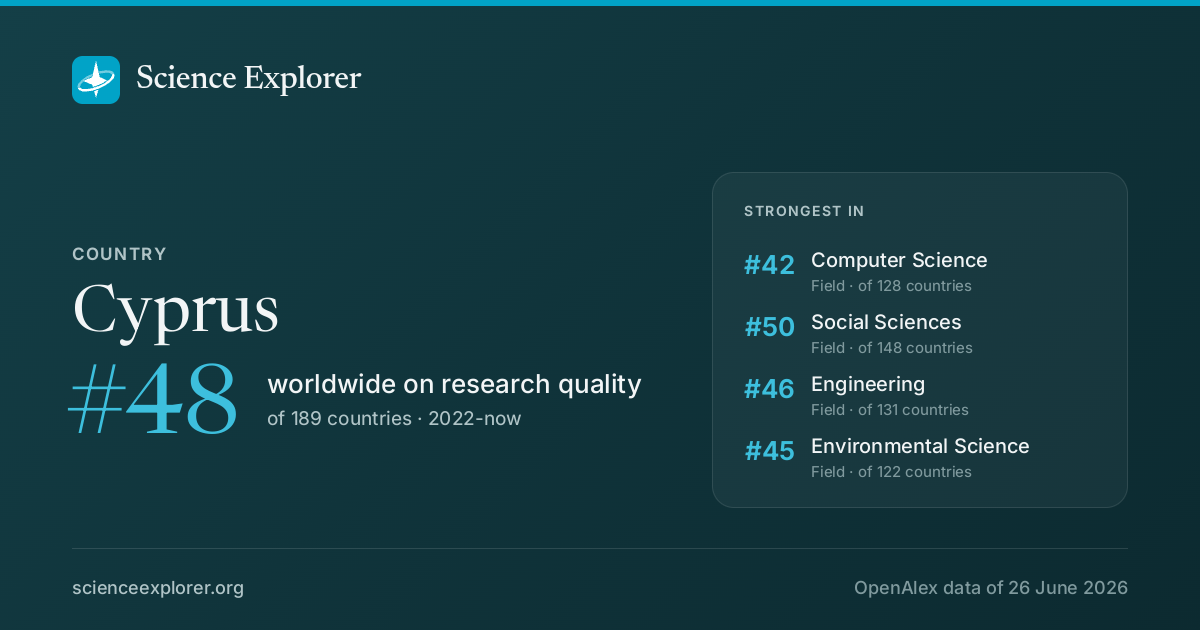
Cyprus ranks #48 of 189 countries on research quality in 2022-now (#46 all time), with 17k research works and 13.6% of them in the world's top 10%.
- World rank, 2022-now
- #48 of 189 · #46 all time
- Works, 2022-now
- 17k ▲ 31% vs 2018-21
- Citations
- 944k 17.5 per fractional work, all time
- Top-10% rate
- 13.6% all institutions 10.0%
- vs its own fields
- 1.09× 1.00× is exactly expected
- In the world top 100
- 0 0 in the top 1,000
- Open access
- 51% world 40%
- International
- 38% world 18%
CyprusWhat is Cyprus strongest at in science?
On research quality in 2022-now, Cyprus ranks highest in Computer Science (#42 of 128), Social Sciences (#50 of 148) and Engineering (#46 of 131). Relative to its size it is most specialised in Space and Planetary Science, General Energy and Tourism, Leisure and Hospitality Management.
| Field | World rank | Where that sits | Top-10% rate | Works | All time | Institutions |
|---|---|---|---|---|---|---|
| Computer ScienceField | #42 of 128 | 12.6% | 1,576 | #39 | Institutions | |
| Social SciencesField | #50 of 148 | 13.8% | 2,657 | #46 | Institutions | |
| EngineeringField | #46 of 131 | 12.1% | 2,206 | #48 | Institutions | |
| Environmental ScienceField | #45 of 122 | 13.2% | 853 | #49 | Institutions | |
| Business, Management and AccountingField | #41 of 110 | 20.5% | 905 | #43 | Institutions | |
| MedicineField | #60 of 152 | 12.1% | 2,318 | #58 | Institutions | |
| Sociology and Political ScienceSubfield | #48 of 119 | 12.6% | 901 | #44 | Institutions | |
| Economics, Econometrics and FinanceField | #44 of 107 | 17.0% | 687 | #43 | Institutions | |
| PsychologyField | #44 of 106 | 11.8% | 830 | #44 | Institutions | |
| Arts and HumanitiesField | #45 of 103 | 14.8% | 717 | #43 | Institutions | |
| EducationSubfield | #49 of 112 | 16.4% | 645 | #41 | Institutions | |
| Economics and EconometricsSubfield | #45 of 98 | 17.6% | 510 | #44 | Institutions |
Where its research is concentrated
Location quotient: how much more (or less) of each node it does than its size predicts. Drawn around 1×, where "twice the world share" and "half of it" are the same distance apart in opposite directions. A volume reading, which on a country axis is largely population and industrial structure.
- Space and Planetary ScienceSubfield · 29.6 works · #36 of 158 active here7.6×
- General EnergySubfield · 34.7 works · #43 of 167 active here6.6×
- Tourism, Leisure and Hospitality ManagementSubfield · 25.0 works · #46 of 165 active here5.7×
- Modeling and SimulationSubfield · 105.6 works · #51 of 206 active here3.9×
- ArcheologySubfield · 195.9 works · #55 of 208 active here3.4×
- Drug DiscoverySubfield · 5.1 works · #35 of 152 active here3.1×
- Numerical AnalysisSubfield · 48.0 works · #57 of 173 active here2.9×
- ArcheologySubfield · 8.1 works · #56 of 158 active here2.7×
The whole field profile
All 26 fields at once. A specialist and a generalist produce the same ranked list and a completely different shape.
Rings at 0.5×, 1× and 2×. Widest outward: Economics, Econometrics and Finance, 1.9×. Every wedge is a field page.
All 26 fields, with their numbers
- Economics, Econometrics and Finance1.86×774 works
- Business, Management and Accounting1.68×1,051 works
- Energy1.65×294 works
- Psychology1.63×962 works
- Mathematics1.61×368 works
- Decision Sciences1.52×285 works
- Arts and Humanities1.47×826 works
- Pharmacology, Toxicology and Pharmaceutics1.37×93 works
- Dentistry1.37×129 works
- Social Sciences1.24×3,058 works
- Physics and Astronomy1.23×533 works
- Computer Science1.22×1,843 works
- Environmental Science1.03×997 works
- Health Professions0.99×508 works
- Earth and Planetary Sciences0.92×280 works
- Engineering0.86×2,500 works
- Nursing0.85×80 works
- Neuroscience0.82×259 works
- Veterinary0.79×21 works
- Medicine0.73×2,717 works
- Chemistry0.68×208 works
- Biochemistry, Genetics and Molecular Biology0.63×654 works
- Immunology and Microbiology0.62×121 works
- Agricultural and Biological Sciences0.58×536 works
- Chemical Engineering0.58×40 works
- Materials Science0.41×281 works
Which fields of science does Cyprus work in?
In 2022-now, 38% of research in Cyprus is in Physical Sciences, 36% in Social Sciences. Its largest fields are Social Sciences (16%), Medicine (14%), Engineering (13%). It does 1.4× the world's share of Social Sciences.
Each ring splits the one inside it: the four domains of science, their fields, their subfields. Size is fractional works in 2022-now. Every slice is a page; the interactive view zooms down to single topics and colours each by how much more of it this country does than the world.
Its 4 domains and 26 fields, with their numbers
- Physical Sciences7,34437.8%
- Engineering2,50012.9%
- Computer Science1,8439.5%
- Environmental Science9975.1%
- Physics and Astronomy5332.7%
- Mathematics3681.9%
- Energy2941.5%
- Materials Science2811.4%
- Earth and Planetary Sciences2801.4%
- Chemistry2081.1%
- Chemical Engineering400.2%
- Social Sciences6,95735.8%
- Social Sciences3,05815.7%
- Business, Management and Accounting1,0515.4%
- Psychology9625.0%
- Arts and Humanities8264.3%
- Economics, Econometrics and Finance7744.0%
- Decision Sciences2851.5%
- Health Sciences3,45617.8%
- Medicine2,71714.0%
- Health Professions5082.6%
- Dentistry1290.7%
- Nursing800.4%
- Veterinary210.1%
- Life Sciences1,6638.6%
Which keywords describe research in Cyprus?
By fractional works in 2022-now, weighted toward what it does more of than the world: Renewable Energy, Machine Learning, Sustainability, Economic Growth, Deep Learning, Climate Change, Artificial Intelligence and Financial Development.
- National Identities
- Mediation
- Peacebuilding
- European Union
- Monetary Policy
- Kuznets Curve
- CO2 Emissions
- Panel Data Analysis
- Security
- Cultural Heritage
- Educational Technology
- COVID-19
- Big Data
- Healthcare
- Social Media
- Education
- Environmental Impact
- Climate Change
- Sustainability
- Deep Learning
- Machine Learning
- Renewable Energy
- Epidemiology
- Globalization
- Artificial Intelligence
- Economic Growth
- Mental Health
- Energy Efficiency
- Supply Chain Management
- Internet of Things
- Urbanization
- Consumer Behavior
- Energy Consumption
- Financial Development
- Environmental Regulation
- Trade Openness
- Smart Cities
- Nonlinear Equations
- Identity Construction
- Cyprus Conflict
Size is fractional works in 2022-now in the topics tagged with each word; colour is the word's share of this country's work against its share of the world's. The 40 words are chosen for being large and distinctive. Each links to the topic it comes from most.
All 40 words, with their numbers
- Machine Learning902▲ 1.40×96 topics
- Deep Learning705◆ 1.05×85 topics
- Renewable Energy665▲ 2.4×53 topics
- Sustainability663▲ 1.40×115 topics
- Epidemiology595▼ 0.77×136 topics
- Climate Change563◆ 1.07×114 topics
- Globalization443▲ 1.16×140 topics
- Environmental Impact435▲ 1.31×63 topics
- Artificial Intelligence426▲ 1.54×61 topics
- Education419▲ 1.26×123 topics
- Economic Growth404▲ 2.5×34 topics
- Social Media370▲ 1.38×39 topics
- Mental Health364▲ 1.31×47 topics
- Healthcare353▲ 1.59×39 topics
- Energy Efficiency333▲ 1.86×42 topics
- Big Data309▲ 1.66×34 topics
- Supply Chain Management309▲ 1.77×24 topics
- COVID-19305▲ 1.21×32 topics
- Internet of Things294▲ 1.76×29 topics
- Educational Technology287▲ 1.25×46 topics
- Urbanization253▲ 3.2×14 topics
- Cultural Heritage243▲ 2.4×32 topics
- Consumer Behavior231▲ 1.91×19 topics
- Security227▲ 1.74×28 topics
- Energy Consumption208▲ 4.7×7 topics
- Panel Data Analysis195▲ 6.5×3 topics
- Financial Development194▲ 6.7×3 topics
- CO2 Emissions178▲ 5.1×4 topics
- Environmental Regulation171▲ 5.9×5 topics
- Kuznets Curve164▲ 7.8×1 topic
- Trade Openness164▲ 7.8×1 topic
- Monetary Policy155▲ 3.4×12 topics
- Smart Cities150▲ 2.9×8 topics
- European Union140▲ 3.2×24 topics
- Nonlinear Equations127▲ 5.1×6 topics
- Peacebuilding126▲ 9.5×6 topics
- Identity Construction115▲ 11×5 topics
- Mediation98▲ 21×4 topics
- Cyprus Conflict92▲ 132×1 topic
- National Identities92▲ 132×1 topic
Which research topics does Cyprus publish the most in?
Its largest topics in 2022-now are Energy, Environment, Economic Growth, Cyprus History, Politics, Society, Blockchain Technology Applications and Security.
Area is fractional works in 2022-now; colour is the subfield each topic belongs to. Every tile is a topic page.
- 1 Energy, Environment, Economic Growth Economics and Econometrics 164 works
- 2 Cyprus History, Politics, Society Sociology and Political Science 92 works
- 3 Blockchain Technology Applications and Security Information Systems 80 works
- 4 Energy, Environment, and Transportation Policies Renewable Energy, Sustainability and the Environment 79 works
- 5 Environmental Sustainability in Business Marketing 78 works
- 6 Market Dynamics and Volatility Economics and Econometrics 74 works
- 7 Digital Marketing and Social Media Sociology and Political Science 73 works
- 8 Fractional Differential Equations Solutions Modeling and Simulation 70 works
- 9 Diverse Aspects of Tourism Research Sociology and Political Science 66 works
- 10 Energy and Environment Impacts Pollution 63 works
- 11 Ethics and Social Impacts of AI Safety Research 61 works
- 12 Black Holes and Theoretical Physics Nuclear and High Energy Physics 57 works
Which universities in Cyprus lead research?
University of Cyprus, University of Nicosia and Eastern Mediterranean University rank highest in Cyprus on research quality in 2022-now.
One dot per institution in the list below. The upper left is the interesting corner.
- 1University of CyprusUniversity · Nicosia · #1,055 worldwide11.9% top 10% · 2.9k works
- 2University of NicosiaUniversity · Nicosia · #1,476 worldwide17.3% top 10% · 1.4k works
- 3Eastern Mediterranean UniversityUniversity · Famagusta · #1,495 worldwide16.4% top 10% · 1.3k works
- 4Cyprus University of TechnologyUniversity · Limassol · #2,029 worldwide14.3% top 10% · 1.2k works
- 5Cyprus International UniversityUniversity · Nicosia · #2,337 worldwide18.4% top 10% · 1.1k works
- 6European University CyprusUniversity · Nicosia · #2,687 worldwide16.6% top 10% · 835 works
- 7Near East UniversityUniversity · Nicosia · #3,029 worldwide12.2% top 10% · 2.8k works
- 8Neapolis University PafosUniversity · Paphos · #3,473 worldwide16.7% top 10% · 314 works
- 9Cyprus InstituteInstitution · Nicosia · #3,706 worldwide12.2% top 10% · 379 works
- 10Frederick UniversityUniversity · Nicosia · #4,528 worldwide9.9% top 10% · 424 works
- 11Agruicultural Research InstituteGovernment institution · Nicosia · #4,873 worldwide7.0% top 10% · 646 works
- 12Open University of CyprusUniversity · Nicosia · #5,466 worldwide22.3% top 10% · 321 works
- 13Global CollegeUniversity · Nicosia · #6,811 worldwide9.8% top 10% · 570 works
- 14Girne American UniversityUniversity · Kyrenia · #7,629 worldwide11.9% top 10% · 298 works
- 15University of KyreniaUniversity · Kyrenia · #8,664 worldwide11.5% top 10% · 243 works


The track on each row is its top-10% rate; the tick is the average of all institutions, 10.0% (how it is set): teal above it, red below.
All ranked institutions in CyprusWho are the top researchers in Cyprus?
Tomiwa Sunday Adebayo, Zahoor Ahmed and Ali Övgün rank highest among researchers based in Cyprus.
- 1 Tomiwa Sunday Adebayo #191 worldwide 23k citations · 354 works
- 2 Zahoor Ahmed #1,212 worldwide 14k citations · 154 works
- 3 Ali Övgün #2,778 worldwide 10k citations · 396 works
- 4 Osman M. Karatepe #3,538 worldwide 18k citations · 275 works
- 5 Michalinos Zembylas #7,077 worldwide 21k citations · 635 works
- 6 Despo Fatta‐Kassinos #13,387 worldwide 32k citations · 225 works
- 7 Hasan Yousef Aljuhmani #13,465 worldwide 1.5k citations · 53 works
- 8 Babatunde Sunday Eweade #19,574 worldwide 1.4k citations · 35 works
- 9 Triantafyllos Stylianopoulos #20,905 worldwide 21k citations · 335 works
- 10 Soteris A. Kalogirou #23,513 worldwide 38k citations · 447 works
Which cities in Cyprus are research hubs?
How open and international is Cyprus's research?
51% of its research is openly available (world: 40%), and 38% is written with international co-authors (world: 18%).
World: 40% of research is openly available.
World: 18% is written across borders.
In 2022-now, 64% of its research is openly available (world 63%) and 43% is written with co-authors abroad (world 22%). Against what its own mix of topics predicts, that is 1.03× the expected open access and 1.89× the expected international share, which puts it #104 of 173 countries on openness.
How has Cyprus's research grown?
Output in 2022-2025 was 31% higher than in 2018-2021.
The same series as a ribbon: one cell per year, darker for more. The line above answers how much; this answers when.
Its share of all research
Growing output can still be a shrinking share: all of science grows. This is Cyprus as a percentage of every work published that year, 0.075% in 2024.
Fractional works of Cyprus over all fractional works that year. How the balance of science has shifted.
How much of it reaches the world top 10%
Over the whole record, 12.7% of its 54k works since 1950 reached the world top 10% for their field and year.
Of each year's output, the share that reached the world's 10% most cited for its field and year. Peak 14.1% in 2025.
Which countries have research most like Cyprus'?
Albania is Cyprus' closest research twin: of all countries, its research is spread across the fields most like Cyprus', with both strong in Economics, Econometrics and Finance.
- 1
 AlbaniaBoth strong in Economics, Econometrics and Finance, Business, Management and Accounting, Decision Sciences
0.72 Compare
- 2
 MaltaBoth strong in Psychology, Arts and Humanities, Dentistry
0.72 Compare
- 3
 North MacedoniaBoth strong in Economics, Econometrics and Finance, Business, Management and Accounting, Decision Sciences
0.71 Compare
- 4
 Bosnia and HerzegovinaBoth strong in Economics, Econometrics and Finance, Arts and Humanities, Dentistry
0.66 Compare
- 5
 KosovoBoth strong in Economics, Econometrics and Finance, Business, Management and Accounting, Mathematics
0.65 Compare
Similarity is the correlation of each side's location quotients across every field it publishes in, on a log scale: 1 is the same shape of research, 0 is unrelated. It ignores size. How it is measured.
Compare Cyprus with
 Uganda
 Russia
 Qatar
 Iceland
 Iran
 Ethiopia
Share Cyprus's ranking
Badges for a website1Each links back here and updates with every snapshot

Research fields in Cyprus
- Physical Sciences
- Computer Science
- Social Sciences
- Social Sciences
- Engineering
- Environmental Science
- Business, Management and Accounting
- Health Sciences
- Medicine
- Sociology and Political Science
- Economics, Econometrics and Finance
- Psychology
- Arts and Humanities
- Education
- Economics and Econometrics
- Life Sciences
- Artificial Intelligence
- Information Systems
- Physics and Astronomy
- Electrical and Electronic Engineering
- Political Science and International Relations
- Agricultural and Biological Sciences
- Biochemistry, Genetics and Molecular Biology
- Mathematics
- Health Professions
- Computer Networks and Communications
- Neuroscience
- Molecular Biology
- Materials Science
Discussion
Ask a question or share a note about Cyprus. Posts are plain text and can be reported.