Science Explorer Back to mapMap
Discussion
Country

Science in Malta

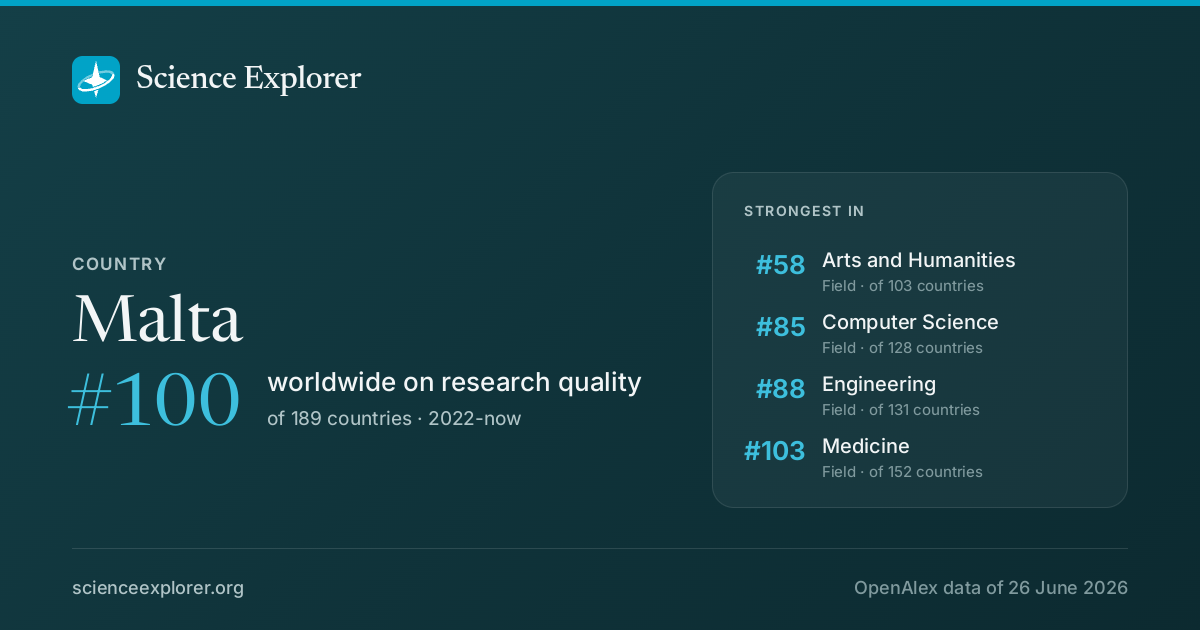
Malta ranks #100 of 189 countries on research quality in 2022-now (#93 all time), with 4k research works and 8.7% of them in the world's top 10%.

World rank, 2022-now
#100
of 189 · #93 all time
Works, 2022-now
4k
▲ 11% vs 2018-21
Citations
192k
12.7 per fractional work, all time
Top-10% rate
8.7%
all institutions 10.0%
vs its own fields
0.79×
1.00× is exactly expected
In the world top 100
0
0 in the top 1,000
Open access
49%
world 40%
International
30%
world 18%

What is Malta strongest at in science?

On research quality in 2022-now, Malta ranks highest in Arts and Humanities (#58 of 103), Computer Science (#85 of 128) and Engineering (#88 of 131). Relative to its size it is most specialised in Space and Planetary Science, Medical Terminology and Archeology.

FieldWorld rankWhere that sitsTop-10% rateWorksAll timeInstitutions
Arts and HumanitiesField #58 of 103 12.8%234 #62 Institutions
Computer ScienceField #85 of 128 8.0%348 #75 Institutions
EngineeringField #88 of 131 8.8%420 #80 Institutions
MedicineField #103 of 152 6.4%861 #116 Institutions
PsychologyField #76 of 106 8.7%232 #67 Institutions
Social SciencesField #116 of 148 9.9%632 #84 Institutions

Where its research is concentrated

Location quotient: how much more (or less) of each node it does than its size predicts. Drawn around 1×, where "twice the world share" and "half of it" are the same distance apart in opposite directions. A volume reading, which on a country axis is largely population and industrial structure.

  1. Space and Planetary ScienceSubfield · 9.3 works · #60 of 158 active here10×
  2. Medical TerminologySubfield · 1.1 works · #62 of 121 active here8.0×
  3. ArcheologySubfield · 58.7 works · #80 of 208 active here4.4×
  4. Research and TheorySubfield · 3.9 works · #87 of 183 active here3.4×
  5. ConservationSubfield · 12.9 works · #82 of 191 active here3.1×
  6. Public AdministrationSubfield · 7.1 works · #86 of 186 active here3.0×
  7. Earth-Surface ProcessesSubfield · 14.7 works · #90 of 212 active here2.8×
  8. Human-Computer InteractionSubfield · 24.6 works · #82 of 193 active here2.7×
← less than its size predicts1×more →

The whole field profile

All 26 fields at once. A specialist and a generalist produce the same ranked list and a completely different shape.

Agricultural and Biological Sciences: 0.37× its world share, 79 worksAgricultural and Bio…Biochemistry, Genetics and Molecular Biology: 0.55× its world share, 131 worksBiochemistry, Geneti…Immunology and Microbiology: 0.62× its world share, 28 worksImmunology and Micro…Neuroscience: 0.97× its world share, 70 worksNeurosciencePharmacology, Toxicology and Pharmaceutics: 0.70× its world share, 11 worksPharmacology, Toxico…Chemical Engineering: 0.43× its world share, 7 worksChemical EngineeringChemistry: 0.49× its world share, 34 worksChemistryComputer Science: 1.10× its world share, 383 worksComputer ScienceEarth and Planetary Sciences: 1.20× its world share, 84 worksEarth and Planetary …Energy: 0.80× its world share, 33 worksEnergyEngineering: 0.70× its world share, 470 worksEngineeringEnvironmental Science: 0.83× its world share, 183 worksEnvironmental ScienceMaterials Science: 0.26× its world share, 40 worksMaterials ScienceMathematics: 0.90× its world share, 48 worksMathematicsPhysics and Astronomy: 0.70× its world share, 69 worksPhysics and AstronomyDentistry: 1.28× its world share, 28 worksDentistryHealth Professions: 1.44× its world share, 169 worksHealth ProfessionsMedicine: 1.14× its world share, 981 worksMedicineNursing: 0.77× its world share, 17 worksNursingVeterinary: 0.23× its world share, 1 worksVeterinaryArts and Humanities: 2.09× its world share, 269 worksArts and HumanitiesBusiness, Management and Accounting: 1.18× its world share, 170 worksBusiness, Management…Decision Sciences: 1.12× its world share, 49 worksDecision SciencesEconomics, Econometrics and Finance: 1.28× its world share, 122 worksEconomics, Econometr…Psychology: 1.95× its world share, 265 worksPsychologySocial Sciences: 1.29× its world share, 727 worksSocial Sciences1×world share
more than its size predictsabout as predictedless

Rings at 0.5×, 1× and 2×. Widest outward: Arts and Humanities, 2.1×. Every wedge is a field page.

All 26 fields, with their numbers
  1. Arts and Humanities2.09×269 works
  2. Psychology1.95×265 works
  3. Health Professions1.44×169 works
  4. Social Sciences1.29×727 works
  5. Dentistry1.28×28 works
  6. Economics, Econometrics and Finance1.28×122 works
  7. Earth and Planetary Sciences1.20×84 works
  8. Business, Management and Accounting1.18×170 works
  9. Medicine1.14×981 works
  10. Decision Sciences1.12×49 works
  11. Computer Science1.10×383 works
  12. Neuroscience0.97×70 works
  13. Mathematics0.90×48 works
  14. Environmental Science0.83×183 works
  15. Energy0.80×33 works
  16. Nursing0.77×17 works
  17. Pharmacology, Toxicology and Pharmaceutics0.70×11 works
  18. Engineering0.70×470 works
  19. Physics and Astronomy0.70×69 works
  20. Immunology and Microbiology0.62×28 works
  21. Biochemistry, Genetics and Molecular Biology0.55×131 works
  22. Chemistry0.49×34 works
  23. Chemical Engineering0.43×7 works
  24. Agricultural and Biological Sciences0.37×79 works
  25. Materials Science0.26×40 works
  26. Veterinary0.23×1 works

Which fields of science does Malta work in?

In 2022-now, 36% of research in Malta is in Social Sciences, 30% in Physical Sciences. Its largest fields are Medicine (22%), Social Sciences (16%), Engineering (11%). It does 1.4× the world's share of Social Sciences.

Social Sciences: 1,602 fractional works · 35.8% of its workSocial Sciences: 727 fractional works · 16.3% of its workSociology and Political Science: 197 fractional works · 4.4% of its workEducation: 177 fractional works · 4.0% of its workPolitical Science and International Relations: 71 fractional works · 1.6% of its workDemography: 56 fractional works · 1.2% of its workGender Studies: 30 fractional works · 0.7% of its workSafety Research: 28 fractional works · 0.6% of its workTransportation: 25 fractional works · 0.6% of its workHealth: 23 fractional works · 0.5% of its workCultural Studies: 17 fractional works · 0.4% of its workAnthropology: 16 fractional works · 0.4% of its workLaw: 16 fractional works · 0.4% of its workUrban Studies: 14 fractional works · 0.3% of its workLinguistics and Language: 14 fractional works · 0.3% of its workGeography, Planning and Development: 13 fractional works · 0.3% of its workCommunication: 10 fractional works · 0.2% of its workSmaller subfields together: 21 fractional works · 0.5% of its workArts and Humanities: 269 fractional works · 6.0% of its workArcheology: 59 fractional works · 1.3% of its workLanguage and Linguistics: 37 fractional works · 0.8% of its workLiterature and Literary Theory: 35 fractional works · 0.8% of its workPhilosophy: 34 fractional works · 0.8% of its workHistory: 23 fractional works · 0.5% of its workReligious studies: 20 fractional works · 0.4% of its workVisual Arts and Performing Arts: 18 fractional works · 0.4% of its workHistory and Philosophy of Science: 14 fractional works · 0.3% of its workConservation: 13 fractional works · 0.3% of its workSmaller subfields together: 18 fractional works · 0.4% of its workPsychology: 265 fractional works · 5.9% of its workClinical Psychology: 91 fractional works · 2.0% of its workSocial Psychology: 69 fractional works · 1.6% of its workDevelopmental and Educational Psychology: 50 fractional works · 1.1% of its workExperimental and Cognitive Psychology: 38 fractional works · 0.8% of its workApplied Psychology: 13 fractional works · 0.3% of its workSmaller subfields together: 4 fractional works · 0.1% of its workBusiness, Management and Accounting: 170 fractional works · 3.8% of its workStrategy and Management: 40 fractional works · 0.9% of its workAccounting: 35 fractional works · 0.8% of its workOrganizational Behavior and Human Resource Management: 27 fractional works · 0.6% of its workMarketing: 24 fractional works · 0.5% of its workManagement Information Systems: 22 fractional works · 0.5% of its workManagement of Technology and Innovation: 17 fractional works · 0.4% of its workSmaller subfields together: 5 fractional works · 0.1% of its workEconomics, Econometrics and Finance: 122 fractional works · 2.7% of its workEconomics and Econometrics: 79 fractional works · 1.8% of its workFinance: 31 fractional works · 0.7% of its workGeneral Economics, Econometrics and Finance: 13 fractional works · 0.3% of its workDecision Sciences: 49 fractional works · 1.1% of its workInformation Systems and Management: 21 fractional works · 0.5% of its workManagement Science and Operations Research: 20 fractional works · 0.4% of its workSmaller subfields together: 8 fractional works · 0.2% of its workPhysical Sciences: 1,351 fractional works · 30.2% of its workEngineering: 470 fractional works · 10.5% of its workElectrical and Electronic Engineering: 96 fractional works · 2.2% of its workMechanical Engineering: 56 fractional works · 1.2% of its workBiomedical Engineering: 54 fractional works · 1.2% of its workAerospace Engineering: 42 fractional works · 0.9% of its workControl and Systems Engineering: 38 fractional works · 0.9% of its workAutomotive Engineering: 35 fractional works · 0.8% of its workOcean Engineering: 29 fractional works · 0.6% of its workIndustrial and Manufacturing Engineering: 26 fractional works · 0.6% of its workCivil and Structural Engineering: 22 fractional works · 0.5% of its workBuilding and Construction: 22 fractional works · 0.5% of its workMedia Technology: 16 fractional works · 0.4% of its workMechanics of Materials: 13 fractional works · 0.3% of its workComputational Mechanics: 12 fractional works · 0.3% of its workSmaller subfields together: 9 fractional works · 0.2% of its workComputer Science: 383 fractional works · 8.6% of its workArtificial Intelligence: 122 fractional works · 2.7% of its workInformation Systems: 68 fractional works · 1.5% of its workComputer Vision and Pattern Recognition: 61 fractional works · 1.4% of its workComputer Networks and Communications: 31 fractional works · 0.7% of its workHuman-Computer Interaction: 25 fractional works · 0.6% of its workComputational Theory and Mathematics: 24 fractional works · 0.5% of its workComputer Science Applications: 24 fractional works · 0.5% of its workSignal Processing: 13 fractional works · 0.3% of its workSmaller subfields together: 16 fractional works · 0.4% of its workEnvironmental Science: 183 fractional works · 4.1% of its workManagement, Monitoring, Policy and Law: 34 fractional works · 0.8% of its workGlobal and Planetary Change: 32 fractional works · 0.7% of its workEcology: 26 fractional works · 0.6% of its workEnvironmental Engineering: 25 fractional works · 0.6% of its workHealth, Toxicology and Mutagenesis: 24 fractional works · 0.5% of its workPollution: 14 fractional works · 0.3% of its workNature and Landscape Conservation: 10 fractional works · 0.2% of its workSmaller subfields together: 18 fractional works · 0.4% of its workEarth and Planetary Sciences: 84 fractional works · 1.9% of its workGeophysics: 17 fractional works · 0.4% of its workEarth-Surface Processes: 15 fractional works · 0.3% of its workOceanography: 14 fractional works · 0.3% of its workGeology: 12 fractional works · 0.3% of its workAtmospheric Science: 10 fractional works · 0.2% of its workSpace and Planetary Science: 9 fractional works · 0.2% of its workSmaller subfields together: 7 fractional works · 0.2% of its workPhysics and Astronomy: 69 fractional works · 1.6% of its workAstronomy and Astrophysics: 38 fractional works · 0.8% of its workNuclear and High Energy Physics: 13 fractional works · 0.3% of its workSmaller subfields together: 19 fractional works · 0.4% of its workMathematics: 48 fractional works · 1.1% of its workMathematical Physics: 11 fractional works · 0.2% of its workSmaller subfields together: 36 fractional works · 0.8% of its workMaterials Science: 40 fractional works · 0.9% of its workMaterials Chemistry: 21 fractional works · 0.5% of its workSmaller subfields together: 19 fractional works · 0.4% of its workChemistry: 34 fractional works · 0.8% of its workOrganic Chemistry: 18 fractional works · 0.4% of its workSmaller subfields together: 16 fractional works · 0.4% of its workEnergy: 33 fractional works · 0.7% of its workRenewable Energy, Sustainability and the Environment: 25 fractional works · 0.6% of its workSmaller subfields together: 8 fractional works · 0.2% of its workChemical Engineering: 7 fractional works · 0.1% of its workHealth Sciences: 1,196 fractional works · 26.8% of its workMedicine: 981 fractional works · 22.0% of its workSurgery: 108 fractional works · 2.4% of its workPublic Health, Environmental and Occupational Health: 81 fractional works · 1.8% of its workEpidemiology: 70 fractional works · 1.6% of its workCardiology and Cardiovascular Medicine: 69 fractional works · 1.6% of its workPulmonary and Respiratory Medicine: 69 fractional works · 1.5% of its workEndocrinology, Diabetes and Metabolism: 45 fractional works · 1.0% of its workOncology: 44 fractional works · 1.0% of its workRadiology, Nuclear Medicine and Imaging: 41 fractional works · 0.9% of its workPhysiology: 39 fractional works · 0.9% of its workPediatrics, Perinatology and Child Health: 37 fractional works · 0.8% of its workInfectious Diseases: 31 fractional works · 0.7% of its workNeurology: 27 fractional works · 0.6% of its workDermatology: 24 fractional works · 0.5% of its workRheumatology: 24 fractional works · 0.5% of its workPsychiatry and Mental health: 24 fractional works · 0.5% of its workOrthopedics and Sports Medicine: 21 fractional works · 0.5% of its workObstetrics and Gynecology: 20 fractional works · 0.4% of its workPathology and Forensic Medicine: 19 fractional works · 0.4% of its workPharmacology: 19 fractional works · 0.4% of its workEmergency Medicine: 18 fractional works · 0.4% of its workReproductive Medicine: 16 fractional works · 0.4% of its workHealth Informatics: 13 fractional works · 0.3% of its workRehabilitation: 13 fractional works · 0.3% of its workOphthalmology: 12 fractional works · 0.3% of its workGeriatrics and Gerontology: 11 fractional works · 0.3% of its workHematology: 9 fractional works · 0.2% of its workComplementary and alternative medicine: 9 fractional works · 0.2% of its workGastroenterology: 9 fractional works · 0.2% of its workSmaller subfields together: 57 fractional works · 1.3% of its workHealth Professions: 169 fractional works · 3.8% of its workGeneral Health Professions: 85 fractional works · 1.9% of its workHealth Information Management: 17 fractional works · 0.4% of its workSpeech and Hearing: 14 fractional works · 0.3% of its workEmergency Medical Services: 13 fractional works · 0.3% of its workOccupational Therapy: 12 fractional works · 0.3% of its workSmaller subfields together: 28 fractional works · 0.6% of its workDentistry: 28 fractional works · 0.6% of its workOral Surgery: 12 fractional works · 0.3% of its workSmaller subfields together: 15 fractional works · 0.3% of its workNursing: 17 fractional works · 0.4% of its workNutrition and Dietetics: 12 fractional works · 0.3% of its workSmaller subfields together: 5 fractional works · 0.1% of its workVeterinary: 1 fractional works · 0.0% of its workLife Sciences: 319 fractional works · 7.1% of its workBiochemistry, Genetics and Molecular Biology: 131 fractional works · 2.9% of its workMolecular Biology: 55 fractional works · 1.2% of its workGenetics: 42 fractional works · 0.9% of its workCancer Research: 11 fractional works · 0.3% of its workSmaller subfields together: 22 fractional works · 0.5% of its workAgricultural and Biological Sciences: 79 fractional works · 1.8% of its workPlant Science: 24 fractional works · 0.5% of its workEcology, Evolution, Behavior and Systematics: 14 fractional works · 0.3% of its workFood Science: 14 fractional works · 0.3% of its workSmaller subfields together: 28 fractional works · 0.6% of its workNeuroscience: 70 fractional works · 1.6% of its workCognitive Neuroscience: 49 fractional works · 1.1% of its workCellular and Molecular Neuroscience: 10 fractional works · 0.2% of its workSmaller subfields together: 12 fractional works · 0.3% of its workImmunology and Microbiology: 28 fractional works · 0.6% of its workImmunology: 14 fractional works · 0.3% of its workSmaller subfields together: 13 fractional works · 0.3% of its workPharmacology, Toxicology and Pharmaceutics: 11 fractional works · 0.2% of its workALL ITS WORKMalta4,468fractional works, 2022-now
Life Sciences7%Physical Sciences30%Health Sciences27%Social Sciences36%

Each ring splits the one inside it: the four domains of science, their fields, their subfields. Size is fractional works in 2022-now. Every slice is a page; the interactive view zooms down to single topics and colours each by how much more of it this country does than the world.

Its 4 domains and 26 fields, with their numbers
  1. Social Sciences1,60235.8%
    1. Social Sciences72716.3%
    2. Arts and Humanities2696.0%
    3. Psychology2655.9%
    4. Business, Management and Accounting1703.8%
    5. Economics, Econometrics and Finance1222.7%
    6. Decision Sciences491.1%
    1. Engineering47010.5%
    2. Computer Science3838.6%
    3. Environmental Science1834.1%
    4. Earth and Planetary Sciences841.9%
    5. Physics and Astronomy691.6%
    6. Mathematics481.1%
    7. Materials Science400.9%
    8. Chemistry340.8%
    9. Energy330.7%
    10. Chemical Engineering70.1%
  2. Health Sciences1,19626.8%
    1. Medicine98122.0%
    2. Health Professions1693.8%
    3. Dentistry280.6%
    4. Nursing170.4%
    5. Veterinary10.0%
    1. Biochemistry, Genetics and Molecular Biology1312.9%
    2. Agricultural and Biological Sciences791.8%
    3. Neuroscience701.6%
    4. Immunology and Microbiology280.6%
    5. Pharmacology, Toxicology and Pharmaceutics110.2%
All of science, and how each field's share has moved since 1950: the Science domain explorer

Which keywords describe research in Malta?

By fractional works in 2022-now, weighted toward what it does more of than the world: Epidemiology, Globalization, Sustainability, Mental Health, Quality of Life, Machine Learning, Resilience and Vulnerability.

▲ more of its work than of the world's◆ about the world's share▼ less than the world's

Size is fractional works in 2022-now in the topics tagged with each word; colour is the word's share of this country's work against its share of the world's. The 40 words are chosen for being large and distinctive. Each links to the topic it comes from most.

All 40 words, with their numbers
  1. Epidemiology204◆ 1.15×128 topics
  2. Globalization151▲ 1.72×97 topics
  3. Sustainability144▲ 1.32×79 topics
  4. Machine Learning136◆ 0.91×83 topics
  5. Deep Learning123▼ 0.80×73 topics
  6. Climate Change117◆ 0.96×96 topics
  7. Mental Health102▲ 1.59×41 topics
  8. Quality of Life100▲ 1.55×56 topics
  9. Education87◆ 1.13×81 topics
  10. Public Health80▲ 1.24×59 topics
  11. Artificial Intelligence79▲ 1.24×46 topics
  12. Renewable Energy79▲ 1.22×43 topics
  13. COVID-1970▲ 1.21×28 topics
  14. Healthcare70▲ 1.37×31 topics
  15. Risk Factors69▲ 1.41×36 topics
  16. Treatment68▲ 1.25×49 topics
  17. Cardiovascular Disease64▲ 1.25×38 topics
  18. Resilience64▲ 2.9×17 topics
  19. Big Data58▲ 1.35×27 topics
  20. Depression58▲ 1.46×25 topics
  21. Identity51▲ 1.59×46 topics
  22. Governance48▲ 3.3×14 topics
  23. Cultural Heritage48▲ 2.0×24 topics
  24. Vulnerability47▲ 4.6×7 topics
  25. Student Engagement46▲ 2.6×13 topics
  26. Ethics45▲ 2.0×39 topics
  27. Social Interaction42▲ 2.4×10 topics
  28. Prevention40▲ 2.1×15 topics
  29. Technology Integration35▲ 2.5×10 topics
  30. Reflective Practice34▲ 4.0×7 topics
  31. Mediterranean34▲ 8.4×6 topics
  32. Decolonization32▲ 8.9×5 topics
  33. European Union32▲ 3.2×17 topics
  34. Academic Achievement30▲ 4.0×10 topics
  35. Pacific30▲ 35×2 topics
  36. Islands29▲ 58×1 topic
  37. Small States29▲ 58×1 topic
  38. Holocene27▲ 5.3×3 topics
  39. Maritime Archaeology23▲ 28×1 topic
  40. Sea-Level Change23▲ 28×1 topic

Which research topics does Malta publish the most in?

Its largest topics in 2022-now are Island Studies and Pacific Affairs, Maritime and Coastal Archaeology, Educational Games and Gamification.

  1. 1 Island Studies and Pacific Affairs Demography 29 works
  2. 2 Maritime and Coastal Archaeology Archeology 23 works
  3. 3 Educational Games and Gamification Developmental and Educational Psychology 15 works
  4. 4 Environmental Education and Sustainability Management, Monitoring, Policy and Law 14 works
  5. 5 COVID-19 and Mental Health Clinical Psychology 14 works
  6. 6 Early Childhood Education and Development Education 14 works
  7. 7 Artificial Intelligence in Healthcare and Education Health Informatics 13 works
  8. 8 Digital Games and Media Sociology and Political Science 13 works
  9. 9 Online Learning and Analytics Computer Science Applications 12 works
  10. 10 Blockchain Technology Applications and Security Information Systems 12 works
  11. 11 Diabetic Foot Ulcer Assessment and Management Endocrinology, Diabetes and Metabolism 12 works
  12. 12 3D Surveying and Cultural Heritage Geology 11 works

Which universities in Malta lead research?

University of Malta, Malta College of Arts, Science and Technology and Primary HealthCare rank highest in Malta on research quality in 2022-now.

0%5%10%mean 7.82%fractional works (log) →share in the world top 10% →University of MaltaMiddlesex UniversityPrimary HealthCareMalta College of Art…
above the meannear itbelow it

One dot per institution in the list below. The upper left is the interesting corner.

  1. 1University of MaltaUniversity · Msida · #2,094 worldwide9.1% top 10% · 3.1k works
  2. 2Malta College of Arts, Science and TechnologyUniversity · Paola · #6,834 worldwide6.7% top 10% · 277 works
  3. 3Primary HealthCareHospital / health system · Floriana · #9,822 worldwide7.1% top 10% · 228 works
  4. 4Middlesex UniversityUniversity · Pembroke · #12,630 worldwide8.5% top 10% · 131 works
  5. 5Heritage MaltaArchive · Kalkara · #16,197 worldwide7.7% top 10% · 72 works

The track on each row is its top-10% rate; the tick is the average of all institutions, 10.0% (how it is set): teal above it, red below.

All ranked institutions in Malta

Who are the top researchers in Malta?

Mark Anthony Camilleri, Miriam Gatt and Mario V. Balzan rank highest among researchers based in Malta.

  1. 1 Mark Anthony Camilleri #68,033 worldwide 8.5k citations · 317 works
  2. 2 Miriam Gatt #75,716 worldwide 7k citations · 183 works
  3. 3 Mario V. Balzan #90,041 worldwide 4.2k citations · 91 works
  4. 4 Mark Mifsud #94,117 worldwide 3.4k citations · 56 works
  5. 5 Josette Camilleri #99,365 worldwide 13k citations · 232 works
  6. 6 Jackson Levi Said #155,333 worldwide 5.8k citations · 171 works
  7. 7 Victoria Farrugia Sant’Angelo #157,177 worldwide 13k citations · 36 works
  8. 8 Paul Pace #226,207 worldwide 5.1k citations · 64 works
  9. 9 Konstantinos F. Dialektopoulos #266,872 worldwide 2k citations · 64 works
  10. 10 Luke Mizzi #302,441 worldwide 3.1k citations · 66 works
Top researchers in Malta

How open and international is Malta's research?

49% of its research is openly available (world: 40%), and 30% is written with international co-authors (world: 18%).

openly available49.0%not open51.0%

World: 40% of research is openly available.

with international co-authors30.0%domestic only70.0%

World: 18% is written across borders.

In 2022-now, 61% of its research is openly available (world 63%) and 34% is written with co-authors abroad (world 22%). Against what its own mix of topics predicts, that is 0.98× the expected open access and 1.52× the expected international share, which puts it #145 of 173 countries on openness.

How has Malta's research grown?

Output in 2022-2025 was 11% higher than in 2018-2021.

still counting1990200020102020
grewheldshrank

The same series as a ribbon: one cell per year, darker for more. The line above answers how much; this answers when.

Its share of all research

Growing output can still be a shrinking share: all of science grows. This is Malta as a percentage of every work published that year, 0.017% in 2024.

still counting0.010%0.020%Malta0.018% in 202519801990200020102020

Fractional works of Malta over all fractional works that year. How the balance of science has shifted.

How much of it reaches the world top 10%

Over the whole record, 8.4% of its 15k works since 1950 reached the world top 10% for their field and year.

still counting5%10%15%all institutions10.0% in 2025Malta9.8% in 2025200020102020

Of each year's output, the share that reached the world's 10% most cited for its field and year. Peak 9.9% in 2020.

Which countries have research most like Malta's?

Dominican Republic is Malta's closest research twin: of all countries, its research is spread across the fields most like Malta's, with both strong in Psychology.

  1. 1 Dominican RepublicBoth strong in Psychology, Arts and Humanities, Health Professions 0.77 Compare
  2. 2 AlbaniaBoth strong in Arts and Humanities, Social Sciences, Dentistry 0.76 Compare
  3. 3 CyprusBoth strong in Psychology, Arts and Humanities, Dentistry 0.72 Compare
  4. 4 KosovoBoth strong in Arts and Humanities, Psychology, Social Sciences 0.71 Compare
  5. 5 PalestineBoth strong in Psychology, Health Professions, Dentistry 0.65 Compare

Similarity is the correlation of each side's location quotients across every field it publishes in, on a log scale: 1 is the same shape of research, 0 is unrelated. It ignores size. How it is measured.

Compare Malta with
Compare any two

Share Malta's ranking

Malta on Science Explorer

A card with Malta's standing and the fields it leads in, for a post or a slide. A link to this page previews as the same card.

Download the card

1200 × 630 PNG, sized for social posts, drawn from the latest snapshot.

Badges for a website1Each links back here and updates with every snapshot

Research fields in Malta

Discussion

Ask a question or share a note about Malta. Posts are plain text and can be reported.