 Science in Palestine
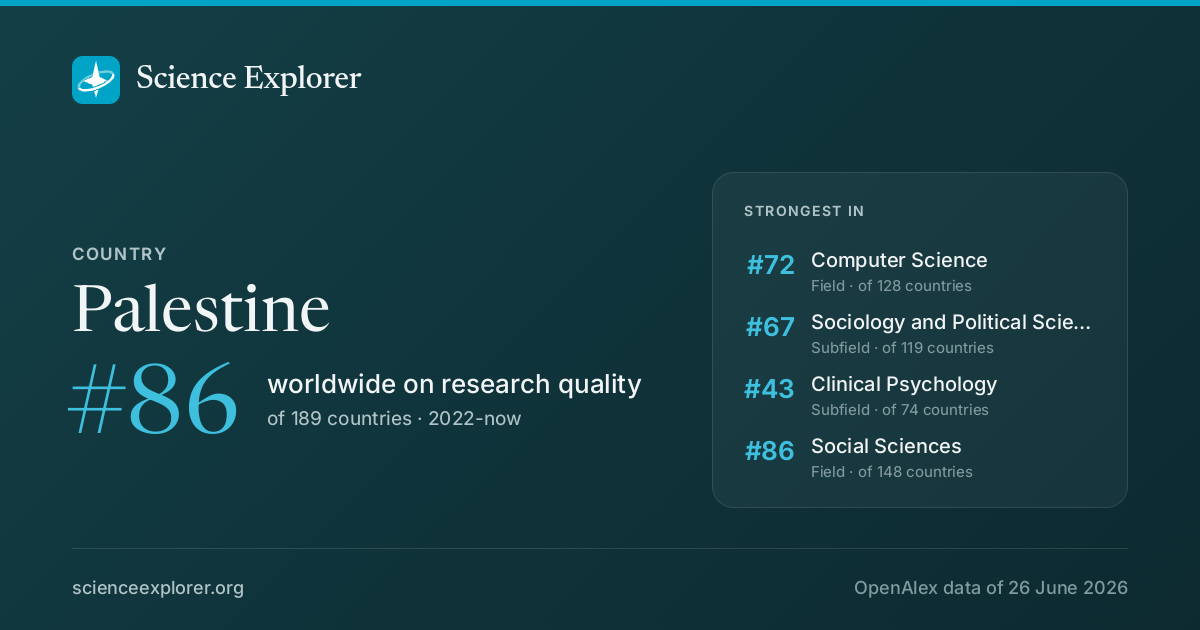
Palestine ranks #86 of 189 countries on research quality in 2022-now (#109 all time), with 6.9k research works and 12.4% of them in the world's top 10%.
- World rank, 2022-now
- #86 of 189 · #109 all time
- Works, 2022-now
- 6.9k ▲ 60% vs 2018-21
- Citations
- 212k 11.4 per fractional work, all time
- Top-10% rate
- 12.4% all institutions 10.0%
- vs its own fields
- 0.93× 1.00× is exactly expected
- In the world top 100
- 0 0 in the top 1,000
- Open access
- 63% world 40%
- International
- 35% world 18%
PalestineWhat is Palestine strongest at in science?
On research quality in 2022-now, Palestine ranks highest in Computer Science (#72 of 128), Sociology and Political Science (#67 of 119) and Clinical Psychology (#43 of 74). Relative to its size it is most specialised in Research and Theory, Applied Microbiology and Biotechnology and Accounting.
| Field | World rank | Where that sits | Top-10% rate | Works | All time | Institutions |
|---|---|---|---|---|---|---|
| Computer ScienceField | #72 of 128 | 13.2% | 646 | #85 | Institutions | |
| Sociology and Political ScienceSubfield | #67 of 119 | 15.6% | 449 | #91 | Institutions | |
| Clinical PsychologySubfield | #43 of 74 | 17.7% | 203 | #64 | Institutions | |
| Social SciencesField | #86 of 148 | 13.1% | 1,092 | #108 | Institutions | |
| Health ProfessionsField | #62 of 106 | 19.3% | 314 | #81 | Institutions | |
| MedicineField | #89 of 152 | 9.1% | 1,645 | #129 | Institutions | |
| EngineeringField | #80 of 131 | 12.1% | 603 | #97 | Institutions | |
| PsychologyField | #65 of 106 | 14.8% | 356 | #76 | Institutions | |
| Business, Management and AccountingField | #68 of 110 | 16.6% | 437 | #87 | Institutions | |
| Artificial IntelligenceSubfield | #61 of 87 | 13.2% | 246 | #72 | ||
| Biochemistry, Genetics and Molecular BiologyField | #75 of 105 | 10.3% | 214 | #93 | Institutions | |
| SurgerySubfield | #64 of 86 | 7.8% | 219 | - |
Where its research is concentrated
Location quotient: how much more (or less) of each node it does than its size predicts. Drawn around 1×, where "twice the world share" and "half of it" are the same distance apart in opposite directions. A volume reading, which on a country axis is largely population and industrial structure.
- Research and TheorySubfield · 19.7 works · #47 of 183 active here9.4×
- Applied Microbiology and BiotechnologySubfield · 18.8 works · #78 of 202 active here4.7×
- AccountingSubfield · 179.8 works · #75 of 208 active here3.6×
- Emergency Medical ServicesSubfield · 50.5 works · #72 of 215 active here3.4×
- Issues, ethics and legal aspectsSubfield · 5.5 works · #65 of 172 active here3.3×
- Health InformaticsSubfield · 32.1 works · #80 of 205 active here3.3×
- Space and Planetary ScienceSubfield · 5.2 works · #75 of 158 active here3.2×
- Family PracticeSubfield · 11.3 works · #75 of 191 active here2.9×
The whole field profile
All 26 fields at once. A specialist and a generalist produce the same ranked list and a completely different shape.
Rings at 0.5×, 1× and 2×. Widest outward: Dentistry, 1.9×. Every wedge is a field page.
All 26 fields, with their numbers
- Dentistry1.87×74 works
- Business, Management and Accounting1.85×484 works
- Health Professions1.83×391 works
- Nursing1.82×72 works
- Psychology1.73×428 works
- Decision Sciences1.46×115 works
- Pharmacology, Toxicology and Pharmaceutics1.38×39 works
- Medicine1.29×2,021 works
- Social Sciences1.21×1,241 works
- Computer Science1.17×740 works
- Economics, Econometrics and Finance0.96×167 works
- Energy0.85×63 works
- Immunology and Microbiology0.84×69 works
- Mathematics0.80×77 works
- Arts and Humanities0.73×170 works
- Chemistry0.69×88 works
- Environmental Science0.67×271 works
- Agricultural and Biological Sciences0.66×255 works
- Biochemistry, Genetics and Molecular Biology0.64×278 works
- Physics and Astronomy0.59×107 works
- Earth and Planetary Sciences0.57×73 works
- Neuroscience0.55×72 works
- Engineering0.55×666 works
- Materials Science0.52×148 works
- Veterinary0.31×3 works
- Chemical Engineering0.22×6 works
Which fields of science does Palestine work in?
In 2022-now, 32% of research in Palestine is in Social Sciences, 32% in Health Sciences. Its largest fields are Medicine (25%), Social Sciences (15%), Computer Science (9%). It does 1.4× the world's share of Health Sciences.
Each ring splits the one inside it: the four domains of science, their fields, their subfields. Size is fractional works in 2022-now. Every slice is a page; the interactive view zooms down to single topics and colours each by how much more of it this country does than the world.
Its 4 domains and 26 fields, with their numbers
- Social Sciences2,60632.1%
- Social Sciences1,24115.3%
- Business, Management and Accounting4846.0%
- Psychology4285.3%
- Arts and Humanities1702.1%
- Economics, Econometrics and Finance1672.1%
- Decision Sciences1151.4%
- Health Sciences2,56131.5%
- Medicine2,02124.9%
- Health Professions3914.8%
- Dentistry740.9%
- Nursing720.9%
- Veterinary30.0%
- Physical Sciences2,23827.6%
- Computer Science7409.1%
- Engineering6668.2%
- Environmental Science2713.3%
- Materials Science1481.8%
- Physics and Astronomy1071.3%
- Chemistry881.1%
- Mathematics770.9%
- Earth and Planetary Sciences730.9%
- Energy630.8%
- Chemical Engineering60.1%
- Life Sciences7148.8%
Which keywords describe research in Palestine?
By fractional works in 2022-now, weighted toward what it does more of than the world: Epidemiology, Machine Learning, Mental Health, Corporate Governance, Palestine, Discrimination, Israel and Healthcare.
- Peacebuilding
- Social Media Marketing
- Ethical Identity
- Conflict
- Performance Analysis
- Finance
- Intifada
- Smart Cities
- Ethnic Identity
- Israel
- Health
- Nationalism
- Discrimination
- Digital Transformation
- Risk Management
- Human Rights
- Corporate Governance
- Globalization
- Deep Learning
- Machine Learning
- Epidemiology
- Mental Health
- Public Health
- Healthcare
- Supply Chain Management
- Depression
- Mortality
- Customer Satisfaction
- Palestine
- Technology Integration
- IoT
- Organizational Performance
- Occupation
- Segregation
- Settler Colonialism
- Trauma
- Financial Stability
- Global Financial Crisis
- Shariah Supervision
- Violence
Size is fractional works in 2022-now in the topics tagged with each word; colour is the word's share of this country's work against its share of the world's. The 40 words are chosen for being large and distinctive. Each links to the topic it comes from most.
All 40 words, with their numbers
- Epidemiology447▲ 1.38×133 topics
- Machine Learning411▲ 1.52×87 topics
- Mental Health286▲ 2.5×40 topics
- Deep Learning260◆ 0.93×81 topics
- Public Health227▲ 1.92×55 topics
- Globalization225▲ 1.41×83 topics
- Healthcare207▲ 2.2×28 topics
- Corporate Governance195▲ 3.3×22 topics
- Supply Chain Management188▲ 2.6×23 topics
- Human Rights173▲ 2.1×48 topics
- Depression166▲ 2.3×24 topics
- Risk Management146▲ 3.8×14 topics
- Mortality139▲ 3.0×13 topics
- Digital Transformation135▲ 3.1×22 topics
- Customer Satisfaction131▲ 5.1×8 topics
- Discrimination123▲ 7.2×6 topics
- Palestine122▲ 28×2 topics
- Nationalism120▲ 3.3×18 topics
- Technology Integration117▲ 4.6×11 topics
- Health117▲ 3.6×18 topics
- IoT116▲ 3.8×14 topics
- Israel113▲ 42×2 topics
- Organizational Performance111▲ 5.2×11 topics
- Ethnic Identity110▲ 12×3 topics
- Occupation110▲ 22×2 topics
- Smart Cities110▲ 5.1×8 topics
- Segregation109▲ 18×2 topics
- Intifada109▲ 50×1 topic
- Settler Colonialism109▲ 32×2 topics
- Finance108▲ 7.3×3 topics
- Trauma103▲ 6.1×7 topics
- Performance Analysis101▲ 6.0×5 topics
- Financial Stability101▲ 6.5×4 topics
- Conflict95▲ 7.2×10 topics
- Global Financial Crisis92▲ 8.7×3 topics
- Ethical Identity91▲ 9.7×1 topic
- Shariah Supervision91▲ 9.7×1 topic
- Social Media Marketing86▲ 22×1 topic
- Violence85▲ 7.1×6 topics
- Peacebuilding82▲ 15×6 topics
Which research topics does Palestine publish the most in?
Its largest topics in 2022-now are Jewish and Middle Eastern Studies, Islamic Finance and Banking Studies, Organizational and Employee Performance.
Area is fractional works in 2022-now; colour is the subfield each topic belongs to. Every tile is a topic page.
- 1 Jewish and Middle Eastern Studies Sociology and Political Science 109 works
- 2 Islamic Finance and Banking Studies Accounting 91 works
- 3 Organizational and Employee Performance Artificial Intelligence 86 works
- 4 Health and Conflict Studies General Health Professions 70 works
- 5 Migration, Health and Trauma Clinical Psychology 65 works
- 6 Technology-Enhanced Education Studies Education 53 works
- 7 Linguistic, Cultural, and Literary Studies Sociology and Political Science 46 works
- 8 Socioeconomic Development in MENA Sociology and Political Science 44 works
- 9 COVID-19 and Mental Health Clinical Psychology 44 works
- 10 Middle East Politics and Society Sociology and Political Science 42 works
- 11 Education and Islamic Studies Education 42 works
- 12 Legal and Regulatory Analysis Transportation 37 works
Which universities in Palestine lead research?
An-Najah National University, Arab American University and Al-Quds University rank highest in Palestine on research quality in 2022-now.
One dot per institution in the list below. The upper left is the interesting corner.
- 1An-Najah National UniversityUniversity · Nablus · #2,607 worldwide14.5% top 10% · 1.7k works
- 2Arab American UniversityUniversity · Jenin · #2,840 worldwide15.7% top 10% · 693 works
- 3Al-Quds UniversityUniversity · East Jerusalem · #4,245 worldwide8.2% top 10% · 834 works
- 4Birzeit UniversityUniversity · Bīr Zayt · #4,433 worldwide11.7% top 10% · 504 works
- 5Islamic University of GazaUniversity · Gaza · #4,909 worldwide16.1% top 10% · 463 works
- 6University College of Applied ScienceUniversity · Gaza · #5,228 worldwide11.1% top 10% · 166 works
- 7Palestine Technical University - KadoorieUniversity · Tulkarm · #5,686 worldwide15.4% top 10% · 446 works
- 8Palestine Polytechnic UniversityUniversity · Hebron · #7,069 worldwide8.5% top 10% · 397 works
- 9University of PalestineUniversity · Gaza · #7,861 worldwide12.8% top 10% · 191 works
- 10Al-Aqsa UniversityUniversity · Gaza · #9,413 worldwide13.9% top 10% · 179 works
- 11Palestine Ahliya UniversityUniversity · Bethlehem · #9,642 worldwide15.8% top 10% · 194 works
- 12Al-Azhar University – GazaUniversity · Gaza · #9,735 worldwide11.3% top 10% · 276 works
- 13Hebron UniversityUniversity · Hebron · #10,416 worldwide7.4% top 10% · 183 works
- 14Bethlehem UniversityUniversity · Bethlehem · #11,992 worldwide10.8% top 10% · 107 works
- 15Al-Quds Open UniversityUniversity · Ramallah · #12,194 worldwide7.4% top 10% · 143 works





The track on each row is its top-10% rate; the tick is the average of all institutions, 10.0% (how it is set): teal above it, red below.
All ranked institutions in PalestineWho are the top researchers in Palestine?
Bassam A. Tayeh, Amira A Shaheen and Majdi M. Mafarja rank highest among researchers based in Palestine.
- 1 Bassam A. Tayeh #1,813 worldwide 17k citations · 233 works
- 2 Amira A Shaheen #16,599 worldwide 119k citations · 109 works
- 3 Majdi M. Mafarja #38,171 worldwide 18k citations · 104 works
- 4 Niveen ME Abu-Rmeileh #50,160 worldwide 43k citations · 40 works
- 5 Mohammad A.A. Zaid #62,516 worldwide 1.7k citations · 35 works
- 6 Ibrahim Fakhri Aqtam #66,344 worldwide 693 citations · 91 works
- 7 Mohammed W.A. Saleh #84,391 worldwide 1.4k citations · 44 works
- 8 Abdullatif S Husseini #117,642 worldwide 83k citations · 120 works
- 9 Zuheir N. Khlaif #154,785 worldwide 2.9k citations · 94 works
- 10 Mohammed A. Awadallah #162,565 worldwide 7.6k citations · 155 works
How open and international is Palestine's research?
63% of its research is openly available (world: 40%), and 35% is written with international co-authors (world: 18%).
World: 40% of research is openly available.
World: 18% is written across borders.
In 2022-now, 72% of its research is openly available (world 63%) and 40% is written with co-authors abroad (world 22%). Against what its own mix of topics predicts, that is 1.09× the expected open access and 1.80× the expected international share, which puts it #83 of 173 countries on openness.
How has Palestine's research grown?
Output in 2022-2025 was 60% higher than in 2018-2021.
The same series as a ribbon: one cell per year, darker for more. The line above answers how much; this answers when.
Its share of all research
Growing output can still be a shrinking share: all of science grows. This is Palestine as a percentage of every work published that year, 0.029% in 2024.
Fractional works of Palestine over all fractional works that year. How the balance of science has shifted.
How much of it reaches the world top 10%
Over the whole record, 10.2% of its 19k works since 1950 reached the world top 10% for their field and year.
Of each year's output, the share that reached the world's 10% most cited for its field and year. Peak 14.3% in 2025.
Which countries have research most like Palestine's?
Jordan is Palestine's closest research twin: of all countries, its research is spread across the fields most like Palestine's, with both strong in Business, Management and Accounting.
- 1
 JordanBoth strong in Business, Management and Accounting, Decision Sciences, Dentistry
0.74 Compare
- 2
 LebanonBoth strong in Dentistry, Business, Management and Accounting, Psychology
0.73 Compare
- 3
 JamaicaBoth strong in Nursing, Health Professions, Dentistry
0.73 Compare
- 4
 GuyanaBoth strong in Health Professions, Nursing, Business, Management and Accounting
0.72 Compare
- 5
 CambodiaBoth strong in Nursing, Dentistry, Business, Management and Accounting
0.70 Compare
Similarity is the correlation of each side's location quotients across every field it publishes in, on a log scale: 1 is the same shape of research, 0 is unrelated. It ignores size. How it is measured.
Compare Palestine with
 Gambia
 Costa Rica
 Bolivia
 Brunei
 Democratic Republic of the Congo
Share Palestine's ranking
Badges for a website1Each links back here and updates with every snapshot

Research fields in Palestine
- Social Sciences
- Physical Sciences
- Computer Science
- Sociology and Political Science
- Clinical Psychology
- Social Sciences
- Health Professions
- Medicine
- Health Sciences
- Engineering
- Psychology
- Business, Management and Accounting
- Life Sciences
- Biochemistry, Genetics and Molecular Biology
- Education
- Agricultural and Biological Sciences
Discussion
Ask a question or share a note about Palestine. Posts are plain text and can be reported.