Science Explorer Back to mapMap
Discussion
Country

Science in Guyana

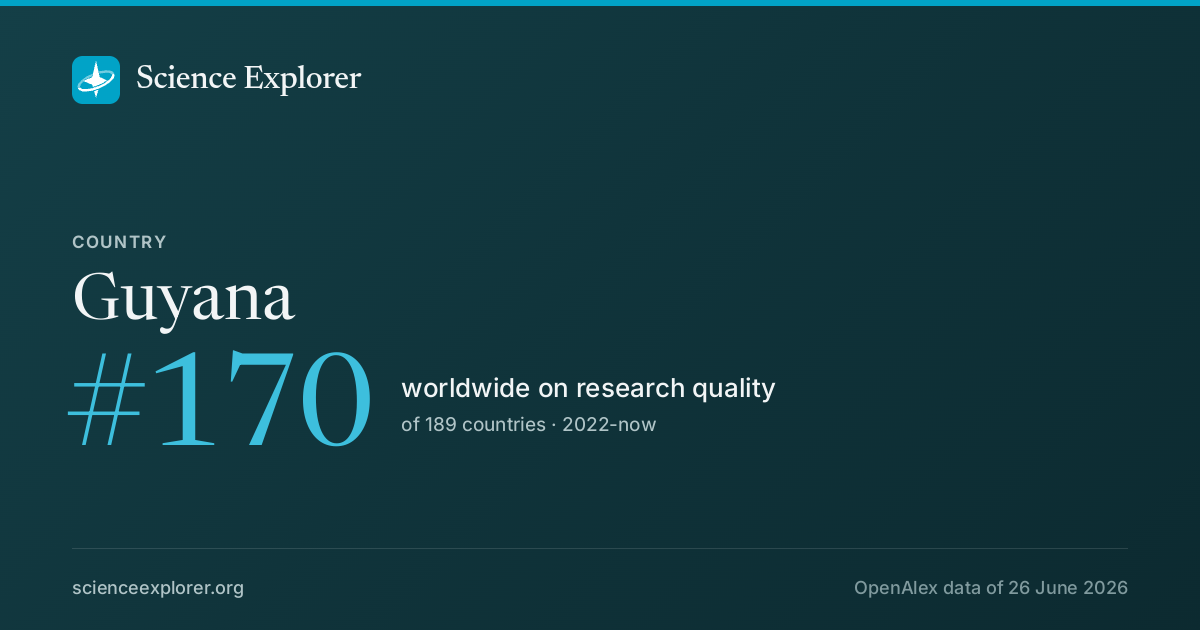
Guyana ranks #170 of 189 countries on research quality in 2022-now (#200 all time), with 866 research works and 4.0% of them in the world's top 10%.

World rank, 2022-now
#170
of 189 · #200 all time
Works, 2022-now
866
▲ 104% vs 2018-21
Citations
9.6k
4.7 per fractional work, all time
Top-10% rate
4.0%
all institutions 10.0%
vs its own fields
0.57×
1.00× is exactly expected
In the world top 100
0
0 in the top 1,000
Open access
69%
world 40%
International
26%
world 18%

Which fields of science does Guyana work in?

In 2022-now, 40% of research in Guyana is in Social Sciences, 25% in Health Sciences. Its largest fields are Social Sciences (21%), Medicine (17%), Agricultural and Biological Sciences (9%). It does 1.6× the world's share of Social Sciences.

Social Sciences: 405 fractional works · 40.2% of its workSocial Sciences: 216 fractional works · 21.5% of its workEducation: 63 fractional works · 6.3% of its workSociology and Political Science: 54 fractional works · 5.3% of its workPolitical Science and International Relations: 20 fractional works · 1.9% of its workCultural Studies: 19 fractional works · 1.9% of its workDemography: 14 fractional works · 1.4% of its workHealth: 11 fractional works · 1.1% of its workSafety Research: 9 fractional works · 0.9% of its workUrban Studies: 7 fractional works · 0.7% of its workAnthropology: 3 fractional works · 0.3% of its workCommunication: 3 fractional works · 0.3% of its workLaw: 2 fractional works · 0.2% of its workTransportation: 2 fractional works · 0.2% of its workGender Studies: 2 fractional works · 0.2% of its workSmaller subfields together: 7 fractional works · 0.7% of its workEconomics, Econometrics and Finance: 58 fractional works · 5.8% of its workEconomics and Econometrics: 41 fractional works · 4.1% of its workGeneral Economics, Econometrics and Finance: 9 fractional works · 0.9% of its workFinance: 8 fractional works · 0.8% of its workBusiness, Management and Accounting: 52 fractional works · 5.2% of its workStrategy and Management: 14 fractional works · 1.4% of its workOrganizational Behavior and Human Resource Management: 13 fractional works · 1.3% of its workManagement Information Systems: 7 fractional works · 0.7% of its workAccounting: 6 fractional works · 0.6% of its workMarketing: 4 fractional works · 0.4% of its workManagement of Technology and Innovation: 4 fractional works · 0.4% of its workBusiness and International Management: 3 fractional works · 0.3% of its workSmaller subfields together: 1 fractional works · 0.1% of its workPsychology: 43 fractional works · 4.3% of its workClinical Psychology: 21 fractional works · 2.0% of its workSocial Psychology: 9 fractional works · 0.9% of its workDevelopmental and Educational Psychology: 8 fractional works · 0.8% of its workExperimental and Cognitive Psychology: 2 fractional works · 0.2% of its workApplied Psychology: 2 fractional works · 0.2% of its workSmaller subfields together: 1 fractional works · 0.1% of its workDecision Sciences: 19 fractional works · 1.9% of its workManagement Science and Operations Research: 10 fractional works · 1.0% of its workInformation Systems and Management: 7 fractional works · 0.7% of its workSmaller subfields together: 2 fractional works · 0.2% of its workArts and Humanities: 17 fractional works · 1.6% of its workHistory: 4 fractional works · 0.4% of its workLanguage and Linguistics: 3 fractional works · 0.3% of its workLiterature and Literary Theory: 3 fractional works · 0.3% of its workSmaller subfields together: 7 fractional works · 0.7% of its workHealth Sciences: 253 fractional works · 25.2% of its workMedicine: 175 fractional works · 17.4% of its workEpidemiology: 24 fractional works · 2.4% of its workInfectious Diseases: 23 fractional works · 2.3% of its workPublic Health, Environmental and Occupational Health: 23 fractional works · 2.2% of its workPediatrics, Perinatology and Child Health: 19 fractional works · 1.9% of its workPharmacology: 10 fractional works · 1.0% of its workSurgery: 9 fractional works · 0.9% of its workPhysiology: 8 fractional works · 0.8% of its workObstetrics and Gynecology: 7 fractional works · 0.7% of its workPulmonary and Respiratory Medicine: 5 fractional works · 0.5% of its workOncology: 5 fractional works · 0.5% of its workCardiology and Cardiovascular Medicine: 5 fractional works · 0.5% of its workEndocrinology, Diabetes and Metabolism: 4 fractional works · 0.4% of its workComplementary and alternative medicine: 3 fractional works · 0.3% of its workBiochemistry: 3 fractional works · 0.3% of its workEmergency Medicine: 3 fractional works · 0.3% of its workHealth Informatics: 3 fractional works · 0.3% of its workGeriatrics and Gerontology: 2 fractional works · 0.2% of its workNeurology: 2 fractional works · 0.2% of its workRheumatology: 2 fractional works · 0.2% of its workRadiology, Nuclear Medicine and Imaging: 2 fractional works · 0.2% of its workPsychiatry and Mental health: 2 fractional works · 0.2% of its workSmaller subfields together: 11 fractional works · 1.1% of its workHealth Professions: 57 fractional works · 5.7% of its workGeneral Health Professions: 34 fractional works · 3.3% of its workEmergency Medical Services: 6 fractional works · 0.6% of its workHealth Information Management: 5 fractional works · 0.5% of its workRadiological and Ultrasound Technology: 5 fractional works · 0.5% of its workMedical Laboratory Technology: 3 fractional works · 0.3% of its workSmaller subfields together: 4 fractional works · 0.4% of its workNursing: 16 fractional works · 1.5% of its workNutrition and Dietetics: 16 fractional works · 1.5% of its workDentistry: 5 fractional works · 0.5% of its workVeterinary: 0 fractional works · 0.0% of its workPhysical Sciences: 205 fractional works · 20.4% of its workEnvironmental Science: 70 fractional works · 6.9% of its workEcology: 16 fractional works · 1.6% of its workGlobal and Planetary Change: 14 fractional works · 1.4% of its workManagement, Monitoring, Policy and Law: 8 fractional works · 0.8% of its workHealth, Toxicology and Mutagenesis: 7 fractional works · 0.7% of its workWater Science and Technology: 6 fractional works · 0.6% of its workIndustrial and Manufacturing Engineering: 6 fractional works · 0.6% of its workPollution: 5 fractional works · 0.5% of its workNature and Landscape Conservation: 3 fractional works · 0.3% of its workSmaller subfields together: 3 fractional works · 0.3% of its workComputer Science: 43 fractional works · 4.2% of its workInformation Systems: 20 fractional works · 2.0% of its workArtificial Intelligence: 10 fractional works · 1.0% of its workComputer Science Applications: 5 fractional works · 0.5% of its workComputer Networks and Communications: 3 fractional works · 0.3% of its workComputer Vision and Pattern Recognition: 2 fractional works · 0.2% of its workSmaller subfields together: 2 fractional works · 0.2% of its workEngineering: 40 fractional works · 4.0% of its workBiomedical Engineering: 8 fractional works · 0.8% of its workBuilding and Construction: 6 fractional works · 0.6% of its workOcean Engineering: 5 fractional works · 0.5% of its workElectrical and Electronic Engineering: 4 fractional works · 0.4% of its workControl and Systems Engineering: 3 fractional works · 0.3% of its workMedia Technology: 3 fractional works · 0.3% of its workMechanics of Materials: 3 fractional works · 0.3% of its workMechanical Engineering: 2 fractional works · 0.2% of its workAutomotive Engineering: 2 fractional works · 0.2% of its workSmaller subfields together: 4 fractional works · 0.4% of its workMaterials Science: 13 fractional works · 1.2% of its workMaterials Chemistry: 6 fractional works · 0.6% of its workBiomaterials: 3 fractional works · 0.3% of its workSmaller subfields together: 3 fractional works · 0.3% of its workEarth and Planetary Sciences: 11 fractional works · 1.1% of its workEarth-Surface Processes: 3 fractional works · 0.3% of its workOceanography: 2 fractional works · 0.2% of its workSmaller subfields together: 6 fractional works · 0.6% of its workChemistry: 9 fractional works · 0.9% of its workOrganic Chemistry: 4 fractional works · 0.4% of its workElectrochemistry: 2 fractional works · 0.2% of its workSmaller subfields together: 3 fractional works · 0.3% of its workEnergy: 8 fractional works · 0.8% of its workRenewable Energy, Sustainability and the Environment: 7 fractional works · 0.7% of its workSmaller subfields together: 1 fractional works · 0.1% of its workMathematics: 7 fractional works · 0.7% of its workModeling and Simulation: 5 fractional works · 0.5% of its workSmaller subfields together: 2 fractional works · 0.2% of its workPhysics and Astronomy: 4 fractional works · 0.4% of its workChemical Engineering: 1 fractional works · 0.1% of its workLife Sciences: 144 fractional works · 14.3% of its workAgricultural and Biological Sciences: 86 fractional works · 8.6% of its workPlant Science: 32 fractional works · 3.2% of its workFood Science: 16 fractional works · 1.6% of its workEcology, Evolution, Behavior and Systematics: 10 fractional works · 1.0% of its workSoil Science: 10 fractional works · 1.0% of its workInsect Science: 5 fractional works · 0.5% of its workGeneral Agricultural and Biological Sciences: 4 fractional works · 0.4% of its workAquatic Science: 4 fractional works · 0.4% of its workForestry: 4 fractional works · 0.4% of its workSmaller subfields together: 1 fractional works · 0.1% of its workBiochemistry, Genetics and Molecular Biology: 36 fractional works · 3.6% of its workMolecular Biology: 22 fractional works · 2.2% of its workCell Biology: 4 fractional works · 0.4% of its workGenetics: 3 fractional works · 0.3% of its workMolecular Medicine: 3 fractional works · 0.3% of its workSmaller subfields together: 4 fractional works · 0.4% of its workPharmacology, Toxicology and Pharmaceutics: 8 fractional works · 0.8% of its workPharmacology: 5 fractional works · 0.5% of its workSmaller subfields together: 3 fractional works · 0.3% of its workImmunology and Microbiology: 7 fractional works · 0.7% of its workImmunology: 3 fractional works · 0.3% of its workSmaller subfields together: 5 fractional works · 0.4% of its workNeuroscience: 6 fractional works · 0.6% of its workBiological Psychiatry: 3 fractional works · 0.3% of its workSmaller subfields together: 3 fractional works · 0.3% of its workALL ITS WORKGuyana1,006fractional works, 2022-now
Life Sciences14%Physical Sciences20%Health Sciences25%Social Sciences40%

Each ring splits the one inside it: the four domains of science, their fields, their subfields. Size is fractional works in 2022-now. Every slice is a page; the interactive view zooms down to single topics and colours each by how much more of it this country does than the world.

Its 4 domains and 26 fields, with their numbers
    1. Social Sciences21621.5%
    2. Economics, Econometrics and Finance585.8%
    3. Business, Management and Accounting525.2%
    4. Psychology434.3%
    5. Decision Sciences191.9%
    6. Arts and Humanities171.6%
    1. Medicine17517.4%
    2. Health Professions575.7%
    3. Nursing161.5%
    4. Dentistry50.5%
    5. Veterinary00.0%
    1. Environmental Science706.9%
    2. Computer Science434.2%
    3. Engineering404.0%
    4. Materials Science131.2%
    5. Earth and Planetary Sciences111.1%
    6. Chemistry90.9%
    7. Energy80.8%
    8. Mathematics70.7%
    9. Physics and Astronomy40.4%
    10. Chemical Engineering10.1%
    1. Agricultural and Biological Sciences868.6%
    2. Biochemistry, Genetics and Molecular Biology363.6%
    3. Pharmacology, Toxicology and Pharmaceutics80.8%
    4. Immunology and Microbiology70.7%
    5. Neuroscience60.6%
All of science, and how each field's share has moved since 1950: the Science domain explorer

Which keywords describe research in Guyana?

By fractional works in 2022-now, weighted toward what it does more of than the world: Globalization, Epidemiology, Economic Development, COVID-19, Postcolonialism, Maternal Mortality, Climate Change and Caribbean.

▲ more of its work than of the world's◆ about the world's share▼ less than the world's

Size is fractional works in 2022-now in the topics tagged with each word; colour is the word's share of this country's work against its share of the world's. The 40 words are chosen for being large and distinctive. Each links to the topic it comes from most.

All 40 words, with their numbers
  1. Globalization58▲ 2.9×51 topics
  2. Epidemiology57▲ 1.42×79 topics
  3. Climate Change46▲ 1.67×59 topics
  4. Sustainability41▲ 1.68×48 topics
  5. COVID-1937▲ 2.8×23 topics
  6. Environmental Impact33▲ 1.94×36 topics
  7. Oxidative Stress32▲ 1.91×36 topics
  8. Economic Development32▲ 3.9×19 topics
  9. Public Health30▲ 2.0×41 topics
  10. Mental Health27▲ 1.88×21 topics
  11. Pandemic26▲ 2.6×12 topics
  12. Antioxidant24▲ 3.5×30 topics
  13. Economic Growth23▲ 2.8×17 topics
  14. Pedagogy23▲ 4.5×12 topics
  15. Antioxidant Activity22▲ 3.5×20 topics
  16. Social Capital22▲ 4.2×16 topics
  17. Identity22▲ 2.9×14 topics
  18. Postcolonialism21▲ 14×4 topics
  19. Maternal Mortality20▲ 9.1×5 topics
  20. Vaccine20▲ 5.0×10 topics
  21. Caribbean19▲ 103×2 topics
  22. Culture19▲ 3.6×6 topics
  23. Nationalism18▲ 4.0×7 topics
  24. Risk Perception18▲ 6.5×6 topics
  25. Politics17▲ 6.5×4 topics
  26. Race17▲ 14×6 topics
  27. Tourism Development16▲ 12×2 topics
  28. Teaching Methods16▲ 9.7×3 topics
  29. Dancehall16▲ 211×1 topic
  30. Language Teaching15▲ 5.6×4 topics
  31. Critical Thinking15▲ 13×3 topics
  32. Digital Education14▲ 9.6×3 topics
  33. Formative Assessment14▲ 17×2 topics
  34. Educational Technologies14▲ 15×2 topics
  35. Poverty Reduction14▲ 11×5 topics
  36. Community Health Workers14▲ 16×2 topics
  37. Artistic Education14▲ 21×1 topic
  38. Student Competencies14▲ 21×1 topic
  39. Health Inequalities14▲ 11×3 topics
  40. Socio-economic Factors13▲ 11×2 topics

Which research topics does Guyana publish the most in?

Its largest topics in 2022-now are Caribbean history, culture, and politics, Education, Innovation and Language Studies, Global Maternal and Child Health.

  1. 1 Caribbean history, culture, and politics Cultural Studies 16 works
  2. 2 Education, Innovation and Language Studies Education 14 works
  3. 3 Global Maternal and Child Health Pediatrics, Perinatology and Child Health 13 works
  4. 4 Child Nutrition and Water Access Nutrition and Dietetics 9 works
  5. 5 Coastal wetland ecosystem dynamics Ecology 8 works
  6. 6 HIV/AIDS Impact and Responses Economics and Econometrics 8 works
  7. 7 Microfinance and Financial Inclusion Economics and Econometrics 7 works
  8. 8 Vaccine Coverage and Hesitancy Health 7 works
  9. 9 Economic and Industrial Development Economics and Econometrics 7 works
  10. 10 Diverse Scientific Research Studies General Health Professions 6 works
  11. 11 HIV/AIDS Research and Interventions Infectious Diseases 6 works
  12. 12 Migration, Identity, and Health Sociology and Political Science 6 works

Which universities in Guyana lead research?

University of Guyana and Texila American University rank highest in Guyana on research quality in 2022-now.

  1. 1University of GuyanaUniversity · Georgetown · #7,431 worldwide4.7% top 10% · 440 works
  2. 2Texila American UniversityUniversity · Georgetown · #9,258 worldwide2.8% top 10% · 397 works

The track on each row is its top-10% rate; the tick is the average of all institutions, 10.0% (how it is set): teal above it, red below.

All ranked institutions in Guyana

Who are the top researchers in Guyana?

Raquel Thomas, Horace Cox and Raquel Thomas‐Caesar rank highest among researchers based in Guyana.

  1. 1 Raquel Thomas #19,194 worldwide 4.9k citations · 57 works
  2. 2 Horace Cox #292,141 worldwide 907 citations · 49 works
  3. 3 Raquel Thomas‐Caesar #650,754 worldwide 2.8k citations · 17 works
  4. 4 Lenandlar Singh #841,463 worldwide 945 citations · 31 works
  5. 5 Paulette Bynoe #1,923,342 worldwide 489 citations · 42 works
  6. 6 Reza Niles‐Robin #2,101,589 worldwide 85 citations · 17 works
  7. 7 Charmaine S Bissessar #2,242,516 worldwide 286 citations · 42 works
  8. 8 Shanshan Xu #2,551,097 worldwide 1.2k citations · 99 works
  9. 9 Troy Devon Thomas #2,555,441 worldwide 1k citations · 29 works
  10. 10 Stephan Moonsammy #2,915,292 worldwide 425 citations · 40 works
Top researchers in Guyana

How open and international is Guyana's research?

69% of its research is openly available (world: 40%), and 26% is written with international co-authors (world: 18%).

openly available69.4%not open30.6%

World: 40% of research is openly available.

with international co-authors26.0%domestic only74.0%

World: 18% is written across borders.

In 2022-now, 75% of its research is openly available (world 63%) and 26% is written with co-authors abroad (world 22%). Against what its own mix of topics predicts, that is 1.05× the expected open access and 1.09× the expected international share, which puts it #143 of 173 countries on openness.

How has Guyana's research grown?

Output in 2022-2025 was 104% higher than in 2018-2021.

still counting1990200020102020
grewheldshrank

The same series as a ribbon: one cell per year, darker for more. The line above answers how much; this answers when.

Its share of all research

Growing output can still be a shrinking share: all of science grows. This is Guyana as a percentage of every work published that year, 0.0053% in 2024.

still counting0.0020%0.0040%0.0060%Guyana0.0038% in 202519801990200020102020

Fractional works of Guyana over all fractional works that year. How the balance of science has shifted.

How much of it reaches the world top 10%

Over the whole record, 3.8% of its 2k works since 1955 reached the world top 10% for their field and year.

still counting5%10%15%all institutions10.0% in 2025Guyana4.9% in 202520102020

Of each year's output, the share that reached the world's 10% most cited for its field and year. Peak 12.0% in 2014.

Which countries have research most like Guyana's?

Jamaica is Guyana's closest research twin: of all countries, its research is spread across the fields most like Guyana's, with both strong in Economics, Econometrics and Finance.

  1. 1 JamaicaBoth strong in Economics, Econometrics and Finance, Nursing, Social Sciences 0.89 Compare
  2. 2 FijiBoth strong in Nursing, Health Professions, Agricultural and Biological Sciences 0.83 Compare
  3. 3 GhanaBoth strong in Nursing, Economics, Econometrics and Finance, Agricultural and Biological Sciences 0.81 Compare
  4. 4 NigeriaBoth strong in Nursing, Pharmacology, Toxicology and Pharmaceutics, Economics, Econometrics and Finance 0.80 Compare
  5. 5 UgandaBoth strong in Nursing, Health Professions, Economics, Econometrics and Finance 0.78 Compare

Similarity is the correlation of each side's location quotients across every field it publishes in, on a log scale: 1 is the same shape of research, 0 is unrelated. It ignores size. How it is measured.

Compare Guyana with

Compare any two

Share Guyana's ranking

Guyana on Science Explorer

A card with Guyana's standing and the fields it leads in, for a post or a slide. A link to this page previews as the same card.

Download the card

1200 × 630 PNG, sized for social posts, drawn from the latest snapshot.

Badges for a website1Each links back here and updates with every snapshot

Research fields in Guyana

Discussion

Ask a question or share a note about Guyana. Posts are plain text and can be reported.