Science Explorer Back to mapMap
Discussion
Country

Science in Fiji

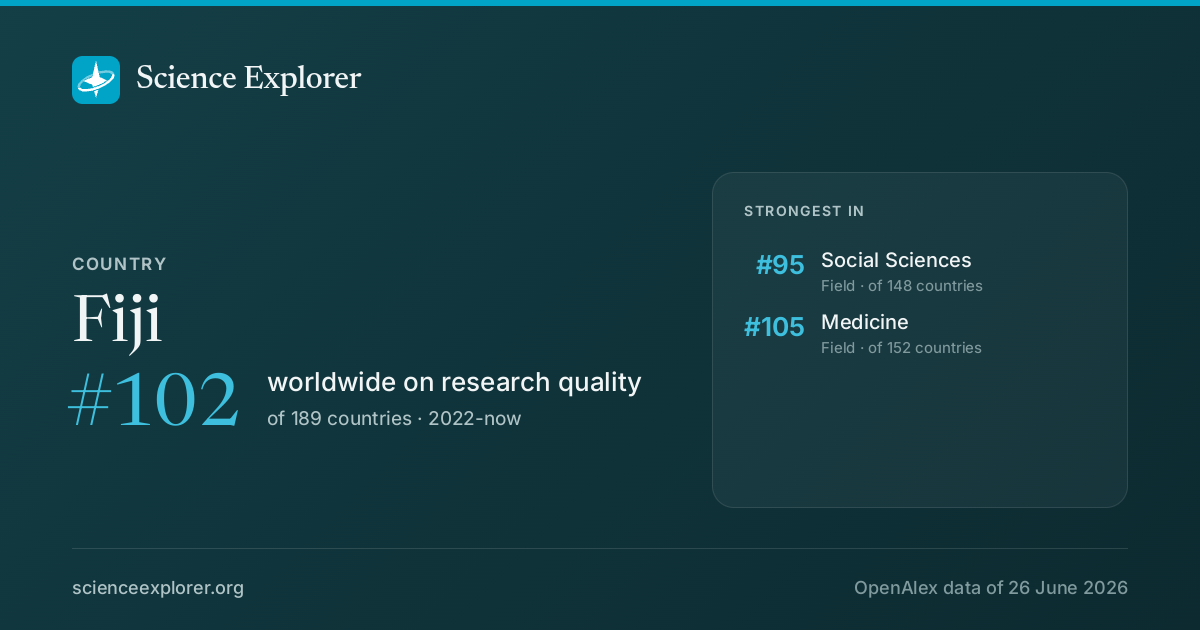
Fiji ranks #102 of 189 countries on research quality in 2022-now (#116 all time), with 1.6k research works and 10.1% of them in the world's top 10%.

World rank, 2022-now
#102
of 189 · #116 all time
Works, 2022-now
1.6k
▲ 16% vs 2018-21
Citations
93k
14.6 per fractional work, all time
Top-10% rate
10.1%
all institutions 10.0%
vs its own fields
0.89×
1.00× is exactly expected
In the world top 100
0
0 in the top 1,000
Open access
47%
world 40%
International
42%
world 18%

What is Fiji strongest at in science?

On research quality in 2022-now, Fiji ranks highest in Social Sciences (#95 of 148) and Medicine (#105 of 152). Relative to its size it is most specialised in Public Administration, Tourism, Leisure and Hospitality Management and Demography.

FieldWorld rankWhere that sitsTop-10% rateWorksAll timeInstitutions
Social SciencesField #95 of 148 12.2%327 #107 Institutions
MedicineField #105 of 152 5.4%238 #126 Institutions

Where its research is concentrated

Location quotient: how much more (or less) of each node it does than its size predicts. Drawn around 1×, where "twice the world share" and "half of it" are the same distance apart in opposite directions. A volume reading, which on a country axis is largely population and industrial structure.

  1. Public AdministrationSubfield · 6.2 works · #89 of 186 active here6.3×
  2. Tourism, Leisure and Hospitality ManagementSubfield · 1.9 works · #105 of 165 active here4.5×
  3. DemographySubfield · 54.8 works · #96 of 221 active here4.4×
  4. Applied Microbiology and BiotechnologySubfield · 3.6 works · #125 of 202 active here4.0×
  5. Geography, Planning and DevelopmentSubfield · 14.6 works · #93 of 213 active here3.9×
  6. Physical Therapy, Sports Therapy and RehabilitationSubfield · 12.7 works · #96 of 193 active here3.8×
  7. Health Information ManagementSubfield · 15.9 works · #111 of 202 active here3.4×
  8. Linguistics and LanguageSubfield · 6.7 works · #135 of 194 active here3.2×
← less than its size predicts1×more →

The whole field profile

All 26 fields at once. A specialist and a generalist produce the same ranked list and a completely different shape.

Agricultural and Biological Sciences: 1.81× its world share, 157 worksAgricultural and Bio…Biochemistry, Genetics and Molecular Biology: 0.51× its world share, 50 worksBiochemistry, Geneti…Immunology and Microbiology: 0.71× its world share, 13 worksImmunology and Micro…Neuroscience: 0.35× its world share, 10 worksNeurosciencePharmacology, Toxicology and Pharmaceutics: 1.07× its world share, 7 worksPharmacology, Toxico…Chemical Engineering: 0.22× its world share, 1 worksChemical EngineeringChemistry: 0.43× its world share, 12 worksChemistryComputer Science: 0.98× its world share, 140 worksComputer ScienceEarth and Planetary Sciences: 0.97× its world share, 28 worksEarth and Planetary …Energy: 1.15× its world share, 19 worksEnergyEngineering: 0.70× its world share, 193 worksEngineeringEnvironmental Science: 1.64× its world share, 149 worksEnvironmental ScienceMaterials Science: 0.27× its world share, 18 worksMaterials ScienceMathematics: 0.42× its world share, 9 worksMathematicsPhysics and Astronomy: 0.19× its world share, 8 worksPhysics and AstronomyDentistry: 1.63× its world share, 14 worksDentistryHealth Professions: 1.81× its world share, 88 worksHealth ProfessionsMedicine: 0.75× its world share, 263 worksMedicineNursing: 2.88× its world share, 26 worksNursingVeterinary: 0.64× its world share, 2 worksVeterinaryArts and Humanities: 0.47× its world share, 25 worksArts and HumanitiesBusiness, Management and Accounting: 1.42× its world share, 84 worksBusiness, Management…Decision Sciences: 1.22× its world share, 22 worksDecision SciencesEconomics, Econometrics and Finance: 1.48× its world share, 58 worksEconomics, Econometr…Psychology: 1.17× its world share, 66 worksPsychologySocial Sciences: 1.60× its world share, 371 worksSocial Sciences1×world share
more than its size predictsabout as predictedless

Rings at 0.5×, 1× and 2×. Widest outward: Nursing, 2.9×. Every wedge is a field page.

All 26 fields, with their numbers
  1. Nursing2.88×26 works
  2. Agricultural and Biological Sciences1.81×157 works
  3. Health Professions1.81×88 works
  4. Environmental Science1.64×149 works
  5. Dentistry1.63×14 works
  6. Social Sciences1.60×371 works
  7. Economics, Econometrics and Finance1.48×58 works
  8. Business, Management and Accounting1.42×84 works
  9. Decision Sciences1.22×22 works
  10. Psychology1.17×66 works
  11. Energy1.15×19 works
  12. Pharmacology, Toxicology and Pharmaceutics1.07×7 works
  13. Computer Science0.98×140 works
  14. Earth and Planetary Sciences0.97×28 works
  15. Medicine0.75×263 works
  16. Immunology and Microbiology0.71×13 works
  17. Engineering0.70×193 works
  18. Veterinary0.64×2 works
  19. Biochemistry, Genetics and Molecular Biology0.51×50 works
  20. Arts and Humanities0.47×25 works
  21. Chemistry0.43×12 works
  22. Mathematics0.42×9 works
  23. Neuroscience0.35×10 works
  24. Materials Science0.27×18 works
  25. Chemical Engineering0.22×1 works
  26. Physics and Astronomy0.19×8 works

Which fields of science does Fiji work in?

In 2022-now, 34% of research in Fiji is in Social Sciences, 32% in Physical Sciences. Its largest fields are Social Sciences (20%), Medicine (14%), Engineering (11%). It does 1.4× the world's share of Social Sciences.

Social Sciences: 624 fractional works · 34.1% of its workSocial Sciences: 371 fractional works · 20.3% of its workSociology and Political Science: 114 fractional works · 6.2% of its workEducation: 93 fractional works · 5.1% of its workDemography: 55 fractional works · 3.0% of its workPolitical Science and International Relations: 16 fractional works · 0.9% of its workGeography, Planning and Development: 15 fractional works · 0.8% of its workHealth: 12 fractional works · 0.7% of its workGender Studies: 11 fractional works · 0.6% of its workTransportation: 11 fractional works · 0.6% of its workLinguistics and Language: 7 fractional works · 0.4% of its workPublic Administration: 6 fractional works · 0.3% of its workAnthropology: 6 fractional works · 0.3% of its workSafety Research: 5 fractional works · 0.3% of its workCultural Studies: 4 fractional works · 0.2% of its workLaw: 4 fractional works · 0.2% of its workCommunication: 4 fractional works · 0.2% of its workSmaller subfields together: 7 fractional works · 0.4% of its workBusiness, Management and Accounting: 84 fractional works · 4.6% of its workOrganizational Behavior and Human Resource Management: 21 fractional works · 1.1% of its workStrategy and Management: 20 fractional works · 1.1% of its workMarketing: 12 fractional works · 0.7% of its workAccounting: 11 fractional works · 0.6% of its workManagement Information Systems: 10 fractional works · 0.6% of its workManagement of Technology and Innovation: 5 fractional works · 0.3% of its workSmaller subfields together: 4 fractional works · 0.2% of its workPsychology: 66 fractional works · 3.6% of its workClinical Psychology: 22 fractional works · 1.2% of its workSocial Psychology: 19 fractional works · 1.0% of its workDevelopmental and Educational Psychology: 15 fractional works · 0.8% of its workExperimental and Cognitive Psychology: 5 fractional works · 0.3% of its workApplied Psychology: 4 fractional works · 0.2% of its workSmaller subfields together: 0 fractional works · 0.0% of its workEconomics, Econometrics and Finance: 58 fractional works · 3.2% of its workEconomics and Econometrics: 43 fractional works · 2.4% of its workGeneral Economics, Econometrics and Finance: 9 fractional works · 0.5% of its workFinance: 6 fractional works · 0.3% of its workArts and Humanities: 25 fractional works · 1.3% of its workLiterature and Literary Theory: 8 fractional works · 0.4% of its workLanguage and Linguistics: 5 fractional works · 0.3% of its workSmaller subfields together: 11 fractional works · 0.6% of its workDecision Sciences: 22 fractional works · 1.2% of its workInformation Systems and Management: 11 fractional works · 0.6% of its workManagement Science and Operations Research: 9 fractional works · 0.5% of its workSmaller subfields together: 2 fractional works · 0.1% of its workPhysical Sciences: 577 fractional works · 31.5% of its workEngineering: 193 fractional works · 10.6% of its workElectrical and Electronic Engineering: 37 fractional works · 2.0% of its workControl and Systems Engineering: 33 fractional works · 1.8% of its workMechanical Engineering: 20 fractional works · 1.1% of its workBiomedical Engineering: 19 fractional works · 1.0% of its workAerospace Engineering: 18 fractional works · 1.0% of its workCivil and Structural Engineering: 15 fractional works · 0.8% of its workBuilding and Construction: 10 fractional works · 0.5% of its workAutomotive Engineering: 9 fractional works · 0.5% of its workIndustrial and Manufacturing Engineering: 8 fractional works · 0.4% of its workOcean Engineering: 7 fractional works · 0.4% of its workComputational Mechanics: 6 fractional works · 0.3% of its workMedia Technology: 5 fractional works · 0.3% of its workMechanics of Materials: 5 fractional works · 0.3% of its workSmaller subfields together: 2 fractional works · 0.1% of its workEnvironmental Science: 149 fractional works · 8.1% of its workEcology: 33 fractional works · 1.8% of its workGlobal and Planetary Change: 29 fractional works · 1.6% of its workManagement, Monitoring, Policy and Law: 19 fractional works · 1.0% of its workPollution: 17 fractional works · 0.9% of its workHealth, Toxicology and Mutagenesis: 11 fractional works · 0.6% of its workIndustrial and Manufacturing Engineering: 11 fractional works · 0.6% of its workEnvironmental Engineering: 9 fractional works · 0.5% of its workWater Science and Technology: 8 fractional works · 0.4% of its workNature and Landscape Conservation: 8 fractional works · 0.4% of its workSmaller subfields together: 3 fractional works · 0.2% of its workComputer Science: 139 fractional works · 7.6% of its workInformation Systems: 42 fractional works · 2.3% of its workArtificial Intelligence: 33 fractional works · 1.8% of its workComputer Vision and Pattern Recognition: 22 fractional works · 1.2% of its workComputer Networks and Communications: 17 fractional works · 0.9% of its workComputer Science Applications: 9 fractional works · 0.5% of its workHuman-Computer Interaction: 8 fractional works · 0.4% of its workSignal Processing: 5 fractional works · 0.3% of its workSmaller subfields together: 3 fractional works · 0.2% of its workEarth and Planetary Sciences: 28 fractional works · 1.5% of its workOceanography: 9 fractional works · 0.5% of its workAtmospheric Science: 9 fractional works · 0.5% of its workGeophysics: 4 fractional works · 0.2% of its workSmaller subfields together: 5 fractional works · 0.3% of its workEnergy: 19 fractional works · 1.1% of its workRenewable Energy, Sustainability and the Environment: 13 fractional works · 0.7% of its workEnergy Engineering and Power Technology: 6 fractional works · 0.3% of its workSmaller subfields together: 1 fractional works · 0.0% of its workMaterials Science: 18 fractional works · 1.0% of its workMaterials Chemistry: 9 fractional works · 0.5% of its workBiomaterials: 4 fractional works · 0.2% of its workSmaller subfields together: 5 fractional works · 0.3% of its workChemistry: 12 fractional works · 0.7% of its workOrganic Chemistry: 5 fractional works · 0.3% of its workSmaller subfields together: 8 fractional works · 0.4% of its workMathematics: 9 fractional works · 0.5% of its workModeling and Simulation: 4 fractional works · 0.2% of its workSmaller subfields together: 5 fractional works · 0.3% of its workPhysics and Astronomy: 8 fractional works · 0.4% of its workAstronomy and Astrophysics: 5 fractional works · 0.3% of its workSmaller subfields together: 3 fractional works · 0.1% of its workChemical Engineering: 1 fractional works · 0.1% of its workHealth Sciences: 392 fractional works · 21.4% of its workMedicine: 263 fractional works · 14.3% of its workPublic Health, Environmental and Occupational Health: 39 fractional works · 2.1% of its workPediatrics, Perinatology and Child Health: 30 fractional works · 1.6% of its workEpidemiology: 19 fractional works · 1.0% of its workSurgery: 18 fractional works · 1.0% of its workPharmacology: 17 fractional works · 1.0% of its workComplementary and alternative medicine: 15 fractional works · 0.8% of its workEndocrinology, Diabetes and Metabolism: 12 fractional works · 0.7% of its workInfectious Diseases: 11 fractional works · 0.6% of its workPhysiology: 11 fractional works · 0.6% of its workPulmonary and Respiratory Medicine: 9 fractional works · 0.5% of its workCardiology and Cardiovascular Medicine: 8 fractional works · 0.4% of its workRadiology, Nuclear Medicine and Imaging: 7 fractional works · 0.4% of its workEmergency Medicine: 7 fractional works · 0.4% of its workPsychiatry and Mental health: 6 fractional works · 0.3% of its workOncology: 6 fractional works · 0.3% of its workObstetrics and Gynecology: 5 fractional works · 0.3% of its workRheumatology: 4 fractional works · 0.2% of its workRehabilitation: 4 fractional works · 0.2% of its workSmaller subfields together: 33 fractional works · 1.8% of its workHealth Professions: 88 fractional works · 4.8% of its workGeneral Health Professions: 34 fractional works · 1.8% of its workHealth Information Management: 16 fractional works · 0.9% of its workPhysical Therapy, Sports Therapy and Rehabilitation: 13 fractional works · 0.7% of its workEmergency Medical Services: 9 fractional works · 0.5% of its workOccupational Therapy: 4 fractional works · 0.2% of its workSpeech and Hearing: 4 fractional works · 0.2% of its workRadiological and Ultrasound Technology: 4 fractional works · 0.2% of its workSmaller subfields together: 4 fractional works · 0.2% of its workNursing: 26 fractional works · 1.4% of its workNutrition and Dietetics: 23 fractional works · 1.3% of its workSmaller subfields together: 3 fractional works · 0.1% of its workDentistry: 14 fractional works · 0.8% of its workPeriodontics: 7 fractional works · 0.4% of its workSmaller subfields together: 7 fractional works · 0.4% of its workVeterinary: 2 fractional works · 0.1% of its workLife Sciences: 237 fractional works · 13.0% of its workAgricultural and Biological Sciences: 157 fractional works · 8.6% of its workPlant Science: 69 fractional works · 3.8% of its workFood Science: 21 fractional works · 1.1% of its workEcology, Evolution, Behavior and Systematics: 13 fractional works · 0.7% of its workSoil Science: 12 fractional works · 0.6% of its workGeneral Agricultural and Biological Sciences: 11 fractional works · 0.6% of its workAgronomy and Crop Science: 7 fractional works · 0.4% of its workAquatic Science: 7 fractional works · 0.4% of its workAnimal Science and Zoology: 6 fractional works · 0.3% of its workInsect Science: 6 fractional works · 0.3% of its workSmaller subfields together: 4 fractional works · 0.2% of its workBiochemistry, Genetics and Molecular Biology: 50 fractional works · 2.7% of its workMolecular Biology: 25 fractional works · 1.4% of its workGenetics: 10 fractional works · 0.5% of its workBiotechnology: 4 fractional works · 0.2% of its workSmaller subfields together: 11 fractional works · 0.6% of its workImmunology and Microbiology: 13 fractional works · 0.7% of its workImmunology: 4 fractional works · 0.2% of its workSmaller subfields together: 9 fractional works · 0.5% of its workNeuroscience: 10 fractional works · 0.6% of its workCognitive Neuroscience: 6 fractional works · 0.3% of its workSmaller subfields together: 4 fractional works · 0.2% of its workPharmacology, Toxicology and Pharmaceutics: 7 fractional works · 0.4% of its workPharmacology: 5 fractional works · 0.3% of its workSmaller subfields together: 2 fractional works · 0.1% of its workALL ITS WORKFiji1,831fractional works, 2022-now
Life Sciences13%Physical Sciences32%Health Sciences21%Social Sciences34%

Each ring splits the one inside it: the four domains of science, their fields, their subfields. Size is fractional works in 2022-now. Every slice is a page; the interactive view zooms down to single topics and colours each by how much more of it this country does than the world.

Its 4 domains and 26 fields, with their numbers
    1. Social Sciences37120.3%
    2. Business, Management and Accounting844.6%
    3. Psychology663.6%
    4. Economics, Econometrics and Finance583.2%
    5. Arts and Humanities251.3%
    6. Decision Sciences221.2%
    1. Engineering19310.6%
    2. Environmental Science1498.1%
    3. Computer Science1397.6%
    4. Earth and Planetary Sciences281.5%
    5. Energy191.1%
    6. Materials Science181.0%
    7. Chemistry120.7%
    8. Mathematics90.5%
    9. Physics and Astronomy80.4%
    10. Chemical Engineering10.1%
    1. Medicine26314.3%
    2. Health Professions884.8%
    3. Nursing261.4%
    4. Dentistry140.8%
    5. Veterinary20.1%
    1. Agricultural and Biological Sciences1578.6%
    2. Biochemistry, Genetics and Molecular Biology502.7%
    3. Immunology and Microbiology130.7%
    4. Neuroscience100.6%
    5. Pharmacology, Toxicology and Pharmaceutics70.4%
All of science, and how each field's share has moved since 1950: the Science domain explorer

Which keywords describe research in Fiji?

By fractional works in 2022-now, weighted toward what it does more of than the world: Vulnerability, Sustainability, Climate Change, Resilience, Governance, Globalization, Decolonization and Economic Development.

▲ more of its work than of the world's◆ about the world's share▼ less than the world's

Size is fractional works in 2022-now in the topics tagged with each word; colour is the word's share of this country's work against its share of the world's. The 40 words are chosen for being large and distinctive. Each links to the topic it comes from most.

All 40 words, with their numbers
  1. Sustainability123▲ 2.8×62 topics
  2. Climate Change120▲ 2.4×83 topics
  3. Vulnerability92▲ 22×7 topics
  4. Globalization90▲ 2.5×51 topics
  5. Epidemiology74◆ 1.02×10⁹ topics
  6. Environmental Impact71▲ 2.3×44 topics
  7. Machine Learning69◆ 1.14×64 topics
  8. Resilience68▲ 7.5×14 topics
  9. Economic Development64▲ 4.4×22 topics
  10. Governance55▲ 9.2×11 topics
  11. Deep Learning55◆ 0.87×57 topics
  12. Decolonization51▲ 34×5 topics
  13. Renewable Energy49▲ 1.84×31 topics
  14. Public Health48▲ 1.81×47 topics
  15. Pacific47▲ 135×2 topics
  16. Islands46▲ 225×1 topic
  17. Small States46▲ 225×1 topic
  18. COVID-1936▲ 1.50×22 topics
  19. Economic Growth33▲ 2.2×20 topics
  20. Community Empowerment31▲ 2.4×11 topics
  21. Child Development31▲ 4.1×7 topics
  22. Adaptation30▲ 5.5×10 topics
  23. Non-Communicable Diseases28▲ 5.7×5 topics
  24. Food Security28▲ 2.8×18 topics
  25. Health Education28▲ 3.5×7 topics
  26. Agriculture26▲ 3.7×9 topics
  27. Migration25▲ 4.0×7 topics
  28. Sea-Level Rise25▲ 12×5 topics
  29. Global Warming25▲ 3.2×11 topics
  30. Genetic Diversity24▲ 3.1×19 topics
  31. COVID-19 Impact23▲ 7.4×6 topics
  32. Resettlement22▲ 14×3 topics
  33. Maternal Health21▲ 4.5×4 topics
  34. Environmental Refugees21▲ 55×1 topic
  35. Natural Disasters21▲ 55×1 topic
  36. Breastfeeding21▲ 5.0×2 topics
  37. Technology Integration21▲ 3.6×8 topics
  38. Path Planning18▲ 7.8×3 topics
  39. Child Nutrition17▲ 5.1×1 topic
  40. Stunting17▲ 5.1×1 topic

Which research topics does Fiji publish the most in?

Its largest topics in 2022-now are Island Studies and Pacific Affairs, Climate Change, Adaptation, Migration, Public Health and Nutrition.

  1. 1 Island Studies and Pacific Affairs Demography 46 works
  2. 2 Climate Change, Adaptation, Migration Sociology and Political Science 21 works
  3. 3 Public Health and Nutrition Pediatrics, Perinatology and Child Health 17 works
  4. 4 Child Nutrition and Water Access Nutrition and Dietetics 13 works
  5. 5 Pacific and Southeast Asian Studies Geography, Planning and Development 13 works
  6. 6 Diverse Aspects of Tourism Research Sociology and Political Science 13 works
  7. 7 Robotic Path Planning Algorithms Computer Vision and Pattern Recognition 12 works
  8. 8 Methodologies in Health Research and Practice Health Information Management 11 works
  9. 9 Global Public Health Policies and Epidemiology Organizational Behavior and Human Resource Management 10 works
  10. 10 Education Systems and Policy Education 9 works
  11. 11 COVID-19 Pandemic Impacts Economics and Econometrics 9 works
  12. 12 Coral and Marine Ecosystems Studies Ecology 9 works

Which universities in Fiji lead research?

University of the South Pacific, Fiji National University and Ministry Of Health rank highest in Fiji on research quality in 2022-now.

0%5%10%15%mean 9.46%fractional works (log) →share in the world top 10% →University of the So…Fiji National Univer…University of FijiMinistry Of Health
above the meannear itbelow it

One dot per institution in the list below. The upper left is the interesting corner.

  1. 1University of the South PacificUniversity · Suva · #3,176 worldwide12.2% top 10% · 623 works
  2. 2Fiji National UniversityUniversity · Suva · #4,537 worldwide10.5% top 10% · 424 works
  3. 3Ministry Of HealthGovernment institution · Suva · #8,288 worldwide5.0% top 10% · 313 works
  4. 4University of FijiUniversity · Lautoka · #12,739 worldwide8.6% top 10% · 135 works
  5. 5Ministry of AgricultureGovernment institution · Suva · #18,609 worldwide11.0% top 10% · 111 works

The track on each row is its top-10% rate; the tick is the average of all institutions, 10.0% (how it is set): teal above it, red below.

All ranked institutions in Fiji

Who are the top researchers in Fiji?

Sangeeta Mangubhai, Stacy D. Jupiter and Shavneet Sharma rank highest among researchers based in Fiji.

  1. 1 Sangeeta Mangubhai #35,741 worldwide 6.3k citations · 189 works
  2. 2 Stacy D. Jupiter #71,945 worldwide 9.3k citations · 212 works
  3. 3 Shavneet Sharma #82,714 worldwide 2.3k citations · 79 works
  4. 4 Ramendra Prasad #86,233 worldwide 3.5k citations · 63 works
  5. 5 Abirami Ramu Ganesan #172,746 worldwide 3.1k citations · 59 works
  6. 6 Priyatma Singh #324,277 worldwide 677 citations · 38 works
  7. 7 Stuart Kininmonth #368,465 worldwide 6.3k citations · 83 works
  8. 8 Hugh Govan #374,967 worldwide 2.5k citations · 102 works
  9. 9 Gurmeet Singh #380,111 worldwide 6.9k citations · 262 works
  10. 10 Pritika Reddy #656,038 worldwide 1.2k citations · 45 works
Top researchers in Fiji

How open and international is Fiji's research?

47% of its research is openly available (world: 40%), and 42% is written with international co-authors (world: 18%).

openly available47.4%not open52.6%

World: 40% of research is openly available.

with international co-authors41.9%domestic only58.1%

World: 18% is written across borders.

In 2022-now, 67% of its research is openly available (world 63%) and 50% is written with co-authors abroad (world 22%). Against what its own mix of topics predicts, that is 1.01× the expected open access and 2.00× the expected international share, which puts it #103 of 173 countries on openness.

How has Fiji's research grown?

Output in 2022-2025 was 16% higher than in 2018-2021.

still counting1990200020102020
grewheldshrank

The same series as a ribbon: one cell per year, darker for more. The line above answers how much; this answers when.

Its share of all research

Growing output can still be a shrinking share: all of science grows. This is Fiji as a percentage of every work published that year, 0.0066% in 2024.

still counting0.0050%0.010%0.015%Fiji0.0075% in 202519801990200020102020

Fractional works of Fiji over all fractional works that year. How the balance of science has shifted.

How much of it reaches the world top 10%

Over the whole record, 9.6% of its 6.4k works since 1950 reached the world top 10% for their field and year.

still counting5%10%15%Fiji10.2% in 2025all institutions10.0% in 2025200020102020

Of each year's output, the share that reached the world's 10% most cited for its field and year. Peak 12.7% in 2006.

Which countries have research most like Fiji's?

Trinidad and Tobago is Fiji's closest research twin: of all countries, its research is spread across the fields most like Fiji's, with both strong in Dentistry.

  1. 1 Trinidad and TobagoBoth strong in Dentistry, Health Professions, Social Sciences 0.86 Compare
  2. 2 PeruBoth strong in Health Professions, Dentistry, Social Sciences 0.85 Compare
  3. 3 GuyanaBoth strong in Nursing, Health Professions, Agricultural and Biological Sciences 0.83 Compare
  4. 4 NepalBoth strong in Agricultural and Biological Sciences, Nursing, Dentistry 0.83 Compare
  5. 5 CambodiaBoth strong in Nursing, Dentistry, Social Sciences 0.82 Compare

Similarity is the correlation of each side's location quotients across every field it publishes in, on a log scale: 1 is the same shape of research, 0 is unrelated. It ignores size. How it is measured.

Compare Fiji with

Compare any two

Share Fiji's ranking

Fiji on Science Explorer

A card with Fiji's standing and the fields it leads in, for a post or a slide. A link to this page previews as the same card.

Download the card

1200 × 630 PNG, sized for social posts, drawn from the latest snapshot.

Badges for a website1Each links back here and updates with every snapshot

Research fields in Fiji

Discussion

Ask a question or share a note about Fiji. Posts are plain text and can be reported.