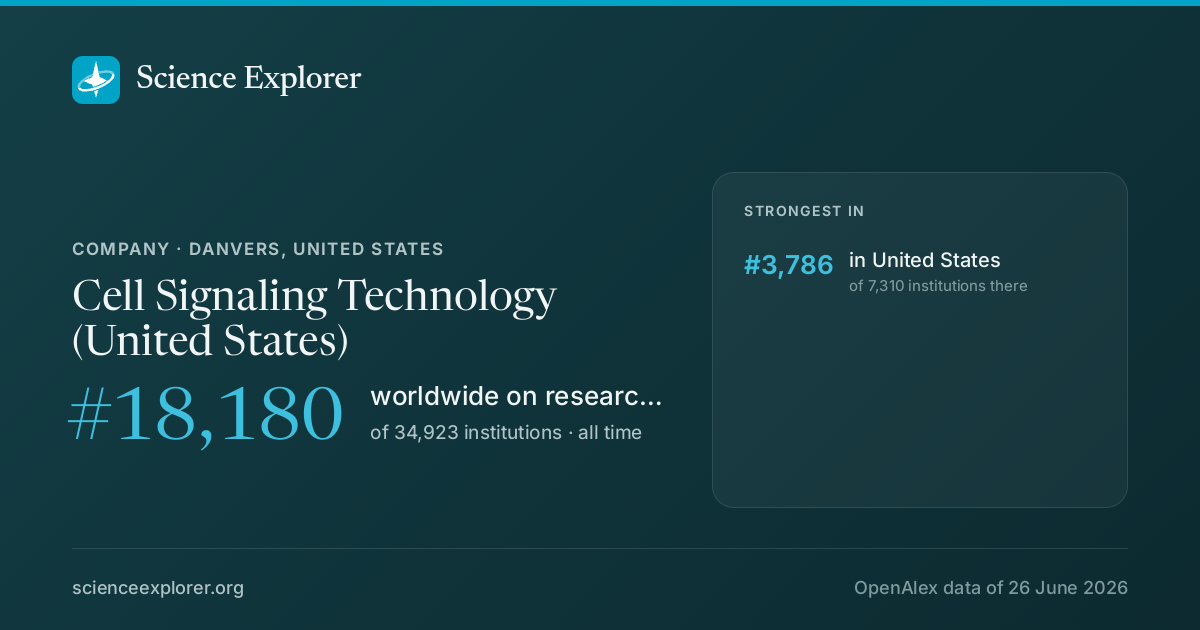
Cell Signaling Technology (United States)
- World rank, all time
- #18,180 of 34,923
- Rank in United States
- #3,786 of 7,310
- Research works
- 199 ▲ 117% vs 2018-21
- Citations
- 22k 112.0 per fractional work
- Top-10% rate
- 13.9% all institutions 10.0%
- vs its own fields
- 1.11× 1.00× is exactly expected
- Open access
- 56% world 40%
- International
- 20% world 18%
Which fields of science does Cell Signaling Technology (United States) work in?
In 2022-now, 59% of research at Cell Signaling Technology (United States) is in Life Sciences, 35% in Health Sciences. Its largest fields are Biochemistry, Genetics and Molecular Biology (46%), Medicine (35%), Immunology and Microbiology (10%). It does 3.4× the world's share of Life Sciences.
Each ring splits the one inside it: the four domains of science, their fields, their subfields. Size is fractional works in 2022-now. Every slice is a page; the interactive view zooms down to single topics and colours each by how much more of it this institution does than the world.
Its 4 domains and 11 fields, with their numbers
- Life Sciences3059.2%
- Health Sciences1835.3%
- Medicine1835.3%
- Physical Sciences35.3%
- Engineering23.7%
- Chemistry11.1%
- Computer Science00.3%
- Earth and Planetary Sciences00.2%
- Materials Science00.0%
- Social Sciences00.2%
- Social Sciences00.2%
What does Cell Signaling Technology (United States) specialise in?
Where its research is concentrated relative to its size: Biochemistry, Genetics and Molecular Biology takes 8.6× the share of its output that it takes of world research.
- Biochemistry, Genetics and Molecular BiologyField · 23.2 works8.6×
Location quotient, a volume reading rather than an impact one. It surfaces small, lopsided specialities.
Field profile
Location quotient across every field it publishes in: outside the ring is more than an institution of this size would be expected to publish, inside it is less.
Rings at 0.5×, 1× and 2×. Widest outward: Immunology and Microbiology, 10.3×. Every wedge is a field page.
All 11 fields, with their numbers
- Immunology and Microbiology10.31×5 works
- Biochemistry, Genetics and Molecular Biology8.60×23 works
- Medicine1.84×18 works
- Neuroscience0.77×1 works
- Chemistry0.68×0 works
- Agricultural and Biological Sciences0.35×1 works
- Engineering0.25×2 works
- Earth and Planetary Sciences0.14×0 works
- Computer Science0.04×0 works
- Materials Science0.01×0 works
- Social Sciences0.01×0 works
Who are the top researchers at Cell Signaling Technology (United States)?
Ranked on the quality score, Michael J. Comb, Ailan Guo and Sean A. Beausoleil lead among researchers whose main affiliation is Cell Signaling Technology (United States).
- 1
Michael J. Comb
 United States · #31,232 worldwide
17k citations · 124 works
- 2
Ailan Guo
United States · #44,894 worldwide
14k citations · 75 works
- 3
Sean A. Beausoleil
United States · #45,696 worldwide
13k citations · 80 works
- 4
Jon M. Kornhauser
United States · #95,210 worldwide
18k citations · 39 works
- 5
Roberto D. Polakiewicz
United States · #115,842 worldwide
15k citations · 109 works
- 6
Katherine Crosby
United States · #161,918 worldwide
5.9k citations · 97 works
- 7
Herbert Haack
United States · #198,918 worldwide
5.1k citations · 84 works
- 8
Anthony P. Possemato
United States · #201,361 worldwide
5.9k citations · 37 works
- 9
Ting-Lei Gu
United States · #224,979 worldwide
6.4k citations · 19 works
- 10
Peter V. Hornbeck
United States · #374,872 worldwide
11k citations · 80 works
Which keywords describe research at Cell Signaling Technology (United States)?
By fractional works in 2022-now, weighted toward what it does more of than the world: Immunotherapy, Tumor Regression, Cancer, Gene Expression, Tumor Microenvironment, Tumor Targeting, Glycosylation and Cancer Immunotherapy.
- Protein Microarrays
- Antigen Presentation
- Medical Imaging
- Genomic Instability
- Precision Medicine
- Quantitative Analysis
- DNA Methylation
- Angiogenesis
- Cancer Stem Cells
- Single-Cell
- Lymphoma
- Chimeric Antigen Receptor
- Therapeutic Antibodies
- Fc Receptors
- Arginine Deprivation
- Monoclonal Antibodies
- Glycosylation
- Tumor Microenvironment
- Gene Expression
- Tumor Regression
- Immunotherapy
- Cancer
- Inflammation
- Tumor Targeting
- Cancer Immunotherapy
- Immunity
- Bacterial Therapy
- Gene Therapy
- CAR T Cells
- Immune Checkpoint Blockade
- PD-1 and PD-L1
- Transcriptomics
- Tumor Metastasis
- Metabolism
- Histone Modification
- Reactive Oxygen Species
- Activation
- Macrophage
- Radiomics
- High-Throughput Analysis
Size is fractional works in 2022-now in the topics tagged with each word; colour is the word's share of this institution's work against its share of the world's. The 40 words are chosen for being large and distinctive. Each links to the topic it comes from most.
All 40 words, with their numbers
- Immunotherapy7▲ 20×5 topics
- Tumor Regression6▲ 103×2 topics
- Cancer5▲ 7.6×17 topics
- Gene Expression4▲ 13×6 topics
- Inflammation4▲ 3.8×11 topics
- Tumor Microenvironment4▲ 17×5 topics
- Tumor Targeting4▲ 41×2 topics
- Glycosylation4▲ 67×3 topics
- Cancer Immunotherapy4▲ 47×2 topics
- Monoclonal Antibodies3▲ 72×2 topics
- Immunity3▲ 16×5 topics
- Arginine Deprivation3▲ 153×1 topic
- Bacterial Therapy3▲ 153×1 topic
- Fc Receptors3▲ 109×1 topic
- Gene Therapy3▲ 31×2 topics
- Therapeutic Antibodies3▲ 85×1 topic
- CAR T Cells3▲ 76×1 topic
- Chimeric Antigen Receptor3▲ 76×1 topic
- Immune Checkpoint Blockade3▲ 49×1 topic
- Lymphoma3▲ 35×2 topics
- PD-1 and PD-L13▲ 49×1 topic
- Single-Cell3▲ 106×1 topic
- Transcriptomics3▲ 106×1 topic
- Cancer Stem Cells2▲ 105×1 topic
- Tumor Metastasis2▲ 83×1 topic
- Angiogenesis2▲ 12×6 topics
- Metabolism2▲ 7.9×5 topics
- DNA Methylation2▲ 33×1 topic
- Histone Modification2▲ 56×1 topic
- Quantitative Analysis2▲ 18×2 topics
- Reactive Oxygen Species2▲ 9.0×6 topics
- Precision Medicine2▲ 7.3×2 topics
- Activation2▲ 54×1 topic
- Genomic Instability2▲ 29×2 topics
- Macrophage2▲ 45×1 topic
- Medical Imaging2▲ 6.2×1 topic
- Radiomics2▲ 29×1 topic
- Antigen Presentation2▲ 34×2 topics
- High-Throughput Analysis1▲ 79×1 topic
- Protein Microarrays1▲ 162×1 topic
Which research topics does Cell Signaling Technology (United States) publish most on?
By volume in 2022-now: Cancer Research and Treatments, Monoclonal and Polyclonal Antibodies Research, Single-cell and spatial transcriptomics and CAR-T cell therapy research.
Area is fractional works; colour is the subfield each topic belongs to.
- 1 Cancer Research and Treatments Biotechnology 3 works
- 2 Monoclonal and Polyclonal Antibodies Research Radiology, Nuclear Medicine and Imaging 3 works
- 3 Single-cell and spatial transcriptomics Molecular Biology 3 works
- 4 CAR-T cell therapy research Oncology 3 works
- 5 Cancer Immunotherapy and Biomarkers Oncology 3 works
- 6 Cancer Cells and Metastasis Oncology 2 works
- 7 Epigenetics and DNA Methylation Molecular Biology 2 works
- 8 Radiomics and Machine Learning in Medical Imaging Radiology, Nuclear Medicine and Imaging 2 works
- 9 Immune cells in cancer Immunology 2 works
- 10 Advanced Biosensing Techniques and Applications Molecular Biology 1 works
How open and international is its research?
Against the world's own shares: the tick on each track. Both are shares of its output, so they sit on one scale and can be read against each other as well as against the world.
World: 40% of research is openly available.
World: 18% is written across borders.
How has Cell Signaling Technology (United States)'s research output changed?
Output in 2022-2025 was 117% higher than in 2018-2021.
The same series as a ribbon: one cell per year, darker for more. The line above answers how much; this answers when.
Its share of all research
Growing output can still be a shrinking share: all of science grows. This is Cell Signaling Technology (United States) as a percentage of every work published that year, 0.00031% in 2024.
Fractional works of Cell Signaling Technology (United States) over all fractional works that year. How the balance of science has shifted.
Other research institutions in Danvers
- North Shore Community College
- Scleroderma Foundation
- Hamilton Thorne (United States)
- Abiomed (United States)
Share Cell Signaling Technology (United States)'s ranking
Badges for a website1Each links back here and updates with every snapshot

Research measures only: rankings here say nothing about teaching, admissions or student experience. Comparable institutions and collaboration partners have tabs of their own, above.
Discussion
Ask a question or share a note about Cell Signaling Technology (United States). Keep it to the research: no personal attacks, advertising or links. Any reader can report a post, which collapses it for everyone until it is opened.