- World rank, all time
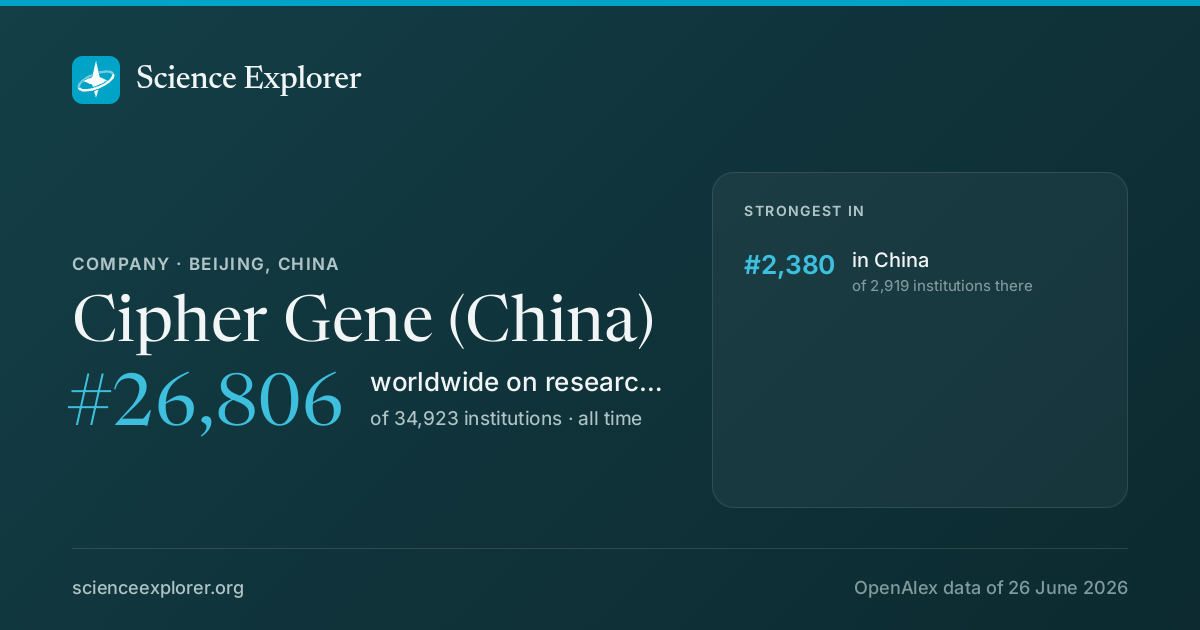
- #26,806 of 34,923
- Rank in China
- #2,380 of 2,919
- Research works
- 148 ▲ 16% vs 2018-21
- Citations
- 4.5k 30.2 per fractional work
- Top-10% rate
- 17.3% all institutions 10.0%
- vs its own fields
- 1.12× 1.00× is exactly expected
- Open access
- 59% world 40%
- International
- 29% world 18%
Which fields of science does Cipher Gene (China) work in?
In 2022-now, 46% of research at Cipher Gene (China) is in Life Sciences, 28% in Health Sciences. Its largest fields are Biochemistry, Genetics and Molecular Biology (40%), Medicine (27%), Computer Science (11%). It does 2.7× the world's share of Life Sciences.
Each ring splits the one inside it: the four domains of science, their fields, their subfields. Size is fractional works in 2022-now. Every slice is a page; the interactive view zooms down to single topics and colours each by how much more of it this institution does than the world.
Its 4 domains and 20 fields, with their numbers
- Life Sciences2146.2%
- Health Sciences1328.1%
- Medicine1227.1%
- Health Professions00.4%
- Dentistry00.4%
- Nursing00.1%
- Physical Sciences818.2%
- Computer Science511.2%
- Engineering23.4%
- Environmental Science11.6%
- Mathematics00.7%
- Materials Science00.7%
- Chemistry00.3%
- Earth and Planetary Sciences00.1%
- Physics and Astronomy00.1%
- Social Sciences37.6%
- Social Sciences25.5%
- Psychology11.2%
- Economics, Econometrics and Finance00.7%
- Decision Sciences00.2%
Field profile
Location quotient across every field it publishes in: outside the ring is more than an institution of this size would be expected to publish, inside it is less.
Rings at 0.5×, 1× and 2×. Widest outward: Biochemistry, Genetics and Molecular Biology, 7.4×. Every wedge is a field page.
All 20 fields, with their numbers
- Biochemistry, Genetics and Molecular Biology7.42×18 works
- Pharmacology, Toxicology and Pharmaceutics3.00×0 works
- Immunology and Microbiology2.55×1 works
- Neuroscience1.83×1 works
- Computer Science1.45×5 works
- Medicine1.41×12 works
- Dentistry0.75×0 works
- Mathematics0.62×0 works
- Social Sciences0.43×2 works
- Psychology0.40×1 works
- Economics, Econometrics and Finance0.34×0 works
- Environmental Science0.32×1 works
- Nursing0.25×0 works
- Engineering0.23×2 works
- Materials Science0.20×0 works
- Chemistry0.19×0 works
- Decision Sciences0.17×0 works
- Health Professions0.16×0 works
- Earth and Planetary Sciences0.08×0 works
- Physics and Astronomy0.05×0 works
- Biochemistry, Genetics and Molecular Biology 7.4×
- Pharmacology, Toxicology and Pharmaceutics 3.0×
- Immunology and Microbiology 2.5×
- Neuroscience 1.8×
- Computer Science 1.4×
- Medicine 1.4×
- Dentistry 0.8×
- Mathematics 0.6×
- Social Sciences 0.4×
- Psychology 0.4×
- Economics, Econometrics and Finance 0.3×
- Environmental Science 0.3×
- Nursing 0.2×
- Engineering 0.2×
- Materials Science 0.2×
- Chemistry 0.2×
- Decision Sciences 0.2×
- Health Professions 0.2×
- Earth and Planetary Sciences 0.1×
- Physics and Astronomy 0.1×
Who are the top researchers at Cipher Gene (China)?
Ranked on the quality score, Jialiang Yang, Geng Tian and Jidong Lang lead among researchers whose main affiliation is Cipher Gene (China).
- 1
Jialiang Yang
 China · #184,584 worldwide
16k citations · 263 works
- 2
Geng Tian
China · #237,796 worldwide
13k citations · 232 works
- 3
Jidong Lang
China · #595,188 worldwide
2.7k citations · 56 works
- 4
Zuozhen Yang
China · #801,276 worldwide
1.6k citations · 65 works
- 5
Yuebin Liang
China · #808,432 worldwide
812 citations · 17 works
- 6
Weishi Yu
China · #868,087 worldwide
2k citations · 36 works
- 7
Qingqing Lu
China · #1,698,270 worldwide
960 citations · 32 works
- 8
Jean-Paul Niko
China · #2,757,113 worldwide
0 citations · 32 works
- 9
Lei Ji
China · #3,203,054 worldwide
162 citations · 23 works
- 10
郑燕华
China · #4,872,650 worldwide
1 citations · 15 works
Which keywords describe research at Cipher Gene (China)?
By fractional works in 2022-now, weighted toward what it does more of than the world: Machine Learning, Cancer, Tumor Microenvironment, Medical Imaging, Gene Expression, Genetic Variants, Precision Medicine and Clinical Genomics.
- Cultural Identity
- Dendritic Spines
- Mitochondrial Dysfunction
- Immunotherapy
- Tumor Heterogeneity
- Drug Resistance
- Chemotherapy
- Subcellular Localization
- Molecular Docking
- Cell Death
- Protein-Protein Interaction Networks
- Gene Set Enrichment Analysis
- Prediction
- Feature Extraction
- Sequence Interpretation
- Clinical Genomics
- Precision Medicine
- Medical Imaging
- Tumor Microenvironment
- Cancer
- Machine Learning
- Inflammation
- Gene Expression
- Genetic Variants
- Bioinformatics
- Genetic Mutations
- Pharmacokinetics
- Oxidative Stress
- Protein
- Predictive Modeling
- Amino Acid Composition
- Inflammatory Diseases
- Quantitative Analysis
- Virtual Screening
- Convolutional Neural Networks
- Radiomics
- Gut Microbiota
- Microbial Communities
- Neurodevelopmental Disorders
- Brain Development
Size is fractional works in 2022-now in the topics tagged with each word; colour is the word's share of this institution's work against its share of the world's. The 40 words are chosen for being large and distinctive. Each links to the topic it comes from most.
All 40 words, with their numbers
- Machine Learning7▲ 4.7×16 topics
- Cancer3▲ 5.0×14 topics
- Inflammation2▲ 2.2×14 topics
- Tumor Microenvironment2▲ 10×6 topics
- Gene Expression2▲ 7.4×7 topics
- Medical Imaging2▲ 8.9×4 topics
- Genetic Variants2▲ 25×2 topics
- Precision Medicine2▲ 8.8×5 topics
- Bioinformatics2▲ 36×2 topics
- Clinical Genomics2▲ 108×1 topic
- Genetic Mutations2▲ 9.3×7 topics
- Sequence Interpretation2▲ 108×1 topic
- Pharmacokinetics2▲ 14×2 topics
- Feature Extraction2▲ 7.8×3 topics
- Oxidative Stress2▲ 2.2×7 topics
- Prediction2▲ 44×2 topics
- Protein2▲ 28×2 topics
- Gene Set Enrichment Analysis2▲ 92×1 topic
- Predictive Modeling2▲ 12×2 topics
- Protein-Protein Interaction Networks2▲ 92×1 topic
- Amino Acid Composition1▲ 114×1 topic
- Cell Death1▲ 12×3 topics
- Inflammatory Diseases1▲ 16×2 topics
- Molecular Docking1▲ 25×1 topic
- Quantitative Analysis1▲ 14×2 topics
- Subcellular Localization1▲ 114×1 topic
- Virtual Screening1▲ 33×1 topic
- Chemotherapy1▲ 3.9×5 topics
- Convolutional Neural Networks1▲ 3.9×5 topics
- Drug Resistance1▲ 9.8×3 topics
- Radiomics1▲ 25×1 topic
- Tumor Heterogeneity1▲ 25×1 topic
- Gut Microbiota1▲ 7.8×1 topic
- Immunotherapy1▲ 3.6×7 topics
- Microbial Communities1▲ 6.2×1 topic
- Mitochondrial Dysfunction1▲ 8.8×5 topics
- Neurodevelopmental Disorders1▲ 19×4 topics
- Dendritic Spines1▲ 32×2 topics
- Brain Development1▲ 12×2 topics
- Cultural Identity1▲ 4.4×2 topics
Which research topics does Cipher Gene (China) publish most on?
By volume in 2022-now: Genomics and Rare Diseases, Bioinformatics and Genomic Networks, Computational Drug Discovery Methods and Machine Learning in Bioinformatics.
Area is fractional works; colour is the subfield each topic belongs to.
- 1 Genomics and Rare Diseases Genetics 2 works
- 2 Bioinformatics and Genomic Networks Molecular Biology 2 works
- 3 Computational Drug Discovery Methods Computational Theory and Mathematics 1 works
- 4 Machine Learning in Bioinformatics Molecular Biology 1 works
- 5 Radiomics and Machine Learning in Medical Imaging Radiology, Nuclear Medicine and Imaging 1 works
- 6 Gut microbiota and health Molecular Biology 1 works
- 7 Genomic variations and chromosomal abnormalities Genetics 1 works
- 8 Genetics and Neurodevelopmental Disorders Genetics 1 works
- 9 Sociopolitical Dynamics in Nepal Demography 1 works
- 10 Sustainability and Climate Change Governance Global and Planetary Change 1 works
How open and international is its research?
Against the world's own shares: the tick on each track. Both are shares of its output, so they sit on one scale and can be read against each other as well as against the world.
World: 40% of research is openly available.
World: 18% is written across borders.
How has Cipher Gene (China)'s research output changed?
Output in 2022-2025 was 16% higher than in 2018-2021.
The same series as a ribbon: one cell per year, darker for more. The line above answers how much; this answers when.
Its share of all research
Growing output can still be a shrinking share: all of science grows. This is Cipher Gene (China) as a percentage of every work published that year, 0.00010% in 2024.
Fractional works of Cipher Gene (China) over all fractional works that year. How the balance of science has shifted.
Other research institutions in Beijing
- Chinese Academy of Sciences
- Tsinghua University
- Peking University
- Chinese Academy of Agricultural Sciences
- University of Chinese Academy of Sciences
- Beihang University
- Beijing Institute of Technology
- Capital Medical University

Share Cipher Gene (China)'s ranking
Badges for a website1Each links back here and updates with every snapshot

Research measures only: rankings here say nothing about teaching, admissions or student experience. Comparable institutions and collaboration partners have tabs of their own, above.
Discussion
Ask a question or share a note about Cipher Gene (China). Keep it to the research: no personal attacks, advertising or links. Any reader can report a post, which collapses it for everyone until it is opened.