Science Explorer Back to mapMap
Discussion

Codexis (United States)

World rank, all time
#15,328
of 34,923
Rank in United States
#3,167
of 7,310
Research works
135
▲ 60% vs 2018-21
Citations
10k
73.9 per fractional work
Top-10% rate
21.2%
all institutions 10.0%
vs its own fields
1.19×
1.00× is exactly expected
Open access
31%
world 40%
International
23%
world 18%

Which fields of science does Codexis (United States) work in?

In 2022-now, 56% of research at Codexis (United States) is in Life Sciences, 21% in Health Sciences. Its largest fields are Biochemistry, Genetics and Molecular Biology (46%), Medicine (20%), Chemistry (7%). It does 2.6× the world's share of Life Sciences.

Life Sciences: 12 fractional works · 55.9% of its workBiochemistry, Genetics and Molecular Biology: 10 fractional works · 45.8% of its workMolecular Biology: 6 fractional works · 28.9% of its workCell Biology: 1 fractional works · 6.6% of its workBiochemistry: 1 fractional works · 3.1% of its workGenetics: 1 fractional works · 2.7% of its workClinical Biochemistry: 0 fractional works · 2.2% of its workAging: 0 fractional works · 2.1% of its workImmunology and Microbiology: 1 fractional works · 5.9% of its workImmunology: 1 fractional works · 5.5% of its workMicrobiology: 0 fractional works · 0.4% of its workNeuroscience: 1 fractional works · 3.7% of its workBiological Psychiatry: 0 fractional works · 1.8% of its workCellular and Molecular Neuroscience: 0 fractional works · 1.0% of its workNeurology: 0 fractional works · 0.4% of its workCognitive Neuroscience: 0 fractional works · 0.3% of its workDevelopmental Neuroscience: 0 fractional works · 0.3% of its workAgricultural and Biological Sciences: 0 fractional works · 0.6% of its workAnimal Science and Zoology: 0 fractional works · 0.6% of its workHealth Sciences: 5 fractional works · 20.6% of its workMedicine: 5 fractional works · 20.3% of its workSurgery: 1 fractional works · 3.1% of its workOncology: 1 fractional works · 2.7% of its workRadiology, Nuclear Medicine and Imaging: 0 fractional works · 2.2% of its workEpidemiology: 0 fractional works · 1.8% of its workPhysiology: 0 fractional works · 1.7% of its workPublic Health, Environmental and Occupational Health: 0 fractional works · 1.7% of its workAnesthesiology and Pain Medicine: 0 fractional works · 1.5% of its workNeurology: 0 fractional works · 1.5% of its workRheumatology: 0 fractional works · 1.2% of its workEmergency Medicine: 0 fractional works · 0.8% of its workGeriatrics and Gerontology: 0 fractional works · 0.8% of its workPulmonary and Respiratory Medicine: 0 fractional works · 0.4% of its workInfectious Diseases: 0 fractional works · 0.3% of its workEndocrinology, Diabetes and Metabolism: 0 fractional works · 0.3% of its workOrthopedics and Sports Medicine: 0 fractional works · 0.3% of its workSmaller subfields together: 0 fractional works · 0.1% of its workHealth Professions: 0 fractional works · 0.2% of its workGeneral Health Professions: 0 fractional works · 0.2% of its workPhysical Sciences: 4 fractional works · 17.9% of its workChemistry: 2 fractional works · 6.9% of its workSpectroscopy: 1 fractional works · 4.0% of its workOrganic Chemistry: 0 fractional works · 1.8% of its workPhysical and Theoretical Chemistry: 0 fractional works · 0.8% of its workInorganic Chemistry: 0 fractional works · 0.3% of its workEngineering: 1 fractional works · 5.4% of its workBiomedical Engineering: 1 fractional works · 2.9% of its workElectrical and Electronic Engineering: 0 fractional works · 1.5% of its workComputational Mechanics: 0 fractional works · 1.0% of its workPhysics and Astronomy: 0 fractional works · 1.8% of its workAstronomy and Astrophysics: 0 fractional works · 0.6% of its workInstrumentation: 0 fractional works · 0.5% of its workStatistical and Nonlinear Physics: 0 fractional works · 0.5% of its workSmaller subfields together: 0 fractional works · 0.2% of its workMaterials Science: 0 fractional works · 1.3% of its workBiomaterials: 0 fractional works · 1.0% of its workMaterials Chemistry: 0 fractional works · 0.3% of its workComputer Science: 0 fractional works · 1.0% of its workComputer Networks and Communications: 0 fractional works · 0.8% of its workArtificial Intelligence: 0 fractional works · 0.3% of its workEarth and Planetary Sciences: 0 fractional works · 0.5% of its workGeophysics: 0 fractional works · 0.5% of its workEnergy: 0 fractional works · 0.5% of its workRenewable Energy, Sustainability and the Environment: 0 fractional works · 0.5% of its workEnvironmental Science: 0 fractional works · 0.4% of its workEcology: 0 fractional works · 0.3% of its workSmaller subfields together: 0 fractional works · 0.1% of its workSocial Sciences: 1 fractional works · 5.6% of its workSocial Sciences: 1 fractional works · 4.3% of its workPolitical Science and International Relations: 1 fractional works · 3.2% of its workEducation: 0 fractional works · 0.8% of its workSafety Research: 0 fractional works · 0.3% of its workArts and Humanities: 0 fractional works · 0.6% of its workLiterature and Literary Theory: 0 fractional works · 0.4% of its workLanguage and Linguistics: 0 fractional works · 0.2% of its workEconomics, Econometrics and Finance: 0 fractional works · 0.5% of its workEconomics and Econometrics: 0 fractional works · 0.5% of its workBusiness, Management and Accounting: 0 fractional works · 0.2% of its workStrategy and Management: 0 fractional works · 0.2% of its workALL ITS WORKCodexis (UnitedStates)22fractional works, 2022-now
Life Sciences56%Physical Sciences18%Health Sciences21%Social Sciences6%

Each ring splits the one inside it: the four domains of science, their fields, their subfields. Size is fractional works in 2022-now. Every slice is a page; the interactive view zooms down to single topics and colours each by how much more of it this institution does than the world.

Its 4 domains and 18 fields, with their numbers
    1. Biochemistry, Genetics and Molecular Biology1045.8%
    2. Immunology and Microbiology15.9%
    3. Neuroscience13.7%
    4. Agricultural and Biological Sciences00.6%
    1. Medicine520.3%
    2. Health Professions00.2%
    1. Chemistry26.9%
    2. Engineering15.4%
    3. Physics and Astronomy01.8%
    4. Materials Science01.3%
    5. Computer Science01.0%
    6. Earth and Planetary Sciences00.5%
    7. Energy00.5%
    8. Environmental Science00.4%
    1. Social Sciences14.3%
    2. Arts and Humanities00.6%
    3. Economics, Econometrics and Finance00.5%
    4. Business, Management and Accounting00.2%
All of science, and how each field's share has moved since 1950: the Science domain explorer

Field profile

Location quotient across every field it publishes in: outside the ring is more than an institution of this size would be expected to publish, inside it is less.

Agricultural and Biological Sciences: 0.13× its world share, 0 worksAgricultural and Bio…Biochemistry, Genetics and Molecular Biology: 8.57× its world share, 10 worksBiochemistry, Geneti…Immunology and Microbiology: 5.84× its world share, 1 worksImmunology and Micro…Neuroscience: 2.30× its world share, 1 worksNeuroscienceChemistry: 4.38× its world share, 2 worksChemistryComputer Science: 0.13× its world share, 0 worksComputer ScienceEarth and Planetary Sciences: 0.32× its world share, 0 worksEarth and Planetary …Energy: 0.54× its world share, 0 worksEnergyEngineering: 0.36× its world share, 1 worksEngineeringEnvironmental Science: 0.09× its world share, 0 worksEnvironmental ScienceMaterials Science: 0.37× its world share, 0 worksMaterials SciencePhysics and Astronomy: 0.83× its world share, 0 worksPhysics and AstronomyHealth Professions: 0.08× its world share, 0 worksHealth ProfessionsMedicine: 1.06× its world share, 4 worksMedicineArts and Humanities: 0.22× its world share, 0 worksArts and HumanitiesBusiness, Management and Accounting: 0.07× its world share, 0 worksBusiness, Management…Economics, Econometrics and Finance: 0.24× its world share, 0 worksEconomics, Econometr…Social Sciences: 0.34× its world share, 1 worksSocial Sciences1×world share
more than its size predictsabout as predictedless

Rings at 0.5×, 1× and 2×. Widest outward: Biochemistry, Genetics and Molecular Biology, 8.6×. Every wedge is a field page.

All 18 fields, with their numbers
  1. Biochemistry, Genetics and Molecular Biology8.57×10 works
  2. Immunology and Microbiology5.84×1 works
  3. Chemistry4.38×2 works
  4. Neuroscience2.30×1 works
  5. Medicine1.06×4 works
  6. Physics and Astronomy0.83×0 works
  7. Energy0.54×0 works
  8. Materials Science0.37×0 works
  9. Engineering0.36×1 works
  10. Social Sciences0.34×1 works
  11. Earth and Planetary Sciences0.32×0 works
  12. Economics, Econometrics and Finance0.24×0 works
  13. Arts and Humanities0.22×0 works
  14. Agricultural and Biological Sciences0.13×0 works
  15. Computer Science0.13×0 works
  16. Environmental Science0.09×0 works
  17. Health Professions0.08×0 works
  18. Business, Management and Accounting0.07×0 works

Who are the top researchers at Codexis (United States)?

Ranked on the quality score, Gjalt W. Huisman, Jack Liang and James Joseph Lalonde lead among researchers whose main affiliation is Codexis (United States).

  1. 1 Gjalt W. Huisman United States · #117,099 worldwide 12k citations · 63 works
  2. 2 Jack Liang United States · #319,132 worldwide 2.5k citations · 18 works
  3. 3 James Joseph Lalonde United States · #332,847 worldwide 2.3k citations · 31 works
  4. 4 Oscar Alvizo United States · #869,849 worldwide 1.5k citations · 23 works
  5. 5 Sotheby Parke Bernet and Co. United States · #3,501,390 worldwide 15 citations · 63 works
All ranked researchers at Codexis (United States)

What are the most cited papers from Codexis (United States)?

The most cited paper from Codexis (United States) is "Engineering the third wave of biocatalysis" (Uwe T. Bornscheuer, Gjalt W. Huisman, Romas J. Kazlauskas et al., 2012), with 2,648 citations. Next come "Biocatalytic Asymmetric Synthesis of Chiral Amines from Ketones Applied to Sitagliptin Manufacture" (1,771) and "Input Versus Output Queueing on a Space-Division Packet Switch" (1,483).

Most cited papers
#PaperReleasedCitations
1 Engineering the third wave of biocatalysis Uwe T. Bornscheuer, Gjalt W. Huisman, Romas J. Kazlauskas et al. · Nature May 2012 2,648
2 Biocatalytic Asymmetric Synthesis of Chiral Amines from Ketones Applied to Sitagliptin Manufacture Christopher K. Savile, Jacob M. Janey, Emily C. Mundorff et al. · Science 17 Jun 2010 1,771
3 Input Versus Output Queueing on a Space-Division Packet Switch M.J. Karol, Michael G. Hluchyj, Samuel Morgan · IRE Transactions on Communications Systems Dec 1987 1,483
4 Efficient Modulation for Band-Limited Channels G. David Forney, Robert G. Gallager, G.R. Lang et al. · IEEE Journal on Selected Areas in Communications Sep 1984 733
5 From nature to industry: Harnessing enzymes for biocatalysis Rebecca Buller, Stefan Zoltan Lutz, Romas J. Kazlauskas et al. · Science Open access 23 Nov 2023 699
All 59 most cited papers, with filters and sorting

Which keywords describe research at Codexis (United States)?

By fractional works in 2022-now, weighted toward what it does more of than the world: Oxidative Stress, Green Chemistry, Mass Spectrometry, Metabolic Disorders, Aging, Biocatalysis, Enzyme Immobilization and Cell Death.

▲ more of its work than of the world's◆ about the world's share▼ less than the world's

Size is fractional works in 2022-now in the topics tagged with each word; colour is the word's share of this institution's work against its share of the world's. The 10 words are chosen for being large and distinctive. Each links to the topic it comes from most.

All 10 words, with their numbers
  1. Oxidative Stress2▲ 5.9×7 topics
  2. Green Chemistry1▲ 34×2 topics
  3. Mass Spectrometry1▲ 36×3 topics
  4. Aging1▲ 9.6×5 topics
  5. Biocatalysis1▲ 83×1 topic
  6. Enzyme Immobilization1▲ 174×1 topic
  7. Metabolic Disorders1▲ 45×2 topics
  8. Cancer1▲ 3.6×5 topics
  9. Cell Death1▲ 21×2 topics
  10. Schizophrenia1▲ 44×2 topics

Which research topics does Codexis (United States) publish most on?

By volume in 2022-now: Enzyme Catalysis and Immobilization, Endoplasmic Reticulum Stress and Disease, Amino Acid Enzymes and Metabolism and Gut microbiota and health.

  1. 1 Enzyme Catalysis and Immobilization Molecular Biology 1 works
  2. 2 Endoplasmic Reticulum Stress and Disease Cell Biology 1 works
  3. 3 Amino Acid Enzymes and Metabolism Biochemistry 1 works
  4. 4 Gut microbiota and health Molecular Biology 1 works
  5. 5 Microbial Metabolic Engineering and Bioproduction Molecular Biology 1 works
  6. 6 Genetics, Aging, and Longevity in Model Organisms Aging 0 works
  7. 7 Metabolomics and Mass Spectrometry Studies Molecular Biology 0 works
  8. 8 Monoclonal and Polyclonal Antibodies Research Radiology, Nuclear Medicine and Imaging 0 works
  9. 9 Metabolism and Genetic Disorders Clinical Biochemistry 0 works
  10. 10 Advanced Proteomics Techniques and Applications Spectroscopy 0 works

How open and international is its research?

Against the world's own shares: the tick on each track. Both are shares of its output, so they sit on one scale and can be read against each other as well as against the world.

openly available31.4%not open68.6%

World: 40% of research is openly available.

with international co-authors22.9%domestic only77.1%

World: 18% is written across borders.

How has Codexis (United States)'s research output changed?

Output in 2022-2025 was 60% higher than in 2018-2021.

still counting1990200020102020
grewheldshrank

The same series as a ribbon: one cell per year, darker for more. The line above answers how much; this answers when.

Its share of all research

Growing output can still be a shrinking share: all of science grows. This is Codexis (United States) as a percentage of every work published that year, 0.00011% in 2024.

still counting0.00025%0.00050%0.00075%Codexis (United States)0.00010% in 202519801990200020102020

Fractional works of Codexis (United States) over all fractional works that year. How the balance of science has shifted.

Other research institutions in Redwood City

All research institutions in Redwood City

Share Codexis (United States)'s ranking
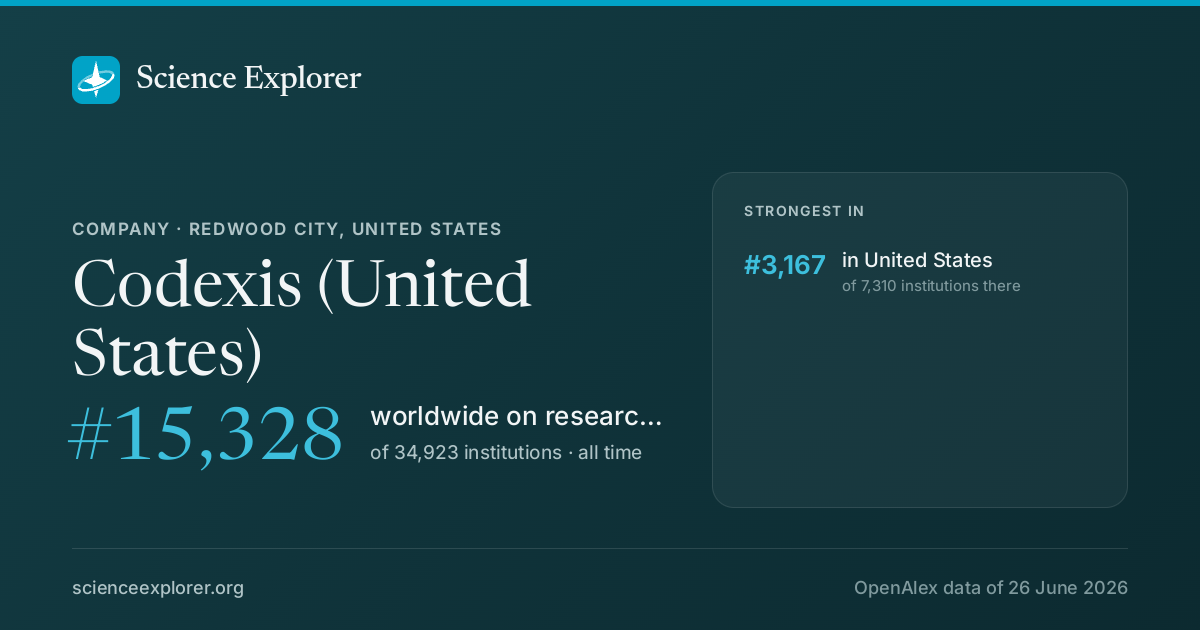
Codexis (United States) on Science Explorer

A card with Codexis (United States)'s standing and the fields it leads in, for a post or a slide. A link to this page previews as the same card.

Download the card

1200 × 630 PNG, sized for social posts, drawn from the latest snapshot.

Badges for a website1Each links back here and updates with every snapshot

Research measures only: rankings here say nothing about teaching, admissions or student experience. Comparable institutions and collaboration partners have tabs of their own, above.

Discussion

Ask a question or share a note about Codexis (United States). Posts are plain text and can be reported.