Science Explorer Back to mapMap
Discussion
University · Daytona Beach · United States

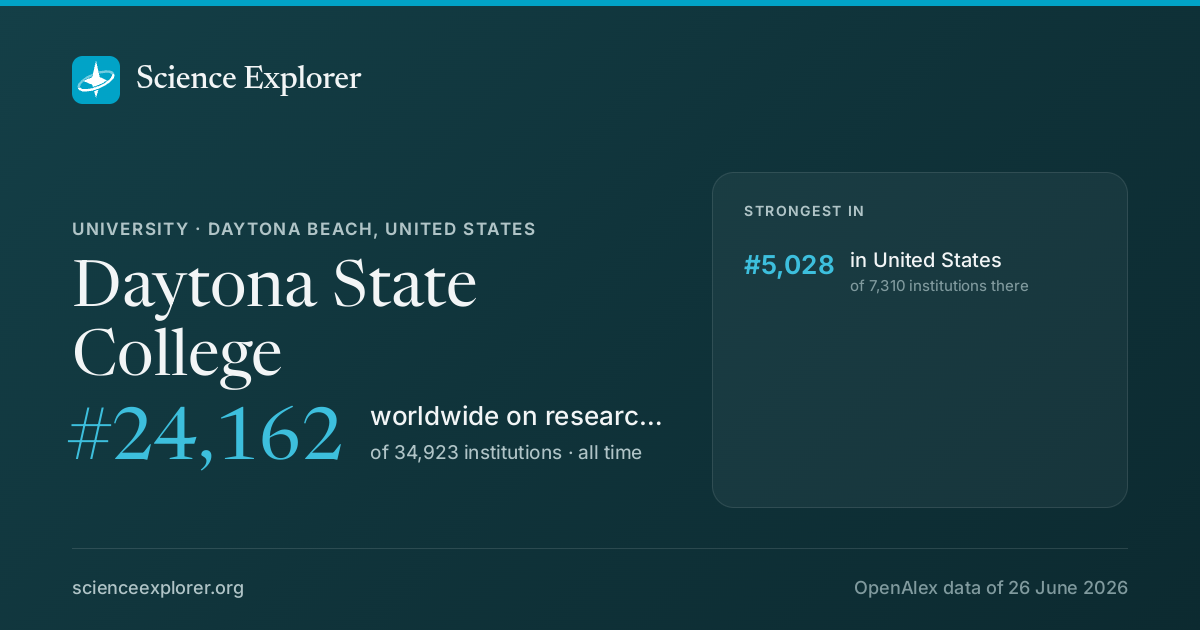
Daytona State College

World rank, all time
#24,162
of 34,923
Rank in United States
#5,028
of 7,310
Research works
212
▼ 27% vs 2018-21
Citations
1.7k
7.8 per fractional work
Top-10% rate
6.9%
all institutions 10.0%
vs its own fields
0.81×
1.00× is exactly expected
Open access
26%
world 40%
International
6%
world 18%

Which fields of science does Daytona State College work in?

In 2022-now, 37% of research at Daytona State College is in Health Sciences, 28% in Social Sciences. Its largest fields are Medicine (34%), Social Sciences (15%), Engineering (14%). It does 1.4× the world's share of Health Sciences.

Health Sciences: 8 fractional works · 37.0% of its workMedicine: 7 fractional works · 33.9% of its workSurgery: 2 fractional works · 8.1% of its workPulmonary and Respiratory Medicine: 1 fractional works · 2.6% of its workNeurology: 0 fractional works · 2.5% of its workPublic Health, Environmental and Occupational Health: 0 fractional works · 2.4% of its workEmergency Medicine: 0 fractional works · 2.0% of its workRheumatology: 0 fractional works · 1.7% of its workObstetrics and Gynecology: 0 fractional works · 1.6% of its workPediatrics, Perinatology and Child Health: 0 fractional works · 1.5% of its workInfectious Diseases: 0 fractional works · 1.3% of its workEpidemiology: 0 fractional works · 1.0% of its workCardiology and Cardiovascular Medicine: 0 fractional works · 0.9% of its workInternal Medicine: 0 fractional works · 0.8% of its workOncology: 0 fractional works · 0.8% of its workPhysiology: 0 fractional works · 0.8% of its workRadiology, Nuclear Medicine and Imaging: 0 fractional works · 0.8% of its workReproductive Medicine: 0 fractional works · 0.8% of its workNephrology: 0 fractional works · 0.6% of its workOrthopedics and Sports Medicine: 0 fractional works · 0.6% of its workUrology: 0 fractional works · 0.6% of its workCritical Care and Intensive Care Medicine: 0 fractional works · 0.5% of its workPsychiatry and Mental health: 0 fractional works · 0.4% of its workRehabilitation: 0 fractional works · 0.4% of its workHealth Informatics: 0 fractional works · 0.3% of its workGastroenterology: 0 fractional works · 0.2% of its workSmaller subfields together: 0 fractional works · 0.3% of its workHealth Professions: 1 fractional works · 2.6% of its workGeneral Health Professions: 0 fractional works · 1.9% of its workHealth Information Management: 0 fractional works · 0.3% of its workPhysical Therapy, Sports Therapy and Rehabilitation: 0 fractional works · 0.3% of its workSmaller subfields together: 0 fractional works · 0.1% of its workDentistry: 0 fractional works · 0.5% of its workOral Surgery: 0 fractional works · 0.5% of its workSocial Sciences: 6 fractional works · 28.1% of its workSocial Sciences: 3 fractional works · 14.7% of its workSociology and Political Science: 1 fractional works · 5.8% of its workTransportation: 1 fractional works · 3.3% of its workEducation: 1 fractional works · 3.2% of its workGender Studies: 0 fractional works · 1.3% of its workCultural Studies: 0 fractional works · 0.8% of its workSafety Research: 0 fractional works · 0.3% of its workPsychology: 1 fractional works · 6.4% of its workApplied Psychology: 1 fractional works · 5.3% of its workClinical Psychology: 0 fractional works · 0.6% of its workSocial Psychology: 0 fractional works · 0.5% of its workArts and Humanities: 1 fractional works · 4.6% of its workPhilosophy: 1 fractional works · 3.3% of its workHistory: 0 fractional works · 1.3% of its workDecision Sciences: 0 fractional works · 1.6% of its workInformation Systems and Management: 0 fractional works · 1.6% of its workBusiness, Management and Accounting: 0 fractional works · 0.8% of its workManagement of Technology and Innovation: 0 fractional works · 0.8% of its workPhysical Sciences: 6 fractional works · 28.1% of its workEngineering: 3 fractional works · 13.5% of its workMedia Technology: 1 fractional works · 4.6% of its workBiomedical Engineering: 1 fractional works · 3.7% of its workArchitecture: 0 fractional works · 2.3% of its workAerospace Engineering: 0 fractional works · 1.6% of its workElectrical and Electronic Engineering: 0 fractional works · 0.8% of its workIndustrial and Manufacturing Engineering: 0 fractional works · 0.3% of its workMechanical Engineering: 0 fractional works · 0.3% of its workMaterials Science: 1 fractional works · 5.8% of its workBiomaterials: 0 fractional works · 2.5% of its workPolymers and Plastics: 0 fractional works · 1.6% of its workElectronic, Optical and Magnetic Materials: 0 fractional works · 0.8% of its workMaterials Chemistry: 0 fractional works · 0.8% of its workMathematics: 1 fractional works · 3.3% of its workApplied Mathematics: 0 fractional works · 1.1% of its workModeling and Simulation: 0 fractional works · 1.1% of its workNumerical Analysis: 0 fractional works · 1.1% of its workSmaller subfields together: 0 fractional works · 0.0% of its workComputer Science: 0 fractional works · 2.5% of its workArtificial Intelligence: 0 fractional works · 1.1% of its workInformation Systems: 0 fractional works · 0.8% of its workSignal Processing: 0 fractional works · 0.5% of its workEarth and Planetary Sciences: 0 fractional works · 1.3% of its workGeology: 0 fractional works · 0.8% of its workOceanography: 0 fractional works · 0.5% of its workChemical Engineering: 0 fractional works · 0.8% of its workBioengineering: 0 fractional works · 0.8% of its workEnvironmental Science: 0 fractional works · 0.5% of its workEcology: 0 fractional works · 0.3% of its workEnvironmental Engineering: 0 fractional works · 0.2% of its workEnergy: 0 fractional works · 0.3% of its workRenewable Energy, Sustainability and the Environment: 0 fractional works · 0.3% of its workLife Sciences: 1 fractional works · 6.8% of its workBiochemistry, Genetics and Molecular Biology: 0 fractional works · 2.2% of its workGenetics: 0 fractional works · 0.9% of its workEndocrinology: 0 fractional works · 0.5% of its workMolecular Biology: 0 fractional works · 0.4% of its workDevelopmental Biology: 0 fractional works · 0.3% of its workSmaller subfields together: 0 fractional works · 0.0% of its workNeuroscience: 0 fractional works · 2.2% of its workCognitive Neuroscience: 0 fractional works · 1.6% of its workCellular and Molecular Neuroscience: 0 fractional works · 0.3% of its workNeurology: 0 fractional works · 0.3% of its workAgricultural and Biological Sciences: 0 fractional works · 1.3% of its workAnimal Science and Zoology: 0 fractional works · 1.1% of its workSmaller subfields together: 0 fractional works · 0.2% of its workImmunology and Microbiology: 0 fractional works · 0.8% of its workImmunology: 0 fractional works · 0.8% of its workPharmacology, Toxicology and Pharmaceutics: 0 fractional works · 0.3% of its workPharmacology: 0 fractional works · 0.3% of its workALL ITS WORKDaytona StateCollege20fractional works, 2022-now
Life Sciences7%Physical Sciences28%Health Sciences37%Social Sciences28%

Each ring splits the one inside it: the four domains of science, their fields, their subfields. Size is fractional works in 2022-now. Every slice is a page; the interactive view zooms down to single topics and colours each by how much more of it this institution does than the world.

Its 4 domains and 21 fields, with their numbers
    1. Medicine733.9%
    2. Health Professions12.6%
    3. Dentistry00.5%
    1. Social Sciences314.7%
    2. Psychology16.4%
    3. Arts and Humanities14.6%
    4. Decision Sciences01.6%
    5. Business, Management and Accounting00.8%
    1. Engineering313.5%
    2. Materials Science15.8%
    3. Mathematics13.3%
    4. Computer Science02.5%
    5. Earth and Planetary Sciences01.3%
    6. Chemical Engineering00.8%
    7. Environmental Science00.5%
    8. Energy00.3%
    1. Biochemistry, Genetics and Molecular Biology02.2%
    2. Neuroscience02.2%
    3. Agricultural and Biological Sciences01.3%
    4. Immunology and Microbiology00.8%
    5. Pharmacology, Toxicology and Pharmaceutics00.3%
All of science, and how each field's share has moved since 1950: the Science domain explorer

Field profile

Location quotient across every field it publishes in: outside the ring is more than an institution of this size would be expected to publish, inside it is less.

Agricultural and Biological Sciences: 0.27× its world share, 0 worksAgricultural and Bio…Biochemistry, Genetics and Molecular Biology: 0.40× its world share, 0 worksBiochemistry, Geneti…Immunology and Microbiology: 0.82× its world share, 0 worksImmunology and Micro…Neuroscience: 1.35× its world share, 0 worksNeurosciencePharmacology, Toxicology and Pharmaceutics: 0.93× its world share, 0 worksPharmacology, Toxico…Chemical Engineering: 2.35× its world share, 0 worksChemical EngineeringComputer Science: 0.32× its world share, 0 worksComputer ScienceEarth and Planetary Sciences: 0.82× its world share, 0 worksEarth and Planetary …Energy: 0.36× its world share, 0 worksEnergyEngineering: 0.90× its world share, 3 worksEngineeringEnvironmental Science: 0.11× its world share, 0 worksEnvironmental ScienceMaterials Science: 1.65× its world share, 1 worksMaterials ScienceMathematics: 2.79× its world share, 1 worksMathematicsDentistry: 1.13× its world share, 0 worksDentistryHealth Professions: 0.99× its world share, 0 worksHealth ProfessionsMedicine: 1.76× its world share, 7 worksMedicineArts and Humanities: 1.59× its world share, 1 worksArts and HumanitiesBusiness, Management and Accounting: 0.25× its world share, 0 worksBusiness, Management…Decision Sciences: 1.70× its world share, 0 worksDecision SciencesPsychology: 2.12× its world share, 1 worksPsychologySocial Sciences: 1.16× its world share, 3 worksSocial Sciences1×world share
more than its size predictsabout as predictedless

Rings at 0.5×, 1× and 2×. Widest outward: Mathematics, 2.8×. Every wedge is a field page.

All 21 fields, with their numbers
  1. Mathematics2.79×1 works
  2. Chemical Engineering2.35×0 works
  3. Psychology2.12×1 works
  4. Medicine1.76×7 works
  5. Decision Sciences1.70×0 works
  6. Materials Science1.65×1 works
  7. Arts and Humanities1.59×1 works
  8. Neuroscience1.35×0 works
  9. Social Sciences1.16×3 works
  10. Dentistry1.13×0 works
  11. Health Professions0.99×0 works
  12. Pharmacology, Toxicology and Pharmaceutics0.93×0 works
  13. Engineering0.90×3 works
  14. Immunology and Microbiology0.82×0 works
  15. Earth and Planetary Sciences0.82×0 works
  16. Biochemistry, Genetics and Molecular Biology0.40×0 works
  17. Energy0.36×0 works
  18. Computer Science0.32×0 works
  19. Agricultural and Biological Sciences0.27×0 works
  20. Business, Management and Accounting0.25×0 works
  21. Environmental Science0.11×0 works

Who are the top researchers at Daytona State College?

Ranked on the quality score, Otto Bernhard Schlutter, Rhidian Harrington and John J. Guthrie lead among researchers whose main affiliation is Daytona State College.

  1. 1 Otto Bernhard Schlutter United States · #1,973,973 worldwide 19 citations · 104 works
  2. 2 Rhidian Harrington United States · #3,056,642 worldwide 273 citations · 16 works
  3. 3 John J. Guthrie United States · #3,080,026 worldwide 235 citations · 15 works
  4. 4 Maxwell Hackman United States · #6,057,131 worldwide 8 citations · 50 works
  5. 5 Bob King United States · #7,170,609 worldwide 14 citations · 73 works
  6. 6 Rachel Owens United States · #7,688,769 worldwide 102 citations · 303 works
All ranked researchers at Daytona State College

What are the most cited papers from Daytona State College?

The most cited paper from Daytona State College is "Fathering, Class, and Gender" (Carla Shows, Naomi R. Gerstel, 2008), with 190 citations. Next come "Locating centric relation with a leaf gauge" (98) and "Rethinking the role of educators in the 21st century: navigating globalization, technology, and pandemics" (88).

Most cited papers
#PaperReleasedCitations
1 Fathering, Class, and Gender Carla Shows, Naomi R. Gerstel · Gender & Society 25 Apr 2008 190
2 Locating centric relation with a leaf gauge James Hart Long · Journal of Prosthetic Dentistry Jun 1973 98
3 Rethinking the role of educators in the 21st century: navigating globalization, technology, and pandemics Ramy A. Rahimi, Grace S. Oh · Journal of Marketing Analytics 2 Apr 2024 88
4 Assessment of Oral Health–Related Quality of Life Before and After Third Molar Surgery Daniel A. Shugars, Michael A. Gentile, Nazir Ahmad et al. · Journal of Oral and Maxillofacial Surgery 20 Nov 2006 87
5 Location of the terminal hinge axis by intraoral means James Hart Long · Journal of Prosthetic Dentistry 1970 82
All 60 most cited papers, with filters and sorting

Which research topics does Daytona State College publish most on?

By volume in 2022-now: Human Resource Development and Performance Evaluation, Engineering Education and Curriculum Development, Engineering Education and Pedagogy and Electrospun Nanofibers in Biomedical Applications.

  1. 1 Human Resource Development and Performance Evaluation Applied Psychology 1 works
  2. 2 Engineering Education and Curriculum Development Media Technology 1 works
  3. 3 Engineering Education and Pedagogy Architecture 0 works
  4. 4 Electrospun Nanofibers in Biomedical Applications Biomaterials 0 works
  5. 5 Trauma Management and Diagnosis Surgery 0 works
  6. 6 Education, Philosophy, and Society Philosophy 0 works
  7. 7 Psychology of Moral and Emotional Judgment Cognitive Neuroscience 0 works
  8. 8 Philosophical Ethics and Theory Philosophy 0 works
  9. 9 Polymer composites and self-healing Polymers and Plastics 0 works
  10. 10 Military Technology and Strategies Aerospace Engineering 0 works

How open and international is its research?

Against the world's own shares: the tick on each track. Both are shares of its output, so they sit on one scale and can be read against each other as well as against the world.

openly available26.4%not open73.6%

World: 40% of research is openly available.

with international co-authors6.2%domestic only93.8%

World: 18% is written across borders.

How has Daytona State College's research output changed?

Output in 2022-2025 was 27% lower than in 2018-2021.

still counting1990200020102020
grewheldshrank

The same series as a ribbon: one cell per year, darker for more. The line above answers how much; this answers when.

Its share of all research

Growing output can still be a shrinking share: all of science grows. This is Daytona State College as a percentage of every work published that year, 0.00014% in 2024.

still counting0.0010%0.0020%Daytona State College0.000091% in 202519801990200020102020

Fractional works of Daytona State College over all fractional works that year. How the balance of science has shifted.

Other research institutions in Daytona Beach

All research institutions in Daytona Beach

Share Daytona State College's ranking

Daytona State College on Science Explorer

A card with Daytona State College's standing and the fields it leads in, for a post or a slide. A link to this page previews as the same card.

Download the card

1200 × 630 PNG, sized for social posts, drawn from the latest snapshot.

Badges for a website1Each links back here and updates with every snapshot

Research measures only: rankings here say nothing about teaching, admissions or student experience. Comparable institutions and collaboration partners have tabs of their own, above.

Discussion

Ask a question or share a note about Daytona State College. Posts are plain text and can be reported.