Science Explorer Back to mapMap
Discussion

Endocyte (United States)

World rank, all time
#21,045
of 34,923
Rank in United States
#4,365
of 7,310
Research works
238
▼ 50% vs 2018-21
Citations
9.5k
39.7 per fractional work
Top-10% rate
8.7%
all institutions 10.0%
vs its own fields
1.18×
1.00× is exactly expected
Open access
27%
world 40%
International
20%
world 18%

Which fields of science does Endocyte (United States) work in?

In all years, 47% of research at Endocyte (United States) is in Health Sciences, 25% in Physical Sciences. Its largest fields are Medicine (46%), Biochemistry, Genetics and Molecular Biology (17%), Engineering (8%). It does 2.0× the world's share of Health Sciences.

Health Sciences: 111 fractional works · 46.7% of its workMedicine: 109 fractional works · 45.7% of its workOncology: 22 fractional works · 9.2% of its workRadiology, Nuclear Medicine and Imaging: 21 fractional works · 8.6% of its workPulmonary and Respiratory Medicine: 13 fractional works · 5.6% of its workRheumatology: 13 fractional works · 5.5% of its workEndocrinology, Diabetes and Metabolism: 4 fractional works · 1.9% of its workPhysiology: 4 fractional works · 1.8% of its workSurgery: 4 fractional works · 1.7% of its workEpidemiology: 3 fractional works · 1.3% of its workPharmacology: 3 fractional works · 1.1% of its workInfectious Diseases: 2 fractional works · 1.0% of its workPublic Health, Environmental and Occupational Health: 2 fractional works · 0.9% of its workNeurology: 2 fractional works · 0.8% of its workPathology and Forensic Medicine: 2 fractional works · 0.8% of its workHematology: 2 fractional works · 0.7% of its workPediatrics, Perinatology and Child Health: 2 fractional works · 0.7% of its workGenetics: 1 fractional works · 0.5% of its workNephrology: 1 fractional works · 0.4% of its workImmunology and Allergy: 1 fractional works · 0.4% of its workDermatology: 1 fractional works · 0.4% of its workReproductive Medicine: 1 fractional works · 0.4% of its workEmergency Medicine: 1 fractional works · 0.3% of its workHepatology: 1 fractional works · 0.3% of its workObstetrics and Gynecology: 1 fractional works · 0.3% of its workOrthopedics and Sports Medicine: 0 fractional works · 0.2% of its workSmaller subfields together: 3 fractional works · 1.2% of its workHealth Professions: 2 fractional works · 0.8% of its workEmergency Medical Services: 1 fractional works · 0.5% of its workSmaller subfields together: 1 fractional works · 0.3% of its workVeterinary: 0 fractional works · 0.1% of its workDentistry: 0 fractional works · 0.1% of its workPhysical Sciences: 60 fractional works · 25.0% of its workEngineering: 20 fractional works · 8.5% of its workBiomedical Engineering: 6 fractional works · 2.4% of its workElectrical and Electronic Engineering: 5 fractional works · 2.2% of its workAerospace Engineering: 4 fractional works · 1.5% of its workMechanics of Materials: 2 fractional works · 0.8% of its workIndustrial and Manufacturing Engineering: 1 fractional works · 0.3% of its workMechanical Engineering: 1 fractional works · 0.3% of its workComputational Mechanics: 1 fractional works · 0.3% of its workCivil and Structural Engineering: 1 fractional works · 0.2% of its workControl and Systems Engineering: 1 fractional works · 0.2% of its workSmaller subfields together: 1 fractional works · 0.3% of its workChemistry: 15 fractional works · 6.4% of its workOrganic Chemistry: 14 fractional works · 5.8% of its workSpectroscopy: 1 fractional works · 0.4% of its workSmaller subfields together: 0 fractional works · 0.2% of its workPhysics and Astronomy: 11 fractional works · 4.8% of its workRadiation: 10 fractional works · 4.1% of its workAtomic and Molecular Physics, and Optics: 1 fractional works · 0.4% of its workAstronomy and Astrophysics: 0 fractional works · 0.2% of its workSmaller subfields together: 0 fractional works · 0.0% of its workComputer Science: 4 fractional works · 1.8% of its workComputer Networks and Communications: 2 fractional works · 0.6% of its workArtificial Intelligence: 1 fractional works · 0.6% of its workComputer Vision and Pattern Recognition: 1 fractional works · 0.3% of its workSmaller subfields together: 1 fractional works · 0.3% of its workMaterials Science: 4 fractional works · 1.7% of its workBiomaterials: 3 fractional works · 1.2% of its workMaterials Chemistry: 1 fractional works · 0.5% of its workSmaller subfields together: 0 fractional works · 0.0% of its workEnvironmental Science: 2 fractional works · 0.7% of its workHealth, Toxicology and Mutagenesis: 1 fractional works · 0.3% of its workSmaller subfields together: 1 fractional works · 0.4% of its workMathematics: 1 fractional works · 0.5% of its workApplied Mathematics: 1 fractional works · 0.5% of its workSmaller subfields together: 0 fractional works · 0.0% of its workEarth and Planetary Sciences: 1 fractional works · 0.4% of its workGeophysics: 1 fractional works · 0.3% of its workSmaller subfields together: 0 fractional works · 0.1% of its workChemical Engineering: 1 fractional works · 0.3% of its workEnergy: 0 fractional works · 0.0% of its workLife Sciences: 55 fractional works · 23.2% of its workBiochemistry, Genetics and Molecular Biology: 41 fractional works · 17.0% of its workMolecular Biology: 23 fractional works · 9.8% of its workGenetics: 4 fractional works · 1.8% of its workBiotechnology: 4 fractional works · 1.8% of its workCancer Research: 3 fractional works · 1.4% of its workCell Biology: 2 fractional works · 0.8% of its workAging: 1 fractional works · 0.5% of its workBiochemistry: 1 fractional works · 0.3% of its workPhysiology: 1 fractional works · 0.3% of its workSmaller subfields together: 1 fractional works · 0.2% of its workImmunology and Microbiology: 10 fractional works · 4.1% of its workImmunology: 9 fractional works · 3.7% of its workVirology: 1 fractional works · 0.3% of its workSmaller subfields together: 0 fractional works · 0.1% of its workAgricultural and Biological Sciences: 3 fractional works · 1.3% of its workPlant Science: 2 fractional works · 0.8% of its workForestry: 1 fractional works · 0.3% of its workSmaller subfields together: 0 fractional works · 0.2% of its workNeuroscience: 2 fractional works · 0.7% of its workCellular and Molecular Neuroscience: 1 fractional works · 0.5% of its workSmaller subfields together: 1 fractional works · 0.3% of its workPharmacology, Toxicology and Pharmaceutics: 0 fractional works · 0.1% of its workSocial Sciences: 12 fractional works · 5.1% of its workSocial Sciences: 7 fractional works · 2.8% of its workSociology and Political Science: 2 fractional works · 0.8% of its workCommunication: 1 fractional works · 0.5% of its workPolitical Science and International Relations: 1 fractional works · 0.4% of its workCultural Studies: 1 fractional works · 0.3% of its workEducation: 1 fractional works · 0.3% of its workSmaller subfields together: 1 fractional works · 0.5% of its workArts and Humanities: 2 fractional works · 0.9% of its workPhilosophy: 1 fractional works · 0.5% of its workLiterature and Literary Theory: 1 fractional works · 0.3% of its workSmaller subfields together: 0 fractional works · 0.1% of its workDecision Sciences: 2 fractional works · 0.7% of its workInformation Systems and Management: 1 fractional works · 0.3% of its workManagement Science and Operations Research: 0 fractional works · 0.2% of its workSmaller subfields together: 0 fractional works · 0.2% of its workPsychology: 1 fractional works · 0.5% of its workNeuropsychology and Physiological Psychology: 1 fractional works · 0.4% of its workSmaller subfields together: 0 fractional works · 0.1% of its workBusiness, Management and Accounting: 1 fractional works · 0.2% of its workALL ITS WORKEndocyte (UnitedStates)238fractional works, all years
Life Sciences23%Physical Sciences25%Health Sciences47%Social Sciences5%

Each ring splits the one inside it: the four domains of science, their fields, their subfields. Size is fractional works in all years. Every slice is a page; the interactive view zooms down to single topics and colours each by how much more of it this institution does than the world.

Its 4 domains and 25 fields, with their numbers
    1. Medicine10945.7%
    2. Health Professions20.8%
    3. Veterinary00.1%
    4. Dentistry00.1%
    5. Nursing00.0%
    1. Engineering208.5%
    2. Chemistry156.4%
    3. Physics and Astronomy114.8%
    4. Computer Science41.8%
    5. Materials Science41.7%
    6. Environmental Science20.7%
    7. Mathematics10.5%
    8. Earth and Planetary Sciences10.4%
    9. Chemical Engineering10.3%
    10. Energy00.0%
    1. Biochemistry, Genetics and Molecular Biology4117.0%
    2. Immunology and Microbiology104.1%
    3. Agricultural and Biological Sciences31.3%
    4. Neuroscience20.7%
    5. Pharmacology, Toxicology and Pharmaceutics00.1%
    1. Social Sciences72.8%
    2. Arts and Humanities20.9%
    3. Decision Sciences20.7%
    4. Psychology10.5%
    5. Business, Management and Accounting10.2%
All of science, and how each field's share has moved since 1950: the Science domain explorer

Field profile

Location quotient across every field it publishes in: outside the ring is more than an institution of this size would be expected to publish, inside it is less.

Biochemistry, Genetics and Molecular Biology: 2.09× its world share, 2 worksBiochemistry, Geneti…Immunology and Microbiology: 4.04× its world share, 1 worksImmunology and Micro…Neuroscience: 1.44× its world share, 0 worksNeuroscienceComputer Science: 0.22× its world share, 0 worksComputer ScienceEarth and Planetary Sciences: 1.57× its world share, 0 worksEarth and Planetary …Energy: 0.46× its world share, 0 worksEnergyEngineering: 0.11× its world share, 0 worksEngineeringEnvironmental Science: 1.39× its world share, 1 worksEnvironmental ScienceMaterials Science: 0.32× its world share, 0 worksMaterials ScienceHealth Professions: 0.68× its world share, 0 worksHealth ProfessionsMedicine: 2.95× its world share, 11 worksMedicineBusiness, Management and Accounting: 0.53× its world share, 0 worksBusiness, Management…Social Sciences: 0.63× its world share, 2 worksSocial Sciences1×world share
more than its size predictsabout as predictedless

Rings at 0.5×, 1× and 2×. Widest outward: Immunology and Microbiology, 4.0×. Every wedge is a field page.

All 13 fields, with their numbers
  1. Immunology and Microbiology4.04×1 works
  2. Medicine2.95×11 works
  3. Biochemistry, Genetics and Molecular Biology2.09×2 works
  4. Earth and Planetary Sciences1.57×0 works
  5. Neuroscience1.44×0 works
  6. Environmental Science1.39×1 works
  7. Health Professions0.68×0 works
  8. Social Sciences0.63×2 works
  9. Business, Management and Accounting0.53×0 works
  10. Energy0.46×0 works
  11. Materials Science0.32×0 works
  12. Computer Science0.22×0 works
  13. Engineering0.11×0 works

Who are the top researchers at Endocyte (United States)?

Ranked on the quality score, Christopher P. Leamon, Richard Adam Messmann and Joseph A. Reddy lead among researchers whose main affiliation is Endocyte (United States).

  1. 1 Christopher P. Leamon United States · #206,762 worldwide 8k citations · 154 works
  2. 2 Richard Adam Messmann United States · #388,867 worldwide 5.2k citations · 65 works
  3. 3 Joseph A. Reddy United States · #857,065 worldwide 3.5k citations · 79 works
  4. 4 Iontcho R. Vlahov United States · #1,183,521 worldwide 3.4k citations · 76 works
  5. 5 Haiyan Chu United States · #1,276,417 worldwide 419 citations · 20 works
  6. 6 Fei You United States · #1,567,165 worldwide 860 citations · 45 works
  7. 7 Marilynn Vetzel United States · #1,601,486 worldwide 1.5k citations · 49 works
  8. 8 Elaine M. Westrick United States · #1,883,298 worldwide 2.6k citations · 37 works
  9. 9 Ryan Dorton United States · #1,931,567 worldwide 822 citations · 33 works
  10. 10 Nikki L. Parker United States · #1,975,426 worldwide 2k citations · 29 works
All ranked researchers at Endocyte (United States)

What are the most cited papers from Endocyte (United States)?

The most cited paper from Endocyte (United States) is "Folate receptor expression in carcinomas and normal tissues determined by a quantitative radioligand binding assay" (Nikki L. Parker, Mary Jo Turk, Elaine M. Westrick et al., 2005), with 1,198 citations. Next come "T-Cell Accumulation and Regulated on Activation, Normal T Cell Expressed and Secreted Upregulation in Adipose Tissue in Obesity" (677) and "The management of imaging dose during image‐guided radiotherapy: Report of the AAPM Task Group 75" (568).

Most cited papers
#PaperReleasedCitations
1 Folate receptor expression in carcinomas and normal tissues determined by a quantitative radioligand binding assay Nikki L. Parker, Mary Jo Turk, Elaine M. Westrick et al. · Analytical Biochemistry 27 Jan 2005 1,198
2 T-Cell Accumulation and Regulated on Activation, Normal T Cell Expressed and Secreted Upregulation in Adipose Tissue in Obesity Huaizhu Wu, Sudip Ghosh, Xiaoyuan Dai Perrard et al. · Circulation 13 Feb 2007 677
3 The management of imaging dose during image‐guided radiotherapy: Report of the AAPM Task Group 75 Martin J. Murphy, James M. Balter, Stephen Balter et al. · Medical Physics Open access 26 Sep 2007 568
4 Folate-targeted chemotherapy CP Leamon · Advanced Drug Delivery Reviews 6 Mar 2004 561
5 The folate receptor as a rational therapeutic target for personalized cancer treatment Yehuda G. Assaraf, Christopher P. Leamon, Joseph A. Reddy · Drug Resistance Updates Oct 2014 400
All 59 most cited papers, with filters and sorting

Which keywords describe research at Endocyte (United States)?

By fractional works in all years, weighted toward what it does more of than the world: Dosimetry, Cancer Therapy, Drug Discovery, Cancer, Cardiovascular Disease, Endothelial Dysfunction, Cognitive Impairment and Folate.

▲ more of its work than of the world's◆ about the world's share▼ less than the world's

Size is fractional works in all years in the topics tagged with each word; colour is the word's share of this institution's work against its share of the world's. The 40 words are chosen for being large and distinctive. Each links to the topic it comes from most.

All 40 words, with their numbers
  1. Cancer16▲ 4.8×17 topics
  2. Dosimetry15▲ 67×2 topics
  3. Cancer Therapy14▲ 9.6×11 topics
  4. Cardiovascular Disease14▲ 5.3×11 topics
  5. Drug Discovery13▲ 14×6 topics
  6. Endothelial Dysfunction12▲ 17×4 topics
  7. Cognitive Impairment12▲ 21×4 topics
  8. Folate11▲ 114×1 topic
  9. Homocysteine11▲ 114×1 topic
  10. Immunotherapy11▲ 7.0×13 topics
  11. PET Imaging10▲ 20×3 topics
  12. Quality Assurance10▲ 21×2 topics
  13. Image-Guided Radiotherapy9▲ 74×1 topic
  14. Radiotherapy Physics9▲ 74×1 topic
  15. Imaging9▲ 11×3 topics
  16. Chemotherapy9▲ 5.1×11 topics
  17. In Vivo Imaging8▲ 36×2 topics
  18. Click Chemistry8▲ 42×1 topic
  19. Copper-Catalyzed Cycloaddition8▲ 100×1 topic
  20. PET/CT8▲ 43×1 topic
  21. tumor8▲ 43×1 topic
  22. Tumor Microenvironment8▲ 8.9×7 topics
  23. Targeted Therapy7▲ 14×5 topics
  24. Apoptosis7▲ 7.4×6 topics
  25. Gene Therapy7▲ 11×5 topics
  26. Cancer Treatment7▲ 11×5 topics
  27. Tumor Suppression7▲ 25×2 topics
  28. Tumor Regression6▲ 28×2 topics
  29. Tumor Targeting6▲ 19×3 topics
  30. Glycosylation6▲ 11×3 topics
  31. Clinical Applications6▲ 31×2 topics
  32. Particle Therapy6▲ 72×1 topic
  33. Proton Therapy6▲ 72×1 topic
  34. Radioimmunotherapy6▲ 58×1 topic
  35. Radiopharmaceuticals6▲ 58×1 topic
  36. Monoclonal Antibodies5▲ 16×2 topics
  37. Mutation5▲ 14×2 topics
  38. Cell Cycle5▲ 37×1 topic
  39. p535▲ 49×1 topic
  40. Fc Receptors5▲ 20×1 topic

Which research topics does Endocyte (United States) publish most on?

By volume in 2022-now: Genetics, Aging, and Longevity in Model Organisms, Telomeres, Telomerase, and Senescence, Dialysis and Renal Disease Management and Cervical Cancer and HPV Research.

  1. 1 Genetics, Aging, and Longevity in Model Organisms Aging 1 works
  2. 2 Telomeres, Telomerase, and Senescence Physiology 1 works
  3. 3 Dialysis and Renal Disease Management Nephrology 1 works
  4. 4 Cervical Cancer and HPV Research Epidemiology 1 works
  5. 5 Pituitary Gland Disorders and Treatments Endocrinology, Diabetes and Metabolism 0 works
  6. 6 Growth Hormone and Insulin-like Growth Factors Endocrinology, Diabetes and Metabolism 0 works
  7. 7 Adrenal and Paraganglionic Tumors Surgery 0 works
  8. 8 French Urban and Social Studies Sociology and Political Science 0 works
  9. 9 Menopause: Health Impacts and Treatments Endocrinology, Diabetes and Metabolism 0 works
  10. 10 Political and Social Issues Political Science and International Relations 0 works

How open and international is its research?

Against the world's own shares: the tick on each track. Both are shares of its output, so they sit on one scale and can be read against each other as well as against the world.

openly available26.7%not open73.3%

World: 40% of research is openly available.

with international co-authors20.1%domestic only79.9%

World: 18% is written across borders.

How has Endocyte (United States)'s research output changed?

Output in 2022-2025 was 50% lower than in 2018-2021.

still counting1990200020102020
grewheldshrank

The same series as a ribbon: one cell per year, darker for more. The line above answers how much; this answers when.

Its share of all research

Growing output can still be a shrinking share: all of science grows. This is Endocyte (United States) as a percentage of every work published that year, 0.000084% in 2024.

still counting0.00050%0.0010%Endocyte (United States)0.000047% in 202519801990200020102020

Fractional works of Endocyte (United States) over all fractional works that year. How the balance of science has shifted.

Other research institutions in West Lafayette

All research institutions in West Lafayette

Share Endocyte (United States)'s ranking
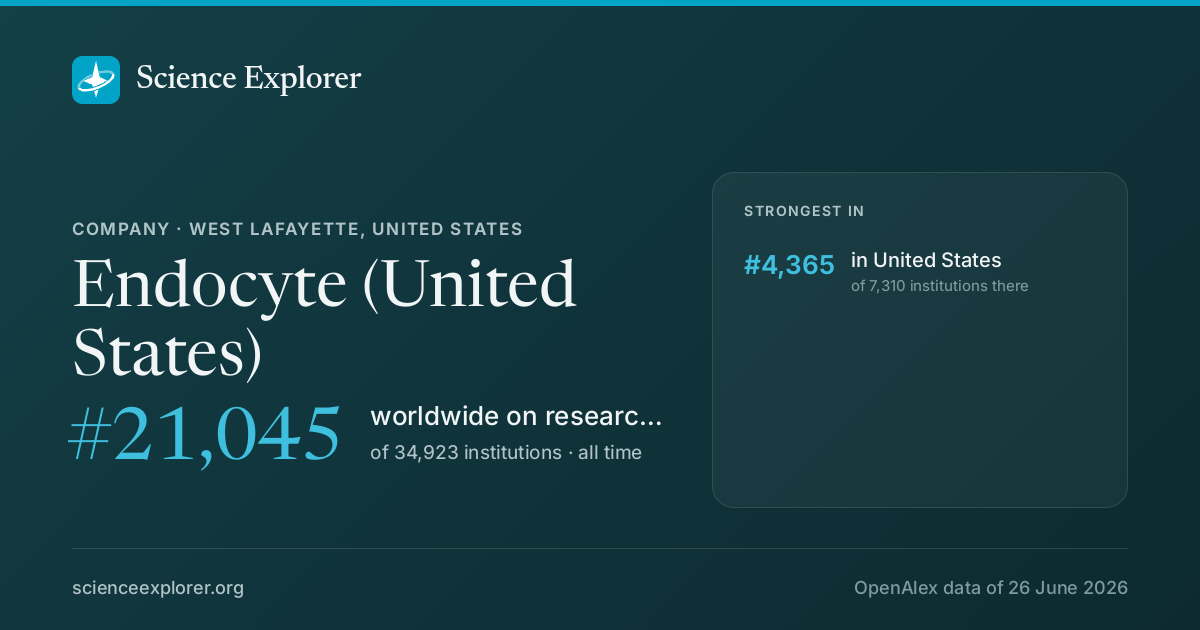
Endocyte (United States) on Science Explorer

A card with Endocyte (United States)'s standing and the fields it leads in, for a post or a slide. A link to this page previews as the same card.

Download the card

1200 × 630 PNG, sized for social posts, drawn from the latest snapshot.

Badges for a website1Each links back here and updates with every snapshot

Research measures only: rankings here say nothing about teaching, admissions or student experience. Comparable institutions and collaboration partners have tabs of their own, above.

Discussion

Ask a question or share a note about Endocyte (United States). Posts are plain text and can be reported.
