Science Explorer Back to mapMap
Discussion
University · Suez · ??

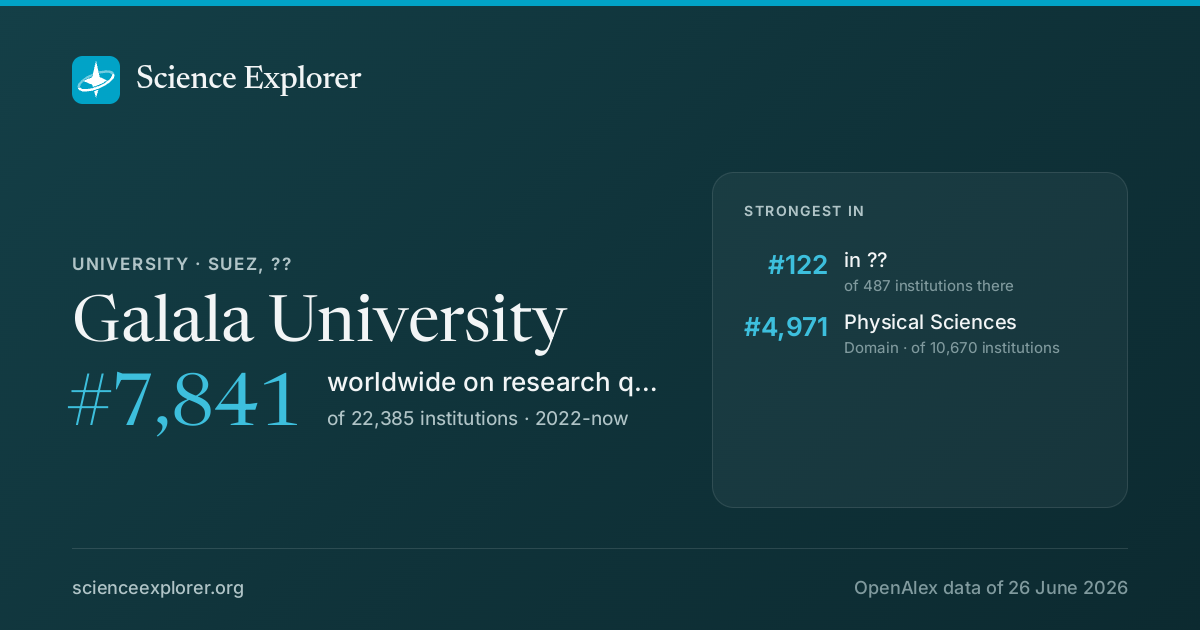
Galala University

In research, Galala University stands highest in Physical Sciences (#4,971 of 10,670 worldwide), 2022-now.

World rank, 2022-now
#7,841
of 22,385 · #14,163 all time
Rank in ??
#122
of 487
Research works
260
▲ 461% vs 2018-21
Citations
3.8k
14.8 per fractional work
Top-10% rate
19.0%
all institutions 10.0%
vs its own fields
1.13×
1.00× is exactly expected
Open access
62%
world 40%
International
46%
world 18%

What is Galala University known for in research?

The fields where it stands highest, 2022-now, ranked among every institution above the floor in each field.

FieldWorld rankWhere that sitsTop-10% rateWorksAll time
Physical SciencesDomain #4,971 of 10,670 19.9%112 #7666

Each strip is that field's whole ranked pool, with the notch where Galala University sits in it, in the colour of the band that rank falls in. The track under the rate is the rate itself: it carries no average mark, because the average differs by field (from about 6% in Dentistry to 21% in Economics).

Which fields of science does Galala University work in?

In 2022-now, 54% of research at Galala University is in Physical Sciences, 23% in Health Sciences. Its largest fields are Medicine (18%), Engineering (17%), Computer Science (13%). It does 1.4× the world's share of Physical Sciences.

Physical Sciences: 120 fractional works · 53.8% of its workEngineering: 38 fractional works · 16.9% of its workElectrical and Electronic Engineering: 10 fractional works · 4.4% of its workBiomedical Engineering: 8 fractional works · 3.8% of its workMechanical Engineering: 5 fractional works · 2.0% of its workBuilding and Construction: 3 fractional works · 1.2% of its workControl and Systems Engineering: 2 fractional works · 1.1% of its workCivil and Structural Engineering: 2 fractional works · 1.1% of its workAerospace Engineering: 2 fractional works · 0.9% of its workMechanics of Materials: 2 fractional works · 0.9% of its workIndustrial and Manufacturing Engineering: 1 fractional works · 0.4% of its workMedia Technology: 1 fractional works · 0.3% of its workOcean Engineering: 1 fractional works · 0.3% of its workAutomotive Engineering: 0 fractional works · 0.2% of its workComputational Mechanics: 0 fractional works · 0.2% of its workComputer Science: 30 fractional works · 13.4% of its workArtificial Intelligence: 16 fractional works · 7.2% of its workComputer Vision and Pattern Recognition: 4 fractional works · 1.8% of its workComputer Networks and Communications: 4 fractional works · 1.6% of its workComputational Theory and Mathematics: 2 fractional works · 0.8% of its workInformation Systems: 2 fractional works · 0.8% of its workSignal Processing: 1 fractional works · 0.5% of its workComputer Science Applications: 1 fractional works · 0.3% of its workHuman-Computer Interaction: 1 fractional works · 0.2% of its workSmaller subfields together: 0 fractional works · 0.2% of its workMaterials Science: 20 fractional works · 9.1% of its workMaterials Chemistry: 13 fractional works · 5.7% of its workBiomaterials: 3 fractional works · 1.2% of its workElectronic, Optical and Magnetic Materials: 2 fractional works · 1.1% of its workPolymers and Plastics: 2 fractional works · 0.7% of its workCeramics and Composites: 1 fractional works · 0.2% of its workSmaller subfields together: 0 fractional works · 0.1% of its workChemistry: 9 fractional works · 3.8% of its workOrganic Chemistry: 5 fractional works · 2.5% of its workInorganic Chemistry: 1 fractional works · 0.7% of its workElectrochemistry: 1 fractional works · 0.3% of its workAnalytical Chemistry: 1 fractional works · 0.2% of its workSmaller subfields together: 0 fractional works · 0.1% of its workEnvironmental Science: 8 fractional works · 3.4% of its workWater Science and Technology: 2 fractional works · 1.0% of its workPollution: 1 fractional works · 0.5% of its workEnvironmental Engineering: 1 fractional works · 0.5% of its workManagement, Monitoring, Policy and Law: 1 fractional works · 0.4% of its workIndustrial and Manufacturing Engineering: 1 fractional works · 0.3% of its workHealth, Toxicology and Mutagenesis: 1 fractional works · 0.3% of its workEcology: 0 fractional works · 0.2% of its workSmaller subfields together: 1 fractional works · 0.3% of its workEnergy: 7 fractional works · 3.0% of its workRenewable Energy, Sustainability and the Environment: 7 fractional works · 2.9% of its workSmaller subfields together: 0 fractional works · 0.1% of its workEarth and Planetary Sciences: 5 fractional works · 2.2% of its workGeophysics: 3 fractional works · 1.5% of its workEarth-Surface Processes: 1 fractional works · 0.3% of its workGeochemistry and Petrology: 1 fractional works · 0.3% of its workSmaller subfields together: 0 fractional works · 0.1% of its workMathematics: 2 fractional works · 0.9% of its workModeling and Simulation: 1 fractional works · 0.4% of its workNumerical Analysis: 0 fractional works · 0.2% of its workSmaller subfields together: 1 fractional works · 0.4% of its workPhysics and Astronomy: 2 fractional works · 0.8% of its workStatistical and Nonlinear Physics: 1 fractional works · 0.4% of its workAtomic and Molecular Physics, and Optics: 1 fractional works · 0.3% of its workSmaller subfields together: 0 fractional works · 0.1% of its workChemical Engineering: 1 fractional works · 0.3% of its workHealth Sciences: 51 fractional works · 22.9% of its workMedicine: 40 fractional works · 18.1% of its workRadiology, Nuclear Medicine and Imaging: 4 fractional works · 1.7% of its workSurgery: 3 fractional works · 1.3% of its workOncology: 3 fractional works · 1.3% of its workPulmonary and Respiratory Medicine: 2 fractional works · 1.1% of its workEpidemiology: 2 fractional works · 1.0% of its workComplementary and alternative medicine: 2 fractional works · 1.0% of its workPhysiology: 2 fractional works · 0.9% of its workPathology and Forensic Medicine: 2 fractional works · 0.8% of its workInfectious Diseases: 2 fractional works · 0.8% of its workCardiology and Cardiovascular Medicine: 2 fractional works · 0.7% of its workPharmacology: 2 fractional works · 0.7% of its workRheumatology: 1 fractional works · 0.6% of its workPublic Health, Environmental and Occupational Health: 1 fractional works · 0.6% of its workEndocrinology, Diabetes and Metabolism: 1 fractional works · 0.6% of its workDermatology: 1 fractional works · 0.6% of its workPsychiatry and Mental health: 1 fractional works · 0.5% of its workOrthopedics and Sports Medicine: 1 fractional works · 0.4% of its workGenetics: 1 fractional works · 0.4% of its workRehabilitation: 1 fractional works · 0.4% of its workUrology: 1 fractional works · 0.4% of its workHealth Informatics: 1 fractional works · 0.3% of its workNeurology: 1 fractional works · 0.3% of its workHematology: 1 fractional works · 0.3% of its workGeriatrics and Gerontology: 1 fractional works · 0.2% of its workSmaller subfields together: 3 fractional works · 1.3% of its workDentistry: 6 fractional works · 2.6% of its workOrthodontics: 2 fractional works · 1.1% of its workOral Surgery: 2 fractional works · 1.1% of its workSmaller subfields together: 1 fractional works · 0.4% of its workHealth Professions: 3 fractional works · 1.2% of its workHealth Information Management: 1 fractional works · 0.5% of its workSmaller subfields together: 1 fractional works · 0.6% of its workNursing: 2 fractional works · 0.8% of its workNutrition and Dietetics: 2 fractional works · 0.8% of its workSmaller subfields together: 0 fractional works · 0.0% of its workVeterinary: 1 fractional works · 0.2% of its workLife Sciences: 37 fractional works · 16.8% of its workBiochemistry, Genetics and Molecular Biology: 14 fractional works · 6.4% of its workMolecular Biology: 8 fractional works · 3.7% of its workBiotechnology: 1 fractional works · 0.6% of its workMolecular Medicine: 1 fractional works · 0.5% of its workCancer Research: 1 fractional works · 0.5% of its workCell Biology: 1 fractional works · 0.4% of its workGenetics: 1 fractional works · 0.3% of its workSmaller subfields together: 1 fractional works · 0.5% of its workAgricultural and Biological Sciences: 13 fractional works · 6.0% of its workPlant Science: 8 fractional works · 3.7% of its workFood Science: 3 fractional works · 1.2% of its workAnimal Science and Zoology: 1 fractional works · 0.3% of its workInsect Science: 1 fractional works · 0.3% of its workSmaller subfields together: 1 fractional works · 0.6% of its workNeuroscience: 5 fractional works · 2.3% of its workNeurology: 2 fractional works · 1.1% of its workCognitive Neuroscience: 2 fractional works · 0.8% of its workCellular and Molecular Neuroscience: 1 fractional works · 0.3% of its workSmaller subfields together: 0 fractional works · 0.1% of its workPharmacology, Toxicology and Pharmaceutics: 3 fractional works · 1.2% of its workPharmacology: 1 fractional works · 0.6% of its workPharmaceutical Science: 1 fractional works · 0.5% of its workSmaller subfields together: 0 fractional works · 0.1% of its workImmunology and Microbiology: 2 fractional works · 1.0% of its workImmunology: 1 fractional works · 0.5% of its workMicrobiology: 1 fractional works · 0.3% of its workSmaller subfields together: 1 fractional works · 0.2% of its workSocial Sciences: 14 fractional works · 6.5% of its workSocial Sciences: 8 fractional works · 3.4% of its workSociology and Political Science: 2 fractional works · 1.0% of its workEducation: 1 fractional works · 0.6% of its workTransportation: 1 fractional works · 0.6% of its workUrban Studies: 1 fractional works · 0.6% of its workSmaller subfields together: 1 fractional works · 0.7% of its workPsychology: 3 fractional works · 1.6% of its workClinical Psychology: 1 fractional works · 0.5% of its workExperimental and Cognitive Psychology: 1 fractional works · 0.4% of its workDevelopmental and Educational Psychology: 1 fractional works · 0.3% of its workSocial Psychology: 1 fractional works · 0.3% of its workSmaller subfields together: 0 fractional works · 0.1% of its workArts and Humanities: 1 fractional works · 0.5% of its workArcheology: 1 fractional works · 0.5% of its workSmaller subfields together: 0 fractional works · 0.0% of its workBusiness, Management and Accounting: 1 fractional works · 0.4% of its workEconomics, Econometrics and Finance: 1 fractional works · 0.3% of its workDecision Sciences: 1 fractional works · 0.3% of its workALL ITS WORKGalala University222fractional works, 2022-now
Life Sciences17%Physical Sciences54%Health Sciences23%Social Sciences6%

Each ring splits the one inside it: the four domains of science, their fields, their subfields. Size is fractional works in 2022-now. Every slice is a page; the interactive view zooms down to single topics and colours each by how much more of it this institution does than the world.

Its 4 domains and 26 fields, with their numbers
    1. Engineering3816.9%
    2. Computer Science3013.4%
    3. Materials Science209.1%
    4. Chemistry93.8%
    5. Environmental Science83.4%
    6. Energy73.0%
    7. Earth and Planetary Sciences52.2%
    8. Mathematics20.9%
    9. Physics and Astronomy20.8%
    10. Chemical Engineering10.3%
    1. Medicine4018.1%
    2. Dentistry62.6%
    3. Health Professions31.2%
    4. Nursing20.8%
    5. Veterinary10.2%
    1. Biochemistry, Genetics and Molecular Biology146.4%
    2. Agricultural and Biological Sciences136.0%
    3. Neuroscience52.3%
    4. Pharmacology, Toxicology and Pharmaceutics31.2%
    5. Immunology and Microbiology21.0%
    1. Social Sciences83.4%
    2. Psychology31.6%
    3. Arts and Humanities10.5%
    4. Business, Management and Accounting10.4%
    5. Economics, Econometrics and Finance10.3%
    6. Decision Sciences10.3%
All of science, and how each field's share has moved since 1950: the Science domain explorer

Field profile

Location quotient across every field it publishes in: outside the ring is more than an institution of this size would be expected to publish, inside it is less.

Agricultural and Biological Sciences: 1.25× its world share, 13 worksAgricultural and Bio…Biochemistry, Genetics and Molecular Biology: 1.20× its world share, 14 worksBiochemistry, Geneti…Immunology and Microbiology: 0.99× its world share, 2 worksImmunology and Micro…Neuroscience: 1.43× its world share, 5 worksNeurosciencePharmacology, Toxicology and Pharmaceutics: 3.27× its world share, 3 worksPharmacology, Toxico…Chemical Engineering: 0.92× its world share, 1 worksChemical EngineeringChemistry: 2.44× its world share, 8 worksChemistryComputer Science: 1.72× its world share, 30 worksComputer ScienceEarth and Planetary Sciences: 1.38× its world share, 5 worksEarth and Planetary …Energy: 3.30× its world share, 7 worksEnergyEngineering: 1.13× its world share, 38 worksEngineeringEnvironmental Science: 0.68× its world share, 8 worksEnvironmental ScienceMaterials Science: 2.59× its world share, 20 worksMaterials ScienceMathematics: 0.77× its world share, 2 worksMathematicsPhysics and Astronomy: 0.37× its world share, 2 worksPhysics and AstronomyDentistry: 5.29× its world share, 6 worksDentistryHealth Professions: 0.45× its world share, 3 worksHealth ProfessionsMedicine: 0.94× its world share, 40 worksMedicineNursing: 1.67× its world share, 2 worksNursingVeterinary: 1.73× its world share, 0 worksVeterinaryArts and Humanities: 0.18× its world share, 1 worksArts and HumanitiesBusiness, Management and Accounting: 0.13× its world share, 1 worksBusiness, Management…Decision Sciences: 0.28× its world share, 1 worksDecision SciencesEconomics, Econometrics and Finance: 0.16× its world share, 1 worksEconomics, Econometr…Psychology: 0.51× its world share, 4 worksPsychologySocial Sciences: 0.27× its world share, 8 worksSocial Sciences1×world share
more than its size predictsabout as predictedless

Rings at 0.5×, 1× and 2×. Widest outward: Dentistry, 5.3×. Every wedge is a field page.

All 26 fields, with their numbers
  1. Dentistry5.29×6 works
  2. Energy3.30×7 works
  3. Pharmacology, Toxicology and Pharmaceutics3.27×3 works
  4. Materials Science2.59×20 works
  5. Chemistry2.44×8 works
  6. Veterinary1.73×0 works
  7. Computer Science1.72×30 works
  8. Nursing1.67×2 works
  9. Neuroscience1.43×5 works
  10. Earth and Planetary Sciences1.38×5 works
  11. Agricultural and Biological Sciences1.25×13 works
  12. Biochemistry, Genetics and Molecular Biology1.20×14 works
  13. Engineering1.13×38 works
  14. Immunology and Microbiology0.99×2 works
  15. Medicine0.94×40 works
  16. Chemical Engineering0.92×1 works
  17. Mathematics0.77×2 works
  18. Environmental Science0.68×8 works
  19. Psychology0.51×4 works
  20. Health Professions0.45×3 works
  21. Physics and Astronomy0.37×2 works
  22. Decision Sciences0.28×1 works
  23. Social Sciences0.27×8 works
  24. Arts and Humanities0.18×1 works
  25. Economics, Econometrics and Finance0.16×1 works
  26. Business, Management and Accounting0.13×1 works

Who are the top researchers at Galala University?

Ranked on the quality score, Shaker El-Sappagh lead among researchers whose main affiliation is Galala University.

  1. 1 Shaker El-Sappagh #2,173,643 worldwide 6 citations · 20 works
All ranked researchers at Galala University

What are the most cited papers from Galala University?

The most cited paper from Galala University is "Explainable Artificial Intelligence (XAI): What we know and what is left to attain Trustworthy Artificial Intelligence" (Sajid Ali, Tamer Abuhmed, Shaker El–Sappagh et al., 2023), with 1,716 citations. Next come "Reptile Search Algorithm (RSA): A nature-inspired meta-heuristic optimizer" (1,443) and "An advanced deep learning models-based plant disease detection: A review of recent research" (490).

Most cited papers
#PaperReleasedCitations
1 Explainable Artificial Intelligence (XAI): What we know and what is left to attain Trustworthy Artificial Intelligence Sajid Ali, Tamer Abuhmed, Shaker El–Sappagh et al. · Information Fusion Open access 18 Apr 2023 1,716
2 Reptile Search Algorithm (RSA): A nature-inspired meta-heuristic optimizer Laith Abualigah, Mohamed Abd Elaziz, Putra Sumari et al. · Expert Systems with Applications 5 Nov 2021 1,443
3 An advanced deep learning models-based plant disease detection: A review of recent research Muhammad Ali Shoaib, Babar Shah, Shaker El–Sappagh et al. · Frontiers in Plant Science Open access 21 Mar 2023 490
4 Brucellosis: epidemiology, pathogenesis, diagnosis and treatment–a comprehensive review Kamal A. Qureshi, Adil Parvez, Nada A. Fahmy et al. · Annals of Medicine Open access 12 Dec 2023 310
5 Preparation methods of different nanomaterials for various potential applications: A review Ahmed M. El‐Khawaga, Alaa Magdy Abdelmordy Zidan, Ahmed I. A. Abd El‐Mageed · Journal of Molecular Structure 12 Feb 2023 259
All 59 most cited papers, with filters and sorting

Which keywords describe research at Galala University?

By fractional works in 2022-now, weighted toward what it does more of than the world: Nanomaterials, Machine Learning, Deep Learning, Nanoparticles, Biomedical Applications, Antimicrobial, Toxicity and Graphene.

▲ more of its work than of the world's◆ about the world's share▼ less than the world's

Size is fractional works in 2022-now in the topics tagged with each word; colour is the word's share of this institution's work against its share of the world's. The 40 words are chosen for being large and distinctive. Each links to the topic it comes from most.

All 40 words, with their numbers
  1. Deep Learning21▲ 2.7×53 topics
  2. Machine Learning21▲ 2.8×50 topics
  3. Nanomaterials14▲ 6.2×15 topics
  4. Nanoparticles10▲ 3.7×25 topics
  5. Biomedical Applications9▲ 3.5×26 topics
  6. Antioxidant7▲ 4.7×31 topics
  7. Graphene7▲ 4.8×9 topics
  8. Inflammation7▲ 1.49×44 topics
  9. Toxicity6▲ 6.6×15 topics
  10. Antimicrobial6▲ 9.5×11 topics
  11. Oxidative Stress6▲ 1.63×38 topics
  12. Cancer6▲ 1.91×27 topics
  13. Drug Delivery6▲ 4.6×13 topics
  14. Metal-Organic Frameworks5▲ 5.8×4 topics
  15. Nanocomposites5▲ 3.0×15 topics
  16. Green Synthesis5▲ 12×3 topics
  17. Medical Imaging5▲ 4.4×7 topics
  18. Feature Extraction5▲ 4.8×7 topics
  19. Water Splitting5▲ 5.9×4 topics
  20. Classification5▲ 4.5×10 topics
  21. Convolutional Neural Networks5▲ 2.9×10 topics
  22. Synthesis4▲ 5.4×15 topics
  23. Biosynthesis4▲ 12×5 topics
  24. Tissue Engineering4▲ 3.1×8 topics
  25. Nanostructures4▲ 4.5×8 topics
  26. Precision Medicine4▲ 3.6×6 topics
  27. Cytotoxicity4▲ 13×5 topics
  28. Visible Light4▲ 7.1×3 topics
  29. Solar Energy4▲ 5.0×4 topics
  30. Evolutionary Algorithms3▲ 15×4 topics
  31. Anti-inflammatory3▲ 5.2×16 topics
  32. Biological Synthesis3▲ 20×1 topic
  33. Silver3▲ 20×1 topic
  34. Transfer Learning3▲ 7.7×3 topics
  35. Convolutional Neural Network3▲ 9.1×4 topics
  36. Medicinal Chemistry3▲ 5.1×7 topics
  37. Particle Swarm Optimization3▲ 11×4 topics
  38. Anticancer Agents3▲ 8.7×7 topics
  39. Medical Image Analysis3▲ 6.8×4 topics
  40. Image Segmentation2▲ 9.3×2 topics

Which research topics does Galala University publish most on?

By volume in 2022-now: Nanoparticles: synthesis and applications, Brain Tumor Detection and Classification, Advanced Photocatalysis Techniques and Metaheuristic Optimization Algorithms Research.

  1. 1 Nanoparticles: synthesis and applications Materials Chemistry 3 works
  2. 2 Brain Tumor Detection and Classification Neurology 2 works
  3. 3 Advanced Photocatalysis Techniques Renewable Energy, Sustainability and the Environment 2 works
  4. 4 Metaheuristic Optimization Algorithms Research Artificial Intelligence 2 works
  5. 5 Machine Learning in Healthcare Artificial Intelligence 2 works
  6. 6 Geological and Geochemical Analysis Geophysics 2 works
  7. 7 Geochemistry and Geologic Mapping Artificial Intelligence 2 works
  8. 8 Dental materials and restorations Orthodontics 2 works
  9. 9 Electrocatalysts for Energy Conversion Renewable Energy, Sustainability and the Environment 2 works
  10. 10 Advanced Nanomaterials in Catalysis Materials Chemistry 2 works

How open and international is its research?

Against the world's own shares: the tick on each track. Both are shares of its output, so they sit on one scale and can be read against each other as well as against the world.

openly available61.5%not open38.5%

World: 40% of research is openly available.

with international co-authors46.5%domestic only53.5%

World: 18% is written across borders.

How has Galala University's research output changed?

Output in 2022-2025 was 461% higher than in 2018-2021.

still counting201520202025
grewheldshrank

The same series as a ribbon: one cell per year, darker for more. The line above answers how much; this answers when.

Share Galala University's ranking

Galala University on Science Explorer

A card with Galala University's standing and the fields it leads in, for a post or a slide. A link to this page previews as the same card.

Download the card

1200 × 630 PNG, sized for social posts, drawn from the latest snapshot.

Badges for a website1Each links back here and updates with every snapshot

Research measures only: rankings here say nothing about teaching, admissions or student experience. Comparable institutions and collaboration partners have tabs of their own, above.

Discussion

Ask a question or share a note about Galala University. Keep it to the research: no personal attacks, advertising or links. Any reader can report a post, which collapses it for everyone until it is opened.