Science Explorer Back to mapMap
Discussion
University · Gurugram · India

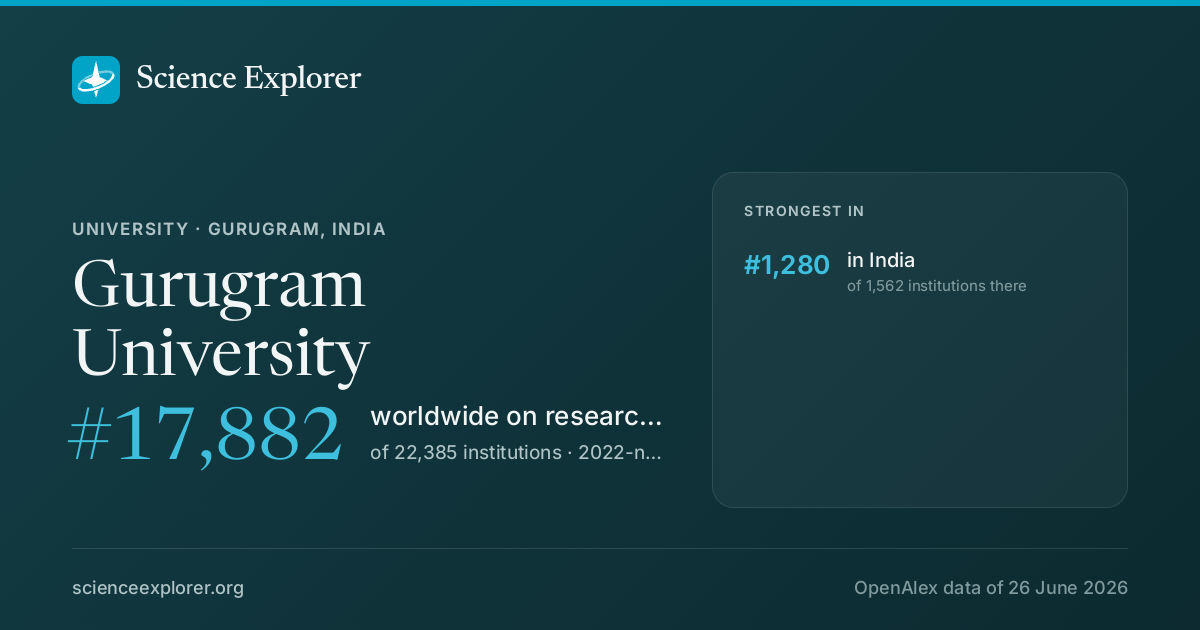
Gurugram University

World rank, 2022-now
#17,882
of 22,385
Rank in India
#1,280
of 1,562
Research works
86
▲ 1057% vs 2018-21
Citations
442
5.2 per fractional work
Top-10% rate
8.1%
all institutions 10.0%
vs its own fields
0.93×
1.00× is exactly expected
Open access
39%
world 40%
International
22%
world 18%

Which fields of science does Gurugram University work in?

In 2022-now, 43% of research at Gurugram University is in Physical Sciences, 25% in Social Sciences. Its largest fields are Medicine (14%), Engineering (10%), Social Sciences (10%).

Physical Sciences: 34 fractional works · 42.6% of its workEngineering: 8 fractional works · 9.8% of its workBiomedical Engineering: 2 fractional works · 2.8% of its workElectrical and Electronic Engineering: 2 fractional works · 2.0% of its workMechanics of Materials: 1 fractional works · 1.6% of its workControl and Systems Engineering: 1 fractional works · 0.9% of its workMechanical Engineering: 0 fractional works · 0.6% of its workAutomotive Engineering: 0 fractional works · 0.5% of its workBuilding and Construction: 0 fractional works · 0.3% of its workCivil and Structural Engineering: 0 fractional works · 0.3% of its workIndustrial and Manufacturing Engineering: 0 fractional works · 0.2% of its workMedia Technology: 0 fractional works · 0.2% of its workSmaller subfields together: 0 fractional works · 0.4% of its workComputer Science: 7 fractional works · 9.1% of its workArtificial Intelligence: 2 fractional works · 2.7% of its workComputer Vision and Pattern Recognition: 1 fractional works · 1.6% of its workInformation Systems: 1 fractional works · 1.6% of its workComputational Theory and Mathematics: 1 fractional works · 1.5% of its workComputer Networks and Communications: 1 fractional works · 1.0% of its workHuman-Computer Interaction: 0 fractional works · 0.4% of its workComputer Science Applications: 0 fractional works · 0.3% of its workSignal Processing: 0 fractional works · 0.2% of its workMaterials Science: 6 fractional works · 7.1% of its workMaterials Chemistry: 3 fractional works · 3.2% of its workBiomaterials: 2 fractional works · 1.9% of its workPolymers and Plastics: 1 fractional works · 1.1% of its workElectronic, Optical and Magnetic Materials: 1 fractional works · 1.0% of its workChemistry: 4 fractional works · 4.6% of its workOrganic Chemistry: 2 fractional works · 3.0% of its workInorganic Chemistry: 0 fractional works · 0.6% of its workSpectroscopy: 0 fractional works · 0.6% of its workSmaller subfields together: 0 fractional works · 0.3% of its workPhysics and Astronomy: 4 fractional works · 4.5% of its workAstronomy and Astrophysics: 2 fractional works · 2.2% of its workStatistical and Nonlinear Physics: 1 fractional works · 0.9% of its workNuclear and High Energy Physics: 1 fractional works · 0.7% of its workAtomic and Molecular Physics, and Optics: 0 fractional works · 0.3% of its workRadiation: 0 fractional works · 0.3% of its workSmaller subfields together: 0 fractional works · 0.1% of its workEnvironmental Science: 2 fractional works · 3.1% of its workEcology: 0 fractional works · 0.6% of its workIndustrial and Manufacturing Engineering: 0 fractional works · 0.6% of its workManagement, Monitoring, Policy and Law: 0 fractional works · 0.5% of its workGlobal and Planetary Change: 0 fractional works · 0.4% of its workPollution: 0 fractional works · 0.4% of its workWater Science and Technology: 0 fractional works · 0.3% of its workEnvironmental Engineering: 0 fractional works · 0.2% of its workSmaller subfields together: 0 fractional works · 0.1% of its workMathematics: 1 fractional works · 1.4% of its workGeometry and Topology: 1 fractional works · 0.7% of its workNumerical Analysis: 0 fractional works · 0.6% of its workSmaller subfields together: 0 fractional works · 0.2% of its workEarth and Planetary Sciences: 1 fractional works · 1.3% of its workOceanography: 0 fractional works · 0.6% of its workGeophysics: 0 fractional works · 0.3% of its workGeochemistry and Petrology: 0 fractional works · 0.3% of its workSmaller subfields together: 0 fractional works · 0.1% of its workEnergy: 1 fractional works · 1.1% of its workRenewable Energy, Sustainability and the Environment: 1 fractional works · 1.1% of its workChemical Engineering: 1 fractional works · 0.7% of its workCatalysis: 0 fractional works · 0.3% of its workSmaller subfields together: 0 fractional works · 0.4% of its workSocial Sciences: 20 fractional works · 25.5% of its workSocial Sciences: 8 fractional works · 9.7% of its workGender Studies: 2 fractional works · 2.2% of its workSociology and Political Science: 2 fractional works · 2.1% of its workEducation: 1 fractional works · 1.7% of its workSafety Research: 1 fractional works · 0.9% of its workPolitical Science and International Relations: 1 fractional works · 0.7% of its workDemography: 0 fractional works · 0.6% of its workHealth: 0 fractional works · 0.4% of its workHuman Factors and Ergonomics: 0 fractional works · 0.3% of its workUrban Studies: 0 fractional works · 0.3% of its workAnthropology: 0 fractional works · 0.2% of its workDevelopment: 0 fractional works · 0.2% of its workSmaller subfields together: 0 fractional works · 0.1% of its workBusiness, Management and Accounting: 5 fractional works · 6.7% of its workStrategy and Management: 2 fractional works · 2.6% of its workOrganizational Behavior and Human Resource Management: 1 fractional works · 1.4% of its workMarketing: 1 fractional works · 1.2% of its workAccounting: 0 fractional works · 0.6% of its workBusiness and International Management: 0 fractional works · 0.4% of its workManagement of Technology and Innovation: 0 fractional works · 0.3% of its workSmaller subfields together: 0 fractional works · 0.2% of its workArts and Humanities: 3 fractional works · 3.4% of its workVisual Arts and Performing Arts: 2 fractional works · 2.3% of its workLiterature and Literary Theory: 1 fractional works · 0.9% of its workPhilosophy: 0 fractional works · 0.2% of its workPsychology: 2 fractional works · 2.9% of its workSocial Psychology: 1 fractional works · 1.7% of its workClinical Psychology: 1 fractional works · 0.7% of its workDevelopmental and Educational Psychology: 0 fractional works · 0.3% of its workSmaller subfields together: 0 fractional works · 0.2% of its workEconomics, Econometrics and Finance: 1 fractional works · 1.8% of its workEconomics and Econometrics: 1 fractional works · 1.5% of its workGeneral Economics, Econometrics and Finance: 0 fractional works · 0.2% of its workSmaller subfields together: 0 fractional works · 0.1% of its workDecision Sciences: 1 fractional works · 1.0% of its workManagement Science and Operations Research: 0 fractional works · 0.6% of its workInformation Systems and Management: 0 fractional works · 0.4% of its workHealth Sciences: 13 fractional works · 16.9% of its workMedicine: 11 fractional works · 13.6% of its workRheumatology: 1 fractional works · 1.4% of its workPulmonary and Respiratory Medicine: 1 fractional works · 1.0% of its workOrthopedics and Sports Medicine: 1 fractional works · 1.0% of its workRadiology, Nuclear Medicine and Imaging: 1 fractional works · 0.9% of its workComplementary and alternative medicine: 1 fractional works · 0.9% of its workPublic Health, Environmental and Occupational Health: 1 fractional works · 0.8% of its workPharmacology: 1 fractional works · 0.7% of its workOncology: 1 fractional works · 0.7% of its workNeurology: 1 fractional works · 0.7% of its workBiochemistry: 0 fractional works · 0.6% of its workPathology and Forensic Medicine: 0 fractional works · 0.6% of its workSurgery: 0 fractional works · 0.6% of its workPhysiology: 0 fractional works · 0.6% of its workEndocrinology, Diabetes and Metabolism: 0 fractional works · 0.5% of its workPsychiatry and Mental health: 0 fractional works · 0.4% of its workRehabilitation: 0 fractional works · 0.4% of its workEpidemiology: 0 fractional works · 0.4% of its workInfectious Diseases: 0 fractional works · 0.2% of its workEmergency Medicine: 0 fractional works · 0.2% of its workSmaller subfields together: 1 fractional works · 0.8% of its workHealth Professions: 2 fractional works · 2.4% of its workRadiological and Ultrasound Technology: 1 fractional works · 1.0% of its workGeneral Health Professions: 1 fractional works · 0.6% of its workHealth Information Management: 0 fractional works · 0.5% of its workSmaller subfields together: 0 fractional works · 0.2% of its workNursing: 1 fractional works · 0.8% of its workNutrition and Dietetics: 1 fractional works · 0.8% of its workDentistry: 0 fractional works · 0.2% of its workLife Sciences: 12 fractional works · 15.0% of its workBiochemistry, Genetics and Molecular Biology: 5 fractional works · 5.7% of its workMolecular Biology: 4 fractional works · 4.5% of its workMolecular Medicine: 0 fractional works · 0.3% of its workGenetics: 0 fractional works · 0.2% of its workCell Biology: 0 fractional works · 0.2% of its workSmaller subfields together: 0 fractional works · 0.4% of its workPharmacology, Toxicology and Pharmaceutics: 4 fractional works · 4.5% of its workPharmaceutical Science: 2 fractional works · 3.0% of its workPharmacology: 1 fractional works · 1.0% of its workDrug Discovery: 0 fractional works · 0.3% of its workSmaller subfields together: 0 fractional works · 0.1% of its workAgricultural and Biological Sciences: 3 fractional works · 3.5% of its workPlant Science: 2 fractional works · 1.9% of its workGeneral Agricultural and Biological Sciences: 0 fractional works · 0.6% of its workFood Science: 0 fractional works · 0.5% of its workSoil Science: 0 fractional works · 0.5% of its workNeuroscience: 1 fractional works · 1.0% of its workNeurology: 0 fractional works · 0.6% of its workCognitive Neuroscience: 0 fractional works · 0.4% of its workSmaller subfields together: 0 fractional works · 0.1% of its workImmunology and Microbiology: 0 fractional works · 0.3% of its workALL ITS WORKGurugramUniversity80fractional works, 2022-now
Life Sciences15%Physical Sciences43%Health Sciences17%Social Sciences25%

Each ring splits the one inside it: the four domains of science, their fields, their subfields. Size is fractional works in 2022-now. Every slice is a page; the interactive view zooms down to single topics and colours each by how much more of it this institution does than the world.

Its 4 domains and 25 fields, with their numbers
    1. Engineering89.8%
    2. Computer Science79.1%
    3. Materials Science67.1%
    4. Chemistry44.6%
    5. Physics and Astronomy44.5%
    6. Environmental Science23.1%
    7. Mathematics11.4%
    8. Earth and Planetary Sciences11.3%
    9. Energy11.1%
    10. Chemical Engineering10.7%
    1. Social Sciences89.7%
    2. Business, Management and Accounting56.7%
    3. Arts and Humanities33.4%
    4. Psychology22.9%
    5. Economics, Econometrics and Finance11.8%
    6. Decision Sciences11.0%
    1. Medicine1113.6%
    2. Health Professions22.4%
    3. Nursing10.8%
    4. Dentistry00.2%
    1. Biochemistry, Genetics and Molecular Biology55.7%
    2. Pharmacology, Toxicology and Pharmaceutics44.5%
    3. Agricultural and Biological Sciences33.5%
    4. Neuroscience11.0%
    5. Immunology and Microbiology00.3%
All of science, and how each field's share has moved since 1950: the Science domain explorer

Field profile

Location quotient across every field it publishes in: outside the ring is more than an institution of this size would be expected to publish, inside it is less.

Agricultural and Biological Sciences: 0.73× its world share, 3 worksAgricultural and Bio…Biochemistry, Genetics and Molecular Biology: 1.07× its world share, 4 worksBiochemistry, Geneti…Immunology and Microbiology: 0.34× its world share, 0 worksImmunology and Micro…Neuroscience: 0.62× its world share, 1 worksNeurosciencePharmacology, Toxicology and Pharmaceutics: 12.66× its world share, 4 worksPharmacology, Toxico…Chemical Engineering: 1.99× its world share, 1 worksChemical EngineeringChemistry: 2.93× its world share, 4 worksChemistryComputer Science: 1.17× its world share, 7 worksComputer ScienceEarth and Planetary Sciences: 0.81× its world share, 1 worksEarth and Planetary …Energy: 1.16× its world share, 1 worksEnergyEngineering: 0.66× its world share, 8 worksEngineeringEnvironmental Science: 0.63× its world share, 2 worksEnvironmental ScienceMaterials Science: 2.03× its world share, 6 worksMaterials ScienceMathematics: 1.20× its world share, 1 worksMathematicsPhysics and Astronomy: 2.01× its world share, 4 worksPhysics and AstronomyDentistry: 0.36× its world share, 0 worksDentistryHealth Professions: 0.91× its world share, 2 worksHealth ProfessionsMedicine: 0.71× its world share, 11 worksMedicineNursing: 1.64× its world share, 1 worksNursingArts and Humanities: 1.18× its world share, 3 worksArts and HumanitiesBusiness, Management and Accounting: 2.07× its world share, 5 worksBusiness, Management…Decision Sciences: 1.00× its world share, 1 worksDecision SciencesEconomics, Econometrics and Finance: 0.85× its world share, 1 worksEconomics, Econometr…Psychology: 0.96× its world share, 2 worksPsychologySocial Sciences: 0.77× its world share, 8 worksSocial Sciences1×world share
more than its size predictsabout as predictedless

Rings at 0.5×, 1× and 2×. Widest outward: Pharmacology, Toxicology and Pharmaceutics, 12.7×. Every wedge is a field page.

All 25 fields, with their numbers
  1. Pharmacology, Toxicology and Pharmaceutics12.66×4 works
  2. Chemistry2.93×4 works
  3. Business, Management and Accounting2.07×5 works
  4. Materials Science2.03×6 works
  5. Physics and Astronomy2.01×4 works
  6. Chemical Engineering1.99×1 works
  7. Nursing1.64×1 works
  8. Mathematics1.20×1 works
  9. Arts and Humanities1.18×3 works
  10. Computer Science1.17×7 works
  11. Energy1.16×1 works
  12. Biochemistry, Genetics and Molecular Biology1.07×4 works
  13. Decision Sciences1.00×1 works
  14. Psychology0.96×2 works
  15. Health Professions0.91×2 works
  16. Economics, Econometrics and Finance0.85×1 works
  17. Earth and Planetary Sciences0.81×1 works
  18. Social Sciences0.77×8 works
  19. Agricultural and Biological Sciences0.73×3 works
  20. Medicine0.71×11 works
  21. Engineering0.66×8 works
  22. Environmental Science0.63×2 works
  23. Neuroscience0.62×1 works
  24. Dentistry0.36×0 works
  25. Immunology and Microbiology0.34×0 works

What are the most cited papers from Gurugram University?

The most cited paper from Gurugram University is "Role of Nanotechnology in Electronics: A Review of Recent Developments and Patents" (Payal Payal, Parijat Pandey, 2021), with 137 citations. Next come "The performance improvement analysis using Six Sigma DMAIC methodology: A case study on Indian manufacturing company" (86) and "The study of remote working outcome and its influence on firm performance" (63).

Most cited papers
#PaperReleasedCitations
1 Role of Nanotechnology in Electronics: A Review of Recent Developments and Patents Payal Payal, Parijat Pandey · Recent Patents on Nanotechnology 26 Jan 2021 137
2 The performance improvement analysis using Six Sigma DMAIC methodology: A case study on Indian manufacturing company Ankesh Mittal, Pardeep Kumar Gupta, Vimal Kumar et al. · Heliyon Open access Mar 2023 86
3 The study of remote working outcome and its influence on firm performance Rohit Raj, Vimal Kumar, Nagendra Kumar Sharma et al. · Social Sciences & Humanities Open Open access 2023 63
4 Exploration of therapeutic applicability and different signaling mechanism of various phytopharmacological agents for treatment of breast cancer Vandana Singh, Kuldeep Kumar, Deepika Purohit et al. · Biomedicine & Pharmacotherapy Open access 10 May 2021 61
5 Revisiting the EKC framework concerning COP-28 carbon neutrality management: Evidence from Top-5 carbon embittering countries Ritika Chopra, Mubeen Abdur Rehman, Anshita Yadav et al. · Journal of Environmental Management Open access 27 Mar 2024 53
All 60 most cited papers, with filters and sorting

Which keywords describe research at Gurugram University?

By fractional works in 2022-now, weighted toward what it does more of than the world: Nanoparticles, Antioxidant, Globalization, Bollywood, Indian cinema, Biomedical Applications, Bioactive Compounds and Alzheimer's Disease.

▲ more of its work than of the world's◆ about the world's share▼ less than the world's

Size is fractional works in 2022-now in the topics tagged with each word; colour is the word's share of this institution's work against its share of the world's. The 40 words are chosen for being large and distinctive. Each links to the topic it comes from most.

All 40 words, with their numbers
  1. Nanoparticles4▲ 4.3×15 topics
  2. Globalization4▲ 2.5×12 topics
  3. Antioxidant3▲ 5.3×14 topics
  4. Biomedical Applications3▲ 3.0×15 topics
  5. Machine Learning3◆ 1.05×22 topics
  6. Nanomaterials2▲ 2.8×10 topics
  7. Environmental Impact2▲ 1.40×10 topics
  8. Nanocomposites2▲ 3.0×8 topics
  9. Bioactive Compounds2▲ 8.8×6 topics
  10. Bollywood2▲ 117×1 topic
  11. Indian cinema2▲ 117×1 topic
  12. Oxidative Stress2▲ 1.37×12 topics
  13. Alzheimer's Disease2▲ 7.7×6 topics
  14. Drug Delivery2▲ 4.0×6 topics
  15. Tissue Engineering2▲ 3.6×7 topics
  16. Antimicrobial2▲ 7.0×6 topics
  17. Cancer2▲ 1.50×6 topics
  18. Social Media2▲ 1.48×7 topics
  19. Graphene1▲ 2.7×6 topics
  20. Toxicity1▲ 4.0×5 topics
  21. Cancer Therapy1▲ 2.8×5 topics
  22. Intersectionality1▲ 8.3×4 topics
  23. Phytochemistry1▲ 14×3 topics
  24. Synthesis1▲ 4.5×11 topics
  25. Anti-inflammatory1▲ 5.3×6 topics
  26. Anticancer Agents1▲ 9.8×6 topics
  27. Autoantibodies1▲ 6.5×4 topics
  28. Environmental Management1▲ 3.7×6 topics
  29. Flavonoids1▲ 6.1×5 topics
  30. Herbal Medicine1▲ 5.2×6 topics
  31. Human Resource Management1▲ 9.7×3 topics
  32. Leadership1▲ 3.1×3 topics
  33. Medicinal Chemistry1▲ 5.7×6 topics
  34. Risk Management1▲ 3.1×4 topics
  35. Apoptosis1▲ 4.6×3 topics
  36. Pharmacology1▲ 5.5×5 topics
  37. General Relativity1▲ 19×2 topics
  38. Green Synthesis1▲ 7.0×3 topics
  39. Organizational Performance1▲ 5.0×3 topics
  40. Pharmacokinetics1▲ 4.8×4 topics

Which research topics does Gurugram University publish most on?

By volume in 2022-now: South Asian Cinema and Culture, Cosmology and Gravitation Theories, Advancements in Transdermal Drug Delivery and Optimization and Variational Analysis.

  1. 1 South Asian Cinema and Culture Visual Arts and Performing Arts 2 works
  2. 2 Cosmology and Gravitation Theories Astronomy and Astrophysics 1 works
  3. 3 Advancements in Transdermal Drug Delivery Pharmaceutical Science 1 works
  4. 4 Optimization and Variational Analysis Computational Theory and Mathematics 1 works
  5. 5 Drug Solubulity and Delivery Systems Pharmaceutical Science 1 works
  6. 6 Advanced Drug Delivery Systems Pharmaceutical Science 1 works
  7. 7 Employer Branding and e-HRM Organizational Behavior and Human Resource Management 1 works
  8. 8 Supply Chain Resilience and Risk Management Strategy and Management 1 works
  9. 9 Gender Politics and Representation Gender Studies 1 works
  10. 10 Synthesis and biological activity Organic Chemistry 1 works

How open and international is its research?

Against the world's own shares: the tick on each track. Both are shares of its output, so they sit on one scale and can be read against each other as well as against the world.

openly available38.8%not open61.2%

World: 40% of research is openly available.

with international co-authors22.5%domestic only77.5%

World: 18% is written across borders.

How has Gurugram University's research output changed?

Output in 2022-2025 was 1057% higher than in 2018-2021.

still counting2025
grewheldshrank

The same series as a ribbon: one cell per year, darker for more. The line above answers how much; this answers when.

Other research institutions in Gurugram

All research institutions in Gurugram

Share Gurugram University's ranking

Gurugram University on Science Explorer

A card with Gurugram University's standing and the fields it leads in, for a post or a slide. A link to this page previews as the same card.

Download the card

1200 × 630 PNG, sized for social posts, drawn from the latest snapshot.

Badges for a website1Each links back here and updates with every snapshot

Research measures only: rankings here say nothing about teaching, admissions or student experience. Comparable institutions and collaboration partners have tabs of their own, above.

Discussion

Ask a question or share a note about Gurugram University. Posts are plain text and can be reported.