Hannah Research Foundation
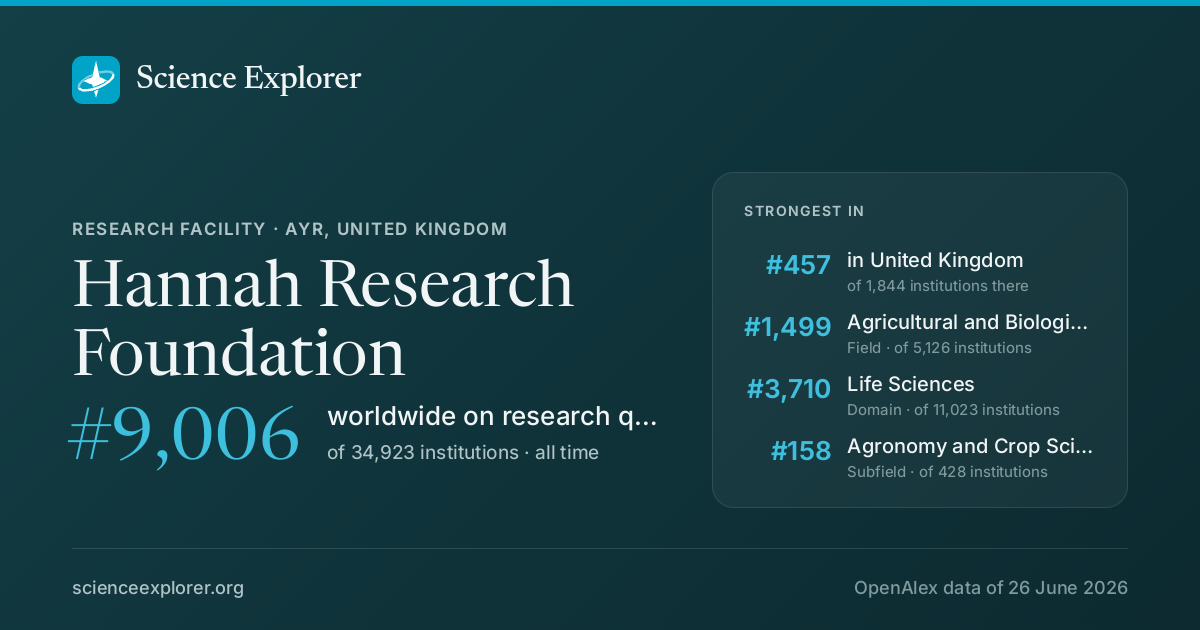
In research, Hannah Research Foundation stands highest in Agricultural and Biological Sciences (#1,499 of 5,126 worldwide), Life Sciences (#3,710 of 11,023 worldwide) and Agronomy and Crop Science (#158 of 428 worldwide), over all time.
- World rank, all time
- #9,006 of 34,923
- Rank in United Kingdom
- #457 of 1,844
- Research works
- 2.2k ▲ 99% vs 2018-21
- Citations
- 71k 32.6 per fractional work
- Top-10% rate
- 6.8% all institutions 10.0%
- vs its own fields
- 1.18× 1.00× is exactly expected
- Open access
- 20% world 40%
- International
- 6% world 18%
What is Hannah Research Foundation known for in research?
The fields where it stands highest, over all time, ranked among every institution above the floor in each field.
| Field | World rank | Where that sits | Top-10% rate | Works |
|---|---|---|---|---|
| Agricultural and Biological SciencesField | #1,499 of 5,126 | 15.0% | 755 | |
| Life SciencesDomain | #3,710 of 11,023 | 12.0% | 1,388 | |
| Agronomy and Crop ScienceSubfield | #158 of 428 | 14.1% | 294 | |
| Food ScienceSubfield | #594 of 1,177 | 13.4% | 180 | |
| Biochemistry, Genetics and Molecular BiologyField | #2,959 of 5,801 | 8.8% | 582 | |
| Health SciencesDomain | #8,597 of 16,688 | 7.2% | 545 | |
| Animal Science and ZoologySubfield | #246 of 462 | 15.8% | 159 | |
| MedicineField | #8,882 of 14,558 | 6.1% | 351 | |
| GeneticsSubfield | #887 of 1,429 | 10.2% | 140 | |
| Molecular BiologySubfield | #2,442 of 3,729 | 7.5% | 247 |
Each strip is that field's whole ranked pool, with the notch where Hannah Research Foundation sits in it, in the colour of the band that rank falls in. The track under the rate is the rate itself: it carries no average mark, because the average differs by field (from about 6% in Dentistry to 21% in Economics).
Which fields of science does Hannah Research Foundation work in?
In all years, 64% of research at Hannah Research Foundation is in Life Sciences, 25% in Health Sciences. Its largest fields are Agricultural and Biological Sciences (35%), Biochemistry, Genetics and Molecular Biology (27%), Medicine (16%). It does 4.2× the world's share of Life Sciences.
Each ring splits the one inside it: the four domains of science, their fields, their subfields. Size is fractional works in all years. Every slice is a page; the interactive view zooms down to single topics and colours each by how much more of it this institution does than the world.
Its 4 domains and 26 fields, with their numbers
- Life Sciences1,38863.9%
- Health Sciences54525.1%
- Medicine35116.2%
- Nursing1607.4%
- Veterinary261.2%
- Health Professions70.3%
- Dentistry10.1%
- Physical Sciences1979.1%
- Environmental Science602.8%
- Chemistry492.2%
- Engineering432.0%
- Materials Science190.9%
- Energy70.3%
- Computer Science60.3%
- Physics and Astronomy40.2%
- Chemical Engineering40.2%
- Earth and Planetary Sciences20.1%
- Mathematics20.1%
- Social Sciences432.0%
Field profile
Location quotient across every field it publishes in: outside the ring is more than an institution of this size would be expected to publish, inside it is less.
Rings at 0.5×, 1× and 2×. Widest outward: Veterinary, 10.5×. Every wedge is a field page.
All 10 fields, with their numbers
- Veterinary10.52×0 works
- Arts and Humanities7.92×3 works
- Psychology6.10×2 works
- Social Sciences2.44×4 works
- Economics, Econometrics and Finance2.00×0 works
- Medicine0.82×2 works
- Biochemistry, Genetics and Molecular Biology0.54×0 works
- Business, Management and Accounting0.37×0 works
- Environmental Science0.29×0 works
- Computer Science0.09×0 works
Who are the top researchers at Hannah Research Foundation?
Ranked on the quality score, Kenneth Lyon Blaxter, Carl Holt and F. W. Wainman lead among researchers whose main affiliation is Hannah Research Foundation.
- 1
Kenneth Lyon Blaxter
 United Kingdom · #389,176 worldwide
10k citations · 231 works
- 2
Carl Holt
United Kingdom · #538,421 worldwide
8.9k citations · 135 works
- 3
F. W. Wainman
United Kingdom · #739,952 worldwide
2.8k citations · 38 works
- 4
D. Thomas Davies
United Kingdom · #962,405 worldwide
2k citations · 25 works
- 5
David S. Horne
United Kingdom · #1,193,436 worldwide
9.1k citations · 194 works
- 6
William W. Christie
United Kingdom · #1,206,371 worldwide
16k citations · 288 works
- 7
J. C. D. White
United Kingdom · #1,456,885 worldwide
1.5k citations · 33 works
- 8
Malcolm Peaker
United Kingdom · #1,827,590 worldwide
7.3k citations · 199 works
- 9
Victor A. Zammit
United Kingdom · #2,072,385 worldwide
9.1k citations · 211 works
- 10
Julian W. Czerkawski
United Kingdom · #2,136,412 worldwide
2.7k citations · 64 works
Which keywords describe research at Hannah Research Foundation?
By fractional works in all years, weighted toward what it does more of than the world: Milk Composition, Microbial Community, Methane Production, Ruminant Nutrition, Lipid Oxidation, Metabolism, Dairy Cattle and Inflammation.
- Animal Breeding
- Mitochondrial Dysfunction
- Consumer Perception
- Marker-Assisted Selection
- Energy Balance
- Fatty Acid Metabolism
- Neurodevelopment
- Digestion
- Livestock Production
- Emulsions
- Insulin Resistance
- Heat Stress
- Metabolic Syndrome
- Plant Breeding
- Probiotics
- Cardiovascular Disease
- Metabolism
- Oxidative Stress
- Methane Production
- Inflammation
- Milk Composition
- Microbial Community
- Ruminant Nutrition
- Lipid Oxidation
- Dairy Cattle
- Animal Welfare
- Nutritional Significance
- Health Benefits
- Proteins
- Chronic Diseases
- Hydrocolloids
- Omega-3 Fatty Acids
- Dietary Intake
- Nanoemulsions
- Antimicrobial Resistance
- Lipid Mediators
- Exercise
- Metabolic Regulation
- Meat Quality
- Quantitative Genetics
Size is fractional works in all years in the topics tagged with each word; colour is the word's share of this institution's work against its share of the world's. The 40 words are chosen for being large and distinctive. Each links to the topic it comes from most.
All 40 words, with their numbers
- Milk Composition209▲ 169×2 topics
- Inflammation179▲ 3.5×44 topics
- Microbial Community147▲ 70×3 topics
- Methane Production142▲ 162×1 topic
- Ruminant Nutrition142▲ 162×1 topic
- Oxidative Stress139▲ 3.5×39 topics
- Lipid Oxidation138▲ 62×2 topics
- Metabolism130▲ 9.3×20 topics
- Dairy Cattle125▲ 87×2 topics
- Cardiovascular Disease109▲ 4.5×13 topics
- Animal Welfare98▲ 40×4 topics
- Probiotics94▲ 17×5 topics
- Nutritional Significance93▲ 31×4 topics
- Plant Breeding93▲ 39×3 topics
- Health Benefits90▲ 14×8 topics
- Metabolic Syndrome89▲ 4.8×15 topics
- Proteins89▲ 33×3 topics
- Heat Stress86▲ 43×2 topics
- Chronic Diseases85▲ 14×6 topics
- Insulin Resistance85▲ 8.5×6 topics
- Hydrocolloids82▲ 59×2 topics
- Emulsions80▲ 65×2 topics
- Omega-3 Fatty Acids79▲ 39×2 topics
- Livestock Production79▲ 60×3 topics
- Dietary Intake77▲ 53×3 topics
- Digestion76▲ 101×1 topic
- Nanoemulsions76▲ 101×1 topic
- Neurodevelopment76▲ 46×2 topics
- Antimicrobial Resistance76▲ 14×7 topics
- Fatty Acid Metabolism75▲ 100×1 topic
- Lipid Mediators75▲ 100×1 topic
- Energy Balance74▲ 37×3 topics
- Exercise73▲ 22×2 topics
- Marker-Assisted Selection71▲ 33×3 topics
- Metabolic Regulation71▲ 12×5 topics
- Consumer Perception71▲ 20×4 topics
- Meat Quality70▲ 34×3 topics
- Mitochondrial Dysfunction70▲ 8.8×7 topics
- Quantitative Genetics69▲ 45×2 topics
- Animal Breeding69▲ 54×1 topic
Which research topics does Hannah Research Foundation publish most on?
By volume in 2022-now: History of Science and Medicine, German Literature and Culture Studies, Biotechnology and Related Fields and Urbanization and City Planning.
Area is fractional works; colour is the subfield each topic belongs to.
- 1 History of Science and Medicine History and Philosophy of Science 1 works
- 2 German Literature and Culture Studies Literature and Literary Theory 1 works
- 3 Biotechnology and Related Fields Public Health, Environmental and Occupational Health 1 works
- 4 Urbanization and City Planning Urban Studies 1 works
- 5 Housing, Finance, and Neoliberalism Finance 0 works
- 6 Gender, Labor, and Family Dynamics Gender Studies 0 works
- 7 Child and Adolescent Psychosocial and Emotional Development Clinical Psychology 0 works
- 8 Migration and Labor Dynamics Sociology and Political Science 0 works
- 9 Race, History, and American Society Sociology and Political Science 0 works
- 10 Latin American and Latino Studies Cultural Studies 0 works
How open and international is its research?
Against the world's own shares: the tick on each track. Both are shares of its output, so they sit on one scale and can be read against each other as well as against the world.
World: 40% of research is openly available.
World: 18% is written across borders.
How has Hannah Research Foundation's research output changed?
Output in 2022-2025 was 99% higher than in 2018-2021.
The same series as a ribbon: one cell per year, darker for more. The line above answers how much; this answers when.
Its share of all research
Growing output can still be a shrinking share: all of science grows. This is Hannah Research Foundation as a percentage of every work published that year, 0.000087% in 2023.
Fractional works of Hannah Research Foundation over all fractional works that year. How the balance of science has shifted.
How much of it reaches the world top 10%
Year by year, against all institutions in the same year.
Of each year's output, the share that reached the world's 10% most cited for its field and year. Peak 15.6% in 1997.
Other research institutions in Ayr
- NHS Ayrshire and Arran
- AvantiCell Science (United Kingdom)
- The Aquatic Coleoptera Conservation Trust
- Neogen Europe (United Kingdom)
Share Hannah Research Foundation's ranking
Badges for a website1Each links back here and updates with every snapshot

Research measures only: rankings here say nothing about teaching, admissions or student experience. Comparable institutions and collaboration partners have tabs of their own, above.
Discussion
Ask a question or share a note about Hannah Research Foundation. Keep it to the research: no personal attacks, advertising or links. Any reader can report a post, which collapses it for everyone until it is opened.