Science Explorer Back to mapMap
Discussion
University · Himeji · Japan

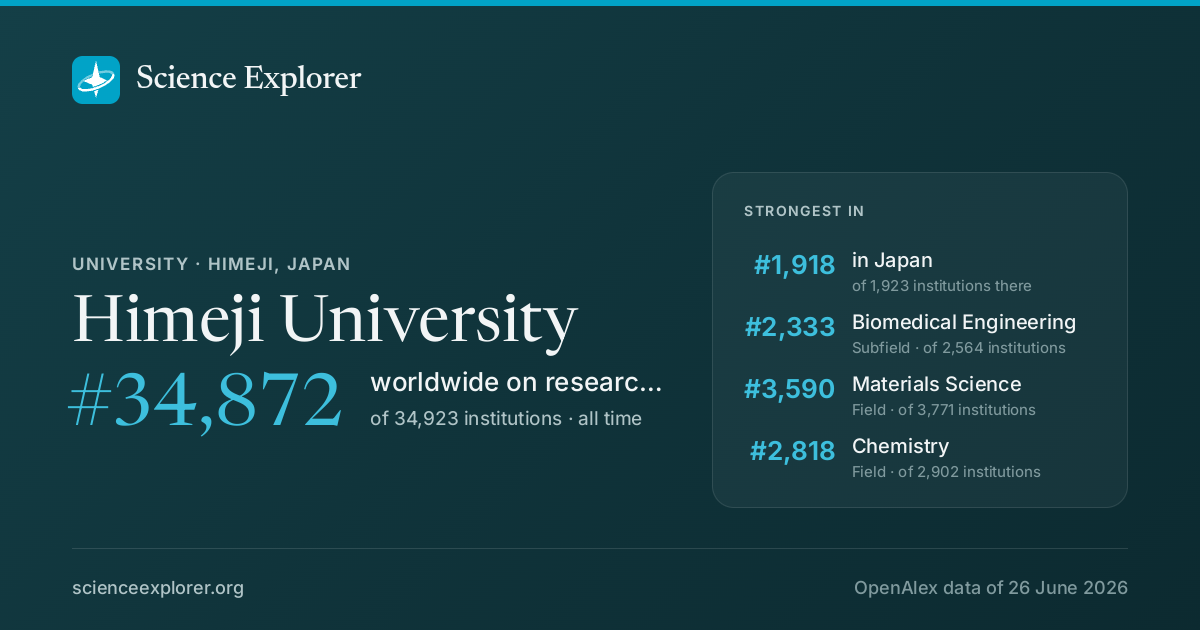
Himeji University

In research, Himeji University stands highest in Biomedical Engineering (#2,333 of 2,564 worldwide), Materials Science (#3,590 of 3,771 worldwide) and Chemistry (#2,818 of 2,902 worldwide), over all time.

World rank, all time
#34,872
of 34,923
Rank in Japan
#1,918
of 1,923
Research works
3.4k
▲ 37% vs 2018-21
Citations
54k
16.1 per fractional work
Top-10% rate
3.6%
all institutions 10.0%
vs its own fields
0.53×
1.00× is exactly expected
Open access
33%
world 40%
International
8%
world 18%

What is Himeji University known for in research?

The fields where it stands highest, over all time, ranked among every institution above the floor in each field.

FieldWorld rankWhere that sitsTop-10% rateWorks
Biomedical EngineeringSubfield #2,333 of 2,564 9.5%207
Materials ScienceField #3,590 of 3,771 3.8%682
ChemistryField #2,818 of 2,902 6.1%331
EngineeringField #9,258 of 9,532 5.7%1,115
Organic ChemistrySubfield #1,781 of 1,832 4.0%153
Materials ChemistrySubfield #2,551 of 2,613 3.1%338
Electronic, Optical and Magnetic MaterialsSubfield #979 of 997 5.5%185
Mechanical EngineeringSubfield #2,491 of 2,525 5.8%218
Electrical and Electronic EngineeringSubfield #3,683 of 3,725 4.6%342
Condensed Matter PhysicsSubfield #578 of 583 6.2%130

Each strip is that field's whole ranked pool, with the notch where Himeji University sits in it, in the colour of the band that rank falls in. The track under the rate is the rate itself: it carries no average mark, because the average differs by field (from about 6% in Dentistry to 21% in Economics).

Which fields of science does Himeji University work in?

In 2022-now, 48% of research at Himeji University is in Physical Sciences, 32% in Health Sciences. Its largest fields are Medicine (26%), Engineering (18%), Computer Science (13%). It does 1.3× the world's share of Health Sciences.

Physical Sciences: 16 fractional works · 48.1% of its workEngineering: 6 fractional works · 17.7% of its workElectrical and Electronic Engineering: 3 fractional works · 9.1% of its workBiomedical Engineering: 1 fractional works · 3.4% of its workMechanical Engineering: 1 fractional works · 1.8% of its workMechanics of Materials: 0 fractional works · 0.8% of its workAerospace Engineering: 0 fractional works · 0.7% of its workAutomotive Engineering: 0 fractional works · 0.5% of its workControl and Systems Engineering: 0 fractional works · 0.5% of its workComputational Mechanics: 0 fractional works · 0.3% of its workMedia Technology: 0 fractional works · 0.3% of its workOcean Engineering: 0 fractional works · 0.3% of its workComputer Science: 4 fractional works · 12.6% of its workComputer Vision and Pattern Recognition: 2 fractional works · 4.6% of its workInformation Systems: 2 fractional works · 4.6% of its workArtificial Intelligence: 1 fractional works · 3.2% of its workHuman-Computer Interaction: 0 fractional works · 0.2% of its workMaterials Science: 3 fractional works · 8.5% of its workMaterials Chemistry: 2 fractional works · 4.9% of its workElectronic, Optical and Magnetic Materials: 0 fractional works · 1.0% of its workSurfaces, Coatings and Films: 0 fractional works · 0.9% of its workCeramics and Composites: 0 fractional works · 0.5% of its workMetals and Alloys: 0 fractional works · 0.5% of its workBiomaterials: 0 fractional works · 0.4% of its workPolymers and Plastics: 0 fractional works · 0.3% of its workEnvironmental Science: 1 fractional works · 3.3% of its workNature and Landscape Conservation: 1 fractional works · 2.1% of its workEcology: 0 fractional works · 0.4% of its workEnvironmental Engineering: 0 fractional works · 0.2% of its workEnvironmental Chemistry: 0 fractional works · 0.2% of its workGlobal and Planetary Change: 0 fractional works · 0.2% of its workSmaller subfields together: 0 fractional works · 0.2% of its workPhysics and Astronomy: 1 fractional works · 2.2% of its workAtomic and Molecular Physics, and Optics: 1 fractional works · 1.9% of its workRadiation: 0 fractional works · 0.3% of its workChemistry: 0 fractional works · 1.1% of its workAnalytical Chemistry: 0 fractional works · 0.5% of its workOrganic Chemistry: 0 fractional works · 0.4% of its workPhysical and Theoretical Chemistry: 0 fractional works · 0.2% of its workEarth and Planetary Sciences: 0 fractional works · 0.8% of its workGeophysics: 0 fractional works · 0.4% of its workOceanography: 0 fractional works · 0.3% of its workEnergy: 0 fractional works · 0.8% of its workRenewable Energy, Sustainability and the Environment: 0 fractional works · 0.5% of its workEnergy Engineering and Power Technology: 0 fractional works · 0.2% of its workChemical Engineering: 0 fractional works · 0.7% of its workBioengineering: 0 fractional works · 0.5% of its workProcess Chemistry and Technology: 0 fractional works · 0.2% of its workMathematics: 0 fractional works · 0.3% of its workMathematical Physics: 0 fractional works · 0.3% of its workHealth Sciences: 10 fractional works · 31.8% of its workMedicine: 8 fractional works · 25.7% of its workPublic Health, Environmental and Occupational Health: 2 fractional works · 5.5% of its workSurgery: 1 fractional works · 2.4% of its workPhysiology: 1 fractional works · 1.8% of its workRadiology, Nuclear Medicine and Imaging: 1 fractional works · 1.7% of its workPediatrics, Perinatology and Child Health: 1 fractional works · 1.7% of its workPulmonary and Respiratory Medicine: 1 fractional works · 1.6% of its workEpidemiology: 0 fractional works · 1.5% of its workOncology: 0 fractional works · 1.2% of its workHepatology: 0 fractional works · 1.1% of its workImmunology and Allergy: 0 fractional works · 1.0% of its workObstetrics and Gynecology: 0 fractional works · 1.0% of its workPsychiatry and Mental health: 0 fractional works · 0.9% of its workCardiology and Cardiovascular Medicine: 0 fractional works · 0.7% of its workOrthopedics and Sports Medicine: 0 fractional works · 0.7% of its workComplementary and alternative medicine: 0 fractional works · 0.5% of its workDermatology: 0 fractional works · 0.5% of its workHematology: 0 fractional works · 0.4% of its workNeurology: 0 fractional works · 0.3% of its workReproductive Medicine: 0 fractional works · 0.3% of its workPathology and Forensic Medicine: 0 fractional works · 0.3% of its workHealth Informatics: 0 fractional works · 0.2% of its workSmaller subfields together: 0 fractional works · 0.3% of its workHealth Professions: 2 fractional works · 4.9% of its workGeneral Health Professions: 1 fractional works · 1.8% of its workRadiological and Ultrasound Technology: 0 fractional works · 1.5% of its workSpeech and Hearing: 0 fractional works · 1.0% of its workEmergency Medical Services: 0 fractional works · 0.5% of its workSmaller subfields together: 0 fractional works · 0.0% of its workNursing: 0 fractional works · 0.9% of its workNutrition and Dietetics: 0 fractional works · 0.5% of its workLeadership and Management: 0 fractional works · 0.2% of its workResearch and Theory: 0 fractional works · 0.2% of its workVeterinary: 0 fractional works · 0.3% of its workSmall Animals: 0 fractional works · 0.3% of its workSocial Sciences: 4 fractional works · 13.5% of its workPsychology: 2 fractional works · 6.4% of its workExperimental and Cognitive Psychology: 1 fractional works · 3.4% of its workClinical Psychology: 1 fractional works · 2.3% of its workDevelopmental and Educational Psychology: 0 fractional works · 0.4% of its workApplied Psychology: 0 fractional works · 0.2% of its workSocial Sciences: 2 fractional works · 6.0% of its workPolitical Science and International Relations: 1 fractional works · 2.1% of its workSociology and Political Science: 0 fractional works · 1.4% of its workEducation: 0 fractional works · 0.9% of its workDemography: 0 fractional works · 0.5% of its workHealth: 0 fractional works · 0.5% of its workGender Studies: 0 fractional works · 0.3% of its workSmaller subfields together: 0 fractional works · 0.4% of its workArts and Humanities: 0 fractional works · 0.8% of its workVisual Arts and Performing Arts: 0 fractional works · 0.8% of its workBusiness, Management and Accounting: 0 fractional works · 0.3% of its workOrganizational Behavior and Human Resource Management: 0 fractional works · 0.3% of its workLife Sciences: 2 fractional works · 6.6% of its workBiochemistry, Genetics and Molecular Biology: 1 fractional works · 3.1% of its workMolecular Biology: 1 fractional works · 2.0% of its workBiophysics: 0 fractional works · 0.5% of its workCell Biology: 0 fractional works · 0.2% of its workSmaller subfields together: 0 fractional works · 0.3% of its workAgricultural and Biological Sciences: 0 fractional works · 1.3% of its workPlant Science: 0 fractional works · 0.8% of its workInsect Science: 0 fractional works · 0.5% of its workPharmacology, Toxicology and Pharmaceutics: 0 fractional works · 1.0% of its workPharmacology: 0 fractional works · 1.0% of its workNeuroscience: 0 fractional works · 0.7% of its workCognitive Neuroscience: 0 fractional works · 0.5% of its workSmaller subfields together: 0 fractional works · 0.2% of its workImmunology and Microbiology: 0 fractional works · 0.6% of its workParasitology: 0 fractional works · 0.5% of its workSmaller subfields together: 0 fractional works · 0.0% of its workALL ITS WORKHimeji University33fractional works, 2022-now
Life Sciences7%Physical Sciences48%Health Sciences32%Social Sciences14%

Each ring splits the one inside it: the four domains of science, their fields, their subfields. Size is fractional works in 2022-now. Every slice is a page; the interactive view zooms down to single topics and colours each by how much more of it this institution does than the world.

Its 4 domains and 23 fields, with their numbers
    1. Engineering617.7%
    2. Computer Science412.6%
    3. Materials Science38.5%
    4. Environmental Science13.3%
    5. Physics and Astronomy12.2%
    6. Chemistry01.1%
    7. Earth and Planetary Sciences00.8%
    8. Energy00.8%
    9. Chemical Engineering00.7%
    10. Mathematics00.3%
    1. Medicine825.7%
    2. Health Professions24.9%
    3. Nursing00.9%
    4. Veterinary00.3%
    1. Psychology26.4%
    2. Social Sciences26.0%
    3. Arts and Humanities00.8%
    4. Business, Management and Accounting00.3%
    1. Biochemistry, Genetics and Molecular Biology13.1%
    2. Agricultural and Biological Sciences01.3%
    3. Pharmacology, Toxicology and Pharmaceutics01.0%
    4. Neuroscience00.7%
    5. Immunology and Microbiology00.6%
All of science, and how each field's share has moved since 1950: the Science domain explorer

Field profile

Location quotient across every field it publishes in: outside the ring is more than an institution of this size would be expected to publish, inside it is less.

Agricultural and Biological Sciences: 0.27× its world share, 0 worksAgricultural and Bio…Biochemistry, Genetics and Molecular Biology: 0.58× its world share, 1 worksBiochemistry, Geneti…Immunology and Microbiology: 0.54× its world share, 0 worksImmunology and Micro…Neuroscience: 0.42× its world share, 0 worksNeurosciencePharmacology, Toxicology and Pharmaceutics: 2.90× its world share, 0 worksPharmacology, Toxico…Chemical Engineering: 2.05× its world share, 0 worksChemical EngineeringChemistry: 0.70× its world share, 0 worksChemistryComputer Science: 1.62× its world share, 4 worksComputer ScienceEarth and Planetary Sciences: 0.49× its world share, 0 worksEarth and Planetary …Energy: 0.83× its world share, 0 worksEnergyEngineering: 1.18× its world share, 6 worksEngineeringEnvironmental Science: 0.66× its world share, 1 worksEnvironmental ScienceMaterials Science: 2.44× its world share, 3 worksMaterials ScienceMathematics: 0.29× its world share, 0 worksMathematicsPhysics and Astronomy: 1.01× its world share, 1 worksPhysics and AstronomyHealth Professions: 1.87× its world share, 2 worksHealth ProfessionsMedicine: 1.33× its world share, 8 worksMedicineNursing: 1.77× its world share, 0 worksNursingVeterinary: 2.46× its world share, 0 worksVeterinaryArts and Humanities: 0.27× its world share, 0 worksArts and HumanitiesBusiness, Management and Accounting: 0.11× its world share, 0 worksBusiness, Management…Psychology: 2.09× its world share, 2 worksPsychologySocial Sciences: 0.48× its world share, 2 worksSocial Sciences1×world share
more than its size predictsabout as predictedless

Rings at 0.5×, 1× and 2×. Widest outward: Pharmacology, Toxicology and Pharmaceutics, 2.9×. Every wedge is a field page.

All 23 fields, with their numbers
  1. Pharmacology, Toxicology and Pharmaceutics2.90×0 works
  2. Veterinary2.46×0 works
  3. Materials Science2.44×3 works
  4. Psychology2.09×2 works
  5. Chemical Engineering2.05×0 works
  6. Health Professions1.87×2 works
  7. Nursing1.77×0 works
  8. Computer Science1.62×4 works
  9. Medicine1.33×8 works
  10. Engineering1.18×6 works
  11. Physics and Astronomy1.01×1 works
  12. Energy0.83×0 works
  13. Chemistry0.70×0 works
  14. Environmental Science0.66×1 works
  15. Biochemistry, Genetics and Molecular Biology0.58×1 works
  16. Immunology and Microbiology0.54×0 works
  17. Earth and Planetary Sciences0.49×0 works
  18. Social Sciences0.48×2 works
  19. Neuroscience0.42×0 works
  20. Mathematics0.29×0 works
  21. Agricultural and Biological Sciences0.27×0 works
  22. Arts and Humanities0.27×0 works
  23. Business, Management and Accounting0.11×0 works

Who are the top researchers at Himeji University?

Ranked on the quality score, Shigeru Terabe, Yuichi Akahama and Kosuke Ueda lead among researchers whose main affiliation is Himeji University.

  1. 1 Shigeru Terabe Japan · #285,891 worldwide 22k citations · 303 works
  2. 2 Yuichi Akahama Japan · #1,092,772 worldwide 6.4k citations · 226 works
  3. 3 Kosuke Ueda Japan · #2,106,151 worldwide 1.7k citations · 112 works
  4. 4 R. P. Kenny Japan · #2,720,385 worldwide 1.8k citations · 24 works
  5. 5 Y. Iwamoto Japan · #2,972,974 worldwide 2.3k citations · 112 works
  6. 6 Hiroshi Nakayama Japan · #4,876,106 worldwide 15k citations · 929 works
  7. 7 Maki Shimizu Japan · #5,565,572 worldwide 2.1k citations · 223 works
  8. 8 Takaaki Matsuda Japan · #5,765,147 worldwide 1.9k citations · 35 works
  9. 9 Y. Sugie Japan · #5,967,696 worldwide 1.3k citations · 38 works
  10. 10 Mototada Kobayashi Japan · #6,071,220 worldwide 1.1k citations · 61 works
All ranked researchers at Himeji University

What are the most cited papers from Himeji University?

The most cited paper from Himeji University is "Structures of Metal Sites of Oxidized Bovine Heart Cytochrome c Oxidase at 2.8 Å" (Tomitake Tsukihara, Hiroshi Aoyama, Eiki Yamashita et al., 1995), with 1,419 citations. Next come "The UDP glycosyltransferase gene superfamily: recommended nomenclature update based on evolutionary divergence" (1,216) and "Redox Regulation of Cellular Signalling" (1,152).

Most cited papers
#PaperReleasedCitations
1 Structures of Metal Sites of Oxidized Bovine Heart Cytochrome c Oxidase at 2.8 Å Tomitake Tsukihara, Hiroshi Aoyama, Eiki Yamashita et al. · Science 25 Aug 1995 1,419
2 The UDP glycosyltransferase gene superfamily: recommended nomenclature update based on evolutionary divergence Peter I. Mackenzie, Ida S. Owens, Brian Burchell et al. · Pharmacogenetics Open access Aug 1997 1,216
3 Redox Regulation of Cellular Signalling Hideaki Kamata, Hajime Hirata · Cellular Signalling 1999 1,152
4 High‐Performance Polymer Solar Cells of an Alternating Polyfluorene Copolymer and a Fullerene Derivative Mattias Svensson, Fengling Zhang, Sjoerd C. Veenstra et al. · Advanced Materials Open access 16 Jun 2003 736
5 Exceeding 5000-Fold Concentration of Dilute Analytes in Micellar Electrokinetic Chromatography Joselito P. Quirino, Shigeru Terabe · Science 16 Oct 1998 644
All 61 most cited papers, with filters and sorting

Which keywords describe research at Himeji University?

By fractional works in 2022-now, weighted toward what it does more of than the world: Lifelong Learning, Self-Efficacy, Online Education, Smart Learning, Ethical Considerations, Convolutional Neural Networks, End-of-Life and Metaphor.

▲ more of its work than of the world's◆ about the world's share▼ less than the world's

Size is fractional works in 2022-now in the topics tagged with each word; colour is the word's share of this institution's work against its share of the world's. The 15 words are chosen for being large and distinctive. Each links to the topic it comes from most.

All 15 words, with their numbers
  1. Deep Learning2▲ 1.81×12 topics
  2. Lifelong Learning2▲ 26×3 topics
  3. Self-Efficacy2▲ 20×3 topics
  4. Epidemiology2◆ 1.12×21 topics
  5. Online Education2▲ 24×1 topic
  6. Smart Learning2▲ 152×1 topic
  7. Machine Learning1▲ 1.29×7 topics
  8. Convolutional Neural Networks1▲ 5.6×6 topics
  9. Ethical Considerations1▲ 10×2 topics
  10. Neural Networks1▲ 2.1×6 topics
  11. Quality of Life1▲ 2.3×7 topics
  12. End-of-Life1▲ 35×1 topic
  13. Metaphor1▲ 74×1 topic
  14. Palliative Care1▲ 20×1 topic
  15. Time1▲ 67×1 topic

Which research topics does Himeji University publish most on?

By volume in 2022-now: Education and Learning Interventions, Language, Metaphor, and Cognition, Palliative Care and End-of-Life Issues and Urban and spatial planning.

  1. 1 Education and Learning Interventions Information Systems 2 works
  2. 2 Language, Metaphor, and Cognition Experimental and Cognitive Psychology 1 works
  3. 3 Palliative Care and End-of-Life Issues Public Health, Environmental and Occupational Health 1 works
  4. 4 Urban and spatial planning Nature and Landscape Conservation 1 works
  5. 5 COVID-19 and Mental Health Clinical Psychology 1 works
  6. 6 Family and Patient Care in Intensive Care Units Radiological and Ultrasound Technology 0 works
  7. 7 Geriatric Care and Nursing Homes General Health Professions 0 works
  8. 8 Digital Media Forensic Detection Computer Vision and Pattern Recognition 0 works
  9. 9 Pharmacy and Medical Practices Pharmacology 0 works
  10. 10 3D IC and TSV technologies Electrical and Electronic Engineering 0 works

How open and international is its research?

Against the world's own shares: the tick on each track. Both are shares of its output, so they sit on one scale and can be read against each other as well as against the world.

openly available32.6%not open67.4%

World: 40% of research is openly available.

with international co-authors8.1%domestic only91.9%

World: 18% is written across borders.

How has Himeji University's research output changed?

Output in 2022-2025 was 37% higher than in 2018-2021.

still counting1990200020102020
grewheldshrank

The same series as a ribbon: one cell per year, darker for more. The line above answers how much; this answers when.

Its share of all research

Growing output can still be a shrinking share: all of science grows. This is Himeji University as a percentage of every work published that year, 0.00010% in 2024.

still counting0.010%0.020%0.030%Himeji University0.000096% in 202519801990200020102020

Fractional works of Himeji University over all fractional works that year. How the balance of science has shifted.

How much of it reaches the world top 10%

Year by year, against all institutions in the same year.

5%10%15%all institutions10.0% in 2005Himeji University2.1% in 20052000

Of each year's output, the share that reached the world's 10% most cited for its field and year. Peak 6.3% in 1996.

Other research institutions in Himeji

All research institutions in Himeji

Share Himeji University's ranking

Himeji University on Science Explorer

A card with Himeji University's standing and the fields it leads in, for a post or a slide. A link to this page previews as the same card.

Download the card

1200 × 630 PNG, sized for social posts, drawn from the latest snapshot.

Badges for a website1Each links back here and updates with every snapshot

Research measures only: rankings here say nothing about teaching, admissions or student experience. Comparable institutions and collaboration partners have tabs of their own, above.

Discussion

Ask a question or share a note about Himeji University. Posts are plain text and can be reported.