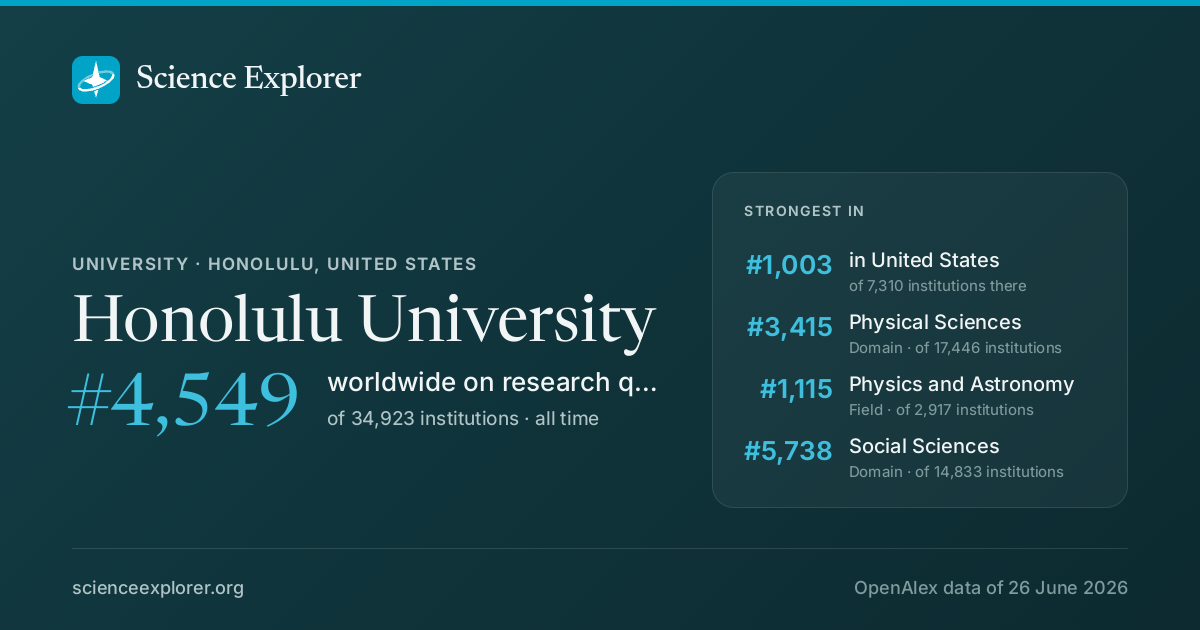
World rank, all time #4,549
of 34,923
Rank in United States #1,003
of 7,310 Research works 971
▼ 11% vs 2018-21
Citations 21k 22.1 per fractional work
Top-10% rate 9.1%
all institutions 10.0%
vs its own fields 1.01×
1.00× is exactly expected
Open access 24%
world 40%
International 10%
world 18%
What is Honolulu University known for in research?
The fields where it stands highest, over all time, ranked among every institution above the floor in each field.
Field World rank Where that sits Top-10% rate Works Domain #3,415 of 17,446 10.8% 491
Field #1,115 of 2,917 12.2% 222
Domain #5,738 of 14,833 11.3% 210
Domain #4,482 of 11,023 6.1% 125
Domain #6,788 of 16,688 9.4% 146
Subfield #570 of 954 10.1% 167
Which fields of science does Honolulu University work in?
In 2022-now, 30% of research at Honolulu University is in Physical Sciences , 26% in Health Sciences . Its largest fields are Medicine (22%), Social Sciences (12%), Agricultural and Biological Sciences (9%).
Physical Sciences: 10 fractional works · 30.1% of its work Environmental Science: 3 fractional works · 8.5% of its work Ecology: 1 fractional works · 3.8% of its work Nature and Landscape Conservation: 1 fractional works · 2.3% of its work Global and Planetary Change: 0 fractional works · 1.4% of its work Industrial and Manufacturing Engineering: 0 fractional works · 0.2% of its work Management, Monitoring, Policy and Law: 0 fractional works · 0.2% of its work Smaller subfields together: 0 fractional works · 0.5% of its work Engineering: 3 fractional works · 7.9% of its work Biomedical Engineering: 1 fractional works · 2.7% of its work Electrical and Electronic Engineering: 1 fractional works · 1.9% of its work Industrial and Manufacturing Engineering: 0 fractional works · 1.1% of its work Control and Systems Engineering: 0 fractional works · 1.0% of its work Mechanical Engineering: 0 fractional works · 0.5% of its work Automotive Engineering: 0 fractional works · 0.3% of its work Smaller subfields together: 0 fractional works · 0.4% of its work Computer Science: 2 fractional works · 6.4% of its work Information Systems: 1 fractional works · 2.3% of its work Artificial Intelligence: 1 fractional works · 1.8% of its work Computer Networks and Communications: 0 fractional works · 1.0% of its work Computer Vision and Pattern Recognition: 0 fractional works · 0.6% of its work Computer Science Applications: 0 fractional works · 0.5% of its work Smaller subfields together: 0 fractional works · 0.2% of its work Earth and Planetary Sciences: 1 fractional works · 2.8% of its work Oceanography: 0 fractional works · 1.0% of its work Atmospheric Science: 0 fractional works · 0.5% of its work Geophysics: 0 fractional works · 0.4% of its work Geochemistry and Petrology: 0 fractional works · 0.3% of its work Earth-Surface Processes: 0 fractional works · 0.3% of its work Smaller subfields together: 0 fractional works · 0.2% of its work Physics and Astronomy: 1 fractional works · 2.6% of its work Radiation: 0 fractional works · 0.9% of its work Astronomy and Astrophysics: 0 fractional works · 0.7% of its work Atomic and Molecular Physics, and Optics: 0 fractional works · 0.5% of its work Nuclear and High Energy Physics: 0 fractional works · 0.4% of its work Smaller subfields together: 0 fractional works · 0.1% of its work Materials Science: 0 fractional works · 1.0% of its work Materials Chemistry: 0 fractional works · 0.8% of its work Biomaterials: 0 fractional works · 0.2% of its work Chemistry: 0 fractional works · 0.7% of its work Spectroscopy: 0 fractional works · 0.7% of its work Energy: 0 fractional works · 0.2% of its work Renewable Energy, Sustainability and the Environment: 0 fractional works · 0.2% of its work Health Sciences: 9 fractional works · 26.5% of its work Medicine: 7 fractional works · 21.6% of its work Cardiology and Cardiovascular Medicine: 1 fractional works · 4.2% of its work Physiology: 1 fractional works · 2.6% of its work Psychiatry and Mental health: 1 fractional works · 2.1% of its work Public Health, Environmental and Occupational Health: 1 fractional works · 1.8% of its work Oncology: 1 fractional works · 1.7% of its work Surgery: 1 fractional works · 1.6% of its work Pulmonary and Respiratory Medicine: 0 fractional works · 1.4% of its work Epidemiology: 0 fractional works · 0.6% of its work Obstetrics and Gynecology: 0 fractional works · 0.6% of its work Pediatrics, Perinatology and Child Health: 0 fractional works · 0.5% of its work Emergency Medicine: 0 fractional works · 0.5% of its work Endocrinology, Diabetes and Metabolism: 0 fractional works · 0.5% of its work Hematology: 0 fractional works · 0.4% of its work Infectious Diseases: 0 fractional works · 0.3% of its work Hepatology: 0 fractional works · 0.3% of its work Nephrology: 0 fractional works · 0.3% of its work Critical Care and Intensive Care Medicine: 0 fractional works · 0.3% of its work Orthopedics and Sports Medicine: 0 fractional works · 0.2% of its work Rheumatology: 0 fractional works · 0.2% of its work Smaller subfields together: 0 fractional works · 1.4% of its work Health Professions: 1 fractional works · 4.2% of its work General Health Professions: 1 fractional works · 3.0% of its work Pharmacy: 0 fractional works · 0.5% of its work Emergency Medical Services: 0 fractional works · 0.3% of its work Smaller subfields together: 0 fractional works · 0.3% of its work Nursing: 0 fractional works · 0.6% of its work Issues, ethics and legal aspects: 0 fractional works · 0.3% of its work Research and Theory: 0 fractional works · 0.3% of its work Veterinary: 0 fractional works · 0.1% of its work Social Sciences: 9 fractional works · 24.9% of its work Social Sciences: 4 fractional works · 11.8% of its work Education: 1 fractional works · 1.9% of its work Health: 1 fractional works · 1.6% of its work Political Science and International Relations: 1 fractional works · 1.6% of its work Sociology and Political Science: 1 fractional works · 1.5% of its work Safety Research: 0 fractional works · 1.4% of its work Cultural Studies: 0 fractional works · 1.0% of its work Development: 0 fractional works · 1.0% of its work Transportation: 0 fractional works · 0.7% of its work Geography, Planning and Development: 0 fractional works · 0.7% of its work Smaller subfields together: 0 fractional works · 0.3% of its work Economics, Econometrics and Finance: 2 fractional works · 4.8% of its work Economics and Econometrics: 1 fractional works · 2.4% of its work Finance: 0 fractional works · 1.4% of its work General Economics, Econometrics and Finance: 0 fractional works · 1.0% of its work Smaller subfields together: 0 fractional works · 0.0% of its work Psychology: 1 fractional works · 3.6% of its work Clinical Psychology: 0 fractional works · 1.2% of its work Experimental and Cognitive Psychology: 0 fractional works · 0.8% of its work Social Psychology: 0 fractional works · 0.8% of its work Applied Psychology: 0 fractional works · 0.3% of its work Neuropsychology and Physiological Psychology: 0 fractional works · 0.3% of its work Smaller subfields together: 0 fractional works · 0.1% of its work Business, Management and Accounting: 1 fractional works · 2.0% of its work Management of Technology and Innovation: 0 fractional works · 1.0% of its work Management Information Systems: 0 fractional works · 0.4% of its work Strategy and Management: 0 fractional works · 0.3% of its work Smaller subfields together: 0 fractional works · 0.3% of its work Arts and Humanities: 1 fractional works · 2.0% of its work Archeology: 0 fractional works · 1.4% of its work Philosophy: 0 fractional works · 0.3% of its work History: 0 fractional works · 0.3% of its work Smaller subfields together: 0 fractional works · 0.0% of its work Decision Sciences: 0 fractional works · 0.8% of its work Information Systems and Management: 0 fractional works · 0.5% of its work Management Science and Operations Research: 0 fractional works · 0.3% of its work Life Sciences: 6 fractional works · 18.5% of its work Agricultural and Biological Sciences: 3 fractional works · 8.7% of its work Ecology, Evolution, Behavior and Systematics: 2 fractional works · 5.3% of its work Insect Science: 0 fractional works · 1.4% of its work Aquatic Science: 0 fractional works · 1.3% of its work General Agricultural and Biological Sciences: 0 fractional works · 0.3% of its work Plant Science: 0 fractional works · 0.2% of its work Smaller subfields together: 0 fractional works · 0.2% of its work Biochemistry, Genetics and Molecular Biology: 2 fractional works · 4.8% of its work Molecular Biology: 1 fractional works · 3.2% of its work Aging: 0 fractional works · 0.7% of its work Cancer Research: 0 fractional works · 0.5% of its work Genetics: 0 fractional works · 0.4% of its work Neuroscience: 1 fractional works · 4.1% of its work Cognitive Neuroscience: 1 fractional works · 3.8% of its work Endocrine and Autonomic Systems: 0 fractional works · 0.2% of its work Smaller subfields together: 0 fractional works · 0.0% of its work Immunology and Microbiology: 0 fractional works · 0.5% of its work Immunology: 0 fractional works · 0.4% of its work Smaller subfields together: 0 fractional works · 0.1% of its work Pharmacology, Toxicology and Pharmaceutics: 0 fractional works · 0.4% of its work Pharmacology: 0 fractional works · 0.3% of its work Smaller subfields together: 0 fractional works · 0.1% of its work Physical Sciences Environmental Science Engineering Computer Science Earth and… Physics a… Health Sciences Medicine Health Pr… Social Sciences Social Sciences Economics Psychology Business Arts and… Life Sciences Agricultural… Biochemis… Neuroscie… ALL ITS WORK Honolulu University 35 fractional works, 2022-now 19% 30% 26% 25%
Each ring splits the one inside it: the four domains of science, their fields, their subfields. Size is fractional works in 2022-now. Every slice is a page; the interactive view zooms down to single topics and colours each by how much more of it this institution does than the world.
Its 4 domains and 23 fields, with their numbers 3 8.5% 3 7.9% 2 6.4% 1 2.8% 1 2.6% 0 1.0% 0 0.7% 0 0.2% 7 21.6% 1 4.2% 0 0.6% 0 0.1% 4 11.8% 2 4.8% 1 3.6% 1 2.0% 1 2.0% 0 0.8% 3 8.7% 2 4.8% 1 4.1% 0 0.5% 0 0.4% All of science, and how each field's share has moved since 1950: the Science domain explorer
Field profile
Location quotient across every field it publishes in: outside the ring is more than an institution of this size would be expected to publish, inside it is less.
Agricultural and Biological Sciences: 1.84× its world share, 3 works Agricultural and Bio… Biochemistry, Genetics and Molecular Biology: 0.90× its world share, 2 works Biochemistry, Geneti… Immunology and Microbiology: 0.46× its world share, 0 works Immunology and Micro… Neuroscience: 2.52× its world share, 1 works Neuroscience Pharmacology, Toxicology and Pharmaceutics: 1.17× its world share, 0 works Pharmacology, Toxico… Chemistry: 0.46× its world share, 0 works Chemistry Computer Science: 0.82× its world share, 2 works Computer Science Earth and Planetary Sciences: 1.81× its world share, 1 works Earth and Planetary … Energy: 0.26× its world share, 0 works Energy Engineering: 0.53× its world share, 3 works Engineering Environmental Science: 1.70× its world share, 3 works Environmental Science Materials Science: 0.30× its world share, 0 works Materials Science Physics and Astronomy: 1.15× its world share, 1 works Physics and Astronomy Health Professions: 1.58× its world share, 1 works Health Professions Medicine: 1.12× its world share, 8 works Medicine Nursing: 1.31× its world share, 0 works Nursing Veterinary: 0.59× its world share, 0 works Veterinary Arts and Humanities: 0.68× its world share, 1 works Arts and Humanities Business, Management and Accounting: 0.62× its world share, 1 works Business, Management… Decision Sciences: 0.84× its world share, 0 works Decision Sciences Economics, Econometrics and Finance: 2.24× its world share, 2 works Economics, Econometr… Psychology: 1.17× its world share, 1 works Psychology Social Sciences: 0.93× its world share, 4 works Social Sciences 1× world share
Rings at 0.5×, 1× and 2×. Widest outward: Neuroscience , 2.5×. Every wedge is a field page.
All 23 fields, with their numbers Neuroscience 2.52× 1 works Economics, Econometrics and Finance 2.24× 2 works Agricultural and Biological Sciences 1.84× 3 works Earth and Planetary Sciences 1.81× 1 works Environmental Science 1.70× 3 works Health Professions 1.58× 1 works Nursing 1.31× 0 works Pharmacology, Toxicology and Pharmaceutics 1.17× 0 works Psychology 1.17× 1 works Physics and Astronomy 1.15× 1 works Medicine 1.12× 8 works Social Sciences 0.93× 4 works Biochemistry, Genetics and Molecular Biology 0.90× 2 works Decision Sciences 0.84× 0 works Computer Science 0.82× 2 works Arts and Humanities 0.68× 1 works Business, Management and Accounting 0.62× 1 works Veterinary 0.59× 0 works Engineering 0.53× 3 works Immunology and Microbiology 0.46× 0 works Chemistry 0.46× 0 works Materials Science 0.30× 0 works Energy 0.26× 0 works
Who are the top researchers at Honolulu University?
Ranked on the quality score, Mary Kawena Pukui , Sereno E. Bishop and Susan E. Postawko lead among researchers whose main affiliation is Honolulu University.
1
Mary Kawena Pukui
United States · #1,330,069 worldwide1.5k citations · 121 works
2
Sereno E. Bishop
United States · #2,346,389 worldwide30 citations · 39 works
3
Susan E. Postawko
United States · #2,390,736 worldwide671 citations · 40 works
4
Robert M. Anderson
United States · #2,965,704 worldwide3.2k citations · 179 works
5
J. C. Kershaw
United States · #2,969,300 worldwide137 citations · 14 works
6
Pamela L. Blake
United States · #3,344,111 worldwide359 citations · 18 works
7
Howard A. Link
United States · #4,046,353 worldwide30 citations · 29 works
8
Cassandra R. Coombs
United States · #5,439,200 worldwide458 citations · 85 works
All ranked researchers at Honolulu University
What are the most cited papers from Honolulu University?
The most cited paper from Honolulu University is "Chemoradiotherapy after Surgery Compared with Surgery Alone for Adenocarcinoma of the Stomach or Gastroesophageal Junction" (John Smyth Macdonald, Stephen R. Smalley, Jacqueline Benedetti et al., 2001), with 3,522 citations. Next come "Screening for Colorectal Cancer" (2,051) and "Revision of the CEAP classification for chronic venous disorders: Consensus statement" (1,927).
Most cited papers
# Paper Released Citations 1
Chemoradiotherapy after Surgery Compared with Surgery Alone for Adenocarcinoma of the Stomach or Gastroesophageal Junction
John Smyth Macdonald, Stephen R. Smalley, Jacqueline Benedetti et al. · New England Journal of Medicine
6 Sep 2001
3,522 2
Screening for Colorectal Cancer
US Preventive Services Task Force, Karina W. Davidson, Michael J. Barry et al. · JAMA
Open access 18 May 2021
2,051 3
Revision of the CEAP classification for chronic venous disorders: Consensus statement
Bo Eklöf, Robert Bruce Rutherford, John J. Bergan et al. · Journal of Vascular Surgery
Open access Dec 2004
1,927 4
Screening for Lung Cancer
US Preventive Services Task Force, Alex H. Krist, Karina W. Davidson et al. · JAMA
Open access 9 Mar 2021
1,824 5
Screening for Prostate Cancer
US Preventive Services Task Force, David C. Grossman, Susan J. Curry et al. · JAMA
Open access 8 May 2018
1,460
All 59 most cited papers, with filters and sorting
Which keywords describe research at Honolulu University?
By fractional works in 2022-now, weighted toward what it does more of than the world: Invasive Species, Aging , Phylogeny, Regulation, Climate Change, Biological Control, Ethical Issues and Morphology.
Size is fractional works in 2022-now in the topics tagged with each word; colour is the word's share of this institution's work against its share of the world's. The 13 words are chosen for being large and distinctive. Each links to the topic it comes from most.
All 13 words, with their numbers Climate Change 2 ▲ 2.4× 22 topics Invasive Species 2 ▲ 13× 9 topics Aging 2 ▲ 9.2× 9 topics Phylogeny 2 ▲ 29× 6 topics Regulation 1 ▲ 7.4× 4 topics Sustainability 1 ▲ 1.40× 5 topics Biological Control 1 ▲ 22× 4 topics Epidemiology 1 ▼ 0.81× 16 topics Ethical Issues 1 ▲ 30× 2 topics Morphology 1 ▲ 18× 2 topics Oxidative Stress 1 ▲ 1.94× 6 topics Cognitive Enhancement 1 ▲ 62× 1 topic Neuroenhancement 1 ▲ 141× 1 topic
Which research topics does Honolulu University publish most on?
By volume in 2022-now: Neuroethics, Human Enhancement, Biomedical Innovations , Bone Tissue Engineering Materials , Hymenoptera taxonomy and phylogeny and Banking stability, regulation, efficiency .
1
Cognitive Neuroscience 1 works
2
Biomedical Engineering 1 works
3
Ecology, Evolution, Behavior and Systematics 1 works
4
Finance 0 works
5
Education 0 works
6
Economics and Econometrics 0 works
7
Ecology, Evolution, Behavior and Systematics 0 works
8
Psychiatry and Mental health 0 works
9
Ecology, Evolution, Behavior and Systematics 0 works
10
Insect Science 0 works
How open and international is its research?
Against the world's own shares: the tick on each track. Both are shares of its output, so they
sit on one scale and can be read against each other as well as against the world.
24% 76%
24.1% 75.9%
World: 40% of research is openly available.
10% 90%
10.4% 89.6%
World: 18% is written across borders.
How has Honolulu University's research output changed?
Output in 2022-2025 was 11% lower than in 2018-2021.
still counting 1990 2000 2010 2020
The same series as a ribbon: one cell per year, darker for more. The line above answers how much ; this answers when .
Its share of all research
still counting 0.0025% 0.0050% 0.0075% Honolulu University 0.00012% in 2025 1980 1990 2000 2010 2020 Fractional works of Honolulu University over all fractional works that year. How the balance of science has shifted .
How much of it reaches the world top 10%
10% 20% all institutions 10.0% in 2001 Honolulu University 3.5% in 2001 2000 Of each year's output, the share that reached the world's 10% most cited for its field and year. Peak 18.2% in 1990.
Share Honolulu University's ranking
A card with Honolulu University's standing and the fields it leads in, for a post or a slide. A link to this page previews as the same card.
Badges for a website 1 Each links back here and updates with every snapshot
 United States · #1,330,069 worldwide
1.5k citations · 121 works