Science Explorer Back to mapMap
Discussion
University · The Bronx · United States

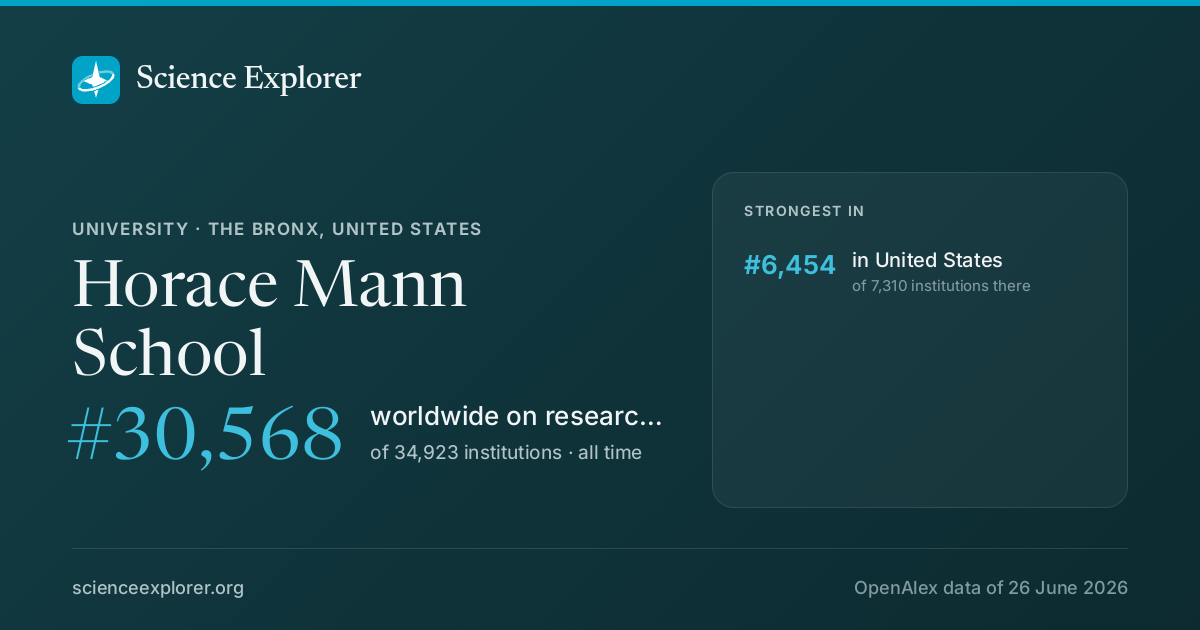
Horace Mann School

World rank, all time
#30,568
of 34,923
Rank in United States
#6,454
of 7,310
Research works
147
▲ 169% vs 2018-21
Citations
885
6.0 per fractional work
Top-10% rate
4.9%
all institutions 10.0%
vs its own fields
0.91×
1.00× is exactly expected
Open access
31%
world 40%
International
10%
world 18%

Which fields of science does Horace Mann School work in?

In 2022-now, 34% of research at Horace Mann School is in Physical Sciences, 31% in Social Sciences. Its largest fields are Social Sciences (15%), Medicine (14%), Computer Science (13%).

Physical Sciences: 12 fractional works · 33.5% of its workComputer Science: 5 fractional works · 13.3% of its workArtificial Intelligence: 3 fractional works · 9.1% of its workComputer Vision and Pattern Recognition: 1 fractional works · 2.1% of its workInformation Systems: 0 fractional works · 0.9% of its workComputational Theory and Mathematics: 0 fractional works · 0.5% of its workComputer Graphics and Computer-Aided Design: 0 fractional works · 0.3% of its workHuman-Computer Interaction: 0 fractional works · 0.3% of its workPhysics and Astronomy: 3 fractional works · 7.1% of its workStatistical and Nonlinear Physics: 1 fractional works · 3.7% of its workAstronomy and Astrophysics: 1 fractional works · 2.5% of its workCondensed Matter Physics: 0 fractional works · 0.9% of its workEngineering: 2 fractional works · 6.5% of its workAerospace Engineering: 1 fractional works · 2.1% of its workMechanical Engineering: 1 fractional works · 1.5% of its workElectrical and Electronic Engineering: 0 fractional works · 0.8% of its workBiomedical Engineering: 0 fractional works · 0.6% of its workMechanics of Materials: 0 fractional works · 0.5% of its workAutomotive Engineering: 0 fractional works · 0.3% of its workComputational Mechanics: 0 fractional works · 0.3% of its workControl and Systems Engineering: 0 fractional works · 0.3% of its workEnvironmental Science: 2 fractional works · 4.6% of its workGlobal and Planetary Change: 1 fractional works · 3.0% of its workEnvironmental Engineering: 0 fractional works · 1.0% of its workWater Science and Technology: 0 fractional works · 0.5% of its workEarth and Planetary Sciences: 0 fractional works · 0.9% of its workAtmospheric Science: 0 fractional works · 0.9% of its workMaterials Science: 0 fractional works · 0.9% of its workPolymers and Plastics: 0 fractional works · 0.5% of its workSurfaces, Coatings and Films: 0 fractional works · 0.5% of its workMathematics: 0 fractional works · 0.3% of its workModeling and Simulation: 0 fractional works · 0.3% of its workSocial Sciences: 11 fractional works · 30.8% of its workSocial Sciences: 5 fractional works · 15.0% of its workEducation: 2 fractional works · 5.5% of its workCultural Studies: 1 fractional works · 2.7% of its workPolitical Science and International Relations: 1 fractional works · 2.3% of its workSociology and Political Science: 1 fractional works · 1.7% of its workDevelopment: 0 fractional works · 1.4% of its workAnthropology: 0 fractional works · 0.7% of its workSafety Research: 0 fractional works · 0.6% of its workSmaller subfields together: 0 fractional works · 0.2% of its workPsychology: 3 fractional works · 7.7% of its workClinical Psychology: 2 fractional works · 5.0% of its workExperimental and Cognitive Psychology: 1 fractional works · 1.6% of its workSocial Psychology: 0 fractional works · 0.9% of its workSmaller subfields together: 0 fractional works · 0.2% of its workEconomics, Econometrics and Finance: 2 fractional works · 4.1% of its workEconomics and Econometrics: 1 fractional works · 2.3% of its workFinance: 0 fractional works · 0.9% of its workGeneral Economics, Econometrics and Finance: 0 fractional works · 0.9% of its workSmaller subfields together: 0 fractional works · 0.0% of its workArts and Humanities: 1 fractional works · 3.7% of its workPhilosophy: 1 fractional works · 1.8% of its workArcheology: 0 fractional works · 0.9% of its workLanguage and Linguistics: 0 fractional works · 0.9% of its workDecision Sciences: 0 fractional works · 0.3% of its workInformation Systems and Management: 0 fractional works · 0.3% of its workLife Sciences: 7 fractional works · 18.4% of its workNeuroscience: 3 fractional works · 7.2% of its workCognitive Neuroscience: 1 fractional works · 3.1% of its workNeurology: 1 fractional works · 2.7% of its workCellular and Molecular Neuroscience: 0 fractional works · 0.9% of its workSensory Systems: 0 fractional works · 0.5% of its workBiochemistry, Genetics and Molecular Biology: 2 fractional works · 5.5% of its workMolecular Biology: 1 fractional works · 3.9% of its workGenetics: 0 fractional works · 1.0% of its workCancer Research: 0 fractional works · 0.5% of its workSmaller subfields together: 0 fractional works · 0.2% of its workImmunology and Microbiology: 1 fractional works · 3.8% of its workImmunology: 1 fractional works · 2.9% of its workMicrobiology: 0 fractional works · 0.9% of its workAgricultural and Biological Sciences: 1 fractional works · 1.7% of its workPlant Science: 0 fractional works · 0.8% of its workAgronomy and Crop Science: 0 fractional works · 0.5% of its workSoil Science: 0 fractional works · 0.5% of its workPharmacology, Toxicology and Pharmaceutics: 0 fractional works · 0.2% of its workToxicology: 0 fractional works · 0.2% of its workHealth Sciences: 6 fractional works · 17.3% of its workMedicine: 5 fractional works · 14.1% of its workEpidemiology: 1 fractional works · 2.3% of its workPhysiology: 1 fractional works · 1.7% of its workEndocrinology, Diabetes and Metabolism: 0 fractional works · 1.2% of its workPediatrics, Perinatology and Child Health: 0 fractional works · 1.1% of its workCardiology and Cardiovascular Medicine: 0 fractional works · 1.0% of its workOncology: 0 fractional works · 1.0% of its workOrthopedics and Sports Medicine: 0 fractional works · 0.9% of its workRadiology, Nuclear Medicine and Imaging: 0 fractional works · 0.9% of its workRehabilitation: 0 fractional works · 0.9% of its workPublic Health, Environmental and Occupational Health: 0 fractional works · 0.9% of its workHealth Informatics: 0 fractional works · 0.7% of its workEmergency Medicine: 0 fractional works · 0.5% of its workSurgery: 0 fractional works · 0.5% of its workTransplantation: 0 fractional works · 0.5% of its workSmaller subfields together: 0 fractional works · 0.1% of its workHealth Professions: 1 fractional works · 3.2% of its workGeneral Health Professions: 1 fractional works · 2.3% of its workSpeech and Hearing: 0 fractional works · 0.5% of its workRadiological and Ultrasound Technology: 0 fractional works · 0.3% of its workSmaller subfields together: 0 fractional works · 0.2% of its workALL ITS WORKHorace MannSchool36fractional works, 2022-now
Life Sciences18%Physical Sciences34%Health Sciences17%Social Sciences31%

Each ring splits the one inside it: the four domains of science, their fields, their subfields. Size is fractional works in 2022-now. Every slice is a page; the interactive view zooms down to single topics and colours each by how much more of it this institution does than the world.

Its 4 domains and 19 fields, with their numbers
    1. Computer Science513.3%
    2. Physics and Astronomy37.1%
    3. Engineering26.5%
    4. Environmental Science24.6%
    5. Earth and Planetary Sciences00.9%
    6. Materials Science00.9%
    7. Mathematics00.3%
    1. Social Sciences515.0%
    2. Psychology37.7%
    3. Economics, Econometrics and Finance24.1%
    4. Arts and Humanities13.7%
    5. Decision Sciences00.3%
    1. Neuroscience37.2%
    2. Biochemistry, Genetics and Molecular Biology25.5%
    3. Immunology and Microbiology13.8%
    4. Agricultural and Biological Sciences11.7%
    5. Pharmacology, Toxicology and Pharmaceutics00.2%
    1. Medicine514.1%
    2. Health Professions13.2%
All of science, and how each field's share has moved since 1950: the Science domain explorer

Field profile

Location quotient across every field it publishes in: outside the ring is more than an institution of this size would be expected to publish, inside it is less.

Agricultural and Biological Sciences: 0.35× its world share, 1 worksAgricultural and Bio…Biochemistry, Genetics and Molecular Biology: 1.04× its world share, 2 worksBiochemistry, Geneti…Immunology and Microbiology: 3.74× its world share, 1 worksImmunology and Micro…Neuroscience: 4.46× its world share, 3 worksNeurosciencePharmacology, Toxicology and Pharmaceutics: 0.65× its world share, 0 worksPharmacology, Toxico…Computer Science: 1.70× its world share, 5 worksComputer ScienceEarth and Planetary Sciences: 0.58× its world share, 0 worksEarth and Planetary …Engineering: 0.43× its world share, 2 worksEngineeringEnvironmental Science: 0.92× its world share, 2 worksEnvironmental ScienceMaterials Science: 0.26× its world share, 0 worksMaterials ScienceMathematics: 0.29× its world share, 0 worksMathematicsPhysics and Astronomy: 3.19× its world share, 3 worksPhysics and AstronomyHealth Professions: 1.21× its world share, 1 worksHealth ProfessionsMedicine: 0.73× its world share, 5 worksMedicineArts and Humanities: 1.27× its world share, 1 worksArts and HumanitiesDecision Sciences: 0.32× its world share, 0 worksDecision SciencesEconomics, Econometrics and Finance: 1.92× its world share, 2 worksEconomics, Econometr…Psychology: 2.53× its world share, 3 worksPsychologySocial Sciences: 1.19× its world share, 6 worksSocial Sciences1×world share
more than its size predictsabout as predictedless

Rings at 0.5×, 1× and 2×. Widest outward: Neuroscience, 4.5×. Every wedge is a field page.

All 19 fields, with their numbers
  1. Neuroscience4.46×3 works
  2. Immunology and Microbiology3.74×1 works
  3. Physics and Astronomy3.19×3 works
  4. Psychology2.53×3 works
  5. Economics, Econometrics and Finance1.92×2 works
  6. Computer Science1.70×5 works
  7. Arts and Humanities1.27×1 works
  8. Health Professions1.21×1 works
  9. Social Sciences1.19×6 works
  10. Biochemistry, Genetics and Molecular Biology1.04×2 works
  11. Environmental Science0.92×2 works
  12. Medicine0.73×5 works
  13. Pharmacology, Toxicology and Pharmaceutics0.65×0 works
  14. Earth and Planetary Sciences0.58×0 works
  15. Engineering0.43×2 works
  16. Agricultural and Biological Sciences0.35×1 works
  17. Decision Sciences0.32×0 works
  18. Mathematics0.29×0 works
  19. Materials Science0.26×0 works

Who are the top researchers at Horace Mann School?

Ranked on the quality score, Cecile White Flemming, Maxie N. Woodring and Henry Carr Pearson lead among researchers whose main affiliation is Horace Mann School.

  1. 1 Cecile White Flemming United States · #2,361,093 worldwide 104 citations · 41 works
  2. 2 Maxie N. Woodring United States · #2,835,750 worldwide 3 citations · 16 works
  3. 3 Henry Carr Pearson United States · #3,008,339 worldwide 27 citations · 43 works
  4. 4 Harlan C. Koch United States · #3,154,291 worldwide 19 citations · 16 works
  5. 5 Caroline W. Hotchkiss United States · #3,194,463 worldwide 30 citations · 18 works
All ranked researchers at Horace Mann School

What are the most cited papers from Horace Mann School?

The most cited paper from Horace Mann School is "Fusobacterium nucleatum promotes colorectal cancer by inducing Wnt/β‐catenin modulator Annexin A1" (Mara Roxana Rubinstein, Jung Eun Baik, Stephen M. Lagana et al., 2019), with 544 citations. Next come "Piezoelectric Effect in Bone" (246) and "Isointegral analysis of body surface maps: surface distribution and temporal variability in normal subjects." (180).

Most cited papers
#PaperReleasedCitations
1 Fusobacterium nucleatum promotes colorectal cancer by inducing Wnt/β‐catenin modulator Annexin A1 Mara Roxana Rubinstein, Jung Eun Baik, Stephen M. Lagana et al. · EMBO Reports Open access 4 Mar 2019 544
2 Piezoelectric Effect in Bone Morris H. Shamos, Leroy S. Lavine, Michael Ian Shamos · Nature 5 Jan 1963 246
3 Isointegral analysis of body surface maps: surface distribution and temporal variability in normal subjects. Terrence J. Montague, Eldon R. Smith, David Cameron et al. · Circulation Open access May 1981 180
4 Effects of the Young Adolescent Sleep Smart Program on sleep hygiene practices, sleep health efficacy, and behavioral well-being Amy Ruth Wolfson, Elizabeth Harkins, Michaela Johnson et al. · Sleep Health Open access 13 Aug 2015 90
5 Vulnerability to ventricular arrhythmia: assessment by mapping of body surface potential. Martin J. Gardner, Terrence J. Montague, Craig Armstrong et al. · Circulation Open access Apr 1986 87
All 62 most cited papers, with filters and sorting

Which keywords describe research at Horace Mann School?

By fractional works in 2022-now, weighted toward what it does more of than the world: Mental Health, Trauma, Acculturation, Medical Imaging, Classification, Clinical Outcomes, Health Disparities and Psychological Adjustment.

▲ more of its work than of the world's◆ about the world's share▼ less than the world's

Size is fractional works in 2022-now in the topics tagged with each word; colour is the word's share of this institution's work against its share of the world's. The 36 words are chosen for being large and distinctive. Each links to the topic it comes from most.

All 36 words, with their numbers
  1. Deep Learning2▲ 2.0×11 topics
  2. Machine Learning2▲ 1.84×9 topics
  3. Mental Health2▲ 4.3×7 topics
  4. Epidemiology2▲ 1.24×11 topics
  5. Globalization2▲ 2.3×3 topics
  6. Trauma2▲ 21×2 topics
  7. Acculturation1▲ 53×2 topics
  8. Classification1▲ 8.4×4 topics
  9. Medical Imaging1▲ 7.5×3 topics
  10. Clinical Outcomes1▲ 17×3 topics
  11. Health Disparities1▲ 14×2 topics
  12. Immigrant1▲ 51×1 topic
  13. Opinion Dynamics1▲ 137×1 topic
  14. Psychological Adjustment1▲ 25×2 topics
  15. Refugee1▲ 64×1 topic
  16. Social Influence1▲ 17×1 topic
  17. Convolutional Neural Networks1▲ 4.4×2 topics
  18. Deep Neural Networks1▲ 27×3 topics
  19. Economic Growth1▲ 3.9×3 topics
  20. Education1▲ 1.86×3 topics
  21. Feature Extraction1▲ 7.1×2 topics
  22. Monoclonal Antibodies1▲ 36×2 topics
  23. Quantum Computation1▲ 59×1 topic
  24. Quantum Information1▲ 27×1 topic
  25. Climate Change1◆ 1.12×3 topics
  26. Acoustic Modeling1▲ 73×1 topic
  27. Adolescents1▲ 7.5×5 topics
  28. Biosimilars1▲ 138×1 topic
  29. Brain Tumor1▲ 41×1 topic
  30. Hallyu1▲ 101×1 topic
  31. Immunogenicity1▲ 64×1 topic
  32. Korean Wave1▲ 101×1 topic
  33. MRI1▲ 34×1 topic
  34. Public Health1▲ 1.94×6 topics
  35. Social Justice1▲ 4.6×3 topics
  36. Speaker Verification1▲ 73×1 topic

Which research topics does Horace Mann School publish most on?

By volume in 2022-now: Opinion Dynamics and Social Influence, Migration, Health and Trauma, Quantum Computing Algorithms and Architecture and Brain Tumor Detection and Classification.

  1. 1 Opinion Dynamics and Social Influence Statistical and Nonlinear Physics 1 works
  2. 2 Migration, Health and Trauma Clinical Psychology 1 works
  3. 3 Quantum Computing Algorithms and Architecture Artificial Intelligence 1 works
  4. 4 Brain Tumor Detection and Classification Neurology 1 works
  5. 5 Asian Culture and Media Studies Cultural Studies 1 works
  6. 6 Speech Recognition and Synthesis Artificial Intelligence 1 works
  7. 7 Biosimilars and Bioanalytical Methods Immunology 1 works
  8. 8 Space Science and Extraterrestrial Life Astronomy and Astrophysics 1 works
  9. 9 Service-Learning and Community Engagement Education 0 works
  10. 10 Parental Involvement in Education Education 0 works

How open and international is its research?

Against the world's own shares: the tick on each track. Both are shares of its output, so they sit on one scale and can be read against each other as well as against the world.

openly available30.8%not open69.2%

World: 40% of research is openly available.

with international co-authors9.8%domestic only90.2%

World: 18% is written across borders.

How has Horace Mann School's research output changed?

Output in 2022-2025 was 169% higher than in 2018-2021.

still counting1990200020102020
grewheldshrank

The same series as a ribbon: one cell per year, darker for more. The line above answers how much; this answers when.

Its share of all research

Growing output can still be a shrinking share: all of science grows. This is Horace Mann School as a percentage of every work published that year, 0.00025% in 2024.

still counting0.00050%0.0010%Horace Mann School0.00011% in 202519801990200020102020

Fractional works of Horace Mann School over all fractional works that year. How the balance of science has shifted.

Other research institutions in The Bronx

All research institutions in The Bronx

Share Horace Mann School's ranking

Horace Mann School on Science Explorer

A card with Horace Mann School's standing and the fields it leads in, for a post or a slide. A link to this page previews as the same card.

Download the card

1200 × 630 PNG, sized for social posts, drawn from the latest snapshot.

Badges for a website1Each links back here and updates with every snapshot

Research measures only: rankings here say nothing about teaching, admissions or student experience. Comparable institutions and collaboration partners have tabs of their own, above.

Discussion

Ask a question or share a note about Horace Mann School. Posts are plain text and can be reported.