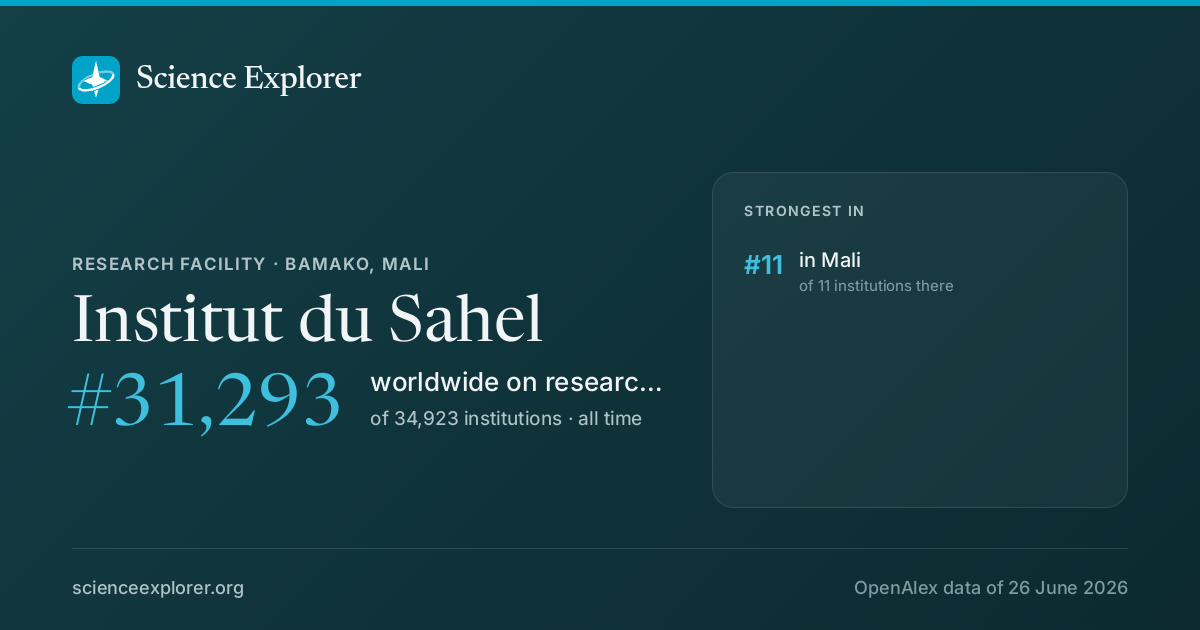
- World rank, all time
- #31,293 of 34,923
- Rank in Mali
- #11 of 11
- Research works
- 180 ▲ 25% vs 2018-21
- Citations
- 2.1k 11.6 per fractional work
- Top-10% rate
- 11.1% all institutions 10.0%
- vs its own fields
- 0.82× 1.00× is exactly expected
- Open access
- 48% world 40%
- International
- 33% world 18%
Which fields of science does Institut du Sahel work in?
In 2022-now, 38% of research at Institut du Sahel is in Health Sciences, 36% in Life Sciences. Its largest fields are Medicine (36%), Agricultural and Biological Sciences (28%), Social Sciences (8%). It does 2.1× the world's share of Life Sciences.
Each ring splits the one inside it: the four domains of science, their fields, their subfields. Size is fractional works in 2022-now. Every slice is a page; the interactive view zooms down to single topics and colours each by how much more of it this institution does than the world.
Its 4 domains and 20 fields, with their numbers
- Health Sciences1738.3%
- Medicine1636.2%
- Health Professions11.4%
- Nursing00.5%
- Veterinary00.1%
- Life Sciences1635.7%
- Social Sciences919.5%
- Physical Sciences36.6%
- Environmental Science12.7%
- Engineering11.3%
- Computer Science00.9%
- Mathematics00.7%
- Physics and Astronomy00.7%
- Energy00.2%
Field profile
Location quotient across every field it publishes in: outside the ring is more than an institution of this size would be expected to publish, inside it is less.
Rings at 0.5×, 1× and 2×. Widest outward: Agricultural and Biological Sciences, 6.0×. Every wedge is a field page.
All 20 fields, with their numbers
- Agricultural and Biological Sciences5.98×13 works
- Medicine1.88×16 works
- Decision Sciences1.65×1 works
- Immunology and Microbiology1.43×1 works
- Nursing1.11×0 works
- Arts and Humanities1.04×1 works
- Business, Management and Accounting1.04×2 works
- Economics, Econometrics and Finance1.03×1 works
- Biochemistry, Genetics and Molecular Biology0.94×2 works
- Veterinary0.92×0 works
- Mathematics0.64×0 works
- Social Sciences0.60×3 works
- Psychology0.57×1 works
- Environmental Science0.54×1 works
- Health Professions0.54×1 works
- Neuroscience0.50×0 works
- Physics and Astronomy0.34×0 works
- Energy0.20×0 works
- Computer Science0.11×0 works
- Engineering0.09×1 works
- Agricultural and Biological Sciences 6.0×
- Medicine 1.9×
- Decision Sciences 1.6×
- Immunology and Microbiology 1.4×
- Nursing 1.1×
- Arts and Humanities 1.0×
- Business, Management and Accounting 1.0×
- Economics, Econometrics and Finance 1.0×
- Biochemistry, Genetics and Molecular Biology 0.9×
- Veterinary 0.9×
- Mathematics 0.6×
- Social Sciences 0.6×
- Psychology 0.6×
- Environmental Science 0.5×
- Health Professions 0.5×
- Neuroscience 0.5×
- Physics and Astronomy 0.3×
- Energy 0.2×
- Computer Science 0.1×
- Engineering 0.1×
Who are the top researchers at Institut du Sahel?
Ranked on the quality score, Lamine Traoré, Hawa Thiam Ndiaye and Mohamed Kole Sidibé lead among researchers whose main affiliation is Institut du Sahel.
- 1
Lamine Traoré
 Mali · #2,915,491 worldwide
474 citations · 43 works
- 2
Hawa Thiam Ndiaye
Mali · #3,009,598 worldwide
408 citations · 16 works
- 3
Mohamed Kole Sidibé
Mali · #4,860,999 worldwide
24 citations · 15 works
- 4
Seydou Bakayoko
Mali · #4,884,903 worldwide
120 citations · 36 works
- 5
Alain Auzemery
Mali · #5,095,313 worldwide
54 citations · 41 works
- 6
Abdoulaye Napo
Mali · #5,205,858 worldwide
129 citations · 49 works
- 7
Abdoulaye Nouhoum Coulibaly
Mali · #5,245,275 worldwide
10 citations · 20 works
- 8
Jeannette Traoré
Mali · #5,585,333 worldwide
56 citations · 43 works
- 9
Nouhoum Guirou
Mali · #5,612,591 worldwide
131 citations · 52 works
Which keywords describe research at Institut du Sahel?
By fractional works in 2022-now, weighted toward what it does more of than the world: Smallholder Farmers, Social Networks, Sustainable Agriculture, Food Security, Rural Development, Sustainability, Agriculture and Glaucoma.
- Retinal Disease
- Ocular Findings
- Femtosecond Laser
- Intravitreal Injection
- Endophthalmitis
- Genetic Mutations
- Antibiotic Resistance
- Diabetic Retinopathy
- Work Organization
- Optic Nerve
- Agricultural Development
- Macular Degeneration
- Risk Management
- Vulnerability
- Glaucoma
- Adaptation
- Agriculture
- Food Security
- Climate Change
- Social Networks
- Smallholder Farmers
- Sustainability
- Sustainable Agriculture
- Rural Development
- Epidemiology
- Agricultural Innovation
- Livelihood Diversification
- Insurance
- Agroecology
- Multifunctionality
- Livestock Farming
- Optical Coherence Tomography
- Cultural Heritage
- Surgical Management
- Cardiovascular Risk
- Job Satisfaction
- Facial Fractures
- Maxillofacial Trauma
- Intraocular Lens Implantation
- Retinal Artery Occlusion
Size is fractional works in 2022-now in the topics tagged with each word; colour is the word's share of this institution's work against its share of the world's. The 40 words are chosen for being large and distinctive. Each links to the topic it comes from most.
All 40 words, with their numbers
- Smallholder Farmers6▲ 62×4 topics
- Social Networks5▲ 45×2 topics
- Sustainability4▲ 4.1×13 topics
- Climate Change4▲ 3.6×13 topics
- Sustainable Agriculture4▲ 28×4 topics
- Food Security4▲ 16×6 topics
- Rural Development3▲ 22×2 topics
- Agriculture3▲ 19×3 topics
- Epidemiology3▲ 1.81×15 topics
- Adaptation3▲ 24×3 topics
- Agricultural Innovation3▲ 149×1 topic
- Glaucoma3▲ 47×3 topics
- Livelihood Diversification3▲ 222×1 topic
- Vulnerability3▲ 29×2 topics
- Insurance2▲ 68×1 topic
- Risk Management2▲ 11×1 topic
- Agroecology2▲ 33×2 topics
- Macular Degeneration2▲ 38×3 topics
- Multifunctionality2▲ 99×2 topics
- Agricultural Development2▲ 29×1 topic
- Livestock Farming2▲ 77×2 topics
- Optic Nerve2▲ 47×2 topics
- Optical Coherence Tomography2▲ 45×2 topics
- Work Organization2▲ 115×1 topic
- Cultural Heritage2▲ 7.1×3 topics
- Diabetic Retinopathy2▲ 39×2 topics
- Surgical Management1▲ 8.0×3 topics
- Antibiotic Resistance1▲ 7.2×3 topics
- Cardiovascular Risk1▲ 9.5×3 topics
- Genetic Mutations1▲ 6.9×8 topics
- Job Satisfaction1▲ 6.8×2 topics
- Endophthalmitis1▲ 74×2 topics
- Facial Fractures1▲ 121×1 topic
- Intravitreal Injection1▲ 37×2 topics
- Maxillofacial Trauma1▲ 121×1 topic
- Femtosecond Laser1▲ 47×1 topic
- Intraocular Lens Implantation1▲ 83×1 topic
- Ocular Findings1▲ 91×1 topic
- Retinal Artery Occlusion1▲ 91×1 topic
- Retinal Disease1▲ 51×1 topic
Which research topics does Institut du Sahel publish most on?
By volume in 2022-now: Agricultural Innovations and Practices, Agricultural risk and resilience, Agriculture and Rural Development Research and Facial Trauma and Fracture Management.
Area is fractional works; colour is the subfield each topic belongs to.
- 1 Agricultural Innovations and Practices General Agricultural and Biological Sciences 3 works
- 2 Agricultural risk and resilience Soil Science 2 works
- 3 Agriculture and Rural Development Research Ecology, Evolution, Behavior and Systematics 2 works
- 4 Facial Trauma and Fracture Management Surgery 1 works
- 5 Retinal and Optic Conditions Ophthalmology 1 works
- 6 Retinal Imaging and Analysis Radiology, Nuclear Medicine and Imaging 1 works
- 7 Intraocular Surgery and Lenses Ophthalmology 1 works
- 8 Glaucoma and retinal disorders Ophthalmology 1 works
- 9 Emotional Labor in Professions Sociology and Political Science 1 works
- 10 Turkish Literature and Culture Literature and Literary Theory 1 works
How open and international is its research?
Against the world's own shares: the tick on each track. Both are shares of its output, so they sit on one scale and can be read against each other as well as against the world.
World: 40% of research is openly available.
World: 18% is written across borders.
How has Institut du Sahel's research output changed?
Output in 2022-2025 was 25% higher than in 2018-2021.
The same series as a ribbon: one cell per year, darker for more. The line above answers how much; this answers when.
Its share of all research
Growing output can still be a shrinking share: all of science grows. This is Institut du Sahel as a percentage of every work published that year, 0.00013% in 2024.
Fractional works of Institut du Sahel over all fractional works that year. How the balance of science has shifted.
Other research institutions in Bamako
- University of Bamako
- Mali-Folkecenter
- Institut National de Recherche en Santé Publique
- Université des Sciences, des Techniques et des Technologies de Bamako
- Université des Lettres et des Sciences Humaines de Bamako
- Ministère de la Santé et de l'Hygiène Publique
- Ministry of Economy and Finance
- Institut d'Économie Rurale
Share Institut du Sahel's ranking
Badges for a website1Each links back here and updates with every snapshot

Research measures only: rankings here say nothing about teaching, admissions or student experience. Comparable institutions and collaboration partners have tabs of their own, above.
Discussion
Ask a question or share a note about Institut du Sahel. Posts are plain text and can be reported.