Science Explorer Back to mapMap
Discussion
Institution · Bucureşci · Romania

Institutul de Cercetari Electrotehnice

In research, Institutul de Cercetari Electrotehnice stands highest in Physical Sciences (#11,360 of 17,446 worldwide), over all time.

World rank, all time
#24,340
of 34,923
Rank in Romania
#95
of 174
Research works
208
▲ 15% vs 2018-21
Citations
1k
4.9 per fractional work
Top-10% rate
7.9%
all institutions 10.0%
vs its own fields
0.98×
1.00× is exactly expected
Open access
55%
world 40%
International
11%
world 18%

What is Institutul de Cercetari Electrotehnice known for in research?

The fields where it stands highest, over all time, ranked among every institution above the floor in each field.

FieldWorld rankWhere that sitsTop-10% rateWorks
Physical SciencesDomain #11,360 of 17,446 3.9%169

Each strip is that field's whole ranked pool, with the notch where Institutul de Cercetari Electrotehnice sits in it, in the colour of the band that rank falls in. The track under the rate is the rate itself: it carries no average mark, because the average differs by field (from about 6% in Dentistry to 21% in Economics).

Which fields of science does Institutul de Cercetari Electrotehnice work in?

In 2022-now, 70% of research at Institutul de Cercetari Electrotehnice is in Physical Sciences, 15% in Health Sciences. Its largest fields are Engineering (44%), Medicine (14%), Mathematics (8%). It does 1.7× the world's share of Physical Sciences.

Physical Sciences: 41 fractional works · 70.1% of its workEngineering: 26 fractional works · 44.2% of its workMechanical Engineering: 7 fractional works · 12.1% of its workElectrical and Electronic Engineering: 4 fractional works · 6.4% of its workAerospace Engineering: 3 fractional works · 5.3% of its workAutomotive Engineering: 2 fractional works · 4.0% of its workBiomedical Engineering: 2 fractional works · 3.9% of its workCivil and Structural Engineering: 1 fractional works · 2.1% of its workControl and Systems Engineering: 1 fractional works · 2.1% of its workBuilding and Construction: 1 fractional works · 2.0% of its workComputational Mechanics: 1 fractional works · 1.9% of its workMechanics of Materials: 1 fractional works · 1.6% of its workIndustrial and Manufacturing Engineering: 1 fractional works · 1.1% of its workMedia Technology: 0 fractional works · 0.7% of its workOcean Engineering: 0 fractional works · 0.6% of its workSafety, Risk, Reliability and Quality: 0 fractional works · 0.3% of its workMathematics: 5 fractional works · 7.9% of its workApplied Mathematics: 2 fractional works · 3.6% of its workGeometry and Topology: 2 fractional works · 2.7% of its workNumerical Analysis: 0 fractional works · 0.9% of its workMathematical Physics: 0 fractional works · 0.5% of its workStatistics and Probability: 0 fractional works · 0.3% of its workEnvironmental Science: 4 fractional works · 7.3% of its workWater Science and Technology: 1 fractional works · 1.3% of its workPollution: 1 fractional works · 1.2% of its workIndustrial and Manufacturing Engineering: 1 fractional works · 1.2% of its workEnvironmental Chemistry: 1 fractional works · 1.1% of its workEcology: 1 fractional works · 1.0% of its workHealth, Toxicology and Mutagenesis: 1 fractional works · 1.0% of its workEnvironmental Engineering: 0 fractional works · 0.3% of its workSmaller subfields together: 0 fractional works · 0.3% of its workMaterials Science: 4 fractional works · 6.3% of its workPolymers and Plastics: 1 fractional works · 2.1% of its workMaterials Chemistry: 1 fractional works · 1.8% of its workGeneral Materials Science: 1 fractional works · 1.7% of its workBiomaterials: 0 fractional works · 0.6% of its workSmaller subfields together: 0 fractional works · 0.2% of its workEnergy: 1 fractional works · 1.7% of its workGeneral Energy: 1 fractional works · 1.7% of its workChemical Engineering: 1 fractional works · 1.4% of its workFluid Flow and Transfer Processes: 1 fractional works · 1.4% of its workEarth and Planetary Sciences: 0 fractional works · 0.7% of its workAtmospheric Science: 0 fractional works · 0.3% of its workPaleontology: 0 fractional works · 0.2% of its workSmaller subfields together: 0 fractional works · 0.2% of its workComputer Science: 0 fractional works · 0.5% of its workComputer Vision and Pattern Recognition: 0 fractional works · 0.3% of its workSmaller subfields together: 0 fractional works · 0.2% of its workChemistry: 0 fractional works · 0.1% of its workHealth Sciences: 9 fractional works · 15.0% of its workMedicine: 8 fractional works · 13.6% of its workObstetrics and Gynecology: 2 fractional works · 3.5% of its workSurgery: 1 fractional works · 2.2% of its workPediatrics, Perinatology and Child Health: 1 fractional works · 2.1% of its workReproductive Medicine: 1 fractional works · 1.7% of its workInfectious Diseases: 0 fractional works · 0.7% of its workRheumatology: 0 fractional works · 0.6% of its workPublic Health, Environmental and Occupational Health: 0 fractional works · 0.6% of its workPulmonary and Respiratory Medicine: 0 fractional works · 0.4% of its workEpidemiology: 0 fractional works · 0.3% of its workCritical Care and Intensive Care Medicine: 0 fractional works · 0.3% of its workUrology: 0 fractional works · 0.3% of its workOncology: 0 fractional works · 0.3% of its workHematology: 0 fractional works · 0.2% of its workSmaller subfields together: 0 fractional works · 0.5% of its workHealth Professions: 1 fractional works · 1.1% of its workPhysical Therapy, Sports Therapy and Rehabilitation: 0 fractional works · 0.6% of its workSpeech and Hearing: 0 fractional works · 0.6% of its workVeterinary: 0 fractional works · 0.2% of its workSmall Animals: 0 fractional works · 0.2% of its workSocial Sciences: 6 fractional works · 10.9% of its workSocial Sciences: 2 fractional works · 3.3% of its workEducation: 1 fractional works · 1.7% of its workUrban Studies: 0 fractional works · 0.9% of its workSociology and Political Science: 0 fractional works · 0.6% of its workSmaller subfields together: 0 fractional works · 0.1% of its workDecision Sciences: 2 fractional works · 3.1% of its workManagement Science and Operations Research: 1 fractional works · 1.7% of its workStatistics, Probability and Uncertainty: 1 fractional works · 1.4% of its workArts and Humanities: 1 fractional works · 1.8% of its workLanguage and Linguistics: 0 fractional works · 0.6% of its workLiterature and Literary Theory: 0 fractional works · 0.6% of its workArcheology: 0 fractional works · 0.4% of its workSmaller subfields together: 0 fractional works · 0.3% of its workPsychology: 1 fractional works · 1.4% of its workClinical Psychology: 0 fractional works · 0.4% of its workSocial Psychology: 0 fractional works · 0.4% of its workDevelopmental and Educational Psychology: 0 fractional works · 0.3% of its workExperimental and Cognitive Psychology: 0 fractional works · 0.3% of its workBusiness, Management and Accounting: 1 fractional works · 1.3% of its workStrategy and Management: 0 fractional works · 0.6% of its workManagement Information Systems: 0 fractional works · 0.3% of its workOrganizational Behavior and Human Resource Management: 0 fractional works · 0.3% of its workSmaller subfields together: 0 fractional works · 0.2% of its workLife Sciences: 2 fractional works · 4.0% of its workBiochemistry, Genetics and Molecular Biology: 1 fractional works · 1.7% of its workMolecular Biology: 0 fractional works · 0.8% of its workCancer Research: 0 fractional works · 0.4% of its workMolecular Medicine: 0 fractional works · 0.3% of its workGenetics: 0 fractional works · 0.2% of its workImmunology and Microbiology: 1 fractional works · 1.3% of its workImmunology: 1 fractional works · 1.0% of its workApplied Microbiology and Biotechnology: 0 fractional works · 0.3% of its workAgricultural and Biological Sciences: 1 fractional works · 1.0% of its workFood Science: 0 fractional works · 0.5% of its workInsect Science: 0 fractional works · 0.5% of its workNeuroscience: 0 fractional works · 0.1% of its workALL ITS WORKInstitutul deCercetari…59fractional works, 2022-now
Life Sciences4%Physical Sciences70%Health Sciences15%Social Sciences11%

Each ring splits the one inside it: the four domains of science, their fields, their subfields. Size is fractional works in 2022-now. Every slice is a page; the interactive view zooms down to single topics and colours each by how much more of it this institution does than the world.

Its 4 domains and 21 fields, with their numbers
    1. Engineering2644.2%
    2. Mathematics57.9%
    3. Environmental Science47.3%
    4. Materials Science46.3%
    5. Energy11.7%
    6. Chemical Engineering11.4%
    7. Earth and Planetary Sciences00.7%
    8. Computer Science00.5%
    9. Chemistry00.1%
    1. Medicine813.6%
    2. Health Professions11.1%
    3. Veterinary00.2%
    1. Social Sciences23.3%
    2. Decision Sciences23.1%
    3. Arts and Humanities11.8%
    4. Psychology11.4%
    5. Business, Management and Accounting11.3%
    1. Biochemistry, Genetics and Molecular Biology11.7%
    2. Immunology and Microbiology11.3%
    3. Agricultural and Biological Sciences11.0%
    4. Neuroscience00.1%
All of science, and how each field's share has moved since 1950: the Science domain explorer

Field profile

Location quotient across every field it publishes in: outside the ring is more than an institution of this size would be expected to publish, inside it is less.

Agricultural and Biological Sciences: 0.20× its world share, 1 worksAgricultural and Bio…Biochemistry, Genetics and Molecular Biology: 0.31× its world share, 1 worksBiochemistry, Geneti…Immunology and Microbiology: 1.28× its world share, 1 worksImmunology and Micro…Neuroscience: 0.07× its world share, 0 worksNeuroscienceChemical Engineering: 4.06× its world share, 1 worksChemical EngineeringChemistry: 0.07× its world share, 0 worksChemistryComputer Science: 0.06× its world share, 0 worksComputer ScienceEarth and Planetary Sciences: 0.45× its world share, 0 worksEarth and Planetary …Energy: 1.85× its world share, 1 worksEnergyEngineering: 2.94× its world share, 26 worksEngineeringEnvironmental Science: 1.47× its world share, 4 worksEnvironmental ScienceMaterials Science: 1.81× its world share, 4 worksMaterials ScienceMathematics: 6.75× its world share, 5 worksMathematicsHealth Professions: 0.43× its world share, 1 worksHealth ProfessionsMedicine: 0.71× its world share, 8 worksMedicineVeterinary: 1.74× its world share, 0 worksVeterinaryArts and Humanities: 0.61× its world share, 1 worksArts and HumanitiesBusiness, Management and Accounting: 0.40× its world share, 1 worksBusiness, Management…Decision Sciences: 3.23× its world share, 2 worksDecision SciencesPsychology: 0.47× its world share, 1 worksPsychologySocial Sciences: 0.26× its world share, 2 worksSocial Sciences1×world share
more than its size predictsabout as predictedless

Rings at 0.5×, 1× and 2×. Widest outward: Mathematics, 6.8×. Every wedge is a field page.

All 21 fields, with their numbers
  1. Mathematics6.75×5 works
  2. Chemical Engineering4.06×1 works
  3. Decision Sciences3.23×2 works
  4. Engineering2.94×26 works
  5. Energy1.85×1 works
  6. Materials Science1.81×4 works
  7. Veterinary1.74×0 works
  8. Environmental Science1.47×4 works
  9. Immunology and Microbiology1.28×1 works
  10. Medicine0.71×8 works
  11. Arts and Humanities0.61×1 works
  12. Psychology0.47×1 works
  13. Earth and Planetary Sciences0.45×0 works
  14. Health Professions0.43×1 works
  15. Business, Management and Accounting0.40×1 works
  16. Biochemistry, Genetics and Molecular Biology0.31×1 works
  17. Social Sciences0.26×2 works
  18. Agricultural and Biological Sciences0.20×1 works
  19. Neuroscience0.07×0 works
  20. Chemistry0.07×0 works
  21. Computer Science0.06×0 works

Who are the top researchers at Institutul de Cercetari Electrotehnice?

Ranked on the quality score, ‎Mihai Monea, Cezara-Liliana Raţ and Dan Ştefan Marinescu lead among researchers whose main affiliation is Institutul de Cercetari Electrotehnice.

  1. 1 ‎Mihai Monea Romania · #4,752,599 worldwide 90 citations · 30 works
  2. 2 Cezara-Liliana Raţ Romania · #4,915,096 worldwide 19 citations · 15 works
  3. 3 Dan Ştefan Marinescu Romania · #5,096,808 worldwide 102 citations · 37 works
All ranked researchers at Institutul de Cercetari Electrotehnice

What are the most cited papers from Institutul de Cercetari Electrotehnice?

The most cited paper from Institutul de Cercetari Electrotehnice is "A study of advancement in application opportunities of aluminum metal matrix composites" (Arun Kumar Sharma, Rakesh Bhandari, Amit Aherwar et al., 2020), with 238 citations. Next come "Infective Endocarditis in Children With Congenital Heart Disease" (196) and "Polymer matrix composites: A state of art review" (98).

Most cited papers
#PaperReleasedCitations
1 A study of advancement in application opportunities of aluminum metal matrix composites Arun Kumar Sharma, Rakesh Bhandari, Amit Aherwar et al. · Materials Today Proceedings Open access 2020 238
2 Infective Endocarditis in Children With Congenital Heart Disease Dinela Rushani, Jay S. Kaufman, Raluca Ionescu‐Ittu et al. · Circulation 23 Sep 2013 196
3 Polymer matrix composites: A state of art review Arun Kumar Sharma, Rakesh Bhandari, Chaitanya Sharma et al. · Materials Today Proceedings 2022 98
4 Endometriosis and the Role of Pro-Inflammatory and Anti-Inflammatory Cytokines in Pathophysiology: A Narrative Review of the Literature Ioan Emilian Oală, Melinda-Ildiko Mitranovici, Diana Maria Chiorean et al. · Diagnostics ReviewOpen access 31 Jan 2024 91
5 A study of fabrication methods of aluminum based composites focused on stir casting process Arun Kumar Sharma, Rakesh Bhandari, Amit Aherwar et al. · Materials Today Proceedings Open access 2020 74
All 61 most cited papers, with filters and sorting

Which keywords describe research at Institutul de Cercetari Electrotehnice?

By fractional works in 2022-now, weighted toward what it does more of than the world: Renewable Energy, Energy Efficiency, Aerodynamics, CFD Simulation, Weibull Distribution, Wind Turbine Wakes, Sustainability and Mechanical Properties.

▲ more of its work than of the world's◆ about the world's share▼ less than the world's

Size is fractional works in 2022-now in the topics tagged with each word; colour is the word's share of this institution's work against its share of the world's. The 40 words are chosen for being large and distinctive. Each links to the topic it comes from most.

All 40 words, with their numbers
  1. Renewable Energy7▲ 8.3×8 topics
  2. Energy Efficiency4▲ 7.4×5 topics
  3. Sustainability3▲ 2.4×7 topics
  4. Aerodynamics3▲ 62×2 topics
  5. Environmental Impact2▲ 2.5×9 topics
  6. Mechanical Properties2▲ 4.2×9 topics
  7. CFD Simulation2▲ 31×2 topics
  8. Weibull Distribution2▲ 74×1 topic
  9. Wind Turbine Wakes2▲ 116×1 topic
  10. Heat Transfer2▲ 6.8×7 topics
  11. Circular Economy2▲ 11×3 topics
  12. Control Systems2▲ 17×4 topics
  13. Emissions2▲ 16×2 topics
  14. Power Electronics2▲ 9.4×2 topics
  15. Lithium-ion Batteries2▲ 6.9×4 topics
  16. Metal Recovery2▲ 15×3 topics
  17. Numerical Simulation2▲ 9.3×5 topics
  18. Optimization2▲ 6.1×3 topics
  19. Oxidation Mechanism2▲ 36×2 topics
  20. Electric Drives2▲ 66×2 topics
  21. Iron Oxides2▲ 138×1 topic
  22. Microstructure2▲ 4.8×6 topics
  23. Reduction Kinetics2▲ 138×1 topic
  24. Doubly Fed Induction Generator1▲ 136×1 topic
  25. Geometry1▲ 156×1 topic
  26. Hyperbolic1▲ 156×1 topic
  27. Wind Power1▲ 27×1 topic
  28. Chemical Kinetics1▲ 25×2 topics
  29. Nanotechnology1▲ 13×2 topics
  30. Metallurgy1▲ 35×2 topics
  31. Power Supply1▲ 128×1 topic
  32. Recycling1▲ 5.5×4 topics
  33. Reliability1▲ 26×1 topic
  34. Biodegradable1▲ 25×2 topics
  35. Environmental Impacts1▲ 6.9×3 topics
  36. Finite Element Method1▲ 20×3 topics
  37. Maternal Mortality1▲ 8.4×3 topics
  38. Microbial Ecology1▲ 11×2 topics
  39. Analytic Hierarchy Process1▲ 31×1 topic
  40. Biodiesel1▲ 19×1 topic

Which research topics does Institutul de Cercetari Electrotehnice publish most on?

By volume in 2022-now: Wind Energy Research and Development, Iron and Steelmaking Processes, Mathematics and Applications and Wind Turbine Control Systems.

  1. 1 Wind Energy Research and Development Aerospace Engineering 2 works
  2. 2 Iron and Steelmaking Processes Mechanical Engineering 2 works
  3. 3 Mathematics and Applications Geometry and Topology 1 works
  4. 4 Wind Turbine Control Systems Electrical and Electronic Engineering 1 works
  5. 5 Electric Power Systems and Control Electrical and Electronic Engineering 1 works
  6. 6 Education Systems and Policy Education 1 works
  7. 7 Global Energy Security and Policy General Energy 1 works
  8. 8 Multi-Criteria Decision Making Management Science and Operations Research 1 works
  9. 9 Material Properties and Applications General Materials Science 1 works
  10. 10 Biodiesel Production and Applications Biomedical Engineering 1 works

How open and international is its research?

Against the world's own shares: the tick on each track. Both are shares of its output, so they sit on one scale and can be read against each other as well as against the world.

openly available55.3%not open44.7%

World: 40% of research is openly available.

with international co-authors10.7%domestic only89.3%

World: 18% is written across borders.

How has Institutul de Cercetari Electrotehnice's research output changed?

Output in 2022-2025 was 15% higher than in 2018-2021.

still counting1990200020102020
grewheldshrank

The same series as a ribbon: one cell per year, darker for more. The line above answers how much; this answers when.

Its share of all research

Growing output can still be a shrinking share: all of science grows. This is Institutul de Cercetari Electrotehnice as a percentage of every work published that year, 0.00022% in 2024.

still counting0.00020%0.00040%0.00060%Institutul de Cercetari Electrotehnice0.00039% in 202519801990200020102020

Fractional works of Institutul de Cercetari Electrotehnice over all fractional works that year. How the balance of science has shifted.

Share Institutul de Cercetari Electrotehnice's ranking
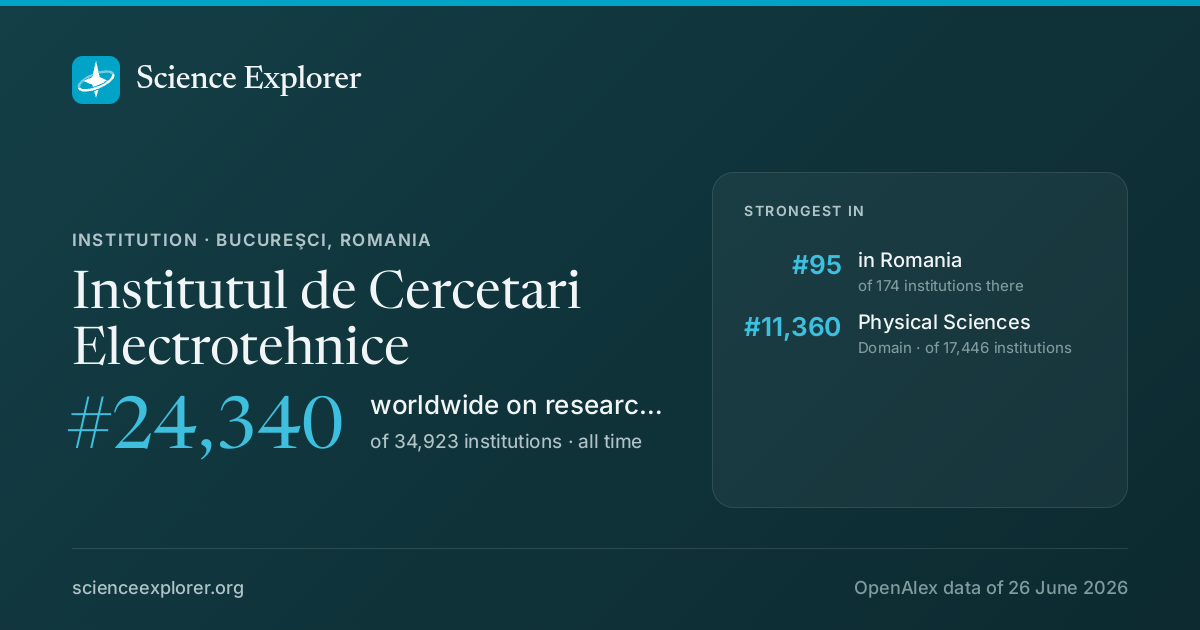
Institutul de Cercetari Electrotehnice on Science Explorer

A card with Institutul de Cercetari Electrotehnice's standing and the fields it leads in, for a post or a slide. A link to this page previews as the same card.

Download the card

1200 × 630 PNG, sized for social posts, drawn from the latest snapshot.

Badges for a website1Each links back here and updates with every snapshot

Research measures only: rankings here say nothing about teaching, admissions or student experience. Comparable institutions and collaboration partners have tabs of their own, above.

Discussion

Ask a question or share a note about Institutul de Cercetari Electrotehnice. Keep it to the research: no personal attacks, advertising or links. Any reader can report a post, which collapses it for everyone until it is opened.