International Development Research Centre
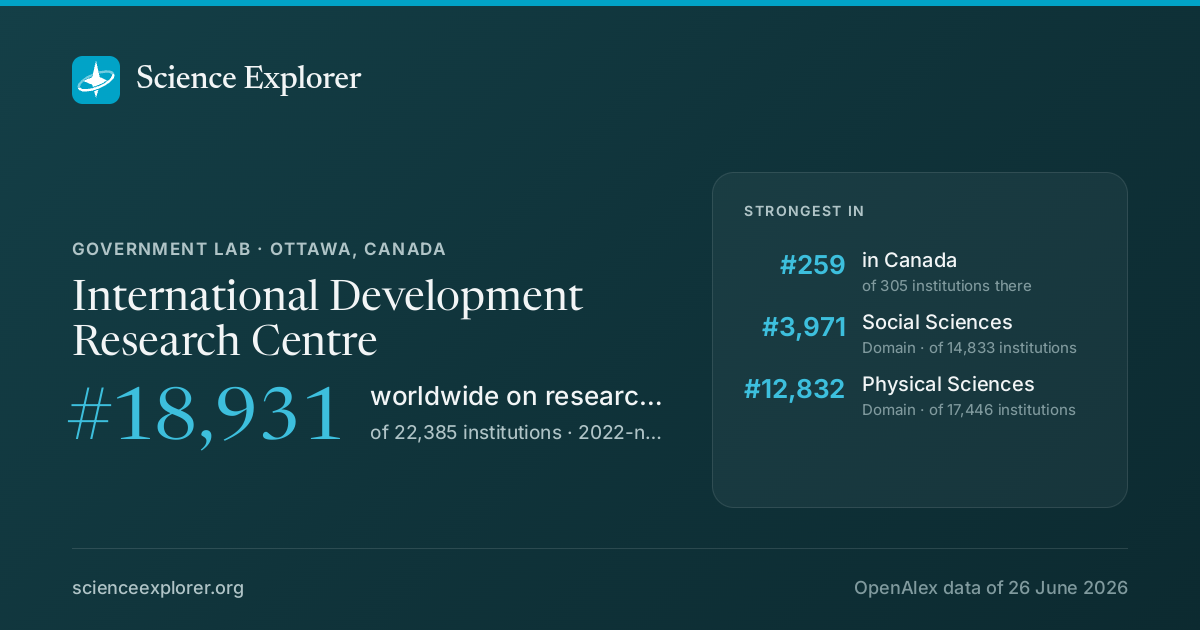
In research, International Development Research Centre stands highest in Social Sciences (#3,971 of 14,833 worldwide), Social Sciences (#3,207 of 9,330 worldwide) and Physical Sciences (#12,832 of 17,446 worldwide), over all time.
- World rank, 2022-now
- #18,931 of 22,385 · #10,286 all time
- Rank in Canada
- #259 of 305
- Research works
- 788 ▼ 20% vs 2018-21
- Citations
- 19k 23.9 per fractional work
- Top-10% rate
- 11.1% all institutions 10.0%
- vs its own fields
- 1.01× 1.00× is exactly expected
- Open access
- 26% world 40%
- International
- 24% world 18%
What is International Development Research Centre known for in research?
The fields where it stands highest, over all time, ranked among every institution above the floor in each field.
| Field | World rank | Where that sits | Top-10% rate | Works |
|---|---|---|---|---|
| Social SciencesDomain | #3,971 of 14,833 | 10.2% | 364 | |
| Social SciencesField | #3,207 of 9,330 | 10.8% | 235 | |
| Physical SciencesDomain | #12,832 of 17,446 | 8.7% | 245 |
Each strip is that field's whole ranked pool, with the notch where International Development Research Centre sits in it, in the colour of the band that rank falls in. The track under the rate is the rate itself: it carries no average mark, because the average differs by field (from about 6% in Dentistry to 21% in Economics).
Which fields of science does International Development Research Centre work in?
In 2022-now, 50% of research at International Development Research Centre is in Social Sciences, 19% in Health Sciences. Its largest fields are Social Sciences (31%), Medicine (12%), Engineering (10%). It does 1.9× the world's share of Social Sciences.
Each ring splits the one inside it: the four domains of science, their fields, their subfields. Size is fractional works in 2022-now. Every slice is a page; the interactive view zooms down to single topics and colours each by how much more of it this institution does than the world.
Its 4 domains and 23 fields, with their numbers
- Social Sciences4049.8%
- Health Sciences1619.4%
- Medicine1012.0%
- Health Professions56.7%
- Nursing10.7%
- Physical Sciences1518.5%
- Engineering810.2%
- Computer Science23.0%
- Environmental Science22.8%
- Materials Science11.4%
- Chemistry00.3%
- Earth and Planetary Sciences00.2%
- Energy00.2%
- Mathematics00.2%
- Physics and Astronomy00.1%
- Life Sciences1012.3%
Field profile
Location quotient across every field it publishes in: outside the ring is more than an institution of this size would be expected to publish, inside it is less.
Rings at 0.5×, 1× and 2×. Widest outward: Pharmacology, Toxicology and Pharmaceutics, 5.0×. Every wedge is a field page.
All 23 fields, with their numbers
- Pharmacology, Toxicology and Pharmaceutics4.97×1 works
- Decision Sciences4.49×4 works
- Economics, Econometrics and Finance2.67×5 works
- Health Professions2.53×5 works
- Social Sciences2.42×25 works
- Agricultural and Biological Sciences1.89×7 works
- Psychology1.74×4 works
- Nursing1.48×1 works
- Business, Management and Accounting0.95×2 works
- Engineering0.68×8 works
- Medicine0.63×10 works
- Environmental Science0.57×2 works
- Materials Science0.41×1 works
- Computer Science0.39×2 works
- Immunology and Microbiology0.33×0 works
- Energy0.26×0 works
- Arts and Humanities0.23×0 works
- Chemistry0.20×0 works
- Biochemistry, Genetics and Molecular Biology0.19×1 works
- Mathematics0.19×0 works
- Neuroscience0.17×0 works
- Earth and Planetary Sciences0.15×0 works
- Physics and Astronomy0.03×0 works
- Pharmacology, Toxicology and Pharmaceutics 5.0×
- Decision Sciences 4.5×
- Economics, Econometrics and Finance 2.7×
- Health Professions 2.5×
- Social Sciences 2.4×
- Agricultural and Biological Sciences 1.9×
- Psychology 1.7×
- Nursing 1.5×
- Business, Management and Accounting 0.9×
- Engineering 0.7×
- Medicine 0.6×
- Environmental Science 0.6×
- Materials Science 0.4×
- Computer Science 0.4×
- Immunology and Microbiology 0.3×
- Energy 0.3×
- Arts and Humanities 0.2×
- Chemistry 0.2×
- Biochemistry, Genetics and Molecular Biology 0.2×
- Mathematics 0.2×
- Neuroscience 0.2×
- Earth and Planetary Sciences 0.1×
- Physics and Astronomy 0.0×
Who are the top researchers at International Development Research Centre?
Ranked on the quality score, Matthew Longshore Smith, Robert K. D. McLean and Bhim Adhikari lead among researchers whose main affiliation is International Development Research Centre.
- 1
Matthew Longshore Smith
 Canada · #152,291 worldwide
2.9k citations · 90 works
- 2
Robert K. D. McLean
Canada · #492,100 worldwide
584 citations · 38 works
- 3
Bhim Adhikari
Canada · #543,990 worldwide
2.2k citations · 58 works
- 4
Arjan de Haan
Canada · #799,968 worldwide
3.4k citations · 147 works
- 5
Chaitali Sinha
Canada · #972,276 worldwide
890 citations · 17 works
- 6
Bruce A. B. Currie-Alder
Canada · #1,482,833 worldwide
405 citations · 42 works
- 7
Charlotte MacAlister
Canada · #1,816,763 worldwide
1k citations · 37 works
- 8
Ronnie Vernooy
Canada · #1,864,184 worldwide
1.9k citations · 237 works
- 9
Marie‐Gloriose Ingabire
Canada · #1,891,949 worldwide
292 citations · 27 works
- 10
Martha Melesse
Canada · #1,935,631 worldwide
147 citations · 15 works
Which keywords describe research at International Development Research Centre?
By fractional works in 2022-now, weighted toward what it does more of than the world: Economic Growth, Political Economy, Democracy, Governance, Corruption, Cross-National Study, Institutions and Vulnerability.
- Secondary Analysis
- Poverty Reduction
- Data Use
- Quality Assessment
- PRISMA Statement
- Infectious Diseases
- Ethical Issues
- Gender Inequality
- Adaptation
- Community Health Workers
- Social Support
- Food Security
- Public Health
- Vulnerability
- Human Rights
- Cross-National Study
- Sustainable Development
- Governance
- Democracy
- Political Economy
- Economic Growth
- Globalization
- Epidemiology
- Climate Change
- Corruption
- Institutions
- Sustainability
- Research Methodology
- Publication Bias
- Water Management
- Agriculture
- Labor Market
- Global Governance
- Social Networks
- Evidence Synthesis
- Intersectionality
- Public-Private Partnerships
- Student Achievement
- Educational Improvement
- Qualitative Data
Size is fractional works in 2022-now in the topics tagged with each word; colour is the word's share of this institution's work against its share of the world's. The 40 words are chosen for being large and distinctive. Each links to the topic it comes from most.
All 40 words, with their numbers
- Economic Growth5▲ 7.4×11 topics
- Political Economy4▲ 21×6 topics
- Globalization4▲ 2.6×17 topics
- Democracy4▲ 14×3 topics
- Epidemiology4▲ 1.20×18 topics
- Governance4▲ 15×5 topics
- Climate Change4▲ 1.64×20 topics
- Sustainable Development4▲ 2.8×11 topics
- Corruption3▲ 27×2 topics
- Cross-National Study3▲ 171×1 topic
- Institutions3▲ 48×1 topic
- Human Rights3▲ 3.6×10 topics
- Sustainability3▲ 1.50×14 topics
- Vulnerability3▲ 15×5 topics
- Research Methodology3▲ 55×2 topics
- Public Health2▲ 2.1×12 topics
- Publication Bias2▲ 62×2 topics
- Food Security2▲ 5.3×5 topics
- Water Management2▲ 22×2 topics
- Social Support2▲ 4.5×4 topics
- Agriculture2▲ 6.2×2 topics
- Community Health Workers2▲ 26×2 topics
- Labor Market2▲ 8.2×5 topics
- Adaptation2▲ 7.6×3 topics
- Global Governance2▲ 9.1×5 topics
- Gender Inequality2▲ 14×4 topics
- Social Networks2▲ 7.4×3 topics
- Ethical Issues1▲ 16×2 topics
- Evidence Synthesis1▲ 65×1 topic
- Infectious Diseases1▲ 5.4×6 topics
- Intersectionality1▲ 9.1×4 topics
- PRISMA Statement1▲ 65×1 topic
- Public-Private Partnerships1▲ 23×2 topics
- Quality Assessment1▲ 9.8×4 topics
- Student Achievement1▲ 20×2 topics
- Data Use1▲ 165×1 topic
- Educational Improvement1▲ 165×1 topic
- Poverty Reduction1▲ 12×3 topics
- Qualitative Data1▲ 302×1 topic
- Secondary Analysis1▲ 302×1 topic
Which research topics does International Development Research Centre publish most on?
By volume in 2022-now: Corruption and Economic Development, Meta-analysis and systematic reviews, Data Analysis and Archiving and Educational Assessment and Improvement.
Area is fractional works; colour is the subfield each topic belongs to.
- 1 Corruption and Economic Development Sociology and Political Science 3 works
- 2 Meta-analysis and systematic reviews Statistics, Probability and Uncertainty 1 works
- 3 Data Analysis and Archiving Sociology and Political Science 1 works
- 4 Educational Assessment and Improvement Information Systems and Management 1 works
- 5 Climate change impacts on agriculture Ecology, Evolution, Behavior and Systematics 1 works
- 6 Public Policy and Administration Research Public Administration 1 works
- 7 Disaster Response and Management Emergency Medical Services 1 works
- 8 Attachment and Relationship Dynamics Social Psychology 1 works
- 9 Sports Analytics and Performance Economics and Econometrics 1 works
- 10 Rice Cultivation and Yield Improvement Plant Science 1 works
How open and international is its research?
Against the world's own shares: the tick on each track. Both are shares of its output, so they sit on one scale and can be read against each other as well as against the world.
World: 40% of research is openly available.
World: 18% is written across borders.
How has International Development Research Centre's research output changed?
Output in 2022-2025 was 20% lower than in 2018-2021.
The same series as a ribbon: one cell per year, darker for more. The line above answers how much; this answers when.
Its share of all research
Growing output can still be a shrinking share: all of science grows. This is International Development Research Centre as a percentage of every work published that year, 0.00040% in 2024.
Fractional works of International Development Research Centre over all fractional works that year. How the balance of science has shifted.
How much of it reaches the world top 10%
Year by year, against all institutions in the same year.
Of each year's output, the share that reached the world's 10% most cited for its field and year. Peak 19.9% in 2018.
Other research institutions in Ottawa
- University of Ottawa
- Carleton University
- National Research Council Canada
- Agriculture and Agri-Food Canada
- Natural Resources Canada
- Environment and Climate Change Canada
- Atomic Energy (Canada)
- Fisheries and Oceans Canada
Share International Development Research Centre's ranking
Badges for a website1Each links back here and updates with every snapshot

Research measures only: rankings here say nothing about teaching, admissions or student experience. Comparable institutions and collaboration partners have tabs of their own, above.
Discussion
Ask a question or share a note about International Development Research Centre. Posts are plain text and can be reported.