Science Explorer Back to mapMap
Discussion
Nonprofit · Ankeny · United States

Iowa Soybean Association

World rank, all time
#28,493
of 34,923
Rank in United States
#5,980
of 7,310
Research works
171
▲ 16% vs 2018-21
Citations
2.7k
15.9 per fractional work
Top-10% rate
6.5%
all institutions 10.0%
vs its own fields
0.87×
1.00× is exactly expected
Open access
34%
world 40%
International
11%
world 18%

Which fields of science does Iowa Soybean Association work in?

In 2022-now, 42% of research at Iowa Soybean Association is in Life Sciences, 32% in Physical Sciences. Its largest fields are Agricultural and Biological Sciences (34%), Environmental Science (14%), Medicine (10%). It does 2.1× the world's share of Life Sciences.

Life Sciences: 10 fractional works · 42.0% of its workAgricultural and Biological Sciences: 8 fractional works · 34.4% of its workPlant Science: 4 fractional works · 16.3% of its workAnimal Science and Zoology: 2 fractional works · 7.5% of its workFood Science: 1 fractional works · 3.1% of its workAgronomy and Crop Science: 1 fractional works · 2.9% of its workSoil Science: 0 fractional works · 1.7% of its workEcology, Evolution, Behavior and Systematics: 0 fractional works · 1.3% of its workGeneral Agricultural and Biological Sciences: 0 fractional works · 1.2% of its workInsect Science: 0 fractional works · 0.3% of its workBiochemistry, Genetics and Molecular Biology: 1 fractional works · 5.4% of its workMolecular Biology: 1 fractional works · 3.0% of its workBiotechnology: 0 fractional works · 0.7% of its workClinical Biochemistry: 0 fractional works · 0.7% of its workCell Biology: 0 fractional works · 0.6% of its workGenetics: 0 fractional works · 0.3% of its workSmaller subfields together: 0 fractional works · 0.1% of its workNeuroscience: 0 fractional works · 1.4% of its workSensory Systems: 0 fractional works · 0.7% of its workEndocrine and Autonomic Systems: 0 fractional works · 0.5% of its workCognitive Neuroscience: 0 fractional works · 0.3% of its workImmunology and Microbiology: 0 fractional works · 0.7% of its workImmunology: 0 fractional works · 0.7% of its workPhysical Sciences: 8 fractional works · 31.8% of its workEnvironmental Science: 3 fractional works · 14.4% of its workEnvironmental Chemistry: 1 fractional works · 4.0% of its workEcology: 1 fractional works · 3.2% of its workManagement, Monitoring, Policy and Law: 0 fractional works · 1.9% of its workWater Science and Technology: 0 fractional works · 1.6% of its workIndustrial and Manufacturing Engineering: 0 fractional works · 1.1% of its workHealth, Toxicology and Mutagenesis: 0 fractional works · 0.8% of its workEnvironmental Engineering: 0 fractional works · 0.7% of its workPollution: 0 fractional works · 0.6% of its workNature and Landscape Conservation: 0 fractional works · 0.5% of its workMaterials Science: 2 fractional works · 7.0% of its workBiomaterials: 1 fractional works · 5.6% of its workMaterials Chemistry: 0 fractional works · 1.4% of its workSmaller subfields together: 0 fractional works · 0.0% of its workChemistry: 1 fractional works · 3.2% of its workOrganic Chemistry: 0 fractional works · 1.4% of its workSpectroscopy: 0 fractional works · 1.4% of its workInorganic Chemistry: 0 fractional works · 0.4% of its workSmaller subfields together: 0 fractional works · 0.0% of its workEarth and Planetary Sciences: 1 fractional works · 2.8% of its workAtmospheric Science: 1 fractional works · 2.8% of its workComputer Science: 1 fractional works · 2.4% of its workArtificial Intelligence: 0 fractional works · 1.4% of its workComputer Vision and Pattern Recognition: 0 fractional works · 0.3% of its workInformation Systems: 0 fractional works · 0.3% of its workSmaller subfields together: 0 fractional works · 0.3% of its workEngineering: 0 fractional works · 1.9% of its workOcean Engineering: 0 fractional works · 0.8% of its workCivil and Structural Engineering: 0 fractional works · 0.5% of its workSafety, Risk, Reliability and Quality: 0 fractional works · 0.4% of its workSmaller subfields together: 0 fractional works · 0.1% of its workHealth Sciences: 4 fractional works · 18.6% of its workMedicine: 2 fractional works · 10.4% of its workEpidemiology: 0 fractional works · 1.9% of its workRehabilitation: 0 fractional works · 1.9% of its workEndocrinology, Diabetes and Metabolism: 0 fractional works · 1.2% of its workPhysiology: 0 fractional works · 1.2% of its workComplementary and alternative medicine: 0 fractional works · 0.7% of its workOrthopedics and Sports Medicine: 0 fractional works · 0.7% of its workSurgery: 0 fractional works · 0.7% of its workCardiology and Cardiovascular Medicine: 0 fractional works · 0.6% of its workNephrology: 0 fractional works · 0.5% of its workNeurology: 0 fractional works · 0.5% of its workPsychiatry and Mental health: 0 fractional works · 0.5% of its workHematology: 0 fractional works · 0.2% of its workHealth Professions: 1 fractional works · 4.5% of its workHealth Information Management: 1 fractional works · 2.6% of its workGeneral Health Professions: 0 fractional works · 0.5% of its workOccupational Therapy: 0 fractional works · 0.5% of its workPhysical Therapy, Sports Therapy and Rehabilitation: 0 fractional works · 0.5% of its workRadiological and Ultrasound Technology: 0 fractional works · 0.3% of its workSpeech and Hearing: 0 fractional works · 0.2% of its workVeterinary: 1 fractional works · 3.7% of its workSmall Animals: 1 fractional works · 3.7% of its workSocial Sciences: 2 fractional works · 7.6% of its workSocial Sciences: 1 fractional works · 4.4% of its workSociology and Political Science: 1 fractional works · 4.2% of its workGender Studies: 0 fractional works · 0.2% of its workPsychology: 0 fractional works · 1.8% of its workDevelopmental and Educational Psychology: 0 fractional works · 1.1% of its workClinical Psychology: 0 fractional works · 0.5% of its workExperimental and Cognitive Psychology: 0 fractional works · 0.3% of its workEconomics, Econometrics and Finance: 0 fractional works · 1.4% of its workEconomics and Econometrics: 0 fractional works · 1.4% of its workALL ITS WORKIowa SoybeanAssociation24fractional works, 2022-now
Life Sciences42%Physical Sciences32%Health Sciences19%Social Sciences8%

Each ring splits the one inside it: the four domains of science, their fields, their subfields. Size is fractional works in 2022-now. Every slice is a page; the interactive view zooms down to single topics and colours each by how much more of it this institution does than the world.

Its 4 domains and 16 fields, with their numbers
    1. Agricultural and Biological Sciences834.4%
    2. Biochemistry, Genetics and Molecular Biology15.4%
    3. Neuroscience01.4%
    4. Immunology and Microbiology00.7%
    1. Environmental Science314.4%
    2. Materials Science27.0%
    3. Chemistry13.2%
    4. Earth and Planetary Sciences12.8%
    5. Computer Science12.4%
    6. Engineering01.9%
    1. Medicine210.4%
    2. Health Professions14.5%
    3. Veterinary13.7%
    1. Social Sciences14.4%
    2. Psychology01.8%
    3. Economics, Econometrics and Finance01.4%
All of science, and how each field's share has moved since 1950: the Science domain explorer

Field profile

Location quotient across every field it publishes in: outside the ring is more than an institution of this size would be expected to publish, inside it is less.

Agricultural and Biological Sciences: 7.25× its world share, 8 worksAgricultural and Bio…Biochemistry, Genetics and Molecular Biology: 1.02× its world share, 1 worksBiochemistry, Geneti…Immunology and Microbiology: 0.70× its world share, 0 worksImmunology and Micro…Neuroscience: 0.89× its world share, 0 worksNeuroscienceChemistry: 2.06× its world share, 1 worksChemistryComputer Science: 0.30× its world share, 1 worksComputer ScienceEarth and Planetary Sciences: 1.79× its world share, 1 worksEarth and Planetary …Engineering: 0.13× its world share, 0 worksEngineeringEnvironmental Science: 2.89× its world share, 3 worksEnvironmental ScienceMaterials Science: 2.01× its world share, 2 worksMaterials ScienceHealth Professions: 1.69× its world share, 1 worksHealth ProfessionsMedicine: 0.54× its world share, 2 worksMedicineVeterinary: 27.53× its world share, 1 worksVeterinaryEconomics, Econometrics and Finance: 0.66× its world share, 0 worksEconomics, Econometr…Psychology: 0.59× its world share, 0 worksPsychologySocial Sciences: 0.35× its world share, 1 worksSocial Sciences1×world share
more than its size predictsabout as predictedless

Rings at 0.5×, 1× and 2×. Widest outward: Veterinary, 27.5×. Every wedge is a field page.

All 16 fields, with their numbers
  1. Veterinary27.53×1 works
  2. Agricultural and Biological Sciences7.25×8 works
  3. Environmental Science2.89×3 works
  4. Chemistry2.06×1 works
  5. Materials Science2.01×2 works
  6. Earth and Planetary Sciences1.79×1 works
  7. Health Professions1.69×1 works
  8. Biochemistry, Genetics and Molecular Biology1.02×1 works
  9. Neuroscience0.89×0 works
  10. Immunology and Microbiology0.70×0 works
  11. Economics, Econometrics and Finance0.66×0 works
  12. Psychology0.59×0 works
  13. Medicine0.54×2 works
  14. Social Sciences0.35×1 works
  15. Computer Science0.30×1 works
  16. Engineering0.13×0 works

Who are the top researchers at Iowa Soybean Association?

Ranked on the quality score, T. M. Blackmer, Tristan A. Mueller and Peter Kyveryga lead among researchers whose main affiliation is Iowa Soybean Association.

  1. 1 T. M. Blackmer United States · #1,171,624 worldwide 2.2k citations · 45 works
  2. 2 Tristan A. Mueller United States · #2,326,598 worldwide 331 citations · 19 works
  3. 3 Peter Kyveryga United States · #2,342,724 worldwide 1.7k citations · 69 works
  4. 4 Christopher H. Hay United States · #3,835,223 worldwide 748 citations · 48 works
  5. 5 Patricia McCollom United States · #5,203,030 worldwide 29 citations · 29 works
  6. 6 Mike O ́Driscoll United States · #6,055,780 worldwide 15 citations · 75 works
  7. 7 Lewis E. Vierling United States · #6,141,089 worldwide 64 citations · 55 works
All ranked researchers at Iowa Soybean Association

What are the most cited papers from Iowa Soybean Association?

The most cited paper from Iowa Soybean Association is "Strengths and Limitations of Nitrogen Rate Recommendations for Corn and Opportunities for Improvement" (Thomas Francis Morris et al., 2018), with 370 citations. Next come "A rule-based fault detection method for air handling units" (323) and "Diagnosis and treatment of adult flatfoot" (240).

Most cited papers
#PaperReleasedCitations
1 Strengths and Limitations of Nitrogen Rate Recommendations for Corn and Opportunities for Improvement Thomas Francis Morris et al. · Agronomy Journal Open access 2018 370
2 A rule-based fault detection method for air handling units Jeffrey Schein, Steven T. Bushby, Natascha S Castro et al. · Energy and Buildings 12 May 2006 323
3 Diagnosis and treatment of adult flatfoot Michael SW Lee, John V. Vanore, James Lawrence Thomas et al. · The Journal of Foot & Ankle Surgery Mar 2005 240
4 Effects of spray-dried animal plasma and immunoglobulins on performance of early weaned pigs1,2 James L. Pierce, Gary L. Cromwell, Merlin D. Lindemann et al. · Journal of Animal Science Dec 2005 181
5 Assessing causes of yield gaps in agricultural areas with diversity in climate and soils Juan I. Rattalino Edreira, Spyridon Mourtzinis, Shawn P. Conley et al. · Agricultural and Forest Meteorology Open access 8 Aug 2017 178
All 60 most cited papers, with filters and sorting

Which keywords describe research at Iowa Soybean Association?

By fractional works in 2022-now, weighted toward what it does more of than the world: Nanoparticles, Climate Change, Cancer Therapy, Drought Tolerance, QTL Mapping, Genome Sequencing, Drug Delivery and Nanocarriers.

▲ more of its work than of the world's◆ about the world's share▼ less than the world's

Size is fractional works in 2022-now in the topics tagged with each word; colour is the word's share of this institution's work against its share of the world's. The 22 words are chosen for being large and distinctive. Each links to the topic it comes from most.

All 22 words, with their numbers
  1. Climate Change3▲ 4.0×12 topics
  2. Nanoparticles2▲ 7.0×4 topics
  3. Environmental Impact2▲ 4.0×7 topics
  4. Cancer Therapy2▲ 11×2 topics
  5. Drought Tolerance1▲ 42×3 topics
  6. QTL Mapping1▲ 49×4 topics
  7. Drug Delivery1▲ 10×1 topic
  8. Genetic Diversity1▲ 13×2 topics
  9. Genome Sequencing1▲ 36×3 topics
  10. Nanocarriers1▲ 99×1 topic
  11. Domestication1▲ 100×1 topic
  12. Inflammation1▲ 2.3×4 topics
  13. Soybean1▲ 258×1 topic
  14. Health Effects1▲ 7.5×5 topics
  15. Heat Stress1▲ 56×2 topics
  16. Social Interaction1▲ 12×2 topics
  17. Sustainability1▲ 1.95×6 topics
  18. Gut Microbiota1▲ 12×2 topics
  19. Online Gaming1▲ 112×1 topic
  20. Probiotics1▲ 18×2 topics
  21. Sustainable Development1▲ 2.8×4 topics
  22. Video Games1▲ 80×1 topic

Which research topics does Iowa Soybean Association publish most on?

By volume in 2022-now: Nanoparticle-Based Drug Delivery, Soybean genetics and cultivation, Digital Games and Media and Animal Nutrition and Physiology.

  1. 1 Nanoparticle-Based Drug Delivery Biomaterials 1 works
  2. 2 Soybean genetics and cultivation Plant Science 1 works
  3. 3 Digital Games and Media Sociology and Political Science 1 works
  4. 4 Animal Nutrition and Physiology Animal Science and Zoology 1 works
  5. 5 Animal health and immunology Small Animals 1 works
  6. 6 Meat and Animal Product Quality Animal Science and Zoology 1 works
  7. 7 Soil and Water Nutrient Dynamics Environmental Chemistry 0 works
  8. 8 Mycotoxins in Agriculture and Food Plant Science 0 works
  9. 9 Crop Yield and Soil Fertility Agronomy and Crop Science 0 works
  10. 10 Smart Agriculture and AI Plant Science 0 works

How open and international is its research?

Against the world's own shares: the tick on each track. Both are shares of its output, so they sit on one scale and can be read against each other as well as against the world.

openly available34.5%not open65.5%

World: 40% of research is openly available.

with international co-authors10.9%domestic only89.1%

World: 18% is written across borders.

How has Iowa Soybean Association's research output changed?

Output in 2022-2025 was 16% higher than in 2018-2021.

still counting1990200020102020
grewheldshrank

The same series as a ribbon: one cell per year, darker for more. The line above answers how much; this answers when.

Its share of all research

Growing output can still be a shrinking share: all of science grows. This is Iowa Soybean Association as a percentage of every work published that year, 0.00011% in 2024.

still counting0.00050%0.0010%0.0015%Iowa Soybean Association0.00013% in 202519801990200020102020

Fractional works of Iowa Soybean Association over all fractional works that year. How the balance of science has shifted.

Other research institutions in Ankeny

All research institutions in Ankeny

Share Iowa Soybean Association's ranking
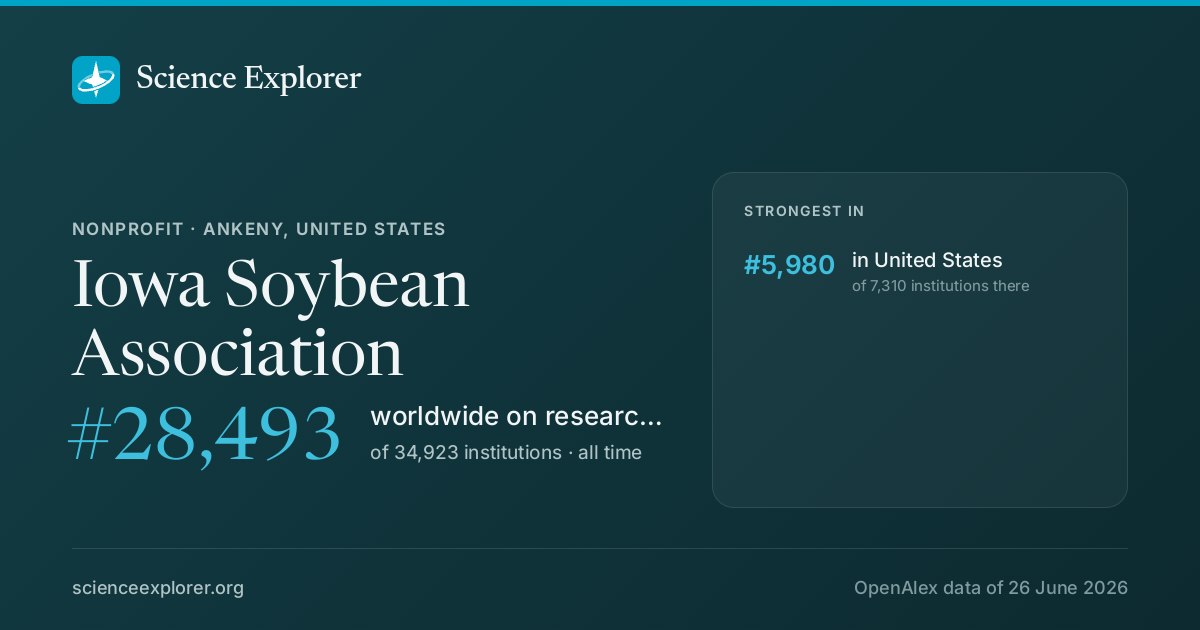
Iowa Soybean Association on Science Explorer

A card with Iowa Soybean Association's standing and the fields it leads in, for a post or a slide. A link to this page previews as the same card.

Download the card

1200 × 630 PNG, sized for social posts, drawn from the latest snapshot.

Badges for a website1Each links back here and updates with every snapshot

Research measures only: rankings here say nothing about teaching, admissions or student experience. Comparable institutions and collaboration partners have tabs of their own, above.

Discussion

Ask a question or share a note about Iowa Soybean Association. Keep it to the research: no personal attacks, advertising or links. Any reader can report a post, which collapses it for everyone until it is opened.
