Science Explorer Back to mapMap
Company · Yokohama · Japan

JGC (Japan)

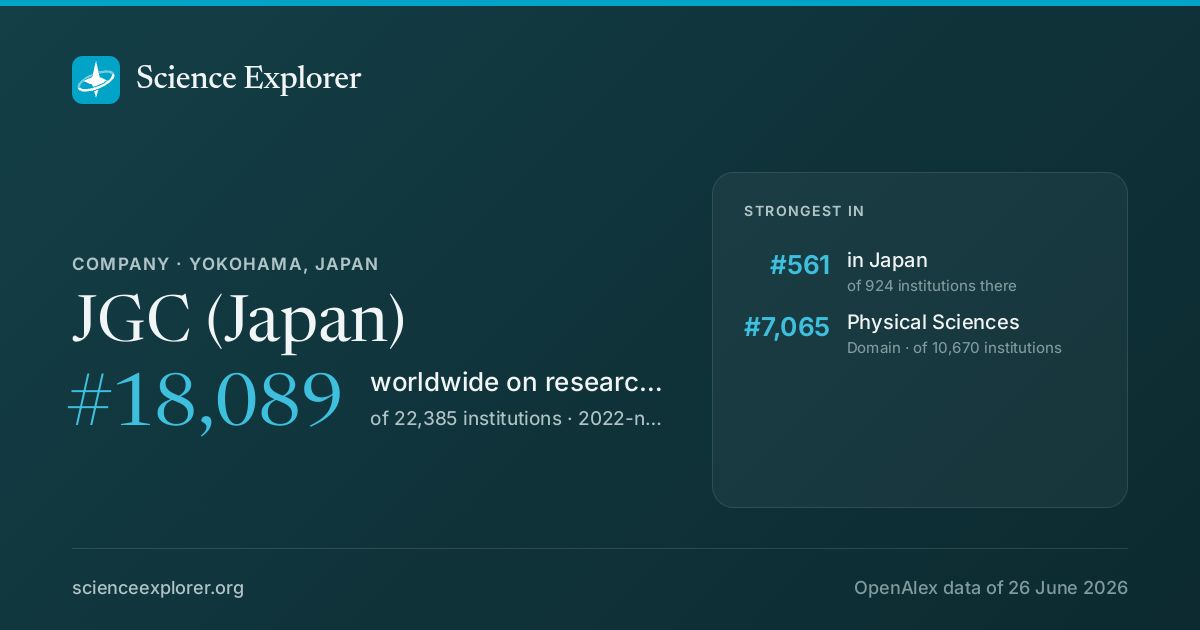
In research, JGC (Japan) stands highest in Physical Sciences (#7,065 of 10,670 worldwide), 2022-now.

World rank, 2022-now
#18,089
of 22,385 · #17,482 all time
Rank in Japan
#561
of 924
Research works
638
▲ 20% vs 2018-21
Citations
6.8k
10.6 per fractional work
Top-10% rate
5.0%
all institutions 10.0%
vs its own fields
0.98×
1.00× is exactly expected
Open access
36%
world 40%
International
18%
world 18%

What is JGC (Japan) known for in research?

The fields where it stands highest, 2022-now, ranked among every institution above the floor in each field.

FieldWorld rankWhere that sitsTop-10% rateWorksAll time
Physical SciencesDomain #7,065 of 10,670 4.2%68 #10550

Each strip is that field's whole ranked pool, with the notch where JGC (Japan) sits in it, in the colour of the band that rank falls in. The track under the rate is the rate itself: it carries no average mark, because the average differs by field (from about 6% in Dentistry to 21% in Economics).

Which fields of science does JGC (Japan) work in?

In 2022-now, 79% of research at JGC (Japan) is in Physical Sciences, 8% in Life Sciences. Its largest fields are Engineering (50%), Materials Science (10%), Medicine (7%). It does 2.0× the world's share of Physical Sciences.

Physical Sciences: 80 fractional works · 78.8% of its workEngineering: 51 fractional works · 50.1% of its workMechanical Engineering: 15 fractional works · 15.2% of its workElectrical and Electronic Engineering: 9 fractional works · 9.0% of its workCivil and Structural Engineering: 9 fractional works · 8.7% of its workBiomedical Engineering: 3 fractional works · 3.2% of its workMechanics of Materials: 3 fractional works · 3.0% of its workAerospace Engineering: 3 fractional works · 2.7% of its workOcean Engineering: 2 fractional works · 2.4% of its workBuilding and Construction: 2 fractional works · 1.5% of its workComputational Mechanics: 1 fractional works · 1.3% of its workControl and Systems Engineering: 1 fractional works · 1.0% of its workIndustrial and Manufacturing Engineering: 1 fractional works · 1.0% of its workSafety, Risk, Reliability and Quality: 1 fractional works · 0.6% of its workAutomotive Engineering: 0 fractional works · 0.4% of its workMaterials Science: 11 fractional works · 10.4% of its workMaterials Chemistry: 5 fractional works · 4.9% of its workElectronic, Optical and Magnetic Materials: 3 fractional works · 3.4% of its workMetals and Alloys: 1 fractional works · 1.0% of its workCeramics and Composites: 0 fractional works · 0.3% of its workGeneral Materials Science: 0 fractional works · 0.3% of its workBiomaterials: 0 fractional works · 0.3% of its workSmaller subfields together: 0 fractional works · 0.1% of its workComputer Science: 6 fractional works · 5.8% of its workArtificial Intelligence: 2 fractional works · 2.1% of its workComputational Theory and Mathematics: 1 fractional works · 1.4% of its workSignal Processing: 1 fractional works · 1.0% of its workInformation Systems: 1 fractional works · 0.7% of its workComputer Vision and Pattern Recognition: 0 fractional works · 0.4% of its workSmaller subfields together: 0 fractional works · 0.2% of its workEnvironmental Science: 4 fractional works · 3.8% of its workEcology: 1 fractional works · 1.3% of its workManagement, Monitoring, Policy and Law: 1 fractional works · 0.6% of its workWater Science and Technology: 0 fractional works · 0.5% of its workIndustrial and Manufacturing Engineering: 0 fractional works · 0.5% of its workEcological Modeling: 0 fractional works · 0.3% of its workEnvironmental Engineering: 0 fractional works · 0.3% of its workSmaller subfields together: 0 fractional works · 0.3% of its workChemistry: 3 fractional works · 2.9% of its workOrganic Chemistry: 2 fractional works · 1.7% of its workPhysical and Theoretical Chemistry: 0 fractional works · 0.5% of its workSpectroscopy: 0 fractional works · 0.3% of its workAnalytical Chemistry: 0 fractional works · 0.2% of its workSmaller subfields together: 0 fractional works · 0.1% of its workPhysics and Astronomy: 3 fractional works · 2.9% of its workAstronomy and Astrophysics: 2 fractional works · 2.1% of its workAtomic and Molecular Physics, and Optics: 1 fractional works · 0.6% of its workSmaller subfields together: 0 fractional works · 0.2% of its workChemical Engineering: 1 fractional works · 0.9% of its workBioengineering: 0 fractional works · 0.3% of its workCatalysis: 0 fractional works · 0.3% of its workFluid Flow and Transfer Processes: 0 fractional works · 0.2% of its workSmaller subfields together: 0 fractional works · 0.1% of its workEarth and Planetary Sciences: 1 fractional works · 0.9% of its workAtmospheric Science: 1 fractional works · 0.5% of its workEarth-Surface Processes: 0 fractional works · 0.3% of its workSmaller subfields together: 0 fractional works · 0.1% of its workEnergy: 1 fractional works · 0.7% of its workRenewable Energy, Sustainability and the Environment: 0 fractional works · 0.4% of its workNuclear Energy and Engineering: 0 fractional works · 0.3% of its workMathematics: 0 fractional works · 0.3% of its workApplied Mathematics: 0 fractional works · 0.3% of its workLife Sciences: 8 fractional works · 7.7% of its workBiochemistry, Genetics and Molecular Biology: 5 fractional works · 4.7% of its workMolecular Biology: 3 fractional works · 3.4% of its workGenetics: 1 fractional works · 0.6% of its workBiophysics: 0 fractional works · 0.3% of its workSmaller subfields together: 0 fractional works · 0.5% of its workAgricultural and Biological Sciences: 2 fractional works · 2.0% of its workPlant Science: 1 fractional works · 0.7% of its workFood Science: 1 fractional works · 0.6% of its workForestry: 0 fractional works · 0.3% of its workSmaller subfields together: 0 fractional works · 0.4% of its workPharmacology, Toxicology and Pharmaceutics: 0 fractional works · 0.5% of its workPharmaceutical Science: 0 fractional works · 0.3% of its workSmaller subfields together: 0 fractional works · 0.2% of its workNeuroscience: 0 fractional works · 0.4% of its workImmunology and Microbiology: 0 fractional works · 0.1% of its workHealth Sciences: 7 fractional works · 7.2% of its workMedicine: 7 fractional works · 6.7% of its workReproductive Medicine: 1 fractional works · 1.0% of its workPulmonary and Respiratory Medicine: 1 fractional works · 0.8% of its workRadiology, Nuclear Medicine and Imaging: 1 fractional works · 0.7% of its workDermatology: 1 fractional works · 0.7% of its workOphthalmology: 1 fractional works · 0.7% of its workBiochemistry: 1 fractional works · 0.5% of its workPharmacology: 0 fractional works · 0.3% of its workInfectious Diseases: 0 fractional works · 0.3% of its workSurgery: 0 fractional works · 0.3% of its workOncology: 0 fractional works · 0.3% of its workSmaller subfields together: 1 fractional works · 1.2% of its workHealth Professions: 0 fractional works · 0.4% of its workGeneral Health Professions: 0 fractional works · 0.3% of its workSmaller subfields together: 0 fractional works · 0.1% of its workVeterinary: 0 fractional works · 0.1% of its workNursing: 0 fractional works · 0.0% of its workSocial Sciences: 6 fractional works · 6.3% of its workBusiness, Management and Accounting: 3 fractional works · 3.2% of its workStrategy and Management: 1 fractional works · 1.3% of its workOrganizational Behavior and Human Resource Management: 1 fractional works · 0.7% of its workMarketing: 0 fractional works · 0.5% of its workManagement of Technology and Innovation: 0 fractional works · 0.4% of its workBusiness and International Management: 0 fractional works · 0.3% of its workSocial Sciences: 1 fractional works · 1.2% of its workSociology and Political Science: 0 fractional works · 0.4% of its workHuman Factors and Ergonomics: 0 fractional works · 0.3% of its workLaw: 0 fractional works · 0.2% of its workSmaller subfields together: 0 fractional works · 0.2% of its workEconomics, Econometrics and Finance: 1 fractional works · 0.8% of its workEconomics and Econometrics: 1 fractional works · 0.8% of its workDecision Sciences: 1 fractional works · 0.7% of its workManagement Science and Operations Research: 0 fractional works · 0.3% of its workStatistics, Probability and Uncertainty: 0 fractional works · 0.3% of its workPsychology: 0 fractional works · 0.4% of its workSocial Psychology: 0 fractional works · 0.3% of its workSmaller subfields together: 0 fractional works · 0.1% of its workALL ITS WORKJGC (Japan)101fractional works, 2022-now
Life Sciences8%Physical Sciences79%Health Sciences7%Social Sciences6%

Each ring splits the one inside it: the four domains of science, their fields, their subfields. Size is fractional works in 2022-now. Every slice is a page; the interactive view zooms down to single topics and colours each by how much more of it this institution does than the world.

Its 4 domains and 24 fields, with their numbers
    1. Engineering5150.1%
    2. Materials Science1110.4%
    3. Computer Science65.8%
    4. Environmental Science43.8%
    5. Chemistry32.9%
    6. Physics and Astronomy32.9%
    7. Chemical Engineering10.9%
    8. Earth and Planetary Sciences10.9%
    9. Energy10.7%
    10. Mathematics00.3%
    1. Biochemistry, Genetics and Molecular Biology54.7%
    2. Agricultural and Biological Sciences22.0%
    3. Pharmacology, Toxicology and Pharmaceutics00.5%
    4. Neuroscience00.4%
    5. Immunology and Microbiology00.1%
    1. Medicine76.7%
    2. Health Professions00.4%
    3. Veterinary00.1%
    4. Nursing00.0%
    1. Business, Management and Accounting33.2%
    2. Social Sciences11.2%
    3. Economics, Econometrics and Finance10.8%
    4. Decision Sciences10.7%
    5. Psychology00.4%
All of science, and how each field's share has moved since 1950: the Science domain explorer

Field profile

Location quotient across every field it publishes in: outside the ring is more than an institution of this size would be expected to publish, inside it is less.

Agricultural and Biological Sciences: 0.42× its world share, 2 worksAgricultural and Bio…Biochemistry, Genetics and Molecular Biology: 0.89× its world share, 5 worksBiochemistry, Geneti…Immunology and Microbiology: 0.11× its world share, 0 worksImmunology and Micro…Neuroscience: 0.27× its world share, 0 worksNeurosciencePharmacology, Toxicology and Pharmaceutics: 1.32× its world share, 0 worksPharmacology, Toxico…Chemical Engineering: 2.72× its world share, 1 worksChemical EngineeringChemistry: 1.86× its world share, 3 worksChemistryComputer Science: 0.75× its world share, 6 worksComputer ScienceEarth and Planetary Sciences: 0.56× its world share, 1 worksEarth and Planetary …Energy: 0.75× its world share, 1 worksEnergyEngineering: 3.34× its world share, 51 worksEngineeringEnvironmental Science: 0.77× its world share, 4 worksEnvironmental ScienceMaterials Science: 2.97× its world share, 10 worksMaterials ScienceMathematics: 0.28× its world share, 0 worksMathematicsPhysics and Astronomy: 1.31× its world share, 3 worksPhysics and AstronomyHealth Professions: 0.16× its world share, 0 worksHealth ProfessionsMedicine: 0.35× its world share, 7 worksMedicineNursing: 0.08× its world share, 0 worksNursingVeterinary: 0.49× its world share, 0 worksVeterinaryBusiness, Management and Accounting: 1.00× its world share, 3 worksBusiness, Management…Decision Sciences: 0.68× its world share, 1 worksDecision SciencesEconomics, Econometrics and Finance: 0.36× its world share, 1 worksEconomics, Econometr…Psychology: 0.14× its world share, 0 worksPsychologySocial Sciences: 0.09× its world share, 1 worksSocial Sciences1×world share
more than its size predictsabout as predictedless

Rings at 0.5×, 1× and 2×. Widest outward: Engineering, 3.3×. Every wedge is a field page.

All 24 fields, with their numbers
  1. Engineering3.34×51 works
  2. Materials Science2.97×10 works
  3. Chemical Engineering2.72×1 works
  4. Chemistry1.86×3 works
  5. Pharmacology, Toxicology and Pharmaceutics1.32×0 works
  6. Physics and Astronomy1.31×3 works
  7. Business, Management and Accounting1.00×3 works
  8. Biochemistry, Genetics and Molecular Biology0.89×5 works
  9. Environmental Science0.77×4 works
  10. Computer Science0.75×6 works
  11. Energy0.75×1 works
  12. Decision Sciences0.68×1 works
  13. Earth and Planetary Sciences0.56×1 works
  14. Veterinary0.49×0 works
  15. Agricultural and Biological Sciences0.42×2 works
  16. Economics, Econometrics and Finance0.36×1 works
  17. Medicine0.35×7 works
  18. Mathematics0.28×0 works
  19. Neuroscience0.27×0 works
  20. Health Professions0.16×0 works
  21. Psychology0.14×0 works
  22. Immunology and Microbiology0.11×0 works
  23. Social Sciences0.09×1 works
  24. Nursing0.08×0 works

Who are the top researchers at JGC (Japan)?

Ranked on the quality score, Makoto Inomata, Kunio Ishii and Kiyoshi Oyamada lead among researchers whose main affiliation is JGC (Japan).

  1. 1 Makoto Inomata Japan · #1,557,498 worldwide 1.1k citations · 38 works
  2. 2 Kunio Ishii Japan · #4,171,369 worldwide 184 citations · 16 works
  3. 3 Kiyoshi Oyamada Japan · #4,565,992 worldwide 8 citations · 38 works
  4. 4 Tomiaki Yamada Japan · #4,677,771 worldwide 55 citations · 20 works
  5. 5 Yuiko Sahara‐Miura Japan · #4,729,990 worldwide 267 citations · 15 works
  6. 6 Yasushi Fujimura Japan · #5,019,501 worldwide 118 citations · 16 works
  7. 7 Toshihiro FUJII Japan · #5,055,809 worldwide 20 citations · 16 works
  8. 8 H. Kuribayashi Japan · #5,102,982 worldwide 20 citations · 16 works
  9. 9 Mamoru Shibuya Japan · #5,188,918 worldwide 55 citations · 16 works
  10. 10 Michael D. Impey Japan · #5,197,662 worldwide 201 citations · 23 works
All ranked researchers at JGC (Japan)

What are the most cited papers from JGC (Japan)?

The most cited paper from JGC (Japan) is "Direct cloning and refactoring of a silent lipopeptide biosynthetic gene cluster yields the antibiotic taromycin A" (Kazuya Yamanaka, Kirk A. Reynolds, Roland D. Kersten et al., 2014), with 512 citations. Next come "The relationship between delirium duration, white matter integrity, and cognitive impairment in intensive care unit survivors as determined by diffusion tensor imaging" (219) and "Some Considerations for Applicability of Seawater as Mixing Water in Concrete" (212).

Most cited papers
#PaperReleasedCitations
1 Direct cloning and refactoring of a silent lipopeptide biosynthetic gene cluster yields the antibiotic taromycin A Kazuya Yamanaka, Kirk A. Reynolds, Roland D. Kersten et al. · Proceedings of the National Academy of Sciences Open access 21 Jan 2014 512
2 The relationship between delirium duration, white matter integrity, and cognitive impairment in intensive care unit survivors as determined by diffusion tensor imaging Alessandro Morandi, Baxter P. Rogers, Max L. Gunther et al. · Critical Care Medicine Open access 15 May 2012 219
3 Some Considerations for Applicability of Seawater as Mixing Water in Concrete Takahiro Nishida, Nobuaki Otsuki, Hiroki Ohara et al. · Journal of Materials in Civil Engineering 13 Dec 2013 212
4 Implanted octacalcium phosphate is more resorbable than β‐tricalcium phosphate and hydroxyapatite Shinji Kamakura, Yasuyuki Sasano, Tetsuji Shimizu et al. · Journal of Biomedical Materials Research 26 Sep 2001 187
5 A Novel Core Fucose-specific Lectin from the Mushroom Pholiota squarrosa Yuka Kobayashi, Hiroaki Tateno, Hideo Dohra et al. · Journal of Biological Chemistry Open access 8 Aug 2012 122
All 60 most cited papers, with filters and sorting

Which keywords describe research at JGC (Japan)?

By fractional works in 2022-now, weighted toward what it does more of than the world: Microstructure, Numerical Simulation, Heat Transfer, Electromigration, Mechanical Properties, Nanoparticles, Welding and Finite Element Analysis.

▲ more of its work than of the world's◆ about the world's share▼ less than the world's

Size is fractional works in 2022-now in the topics tagged with each word; colour is the word's share of this institution's work against its share of the world's. The 40 words are chosen for being large and distinctive. Each links to the topic it comes from most.

All 40 words, with their numbers
  1. Nanoparticles5▲ 3.8×12 topics
  2. Microstructure5▲ 9.2×8 topics
  3. Mechanical Properties4▲ 4.5×8 topics
  4. Numerical Simulation4▲ 15×6 topics
  5. Heat Transfer4▲ 8.0×7 topics
  6. Electromigration4▲ 136×2 topics
  7. Sustainability4▲ 1.57×8 topics
  8. Renewable Energy3▲ 2.1×9 topics
  9. Finite Element Analysis3▲ 13×6 topics
  10. Welding3▲ 47×3 topics
  11. Thermal Management3▲ 8.4×4 topics
  12. Thin Films3▲ 15×4 topics
  13. Laser Welding3▲ 57×2 topics
  14. Hydrogen Embrittlement3▲ 32×3 topics
  15. Residual Stress2▲ 46×1 topic
  16. Weld Pool Dynamics2▲ 56×1 topic
  17. Failure Analysis2▲ 25×2 topics
  18. Numerical Modeling2▲ 21×3 topics
  19. Nanowires2▲ 15×3 topics
  20. Rare Earth Elements2▲ 14×3 topics
  21. Low-k Dielectrics2▲ 195×1 topic
  22. Microelectronics2▲ 159×1 topic
  23. Thermal Analysis2▲ 15×4 topics
  24. Construction2▲ 14×3 topics
  25. Interconnect2▲ 113×1 topic
  26. Interfacial Reactions2▲ 105×1 topic
  27. Lead-free Solders2▲ 105×1 topic
  28. Structural Analysis2▲ 21×3 topics
  29. Through-Silicon Via2▲ 113×1 topic
  30. Corrosion2▲ 15×5 topics
  31. Control Strategies2▲ 12×3 topics
  32. Material Properties2▲ 18×3 topics
  33. Friction Stir Welding2▲ 52×1 topic
  34. Processing2▲ 26×1 topic
  35. Biomedical Science2▲ 68×2 topics
  36. Evolutionary Algorithms2▲ 14×2 topics
  37. Finite Element Method2▲ 15×2 topics
  38. Monoclonal Antibodies2▲ 16×2 topics
  39. Particle Swarm Optimization2▲ 13×2 topics
  40. Therapeutic Antibodies2▲ 21×2 topics

Which research topics does JGC (Japan) publish most on?

By volume in 2022-now: Welding Techniques and Residual Stresses, Copper Interconnects and Reliability, Electronic Packaging and Soldering Technologies and 3D IC and TSV technologies.

  1. 1 Welding Techniques and Residual Stresses Mechanical Engineering 2 works
  2. 2 Copper Interconnects and Reliability Electronic, Optical and Magnetic Materials 2 works
  3. 3 Electronic Packaging and Soldering Technologies Electrical and Electronic Engineering 2 works
  4. 4 3D IC and TSV technologies Electrical and Electronic Engineering 2 works
  5. 5 Advanced Welding Techniques Analysis Mechanical Engineering 2 works
  6. 6 Mechanical Failure Analysis and Simulation Mechanical Engineering 1 works
  7. 7 Seismic Performance and Analysis Civil and Structural Engineering 1 works
  8. 8 Engineering Structural Analysis Methods Mechanical Engineering 1 works
  9. 9 Microstructure and Mechanical Properties of Steels Mechanical Engineering 1 works
  10. 10 Wave and Wind Energy Systems Ocean Engineering 1 works

How open and international is its research?

Against the world's own shares: the tick on each track. Both are shares of its output, so they sit on one scale and can be read against each other as well as against the world.

openly available36.3%not open63.7%

World: 40% of research is openly available.

with international co-authors17.9%domestic only82.1%

World: 18% is written across borders.

How has JGC (Japan)'s research output changed?

Output in 2022-2025 was 20% higher than in 2018-2021.

still counting1990200020102020
grewheldshrank

The same series as a ribbon: one cell per year, darker for more. The line above answers how much; this answers when.

Its share of all research

Growing output can still be a shrinking share: all of science grows. This is JGC (Japan) as a percentage of every work published that year, 0.00042% in 2024.

still counting0.0010%0.0020%0.0030%JGC (Japan)0.00055% in 202519801990200020102020

Fractional works of JGC (Japan) over all fractional works that year. How the balance of science has shifted.

How much of it reaches the world top 10%

Year by year, against all institutions in the same year.

still counting5%10%15%all institutions10.0% in 2025JGC (Japan)4.5% in 202520102020

Of each year's output, the share that reached the world's 10% most cited for its field and year. Peak 7.2% in 2007.

Other research institutions in Yokohama

All research institutions in Yokohama

Share JGC (Japan)'s ranking

JGC (Japan) on Science Explorer

A card with JGC (Japan)'s standing and the fields it leads in, for a post or a slide. A link to this page previews as the same card.

Download the card

1200 × 630 PNG, sized for social posts, drawn from the latest snapshot.

Badges for a website1Each links back here and updates with every snapshot

Research measures only: rankings here say nothing about teaching, admissions or student experience. Comparable institutions and collaboration partners have tabs of their own, above.

Discussion

Ask a question or share a note about JGC (Japan). Keep it to the research: no personal attacks, advertising or links. Any reader can report a post, which collapses it for everyone until it is opened.