Jilin Engineering Normal University
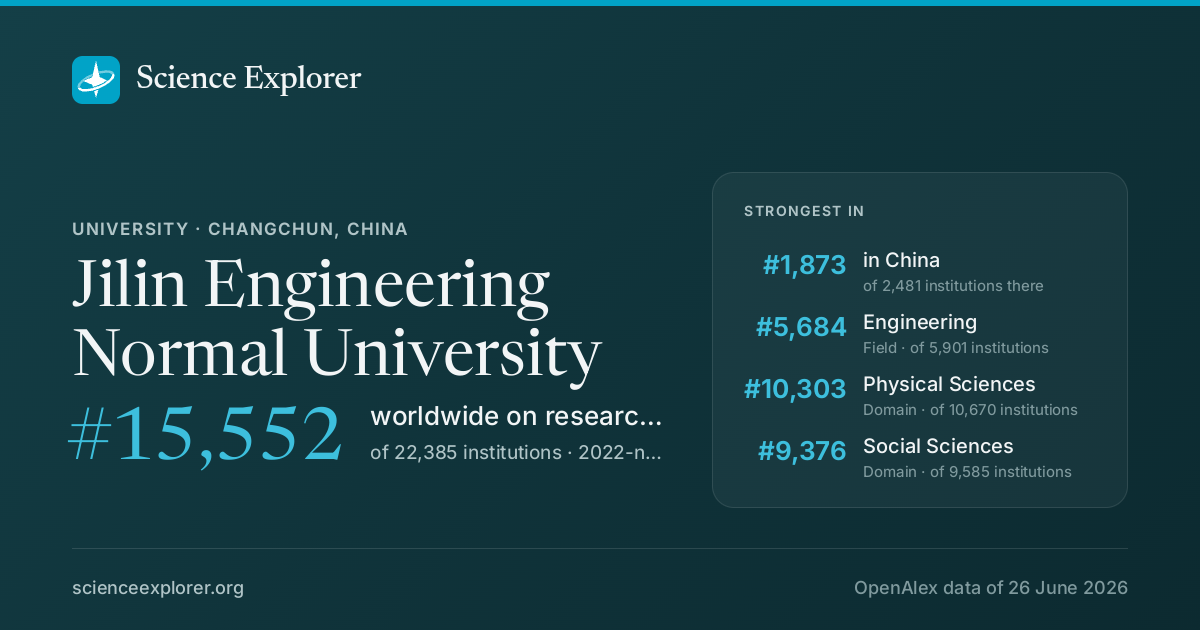
In research, Jilin Engineering Normal University stands highest in Engineering (#5,684 of 5,901 worldwide), Physical Sciences (#10,303 of 10,670 worldwide) and Social Sciences (#9,376 of 9,585 worldwide), 2022-now.
- World rank, 2022-now
- #15,552 of 22,385 · #17,038 all time
- Rank in China
- #1,873 of 2,481
- Research works
- 1.5k ▼ 41% vs 2018-21
- Citations
- 5.6k 3.8 per fractional work
- Top-10% rate
- 6.1% all institutions 10.0%
- vs its own fields
- 0.75× 1.00× is exactly expected
- Open access
- 40% world 40%
- International
- 5% world 18%
What is Jilin Engineering Normal University known for in research?
The fields where it stands highest, 2022-now, ranked among every institution above the floor in each field.
| Field | World rank | Where that sits | Top-10% rate | Works | All time |
|---|---|---|---|---|---|
| EngineeringField | #5,684 of 5,901 | 4.6% | 103 | #8465 | |
| Physical SciencesDomain | #10,303 of 10,670 | 4.5% | 280 | #14894 | |
| Social SciencesDomain | #9,376 of 9,585 | 6.6% | 63 | #7145 |
Each strip is that field's whole ranked pool, with the notch where Jilin Engineering Normal University sits in it, in the colour of the band that rank falls in. The track under the rate is the rate itself: it carries no average mark, because the average differs by field (from about 6% in Dentistry to 21% in Economics).
Which of those standings moved
The same fields on both windows: where it stood over the whole record, and where it stands in 2022-now. The distance is the story, and it is the one thing the two rank columns above cannot show.
- Engineering#8,465 #5,684
- Physical Sciences#14,894 #10,303
- Social Sciences#7,145 #9,376
A dot further right is a better standing. Fields it was not ranked in over the whole record are left out.
Which fields of science does Jilin Engineering Normal University work in?
In 2022-now, 70% of research at Jilin Engineering Normal University is in Physical Sciences, 16% in Social Sciences. Its largest fields are Engineering (26%), Computer Science (13%), Materials Science (13%). It does 1.8× the world's share of Physical Sciences.
Each ring splits the one inside it: the four domains of science, their fields, their subfields. Size is fractional works in 2022-now. Every slice is a page; the interactive view zooms down to single topics and colours each by how much more of it this institution does than the world.
Its 4 domains and 25 fields, with their numbers
- Physical Sciences32370.2%
- Engineering11825.5%
- Computer Science6113.2%
- Materials Science5912.8%
- Chemistry275.9%
- Physics and Astronomy204.3%
- Environmental Science163.5%
- Energy122.6%
- Earth and Planetary Sciences51.1%
- Chemical Engineering51.1%
- Mathematics10.3%
- Social Sciences7215.7%
- Social Sciences306.5%
- Business, Management and Accounting132.8%
- Arts and Humanities122.7%
- Psychology102.1%
- Economics, Econometrics and Finance51.2%
- Decision Sciences20.5%
- Life Sciences388.2%
- Health Sciences286.0%
- Medicine224.8%
- Health Professions40.9%
- Nursing10.2%
- Veterinary00.1%
Field profile
Location quotient across every field it publishes in: outside the ring is more than an institution of this size would be expected to publish, inside it is less.
Rings at 0.5×, 1× and 2×. Widest outward: Chemistry, 3.8×. Every wedge is a field page.
All 25 fields, with their numbers
- Chemistry3.76×27 works
- Materials Science3.66×59 works
- Chemical Engineering3.02×5 works
- Energy2.87×12 works
- Physics and Astronomy1.91×20 works
- Engineering1.70×118 works
- Computer Science1.69×61 works
- Arts and Humanities0.93×12 works
- Business, Management and Accounting0.86×13 works
- Biochemistry, Genetics and Molecular Biology0.75×18 works
- Veterinary0.75×0 works
- Earth and Planetary Sciences0.71×5 works
- Environmental Science0.70×16 works
- Psychology0.68×10 works
- Agricultural and Biological Sciences0.57×12 works
- Immunology and Microbiology0.56×3 works
- Decision Sciences0.56×2 works
- Economics, Econometrics and Finance0.55×5 works
- Pharmacology, Toxicology and Pharmaceutics0.51×1 works
- Social Sciences0.51×30 works
- Neuroscience0.45×3 works
- Health Professions0.35×4 works
- Nursing0.32×1 works
- Medicine0.25×22 works
- Mathematics0.23×1 works
- Chemistry 3.8×
- Materials Science 3.7×
- Chemical Engineering 3.0×
- Energy 2.9×
- Physics and Astronomy 1.9×
- Engineering 1.7×
- Computer Science 1.7×
- Arts and Humanities 0.9×
- Business, Management and Accounting 0.9×
- Biochemistry, Genetics and Molecular Biology 0.8×
- Veterinary 0.8×
- Earth and Planetary Sciences 0.7×
- Environmental Science 0.7×
- Psychology 0.7×
- Agricultural and Biological Sciences 0.6×
- Immunology and Microbiology 0.6×
- Decision Sciences 0.6×
- Economics, Econometrics and Finance 0.6×
- Pharmacology, Toxicology and Pharmaceutics 0.5×
- Social Sciences 0.5×
- Neuroscience 0.5×
- Health Professions 0.3×
- Nursing 0.3×
- Medicine 0.2×
- Mathematics 0.2×
Who are the top researchers at Jilin Engineering Normal University?
Ranked on the quality score, Yanling Wei, Shaozhong Song and Chunyan Wang lead among researchers whose main affiliation is Jilin Engineering Normal University.
- 1
Yanling Wei
 China · #1,221,696 worldwide
971 citations · 40 works
- 2
Shaozhong Song
China · #2,075,227 worldwide
246 citations · 44 works
- 3
Chunyan Wang
China · #3,167,781 worldwide
284 citations · 46 works
- 4
Ziyu Liu
China · #3,590,266 worldwide
145 citations · 27 works
- 5
Chunyan Xu
China · #3,597,544 worldwide
4.7k citations · 216 works
- 6
Xiaoe Wang
China · #3,778,300 worldwide
1k citations · 56 works
- 7
Shu Qing Ma
China · #4,009,400 worldwide
339 citations · 15 works
- 8
Xiaohong Li
China · #4,357,973 worldwide
686 citations · 19 works
- 9
Xu Guang Sun
China · #4,388,209 worldwide
231 citations · 45 works
- 10
Shuwei Lv
China · #4,578,793 worldwide
170 citations · 28 works
Which keywords describe research at Jilin Engineering Normal University?
By fractional works in 2022-now, weighted toward what it does more of than the world: Deep Learning, Artificial Intelligence, Internet of Things, Wireless Sensor Networks, Machine Learning, Nanomaterials, Cloud Computing and Data Mining.
- Pollution Monitoring
- Biochar Application
- Electronic Structure
- CO2 Reduction
- Detection
- Teaching Evaluation
- Visible Light
- Electrocatalysis
- Online Education
- Bioimaging
- Semiconductors
- Image Processing
- Metal-Organic Frameworks
- Semiconductor
- Cloud Computing
- Catalysis
- Biomedical Applications
- Wireless Sensor Networks
- Internet of Things
- Artificial Intelligence
- Deep Learning
- Machine Learning
- Nanomaterials
- Data Mining
- Remote Sensing
- Graphene
- Chemical Sensors
- Energy Storage
- Water Splitting
- Crystal Growth
- Nanostructures
- Robotics
- Two-Dimensional Materials
- Multimedia Technology
- Multimedia Teaching
- Nanocrystals
- Photodynamic Therapy
- Regional Planning
- Big Data Analytics
- Environmental Risk Assessment
Size is fractional works in 2022-now in the topics tagged with each word; colour is the word's share of this institution's work against its share of the world's. The 40 words are chosen for being large and distinctive. Each links to the topic it comes from most.
All 40 words, with their numbers
- Deep Learning49▲ 3.1×63 topics
- Artificial Intelligence32▲ 4.9×25 topics
- Machine Learning32▲ 2.1×48 topics
- Internet of Things24▲ 6.2×21 topics
- Nanomaterials21▲ 4.3×13 topics
- Wireless Sensor Networks17▲ 8.4×11 topics
- Data Mining16▲ 4.7×11 topics
- Biomedical Applications16▲ 2.9×23 topics
- Remote Sensing15▲ 2.7×15 topics
- Catalysis14▲ 4.6×18 topics
- Graphene14▲ 4.4×9 topics
- Cloud Computing13▲ 9.7×10 topics
- Chemical Sensors12▲ 12×3 topics
- Semiconductor12▲ 8.0×7 topics
- Energy Storage12▲ 4.0×8 topics
- Metal-Organic Frameworks12▲ 6.2×6 topics
- Water Splitting10▲ 6.0×4 topics
- Image Processing10▲ 5.0×8 topics
- Crystal Growth10▲ 7.8×8 topics
- Semiconductors10▲ 7.1×4 topics
- Nanostructures9▲ 5.0×8 topics
- Bioimaging9▲ 9.0×4 topics
- Robotics9▲ 7.7×4 topics
- Online Education9▲ 9.6×4 topics
- Two-Dimensional Materials8▲ 8.1×4 topics
- Electrocatalysis8▲ 6.3×5 topics
- Multimedia Technology8▲ 28×2 topics
- Visible Light8▲ 7.3×2 topics
- Multimedia Teaching8▲ 51×1 topic
- Teaching Evaluation8▲ 51×1 topic
- Nanocrystals8▲ 6.3×5 topics
- Detection7▲ 5.7×7 topics
- Photodynamic Therapy7▲ 6.7×3 topics
- CO2 Reduction7▲ 7.0×2 topics
- Regional Planning7▲ 22×2 topics
- Electronic Structure7▲ 8.2×7 topics
- Big Data Analytics7▲ 6.8×2 topics
- Biochar Application7▲ 14×2 topics
- Environmental Risk Assessment6▲ 16×1 topic
- Pollution Monitoring6▲ 38×1 topic
Which research topics does Jilin Engineering Normal University publish most on?
By volume in 2022-now: Educational Technology and Pedagogy, Educational Reforms and Innovations, Advanced Photocatalysis Techniques and Luminescence and Fluorescent Materials.
Area is fractional works; colour is the subfield each topic belongs to.
- 1 Educational Technology and Pedagogy Artificial Intelligence 8 works
- 2 Educational Reforms and Innovations Health, Toxicology and Mutagenesis 6 works
- 3 Advanced Photocatalysis Techniques Renewable Energy, Sustainability and the Environment 6 works
- 4 Luminescence and Fluorescent Materials Materials Chemistry 5 works
- 5 E-commerce and Technology Innovations Business and International Management 4 works
- 6 Translation Studies and Practices Language and Linguistics 4 works
- 7 Smart Agriculture and AI Plant Science 4 works
- 8 Organic Light-Emitting Diodes Research Electrical and Electronic Engineering 4 works
- 9 Advanced Measurement and Detection Methods Electrical and Electronic Engineering 4 works
- 10 Ideological and Political Education Education 4 works
How open and international is its research?
Against the world's own shares: the tick on each track. Both are shares of its output, so they sit on one scale and can be read against each other as well as against the world.
World: 40% of research is openly available.
World: 18% is written across borders.
How has Jilin Engineering Normal University's research output changed?
Output in 2022-2025 was 41% lower than in 2018-2021.
The same series as a ribbon: one cell per year, darker for more. The line above answers how much; this answers when.
Its share of all research
Growing output can still be a shrinking share: all of science grows. This is Jilin Engineering Normal University as a percentage of every work published that year, 0.0017% in 2024.
Fractional works of Jilin Engineering Normal University over all fractional works that year. How the balance of science has shifted.
How much of it reaches the world top 10%
Year by year, against all institutions in the same year.
Of each year's output, the share that reached the world's 10% most cited for its field and year. Peak 16.4% in 2014.
Other research institutions in Changchun
- Jilin University
- Northeast Normal University
- Changchun University of Science and Technology
- Jilin Agricultural University
- Changchun University of Technology
- Changchun University
- Second Affiliated Hospital of Jilin University
- Changchun Institute of Technology
Share Jilin Engineering Normal University's ranking
Badges for a website1Each links back here and updates with every snapshot

Research measures only: rankings here say nothing about teaching, admissions or student experience. Comparable institutions and collaboration partners have tabs of their own, above.
Discussion
Ask a question or share a note about Jilin Engineering Normal University. Posts are plain text and can be reported.