Johnson County Community College
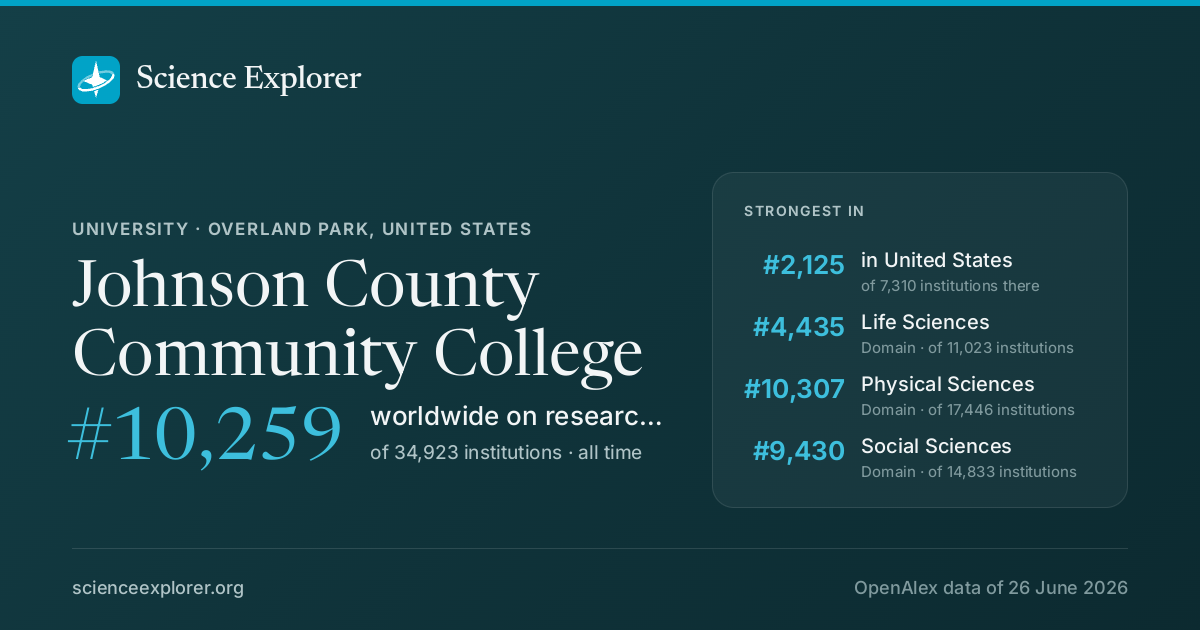
In research, Johnson County Community College stands highest in Life Sciences (#4,435 of 11,023 worldwide), Physical Sciences (#10,307 of 17,446 worldwide) and Social Sciences (#9,430 of 14,833 worldwide), over all time. Relative to its size it is most specialised in Pollution and Pharmacology (Pollution is 23.3× its share of world research).
- World rank, all time
- #10,259 of 34,923
- Rank in United States
- #2,125 of 7,310
- Research works
- 640 ◆ 1% vs 2018-21
- Citations
- 2.3k 3.6 per fractional work
- Top-10% rate
- 1.7% all institutions 10.0%
- vs its own fields
- 0.82× 1.00× is exactly expected
- Open access
- 20% world 40%
- International
- 2% world 18%
What is Johnson County Community College known for in research?
The fields where it stands highest, over all time, ranked among every institution above the floor in each field.
| Field | World rank | Where that sits | Top-10% rate | Works |
|---|---|---|---|---|
| Life SciencesDomain | #4,435 of 11,023 | 1.5% | 120 | |
| Physical SciencesDomain | #10,307 of 17,446 | 2.0% | 208 | |
| Social SciencesDomain | #9,430 of 14,833 | 5.0% | 210 |
Each strip is that field's whole ranked pool, with the notch where Johnson County Community College sits in it, in the colour of the band that rank falls in. The track under the rate is the rate itself: it carries no average mark, because the average differs by field (from about 6% in Dentistry to 21% in Economics).
Which fields of science does Johnson County Community College work in?
In 2022-now, 46% of research at Johnson County Community College is in Physical Sciences, 29% in Life Sciences. Its largest fields are Environmental Science (26%), Biochemistry, Genetics and Molecular Biology (13%), Medicine (12%). It does 2.1× the world's share of Life Sciences.
Each ring splits the one inside it: the four domains of science, their fields, their subfields. Size is fractional works in 2022-now. Every slice is a page; the interactive view zooms down to single topics and colours each by how much more of it this institution does than the world.
Its 4 domains and 24 fields, with their numbers
- Physical Sciences16245.6%
- Environmental Science9426.4%
- Chemistry246.7%
- Materials Science143.9%
- Engineering133.6%
- Computer Science71.9%
- Physics and Astronomy41.1%
- Earth and Planetary Sciences41.1%
- Energy30.8%
- Chemical Engineering00.1%
- Mathematics00.1%
- Life Sciences10228.8%
- Health Sciences5114.3%
- Medicine4211.9%
- Health Professions61.7%
- Nursing20.7%
- Dentistry00.1%
- Social Sciences4011.3%
- Social Sciences164.6%
- Arts and Humanities154.3%
- Psychology61.7%
- Business, Management and Accounting20.6%
- Decision Sciences10.2%
What does Johnson County Community College specialise in?
Where its research is concentrated relative to its size: Pollution takes 23.3× the share of its output that it takes of world research.
- PollutionSubfield · 32.7 works23×
- PharmacologySubfield · 23.0 works16×
Location quotient, a volume reading rather than an impact one. It surfaces small, lopsided specialities.
Field profile
Location quotient across every field it publishes in: outside the ring is more than an institution of this size would be expected to publish, inside it is less.
Rings at 0.5×, 1× and 2×. Widest outward: Environmental Science, 5.3×. Every wedge is a field page.
All 24 fields, with their numbers
- Environmental Science5.31×94 works
- Immunology and Microbiology5.07×18 works
- Chemistry4.30×24 works
- Pharmacology, Toxicology and Pharmaceutics2.92×4 works
- Biochemistry, Genetics and Molecular Biology2.43×46 works
- Agricultural and Biological Sciences1.85×31 works
- Arts and Humanities1.50×15 works
- Nursing1.34×2 works
- Materials Science1.11×14 works
- Energy0.82×3 works
- Earth and Planetary Sciences0.70×4 works
- Health Professions0.63×6 works
- Medicine0.62×42 works
- Neuroscience0.58×3 works
- Psychology0.54×6 works
- Physics and Astronomy0.51×4 works
- Social Sciences0.36×16 works
- Chemical Engineering0.27×0 works
- Computer Science0.24×7 works
- Engineering0.24×13 works
- Decision Sciences0.20×1 works
- Dentistry0.19×0 works
- Business, Management and Accounting0.19×2 works
- Mathematics0.08×0 works
- Environmental Science 5.3×
- Immunology and Microbiology 5.1×
- Chemistry 4.3×
- Pharmacology, Toxicology and Pharmaceutics 2.9×
- Biochemistry, Genetics and Molecular Biology 2.4×
- Agricultural and Biological Sciences 1.9×
- Arts and Humanities 1.5×
- Nursing 1.3×
- Materials Science 1.1×
- Energy 0.8×
- Earth and Planetary Sciences 0.7×
- Health Professions 0.6×
- Medicine 0.6×
- Neuroscience 0.6×
- Psychology 0.5×
- Physics and Astronomy 0.5×
- Social Sciences 0.4×
- Chemical Engineering 0.3×
- Computer Science 0.2×
- Engineering 0.2×
- Decision Sciences 0.2×
- Dentistry 0.2×
- Business, Management and Accounting 0.2×
- Mathematics 0.1×
Who are the top researchers at Johnson County Community College?
Ranked on the quality score, Carl David Frailey, Robert G. Hunt and Barry Bailey lead among researchers whose main affiliation is Johnson County Community College.
- 1
Carl David Frailey
 United States · #1,629,885 worldwide
802 citations · 15 works
- 2
Robert G. Hunt
United States · #1,998,346 worldwide
1.4k citations · 29 works
- 3
Barry Bailey
United States · #2,232,607 worldwide
99 citations · 145 works
- 4
Marziah Karch
United States · #2,471,666 worldwide
38 citations · 86 works
- 5
Andrea Kempf
United States · #3,170,757 worldwide
0 citations · 104 works
- 6
David VanderHamm
United States · #3,390,417 worldwide
21 citations · 20 works
- 7
Kami Day
United States · #3,507,165 worldwide
28 citations · 26 works
- 8
Ian Reynolds
United States · #3,531,462 worldwide
8 citations · 21 works
- 9
Heather Seitz
United States · #3,663,353 worldwide
621 citations · 17 works
- 10
James N. Leiker
United States · #3,695,844 worldwide
48 citations · 23 works
Which keywords describe research at Johnson County Community College?
By fractional works in 2022-now, weighted toward what it does more of than the world: Antibiotics, Environmental Impact, Microbial Communities, Secondary Metabolites, Drug Discovery, Microbial Metabolites, Natural Products and Resistance Genes.
- Urban Stormwater Management
- Sustainable Drainage Systems
- Immunology
- Pharmacology
- Microbial Biotechnology
- Wastewater Treatment
- Microbiology
- Microplastics
- Pollution
- Chemical Analysis
- Waterborne Disease
- Antibiotic Resistance
- Marine Microbes
- Quaternary Ammonium Compounds
- Surface Modification
- Polymeric Materials
- Resistance Genes
- Microbial Metabolites
- Secondary Metabolites
- Environmental Impact
- Antibiotics
- Microbial Communities
- Drug Discovery
- Natural Products
- Wastewater Contaminants
- Water Quality
- Antimicrobial Polymers
- Microbial Ecology
- Microbial Biogeography
- Pathogen Transport
- Marine Environment
- Invasive Species
- Recycling
- Terrestrial Ecosystems
- Sustainable Development Goals
- Immune Modulation
- Soil Health
- Resistance
- Paul Ehrlich
- Translational Medicine
Size is fractional works in 2022-now in the topics tagged with each word; colour is the word's share of this institution's work against its share of the world's. The 40 words are chosen for being large and distinctive. Each links to the topic it comes from most.
All 40 words, with their numbers
- Antibiotics52▲ 172×3 topics
- Environmental Impact43▲ 7.1×9 topics
- Microbial Communities26▲ 17×4 topics
- Secondary Metabolites26▲ 94×2 topics
- Drug Discovery25▲ 32×2 topics
- Microbial Metabolites23▲ 178×1 topic
- Natural Products23▲ 45×1 topic
- Resistance Genes22▲ 118×1 topic
- Wastewater Contaminants22▲ 118×1 topic
- Polymeric Materials21▲ 81×2 topics
- Water Quality20▲ 14×7 topics
- Surface Modification19▲ 40×2 topics
- Antimicrobial Polymers19▲ 270×1 topic
- Quaternary Ammonium Compounds19▲ 194×1 topic
- Microbial Ecology14▲ 22×2 topics
- Marine Microbes13▲ 63×1 topic
- Microbial Biogeography13▲ 63×1 topic
- Antibiotic Resistance13▲ 9.0×5 topics
- Pathogen Transport11▲ 266×1 topic
- Waterborne Disease11▲ 266×1 topic
- Marine Environment10▲ 19×2 topics
- Chemical Analysis9▲ 44×2 topics
- Invasive Species9▲ 6.0×7 topics
- Pollution9▲ 13×2 topics
- Recycling9▲ 6.6×2 topics
- Microplastics9▲ 25×1 topic
- Terrestrial Ecosystems9▲ 25×1 topic
- Microbiology8▲ 42×2 topics
- Sustainable Development Goals8▲ 13×2 topics
- Wastewater Treatment8▲ 9.5×3 topics
- Immune Modulation8▲ 21×2 topics
- Microbial Biotechnology8▲ 978×1 topic
- Soil Health8▲ 121×1 topic
- Pharmacology7▲ 8.4×2 topics
- Resistance7▲ 20×3 topics
- Immunology7▲ 18×2 topics
- Paul Ehrlich7▲ 635×1 topic
- Sustainable Drainage Systems7▲ 102×1 topic
- Translational Medicine7▲ 635×1 topic
- Urban Stormwater Management7▲ 102×1 topic
Which research topics does Johnson County Community College publish most on?
By volume in 2022-now: Microbial Natural Products and Biosynthesis, Pharmaceutical and Antibiotic Environmental Impacts, Antimicrobial agents and applications and Microbial Community Ecology and Physiology.
Area is fractional works; colour is the subfield each topic belongs to.
- 1 Microbial Natural Products and Biosynthesis Pharmacology 23 works
- 2 Pharmaceutical and Antibiotic Environmental Impacts Pollution 22 works
- 3 Antimicrobial agents and applications Organic Chemistry 19 works
- 4 Microbial Community Ecology and Physiology Ecology 13 works
- 5 Fecal contamination and water quality Water Science and Technology 11 works
- 6 Microplastics and Plastic Pollution Pollution 9 works
- 7 Alexander von Humboldt Studies Microbiology 8 works
- 8 Historical Medical Research and Treatments Radiology, Nuclear Medicine and Imaging 7 works
- 9 Urban Stormwater Management Solutions Environmental Engineering 7 works
- 10 Antimicrobial Peptides and Activities Microbiology 6 works
How open and international is its research?
Against the world's own shares: the tick on each track. Both are shares of its output, so they sit on one scale and can be read against each other as well as against the world.
World: 40% of research is openly available.
World: 18% is written across borders.
How has Johnson County Community College's research output changed?
Output in 2022-2025 was 1% higher than in 2018-2021.
The same series as a ribbon: one cell per year, darker for more. The line above answers how much; this answers when.
Its share of all research
Growing output can still be a shrinking share: all of science grows. This is Johnson County Community College as a percentage of every work published that year, 0.00014% in 2024.
Fractional works of Johnson County Community College over all fractional works that year. How the balance of science has shifted.
Other research institutions in Overland Park
- Sprint (United States)
- Adult and Pediatric Dermatology
- Eastern Research Group (United States)
- Cleveland University
- Menorah Medical Center
- Altasciences Clinical Research Vince & Associates
- International Clinical Research Institute
- Shawnee Mission South High School

Share Johnson County Community College's ranking
Badges for a website1Each links back here and updates with every snapshot

Research measures only: rankings here say nothing about teaching, admissions or student experience. Comparable institutions and collaboration partners have tabs of their own, above.
Discussion
Ask a question or share a note about Johnson County Community College. Posts are plain text and can be reported.