Science Explorer Back to mapMap
Discussion
Company · Tokyo · Japan

Kaken Pharmaceutical (Japan)

In research, Kaken Pharmaceutical (Japan) stands highest in Medicine (#12,933 of 14,558 worldwide), Life Sciences (#9,821 of 11,023 worldwide) and Health Sciences (#14,900 of 16,688 worldwide), over all time.

World rank, all time
#25,757
of 34,923
Rank in Japan
#958
of 1,923
Research works
641
▼ 7% vs 2018-21
Citations
9.8k
15.4 per fractional work
Top-10% rate
6.3%
all institutions 10.0%
vs its own fields
0.67×
1.00× is exactly expected
Open access
55%
world 40%
International
15%
world 18%

What is Kaken Pharmaceutical (Japan) known for in research?

The fields where it stands highest, over all time, ranked among every institution above the floor in each field.

FieldWorld rankWhere that sitsTop-10% rateWorks
MedicineField #12,933 of 14,558 7.8%149
Life SciencesDomain #9,821 of 11,023 7.2%199
Health SciencesDomain #14,900 of 16,688 7.4%163
Physical SciencesDomain #16,638 of 17,446 5.4%251

Each strip is that field's whole ranked pool, with the notch where Kaken Pharmaceutical (Japan) sits in it, in the colour of the band that rank falls in. The track under the rate is the rate itself: it carries no average mark, because the average differs by field (from about 6% in Dentistry to 21% in Economics).

Which fields of science does Kaken Pharmaceutical (Japan) work in?

In 2022-now, 47% of research at Kaken Pharmaceutical (Japan) is in Physical Sciences, 28% in Health Sciences. Its largest fields are Engineering (28%), Medicine (21%), Biochemistry, Genetics and Molecular Biology (9%).

Physical Sciences: 24 fractional works · 47.1% of its workEngineering: 15 fractional works · 28.2% of its workCivil and Structural Engineering: 4 fractional works · 8.5% of its workBiomedical Engineering: 2 fractional works · 4.2% of its workBuilding and Construction: 2 fractional works · 4.2% of its workSafety, Risk, Reliability and Quality: 2 fractional works · 3.0% of its workElectrical and Electronic Engineering: 1 fractional works · 2.2% of its workMechanical Engineering: 1 fractional works · 2.1% of its workAerospace Engineering: 1 fractional works · 1.5% of its workIndustrial and Manufacturing Engineering: 0 fractional works · 0.8% of its workComputational Mechanics: 0 fractional works · 0.5% of its workMechanics of Materials: 0 fractional works · 0.4% of its workControl and Systems Engineering: 0 fractional works · 0.3% of its workMedia Technology: 0 fractional works · 0.2% of its workEnvironmental Science: 4 fractional works · 7.5% of its workIndustrial and Manufacturing Engineering: 2 fractional works · 3.0% of its workNature and Landscape Conservation: 1 fractional works · 1.1% of its workManagement, Monitoring, Policy and Law: 0 fractional works · 0.9% of its workEcology: 0 fractional works · 0.9% of its workEnvironmental Engineering: 0 fractional works · 0.9% of its workGlobal and Planetary Change: 0 fractional works · 0.6% of its workSmaller subfields together: 0 fractional works · 0.0% of its workComputer Science: 2 fractional works · 3.7% of its workArtificial Intelligence: 1 fractional works · 1.7% of its workComputer Vision and Pattern Recognition: 1 fractional works · 1.7% of its workComputer Graphics and Computer-Aided Design: 0 fractional works · 0.3% of its workMaterials Science: 2 fractional works · 3.1% of its workMaterials Chemistry: 1 fractional works · 2.3% of its workPolymers and Plastics: 0 fractional works · 0.5% of its workElectronic, Optical and Magnetic Materials: 0 fractional works · 0.3% of its workSmaller subfields together: 0 fractional works · 0.1% of its workEarth and Planetary Sciences: 1 fractional works · 1.9% of its workOceanography: 0 fractional works · 0.6% of its workEarth-Surface Processes: 0 fractional works · 0.5% of its workAtmospheric Science: 0 fractional works · 0.4% of its workGeochemistry and Petrology: 0 fractional works · 0.3% of its workChemistry: 1 fractional works · 1.5% of its workInorganic Chemistry: 0 fractional works · 0.6% of its workSpectroscopy: 0 fractional works · 0.6% of its workOrganic Chemistry: 0 fractional works · 0.2% of its workSmaller subfields together: 0 fractional works · 0.0% of its workPhysics and Astronomy: 0 fractional works · 0.6% of its workRadiation: 0 fractional works · 0.6% of its workChemical Engineering: 0 fractional works · 0.3% of its workCatalysis: 0 fractional works · 0.3% of its workEnergy: 0 fractional works · 0.2% of its workRenewable Energy, Sustainability and the Environment: 0 fractional works · 0.2% of its workHealth Sciences: 14 fractional works · 27.6% of its workMedicine: 11 fractional works · 20.8% of its workPhysiology: 2 fractional works · 3.8% of its workEpidemiology: 2 fractional works · 3.6% of its workPathology and Forensic Medicine: 1 fractional works · 1.6% of its workOphthalmology: 1 fractional works · 1.4% of its workSurgery: 1 fractional works · 1.0% of its workUrology: 0 fractional works · 1.0% of its workRadiology, Nuclear Medicine and Imaging: 0 fractional works · 0.9% of its workRheumatology: 0 fractional works · 0.9% of its workOncology: 0 fractional works · 0.8% of its workPulmonary and Respiratory Medicine: 0 fractional works · 0.7% of its workHematology: 0 fractional works · 0.7% of its workComplementary and alternative medicine: 0 fractional works · 0.6% of its workOrthopedics and Sports Medicine: 0 fractional works · 0.6% of its workRehabilitation: 0 fractional works · 0.6% of its workDermatology: 0 fractional works · 0.5% of its workPublic Health, Environmental and Occupational Health: 0 fractional works · 0.5% of its workPsychiatry and Mental health: 0 fractional works · 0.3% of its workGeriatrics and Gerontology: 0 fractional works · 0.2% of its workImmunology and Allergy: 0 fractional works · 0.2% of its workSmaller subfields together: 0 fractional works · 0.7% of its workHealth Professions: 2 fractional works · 4.7% of its workSpeech and Hearing: 1 fractional works · 2.1% of its workPhysical Therapy, Sports Therapy and Rehabilitation: 1 fractional works · 1.3% of its workGeneral Health Professions: 0 fractional works · 0.6% of its workEmergency Medical Services: 0 fractional works · 0.3% of its workSmaller subfields together: 0 fractional works · 0.3% of its workNursing: 1 fractional works · 1.2% of its workNutrition and Dietetics: 1 fractional works · 1.2% of its workDentistry: 0 fractional works · 0.8% of its workOral Surgery: 0 fractional works · 0.4% of its workOrthodontics: 0 fractional works · 0.4% of its workLife Sciences: 8 fractional works · 16.0% of its workBiochemistry, Genetics and Molecular Biology: 5 fractional works · 8.9% of its workMolecular Biology: 2 fractional works · 4.3% of its workCell Biology: 1 fractional works · 2.4% of its workBiophysics: 0 fractional works · 0.3% of its workBiochemistry: 0 fractional works · 0.3% of its workCancer Research: 0 fractional works · 0.3% of its workClinical Biochemistry: 0 fractional works · 0.3% of its workMolecular Medicine: 0 fractional works · 0.3% of its workBiotechnology: 0 fractional works · 0.2% of its workGenetics: 0 fractional works · 0.2% of its workSmaller subfields together: 0 fractional works · 0.1% of its workAgricultural and Biological Sciences: 3 fractional works · 6.6% of its workFood Science: 2 fractional works · 3.1% of its workPlant Science: 1 fractional works · 1.6% of its workGeneral Agricultural and Biological Sciences: 0 fractional works · 0.8% of its workInsect Science: 0 fractional works · 0.6% of its workAnimal Science and Zoology: 0 fractional works · 0.5% of its workNeuroscience: 0 fractional works · 0.4% of its workCognitive Neuroscience: 0 fractional works · 0.4% of its workSmaller subfields together: 0 fractional works · 0.1% of its workSocial Sciences: 5 fractional works · 9.3% of its workSocial Sciences: 3 fractional works · 5.3% of its workSociology and Political Science: 1 fractional works · 1.7% of its workLaw: 1 fractional works · 1.6% of its workPolitical Science and International Relations: 0 fractional works · 0.8% of its workTransportation: 0 fractional works · 0.5% of its workSafety Research: 0 fractional works · 0.3% of its workCultural Studies: 0 fractional works · 0.2% of its workSmaller subfields together: 0 fractional works · 0.2% of its workEconomics, Econometrics and Finance: 1 fractional works · 1.5% of its workEconomics and Econometrics: 0 fractional works · 0.9% of its workFinance: 0 fractional works · 0.4% of its workGeneral Economics, Econometrics and Finance: 0 fractional works · 0.2% of its workSmaller subfields together: 0 fractional works · 0.0% of its workArts and Humanities: 1 fractional works · 1.0% of its workHistory: 0 fractional works · 0.6% of its workLiterature and Literary Theory: 0 fractional works · 0.2% of its workSmaller subfields together: 0 fractional works · 0.2% of its workPsychology: 0 fractional works · 0.8% of its workExperimental and Cognitive Psychology: 0 fractional works · 0.4% of its workSocial Psychology: 0 fractional works · 0.2% of its workSmaller subfields together: 0 fractional works · 0.2% of its workBusiness, Management and Accounting: 0 fractional works · 0.7% of its workStrategy and Management: 0 fractional works · 0.7% of its workALL ITS WORKKakenPharmaceutical…51fractional works, 2022-now
Life Sciences16%Physical Sciences47%Health Sciences28%Social Sciences9%

Each ring splits the one inside it: the four domains of science, their fields, their subfields. Size is fractional works in 2022-now. Every slice is a page; the interactive view zooms down to single topics and colours each by how much more of it this institution does than the world.

Its 4 domains and 21 fields, with their numbers
    1. Engineering1528.2%
    2. Environmental Science47.5%
    3. Computer Science23.7%
    4. Materials Science23.1%
    5. Earth and Planetary Sciences11.9%
    6. Chemistry11.5%
    7. Physics and Astronomy00.6%
    8. Chemical Engineering00.3%
    9. Energy00.2%
    1. Medicine1120.8%
    2. Health Professions24.7%
    3. Nursing11.2%
    4. Dentistry00.8%
    1. Biochemistry, Genetics and Molecular Biology58.9%
    2. Agricultural and Biological Sciences36.6%
    3. Neuroscience00.4%
    1. Social Sciences35.3%
    2. Economics, Econometrics and Finance11.5%
    3. Arts and Humanities11.0%
    4. Psychology00.8%
    5. Business, Management and Accounting00.7%
All of science, and how each field's share has moved since 1950: the Science domain explorer

Field profile

Location quotient across every field it publishes in: outside the ring is more than an institution of this size would be expected to publish, inside it is less.

Agricultural and Biological Sciences: 1.39× its world share, 3 worksAgricultural and Bio…Biochemistry, Genetics and Molecular Biology: 1.67× its world share, 5 worksBiochemistry, Geneti…Neuroscience: 0.27× its world share, 0 worksNeuroscienceChemical Engineering: 0.93× its world share, 0 worksChemical EngineeringChemistry: 0.96× its world share, 1 worksChemistryComputer Science: 0.48× its world share, 2 worksComputer ScienceEarth and Planetary Sciences: 1.20× its world share, 1 worksEarth and Planetary …Energy: 0.23× its world share, 0 worksEnergyEngineering: 1.88× its world share, 14 worksEngineeringEnvironmental Science: 1.51× its world share, 4 worksEnvironmental ScienceMaterials Science: 0.89× its world share, 2 worksMaterials SciencePhysics and Astronomy: 0.29× its world share, 0 worksPhysics and AstronomyDentistry: 1.73× its world share, 0 worksDentistryHealth Professions: 1.78× its world share, 2 worksHealth ProfessionsMedicine: 1.08× its world share, 11 worksMedicineNursing: 2.51× its world share, 1 worksNursingArts and Humanities: 0.36× its world share, 0 worksArts and HumanitiesBusiness, Management and Accounting: 0.22× its world share, 0 worksBusiness, Management…Economics, Econometrics and Finance: 0.71× its world share, 1 worksEconomics, Econometr…Psychology: 0.26× its world share, 0 worksPsychologySocial Sciences: 0.42× its world share, 3 worksSocial Sciences1×world share
more than its size predictsabout as predictedless

Rings at 0.5×, 1× and 2×. Widest outward: Nursing, 2.5×. Every wedge is a field page.

All 21 fields, with their numbers
  1. Nursing2.51×1 works
  2. Engineering1.88×14 works
  3. Health Professions1.78×2 works
  4. Dentistry1.73×0 works
  5. Biochemistry, Genetics and Molecular Biology1.67×5 works
  6. Environmental Science1.51×4 works
  7. Agricultural and Biological Sciences1.39×3 works
  8. Earth and Planetary Sciences1.20×1 works
  9. Medicine1.08×11 works
  10. Chemistry0.96×1 works
  11. Chemical Engineering0.93×0 works
  12. Materials Science0.89×2 works
  13. Economics, Econometrics and Finance0.71×1 works
  14. Computer Science0.48×2 works
  15. Social Sciences0.42×3 works
  16. Arts and Humanities0.36×0 works
  17. Physics and Astronomy0.29×0 works
  18. Neuroscience0.27×0 works
  19. Psychology0.26×0 works
  20. Energy0.23×0 works
  21. Business, Management and Accounting0.22×0 works

Who are the top researchers at Kaken Pharmaceutical (Japan)?

Ranked on the quality score, Katsumi Nogimori, Akio TERASHIMA and Yoshiyuki Hiyama lead among researchers whose main affiliation is Kaken Pharmaceutical (Japan).

  1. 1 Katsumi Nogimori Japan · #2,746,200 worldwide 1.5k citations · 25 works
  2. 2 Akio TERASHIMA Japan · #3,311,924 worldwide 579 citations · 15 works
  3. 3 Yoshiyuki Hiyama Japan · #3,555,198 worldwide 1.2k citations · 46 works
  4. 4 Norio Kajikawa Japan · #3,683,850 worldwide 1k citations · 17 works
  5. 5 Teruhiko Umetsu Japan · #3,922,805 worldwide 523 citations · 26 works
  6. 6 Yoshiyuki Tatsumi Japan · #3,982,913 worldwide 1.2k citations · 45 works
  7. 7 Motoyuki YAJIMA Japan · #4,140,495 worldwide 826 citations · 24 works
  8. 8 Motoyuki Yajima Japan · #4,206,297 worldwide 1.3k citations · 46 works
  9. 9 Yoshinori Tsuchiya Japan · #4,415,086 worldwide 501 citations · 23 works
  10. 10 Kiyoshi Inoguchi Japan · #4,671,150 worldwide 535 citations · 27 works
All ranked researchers at Kaken Pharmaceutical (Japan)

What are the most cited papers from Kaken Pharmaceutical (Japan)?

The most cited paper from Kaken Pharmaceutical (Japan) is "Simultaneous inhibitions of inositol phospholipid breakdown, arachidonic acid release, and histamine secretion in mast cells by islet-activating protein, pertussis toxin. A possible involvement of the toxin-specific substrate in the Ca2+-mobilizing receptor-mediated biosignaling system." (T. Nakamura, M Ui, 1985), with 508 citations. Next come "Stimulatory Effects of Basic Fibroblast Growth Factor and Bone Morphogenetic Protein-2 on Osteogenic Differentiation of Rat Bone Marrow-Derived Mesenchymal Stem Cells" (381) and "GFP-based optimization scheme for the overexpression and purification of eukaryotic membrane proteins in Saccharomyces cerevisiae" (325).

Most cited papers
#PaperReleasedCitations
1 Simultaneous inhibitions of inositol phospholipid breakdown, arachidonic acid release, and histamine secretion in mast cells by islet-activating protein, pertussis toxin. A possible involvement of the toxin-specific substrate in the Ca2+-mobilizing receptor-mediated biosignaling system. T. Nakamura, M Ui · Journal of Biological Chemistry Open access Mar 1985 508
2 Stimulatory Effects of Basic Fibroblast Growth Factor and Bone Morphogenetic Protein-2 on Osteogenic Differentiation of Rat Bone Marrow-Derived Mesenchymal Stem Cells Keigo Hanada, James E. Dennis, Arnold I. Caplan · Journal of Bone and Mineral Research Oct 1997 381
3 GFP-based optimization scheme for the overexpression and purification of eukaryotic membrane proteins in Saccharomyces cerevisiae David A. Drew, Simon L. Newstead, Yo Sonoda et al. · Nature Protocols Open access 10 Apr 2008 325
4 Comparative specificity and kinetic studies on porcine calpain I and calpain II with naturally occurring peptides and synthetic fluorogenic substrates. Takashi Sasaki, Toshimi Kikuchi, Noboru Yumoto et al. · Journal of Biological Chemistry Open access Oct 1984 289
5 Salinomycin, a new polyether antibiotic. Yukio Miyazaki, MITSUO SHIBUYA, Hideo Sugawara et al. · The Journal of Antibiotics Open access 1974 274
All 60 most cited papers, with filters and sorting

Which keywords describe research at Kaken Pharmaceutical (Japan)?

By fractional works in 2022-now, weighted toward what it does more of than the world: Fungal Pathogens, Antifungal Therapy, Health Effects, Fermentation, Adsorption, 3D Printing, Rheology and Metabolism.

▲ more of its work than of the world's◆ about the world's share▼ less than the world's

Size is fractional works in 2022-now in the topics tagged with each word; colour is the word's share of this institution's work against its share of the world's. The 31 words are chosen for being large and distinctive. Each links to the topic it comes from most.

All 31 words, with their numbers
  1. Fungal Pathogens2▲ 30×3 topics
  2. Epidemiology2◆ 0.92×9 topics
  3. Antifungal Therapy2▲ 36×2 topics
  4. Health Effects2▲ 5.5×4 topics
  5. Metabolism2▲ 5.8×5 topics
  6. Quality of Life2▲ 2.1×6 topics
  7. 3D Printing1▲ 12×2 topics
  8. Adsorption1▲ 13×3 topics
  9. Antioxidant1▲ 4.1×4 topics
  10. Fermentation1▲ 21×3 topics
  11. Nanomaterials1▲ 2.6×4 topics
  12. Public Health1▲ 1.85×5 topics
  13. Rheology1▲ 14×2 topics
  14. Treatment1▲ 2.2×6 topics
  15. Climate Change1◆ 0.95×12 topics
  16. Nanoparticles1▲ 2.1×11 topics
  17. Additive Manufacturing1▲ 7.9×1 topic
  18. Concrete Extrusion1▲ 47×1 topic
  19. Axillary Hyperhidrosis1▲ 221×1 topic
  20. Cancer1▲ 1.56×5 topics
  21. Deep Learning1▼ 0.63×5 topics
  22. Environmental Noise1▲ 50×1 topic
  23. Finite Element Analysis1▲ 9.6×2 topics
  24. Hybrid Materials1▲ 33×2 topics
  25. Hyperhidrosis1▲ 221×1 topic
  26. Machine Learning1▼ 0.63×5 topics
  27. Noise Pollution1▲ 50×1 topic
  28. Risk Assessment1▲ 3.3×3 topics
  29. Athletic Training1▲ 21×2 topics
  30. Cesium Removal1▲ 94×1 topic
  31. Ion Exchange1▲ 94×1 topic

Which research topics does Kaken Pharmaceutical (Japan) publish most on?

By volume in 2022-now: Innovations in Concrete and Construction Materials, Noise Effects and Management, Sympathectomy and Hyperhidrosis Treatments and Chemical Synthesis and Characterization.

  1. 1 Innovations in Concrete and Construction Materials Building and Construction 1 works
  2. 2 Noise Effects and Management Speech and Hearing 1 works
  3. 3 Sympathectomy and Hyperhidrosis Treatments Physiology 1 works
  4. 4 Chemical Synthesis and Characterization Industrial and Manufacturing Engineering 1 works
  5. 5 Geotechnical Engineering and Soil Stabilization Civil and Structural Engineering 1 works
  6. 6 Fermentation and Sensory Analysis Food Science 1 works
  7. 7 Geotechnical Engineering and Analysis Safety, Risk, Reliability and Quality 1 works
  8. 8 Plant Pathogens and Fungal Diseases Cell Biology 1 works
  9. 9 Fungal Infections and Studies Epidemiology 1 works
  10. 10 Nail Diseases and Treatments Epidemiology 1 works

How open and international is its research?

Against the world's own shares: the tick on each track. Both are shares of its output, so they sit on one scale and can be read against each other as well as against the world.

openly available55.2%not open44.8%

World: 40% of research is openly available.

with international co-authors14.8%domestic only85.2%

World: 18% is written across borders.

How has Kaken Pharmaceutical (Japan)'s research output changed?

Output in 2022-2025 was 7% lower than in 2018-2021.

still counting1990200020102020
grewheldshrank

The same series as a ribbon: one cell per year, darker for more. The line above answers how much; this answers when.

Its share of all research

Growing output can still be a shrinking share: all of science grows. This is Kaken Pharmaceutical (Japan) as a percentage of every work published that year, 0.00018% in 2024.

still counting0.0020%0.0040%Kaken Pharmaceutical (Japan)0.00022% in 202519801990200020102020

Fractional works of Kaken Pharmaceutical (Japan) over all fractional works that year. How the balance of science has shifted.

Other research institutions in Tokyo

All research institutions in Tokyo

Share Kaken Pharmaceutical (Japan)'s ranking
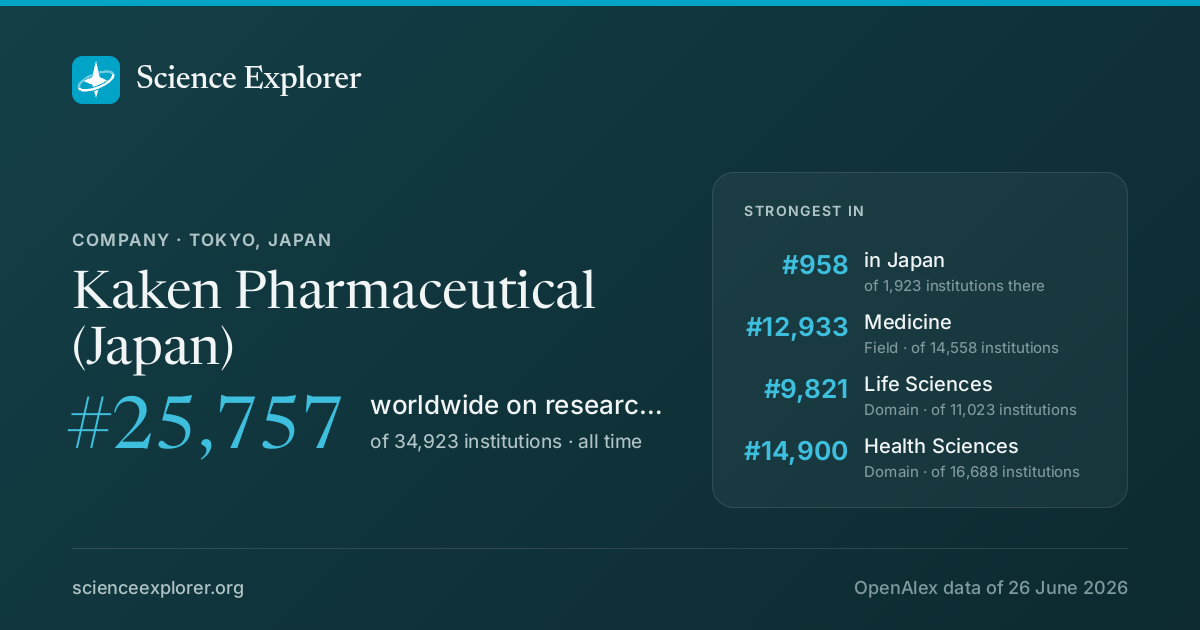
Kaken Pharmaceutical (Japan) on Science Explorer

A card with Kaken Pharmaceutical (Japan)'s standing and the fields it leads in, for a post or a slide. A link to this page previews as the same card.

Download the card

1200 × 630 PNG, sized for social posts, drawn from the latest snapshot.

Badges for a website1Each links back here and updates with every snapshot

Research measures only: rankings here say nothing about teaching, admissions or student experience. Comparable institutions and collaboration partners have tabs of their own, above.

Discussion

Ask a question or share a note about Kaken Pharmaceutical (Japan). Keep it to the research: no personal attacks, advertising or links. Any reader can report a post, which collapses it for everyone until it is opened.