Science Explorer Back to mapMap
University · Nicosia · Cyprus

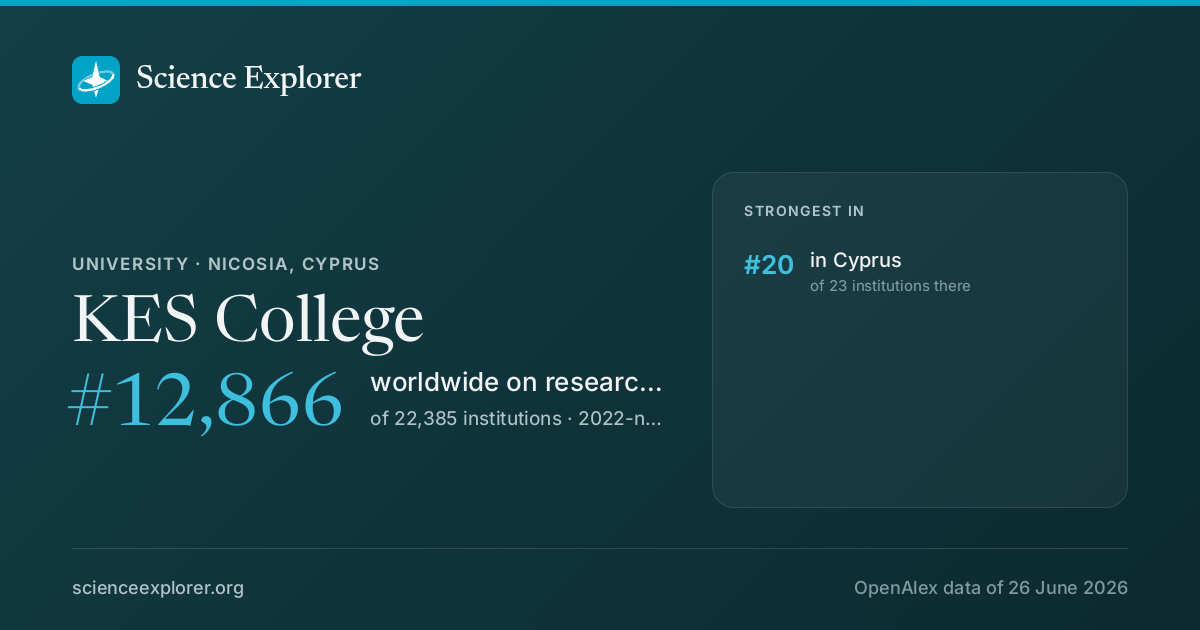
KES College

World rank, 2022-now
#12,866
of 22,385 · #19,000 all time
Rank in Cyprus
#20
of 23
Research works
360
▲ 98% vs 2018-21
Citations
2k
5.6 per fractional work
Top-10% rate
7.8%
all institutions 10.0%
vs its own fields
0.93×
1.00× is exactly expected
Open access
60%
world 40%
International
40%
world 18%

Which fields of science does KES College work in?

In 2022-now, 29% of research at KES College is in Physical Sciences, 27% in Life Sciences. Its largest fields are Medicine (19%), Pharmacology, Toxicology and Pharmaceutics (11%), Agricultural and Biological Sciences (11%). It does 1.9× the world's share of Life Sciences.

Physical Sciences: 44 fractional works · 29.1% of its workEngineering: 15 fractional works · 10.1% of its workElectrical and Electronic Engineering: 6 fractional works · 3.9% of its workBiomedical Engineering: 2 fractional works · 1.4% of its workMechanical Engineering: 1 fractional works · 0.8% of its workControl and Systems Engineering: 1 fractional works · 0.7% of its workMedia Technology: 1 fractional works · 0.7% of its workCivil and Structural Engineering: 1 fractional works · 0.6% of its workAerospace Engineering: 1 fractional works · 0.6% of its workAutomotive Engineering: 0 fractional works · 0.3% of its workMechanics of Materials: 0 fractional works · 0.2% of its workSafety, Risk, Reliability and Quality: 0 fractional works · 0.2% of its workIndustrial and Manufacturing Engineering: 0 fractional works · 0.2% of its workSmaller subfields together: 1 fractional works · 0.4% of its workComputer Science: 12 fractional works · 7.7% of its workArtificial Intelligence: 2 fractional works · 1.6% of its workComputer Vision and Pattern Recognition: 2 fractional works · 1.5% of its workComputer Networks and Communications: 2 fractional works · 1.4% of its workInformation Systems: 2 fractional works · 1.1% of its workComputational Theory and Mathematics: 1 fractional works · 0.8% of its workHuman-Computer Interaction: 1 fractional works · 0.7% of its workSignal Processing: 1 fractional works · 0.4% of its workSmaller subfields together: 0 fractional works · 0.1% of its workChemistry: 6 fractional works · 3.9% of its workAnalytical Chemistry: 2 fractional works · 1.3% of its workOrganic Chemistry: 2 fractional works · 1.1% of its workInorganic Chemistry: 2 fractional works · 1.0% of its workSpectroscopy: 1 fractional works · 0.5% of its workSmaller subfields together: 0 fractional works · 0.0% of its workEnvironmental Science: 5 fractional works · 3.4% of its workWater Science and Technology: 1 fractional works · 0.8% of its workHealth, Toxicology and Mutagenesis: 1 fractional works · 0.6% of its workGlobal and Planetary Change: 1 fractional works · 0.5% of its workNature and Landscape Conservation: 1 fractional works · 0.5% of its workManagement, Monitoring, Policy and Law: 1 fractional works · 0.4% of its workEcology: 0 fractional works · 0.3% of its workSmaller subfields together: 1 fractional works · 0.4% of its workMaterials Science: 5 fractional works · 3.1% of its workMaterials Chemistry: 3 fractional works · 2.2% of its workBiomaterials: 1 fractional works · 0.3% of its workCeramics and Composites: 0 fractional works · 0.3% of its workElectronic, Optical and Magnetic Materials: 0 fractional works · 0.2% of its workSmaller subfields together: 0 fractional works · 0.0% of its workEarth and Planetary Sciences: 1 fractional works · 0.4% of its workMathematics: 0 fractional works · 0.3% of its workEnergy: 0 fractional works · 0.1% of its workPhysics and Astronomy: 0 fractional works · 0.1% of its workLife Sciences: 41 fractional works · 27.4% of its workPharmacology, Toxicology and Pharmaceutics: 17 fractional works · 11.0% of its workPharmaceutical Science: 13 fractional works · 8.3% of its workPharmacology: 3 fractional works · 1.9% of its workToxicology: 1 fractional works · 0.5% of its workDrug Discovery: 0 fractional works · 0.3% of its workAgricultural and Biological Sciences: 16 fractional works · 10.8% of its workPlant Science: 7 fractional works · 4.6% of its workFood Science: 3 fractional works · 1.7% of its workSoil Science: 2 fractional works · 1.2% of its workGeneral Agricultural and Biological Sciences: 1 fractional works · 0.7% of its workForestry: 1 fractional works · 0.7% of its workAquatic Science: 1 fractional works · 0.6% of its workAgronomy and Crop Science: 1 fractional works · 0.5% of its workEcology, Evolution, Behavior and Systematics: 1 fractional works · 0.5% of its workAnimal Science and Zoology: 0 fractional works · 0.2% of its workSmaller subfields together: 0 fractional works · 0.1% of its workBiochemistry, Genetics and Molecular Biology: 5 fractional works · 3.4% of its workMolecular Biology: 3 fractional works · 1.9% of its workGenetics: 1 fractional works · 0.4% of its workCell Biology: 0 fractional works · 0.3% of its workDevelopmental Biology: 0 fractional works · 0.3% of its workBiochemistry: 0 fractional works · 0.2% of its workSmaller subfields together: 1 fractional works · 0.3% of its workImmunology and Microbiology: 2 fractional works · 1.4% of its workImmunology: 2 fractional works · 1.2% of its workSmaller subfields together: 0 fractional works · 0.2% of its workNeuroscience: 1 fractional works · 0.8% of its workNeurology: 0 fractional works · 0.3% of its workCognitive Neuroscience: 0 fractional works · 0.2% of its workEndocrine and Autonomic Systems: 0 fractional works · 0.2% of its workSmaller subfields together: 0 fractional works · 0.1% of its workHealth Sciences: 38 fractional works · 24.9% of its workMedicine: 29 fractional works · 19.0% of its workPediatrics, Perinatology and Child Health: 2 fractional works · 1.6% of its workEndocrinology, Diabetes and Metabolism: 2 fractional works · 1.5% of its workPublic Health, Environmental and Occupational Health: 2 fractional works · 1.5% of its workSurgery: 2 fractional works · 1.4% of its workPulmonary and Respiratory Medicine: 2 fractional works · 1.3% of its workInfectious Diseases: 2 fractional works · 1.2% of its workPharmacology: 2 fractional works · 1.0% of its workComplementary and alternative medicine: 1 fractional works · 0.9% of its workGeriatrics and Gerontology: 1 fractional works · 0.8% of its workNeurology: 1 fractional works · 0.8% of its workCardiology and Cardiovascular Medicine: 1 fractional works · 0.7% of its workOncology: 1 fractional works · 0.7% of its workPathology and Forensic Medicine: 1 fractional works · 0.7% of its workFamily Practice: 1 fractional works · 0.6% of its workGenetics: 1 fractional works · 0.6% of its workHematology: 1 fractional works · 0.5% of its workDermatology: 1 fractional works · 0.4% of its workEmergency Medicine: 1 fractional works · 0.4% of its workGastroenterology: 0 fractional works · 0.3% of its workEpidemiology: 0 fractional works · 0.3% of its workPhysiology: 0 fractional works · 0.3% of its workObstetrics and Gynecology: 0 fractional works · 0.3% of its workCritical Care and Intensive Care Medicine: 0 fractional works · 0.2% of its workBiochemistry: 0 fractional works · 0.2% of its workNephrology: 0 fractional works · 0.2% of its workSmaller subfields together: 1 fractional works · 0.8% of its workHealth Professions: 7 fractional works · 4.5% of its workGeneral Health Professions: 3 fractional works · 1.7% of its workHealth Information Management: 1 fractional works · 0.9% of its workEmergency Medical Services: 1 fractional works · 0.6% of its workOccupational Therapy: 1 fractional works · 0.5% of its workMedical Laboratory Technology: 0 fractional works · 0.3% of its workPhysical Therapy, Sports Therapy and Rehabilitation: 0 fractional works · 0.2% of its workRadiological and Ultrasound Technology: 0 fractional works · 0.2% of its workSmaller subfields together: 0 fractional works · 0.1% of its workNursing: 2 fractional works · 1.1% of its workNutrition and Dietetics: 1 fractional works · 0.7% of its workIssues, ethics and legal aspects: 1 fractional works · 0.3% of its workSmaller subfields together: 0 fractional works · 0.1% of its workDentistry: 0 fractional works · 0.3% of its workPeriodontics: 0 fractional works · 0.2% of its workSmaller subfields together: 0 fractional works · 0.1% of its workSocial Sciences: 28 fractional works · 18.6% of its workSocial Sciences: 12 fractional works · 7.8% of its workSociology and Political Science: 4 fractional works · 2.7% of its workEducation: 2 fractional works · 1.6% of its workGeneral Social Sciences: 1 fractional works · 0.9% of its workSafety Research: 1 fractional works · 0.8% of its workPolitical Science and International Relations: 1 fractional works · 0.7% of its workHealth: 1 fractional works · 0.5% of its workGender Studies: 1 fractional works · 0.4% of its workSmaller subfields together: 0 fractional works · 0.3% of its workBusiness, Management and Accounting: 5 fractional works · 3.2% of its workManagement of Technology and Innovation: 2 fractional works · 1.1% of its workTourism, Leisure and Hospitality Management: 1 fractional works · 0.7% of its workManagement Information Systems: 1 fractional works · 0.6% of its workAccounting: 1 fractional works · 0.5% of its workSmaller subfields together: 1 fractional works · 0.4% of its workEconomics, Econometrics and Finance: 4 fractional works · 2.4% of its workEconomics and Econometrics: 3 fractional works · 2.3% of its workSmaller subfields together: 0 fractional works · 0.1% of its workPsychology: 3 fractional works · 2.0% of its workClinical Psychology: 2 fractional works · 1.2% of its workSocial Psychology: 1 fractional works · 0.5% of its workSmaller subfields together: 0 fractional works · 0.3% of its workArts and Humanities: 3 fractional works · 1.9% of its workLiterature and Literary Theory: 1 fractional works · 0.8% of its workConservation: 1 fractional works · 0.5% of its workVisual Arts and Performing Arts: 0 fractional works · 0.3% of its workSmaller subfields together: 0 fractional works · 0.2% of its workDecision Sciences: 2 fractional works · 1.3% of its workManagement Science and Operations Research: 1 fractional works · 0.6% of its workInformation Systems and Management: 1 fractional works · 0.4% of its workStatistics, Probability and Uncertainty: 0 fractional works · 0.3% of its workALL ITS WORKKES College152fractional works, 2022-now
Life Sciences27%Physical Sciences29%Health Sciences25%Social Sciences19%

Each ring splits the one inside it: the four domains of science, their fields, their subfields. Size is fractional works in 2022-now. Every slice is a page; the interactive view zooms down to single topics and colours each by how much more of it this institution does than the world.

Its 4 domains and 24 fields, with their numbers
    1. Engineering1510.1%
    2. Computer Science127.7%
    3. Chemistry63.9%
    4. Environmental Science53.4%
    5. Materials Science53.1%
    6. Earth and Planetary Sciences10.4%
    7. Mathematics00.3%
    8. Energy00.1%
    9. Physics and Astronomy00.1%
    1. Pharmacology, Toxicology and Pharmaceutics1711.0%
    2. Agricultural and Biological Sciences1610.8%
    3. Biochemistry, Genetics and Molecular Biology53.4%
    4. Immunology and Microbiology21.4%
    5. Neuroscience10.8%
    1. Medicine2919.0%
    2. Health Professions74.5%
    3. Nursing21.1%
    4. Dentistry00.3%
    1. Social Sciences127.8%
    2. Business, Management and Accounting53.2%
    3. Economics, Econometrics and Finance42.4%
    4. Psychology32.0%
    5. Arts and Humanities31.9%
    6. Decision Sciences21.3%
All of science, and how each field's share has moved since 1950: the Science domain explorer

Field profile

Location quotient across every field it publishes in: outside the ring is more than an institution of this size would be expected to publish, inside it is less.

Agricultural and Biological Sciences: 2.26× its world share, 16 worksAgricultural and Bio…Biochemistry, Genetics and Molecular Biology: 0.65× its world share, 5 worksBiochemistry, Geneti…Immunology and Microbiology: 1.35× its world share, 2 worksImmunology and Micro…Neuroscience: 0.51× its world share, 1 worksNeurosciencePharmacology, Toxicology and Pharmaceutics: 31.15× its world share, 17 worksPharmacology, Toxico…Chemistry: 2.51× its world share, 6 worksChemistryComputer Science: 0.99× its world share, 12 worksComputer ScienceEarth and Planetary Sciences: 0.25× its world share, 1 worksEarth and Planetary …Energy: 0.10× its world share, 0 worksEnergyEngineering: 0.67× its world share, 15 worksEngineeringEnvironmental Science: 0.69× its world share, 5 worksEnvironmental ScienceMaterials Science: 0.89× its world share, 5 worksMaterials ScienceMathematics: 0.26× its world share, 0 worksMathematicsPhysics and Astronomy: 0.03× its world share, 0 worksPhysics and AstronomyDentistry: 0.57× its world share, 0 worksDentistryHealth Professions: 1.70× its world share, 7 worksHealth ProfessionsMedicine: 0.99× its world share, 29 worksMedicineNursing: 2.30× its world share, 2 worksNursingArts and Humanities: 0.65× its world share, 3 worksArts and HumanitiesBusiness, Management and Accounting: 0.99× its world share, 5 worksBusiness, Management…Decision Sciences: 1.30× its world share, 2 worksDecision SciencesEconomics, Econometrics and Finance: 1.13× its world share, 4 worksEconomics, Econometr…Psychology: 0.66× its world share, 3 worksPsychologySocial Sciences: 0.62× its world share, 12 worksSocial Sciences1×world share
more than its size predictsabout as predictedless

Rings at 0.5×, 1× and 2×. Widest outward: Pharmacology, Toxicology and Pharmaceutics, 31.1×. Every wedge is a field page.

All 24 fields, with their numbers
  1. Pharmacology, Toxicology and Pharmaceutics31.15×17 works
  2. Chemistry2.51×6 works
  3. Nursing2.30×2 works
  4. Agricultural and Biological Sciences2.26×16 works
  5. Health Professions1.70×7 works
  6. Immunology and Microbiology1.35×2 works
  7. Decision Sciences1.30×2 works
  8. Economics, Econometrics and Finance1.13×4 works
  9. Computer Science0.99×12 works
  10. Medicine0.99×29 works
  11. Business, Management and Accounting0.99×5 works
  12. Materials Science0.89×5 works
  13. Environmental Science0.69×5 works
  14. Engineering0.67×15 works
  15. Psychology0.66×3 works
  16. Biochemistry, Genetics and Molecular Biology0.65×5 works
  17. Arts and Humanities0.65×3 works
  18. Social Sciences0.62×12 works
  19. Dentistry0.57×0 works
  20. Neuroscience0.51×1 works
  21. Mathematics0.26×0 works
  22. Earth and Planetary Sciences0.25×1 works
  23. Energy0.10×0 works
  24. Physics and Astronomy0.03×0 works

Who are the top researchers at KES College?

Ranked on the quality score, G. M. Sreenivasa, Preethı Sudheer and Nitin Mahurkar lead among researchers whose main affiliation is KES College.

  1. 1 G. M. Sreenivasa Cyprus · #4,917,672 worldwide 49 citations · 20 works
  2. 2 Preethı Sudheer Cyprus · #5,790,316 worldwide 227 citations · 37 works
  3. 3 Nitin Mahurkar Cyprus · #6,189,654 worldwide 183 citations · 39 works
All ranked researchers at KES College

What are the most cited papers from KES College?

The most cited paper from KES College is "Firm self-regulation through international certifiable standards: determinants of symbolic versus substantive implementation" (Petra Christmann, Glen Taylor, 2006), with 742 citations. Next come "A review: Brief insight into Polycystic Ovarian syndrome" (166) and "Immunomodulatory activity of methanolic leaf extract of Moringa oleifera in animals." (122).

Most cited papers
#PaperReleasedCitations
1 Firm self-regulation through international certifiable standards: determinants of symbolic versus substantive implementation Petra Christmann, Glen Taylor · Journal of International Business Studies 7 Sep 2006 742
2 A review: Brief insight into Polycystic Ovarian syndrome Jeshica Bulsara, Priyanshi Patel, Arun K. Soni et al. · Endocrine and Metabolic Science Open access 10 Feb 2021 166
3 Immunomodulatory activity of methanolic leaf extract of Moringa oleifera in animals. Paul J Davis Thangirala Sudha, Syed Mohammed Basheeruddin Asdaq, Sunil S Dhamingi et al. · PubMed 15 Dec 2010 122
4 W ithania somnifera (Ashwagandha) in neurobehavioural disorders induced by brain oxidative stress in rodents: a systematic review and meta-analysis Sharanbasappa Durg, Shivsharan Basavraj Dhadde, Ravichandra Vandal et al. · Journal of Pharmacy and Pharmacology Review 2 Apr 2015 106
5 Microwave-assisted one-pot synthesis of benzothiazole and benzoxazole libraries as analgesic agents Chandrasekar Praveen, Avanashiappan Nandakumar, P. Dheenkumar et al. · Journal of Chemical Sciences May 2012 88
All 62 most cited papers, with filters and sorting

Which keywords describe research at KES College?

By fractional works in 2022-now, weighted toward what it does more of than the world: Nanoparticles, Machine Learning, Cyclodextrins, Solid Dispersions, Drug Delivery, Antioxidant, Oxidative Stress and Chitosan.

▲ more of its work than of the world's◆ about the world's share▼ less than the world's

Size is fractional works in 2022-now in the topics tagged with each word; colour is the word's share of this institution's work against its share of the world's. The 40 words are chosen for being large and distinctive. Each links to the topic it comes from most.

All 40 words, with their numbers
  1. Machine Learning11▲ 2.3×24 topics
  2. Nanoparticles8▲ 4.4×12 topics
  3. Deep Learning8▲ 1.46×21 topics
  4. Oxidative Stress7▲ 2.7×15 topics
  5. Antioxidant6▲ 5.4×21 topics
  6. Cyclodextrins5▲ 163×1 topic
  7. Drug Delivery5▲ 6.5×6 topics
  8. Solid Dispersions5▲ 163×1 topic
  9. Inflammation5▲ 1.43×16 topics
  10. Sustainability4▲ 1.17×9 topics
  11. Antioxidants4▲ 6.2×5 topics
  12. Internet of Things4▲ 3.2×12 topics
  13. Medicinal Plants4▲ 6.6×6 topics
  14. Antioxidant Activity4▲ 4.0×12 topics
  15. Chitosan4▲ 30×1 topic
  16. Mucosal4▲ 73×1 topic
  17. Big Data4▲ 2.5×10 topics
  18. Microneedles4▲ 78×1 topic
  19. Solid Lipid Nanoparticles4▲ 78×1 topic
  20. Flavonoids3▲ 8.9×5 topics
  21. Bioactive Compounds3▲ 8.6×10 topics
  22. Diabetes3▲ 4.3×7 topics
  23. Data Mining3▲ 2.6×6 topics
  24. IoT3▲ 5.2×8 topics
  25. Anti-inflammatory2▲ 5.9×10 topics
  26. Herbal Medicine2▲ 5.8×5 topics
  27. Insulin Resistance2▲ 3.5×3 topics
  28. Hepatotoxicity2▲ 31×2 topics
  29. India2▲ 21×3 topics
  30. Method Validation2▲ 26×2 topics
  31. Type 2 Diabetes2▲ 6.4×2 topics
  32. Alpha-Glucosidase Inhibitors2▲ 36×1 topic
  33. Oxidative Damage2▲ 31×1 topic
  34. Pharmacokinetics2▲ 4.9×5 topics
  35. Phytochemicals2▲ 12×3 topics
  36. Green Analytical Chemistry2▲ 21×2 topics
  37. Phytochemistry2▲ 9.1×4 topics
  38. Pharmaceutical Analysis2▲ 57×1 topic
  39. Validation2▲ 11×1 topic
  40. Entrepreneurial Orientation2▲ 12×1 topic

Which research topics does KES College publish most on?

By volume in 2022-now: Drug Solubulity and Delivery Systems, Advanced Drug Delivery Systems, Advancements in Transdermal Drug Delivery and Natural Antidiabetic Agents Studies.

  1. 1 Drug Solubulity and Delivery Systems Pharmaceutical Science 5 works
  2. 2 Advanced Drug Delivery Systems Pharmaceutical Science 4 works
  3. 3 Advancements in Transdermal Drug Delivery Pharmaceutical Science 4 works
  4. 4 Natural Antidiabetic Agents Studies Endocrinology, Diabetes and Metabolism 2 works
  5. 5 Analytical Methods in Pharmaceuticals Analytical Chemistry 2 works
  6. 6 Entrepreneurship Studies and Influences Management of Technology and Innovation 2 works
  7. 7 Pharmaceutical Practices and Patient Outcomes Geriatrics and Gerontology 1 works
  8. 8 Drug-Induced Hepatotoxicity and Protection Pharmacology 1 works
  9. 9 Computational Drug Discovery Methods Computational Theory and Mathematics 1 works
  10. 10 Diverse Scientific Research Studies General Health Professions 1 works

How open and international is its research?

Against the world's own shares: the tick on each track. Both are shares of its output, so they sit on one scale and can be read against each other as well as against the world.

openly available59.7%not open40.3%

World: 40% of research is openly available.

with international co-authors40.5%domestic only59.5%

World: 18% is written across borders.

How has KES College's research output changed?

Output in 2022-2025 was 98% higher than in 2018-2021.

still counting1990200020102020
grewheldshrank

The same series as a ribbon: one cell per year, darker for more. The line above answers how much; this answers when.

Its share of all research

Growing output can still be a shrinking share: all of science grows. This is KES College as a percentage of every work published that year, 0.00073% in 2024.

still counting0.00025%0.00050%0.00075%KES College0.00054% in 202519801990200020102020

Fractional works of KES College over all fractional works that year. How the balance of science has shifted.

Other research institutions in Nicosia

All research institutions in Nicosia

Share KES College's ranking

KES College on Science Explorer

A card with KES College's standing and the fields it leads in, for a post or a slide. A link to this page previews as the same card.

Download the card

1200 × 630 PNG, sized for social posts, drawn from the latest snapshot.

Badges for a website1Each links back here and updates with every snapshot

Research measures only: rankings here say nothing about teaching, admissions or student experience. Comparable institutions and collaboration partners have tabs of their own, above.

Discussion

Ask a question or share a note about KES College. Posts are plain text and can be reported.