Klinikum Bremen-Mitte
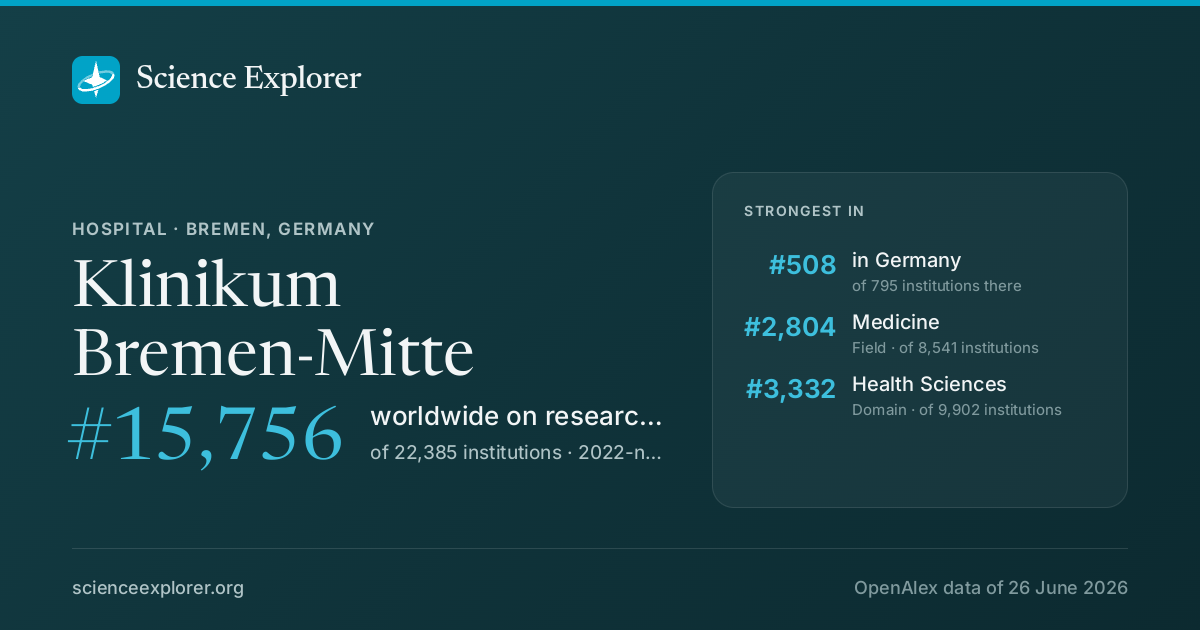
In research, Klinikum Bremen-Mitte stands highest in Medicine (#2,804 of 8,541 worldwide) and Health Sciences (#3,332 of 9,902 worldwide), 2022-now.
- World rank, 2022-now
- #15,756 of 22,385 · #9,384 all time
- Rank in Germany
- #508 of 795
- Research works
- 1.1k ▼ 20% vs 2018-21
- Citations
- 13k 12.0 per fractional work
- Top-10% rate
- 6.2% all institutions 10.0%
- vs its own fields
- 1.00× 1.00× is exactly expected
- Open access
- 20% world 40%
- International
- 12% world 18%
What is Klinikum Bremen-Mitte known for in research?
The fields where it stands highest, 2022-now, ranked among every institution above the floor in each field.
| Field | World rank | Where that sits | Top-10% rate | Works | All time |
|---|---|---|---|---|---|
| MedicineField | #2,804 of 8,541 | 5.9% | 91 | #2172 | |
| Health SciencesDomain | #3,332 of 9,902 | 5.7% | 100 | #2418 |
Each strip is that field's whole ranked pool, with the notch where Klinikum Bremen-Mitte sits in it, in the colour of the band that rank falls in. The track under the rate is the rate itself: it carries no average mark, because the average differs by field (from about 6% in Dentistry to 21% in Economics).
Which fields of science does Klinikum Bremen-Mitte work in?
In 2022-now, 79% of research at Klinikum Bremen-Mitte is in Health Sciences, 11% in Life Sciences. Its largest fields are Medicine (72%), Biochemistry, Genetics and Molecular Biology (6%), Health Professions (5%). It does 3.2× the world's share of Health Sciences.
Each ring splits the one inside it: the four domains of science, their fields, their subfields. Size is fractional works in 2022-now. Every slice is a page; the interactive view zooms down to single topics and colours each by how much more of it this institution does than the world.
Its 4 domains and 23 fields, with their numbers
- Health Sciences10779.5%
- Medicine9772.2%
- Health Professions75.4%
- Dentistry21.1%
- Nursing10.8%
- Veterinary00.0%
- Life Sciences1511.1%
- Social Sciences96.4%
- Physical Sciences43.1%
- Engineering32.0%
- Environmental Science10.5%
- Materials Science00.2%
- Computer Science00.2%
- Physics and Astronomy00.1%
- Chemical Engineering00.0%
- Mathematics00.0%
Field profile
Location quotient across every field it publishes in: outside the ring is more than an institution of this size would be expected to publish, inside it is less.
Rings at 0.5×, 1× and 2×. Widest outward: Medicine, 3.8×. Every wedge is a field page.
All 22 fields, with their numbers
- Medicine3.75×97 works
- Immunology and Microbiology2.57×4 works
- Dentistry2.30×2 works
- Health Professions2.05×7 works
- Neuroscience1.59×4 works
- Nursing1.58×1 works
- Biochemistry, Genetics and Molecular Biology1.09×8 works
- Psychology0.78×3 works
- Economics, Econometrics and Finance0.37×1 works
- Arts and Humanities0.35×1 works
- Pharmacology, Toxicology and Pharmaceutics0.28×0 works
- Business, Management and Accounting0.15×1 works
- Veterinary0.14×0 works
- Social Sciences0.14×2 works
- Engineering0.13×3 works
- Chemical Engineering0.12×0 works
- Environmental Science0.10×1 works
- Materials Science0.07×0 works
- Physics and Astronomy0.04×0 works
- Mathematics0.03×0 works
- Computer Science0.02×0 works
- Decision Sciences0.01×0 works
- Medicine 3.8×
- Immunology and Microbiology 2.6×
- Dentistry 2.3×
- Health Professions 2.0×
- Neuroscience 1.6×
- Nursing 1.6×
- Biochemistry, Genetics and Molecular Biology 1.1×
- Psychology 0.8×
- Economics, Econometrics and Finance 0.4×
- Arts and Humanities 0.3×
- Pharmacology, Toxicology and Pharmaceutics 0.3×
- Business, Management and Accounting 0.1×
- Veterinary 0.1×
- Social Sciences 0.1×
- Engineering 0.1×
- Chemical Engineering 0.1×
- Environmental Science 0.1×
- Materials Science 0.1×
- Physics and Astronomy 0.0×
- Mathematics 0.0×
- Computer Science 0.0×
- Decision Sciences 0.0×
Who are the top researchers at Klinikum Bremen-Mitte?
Ranked on the quality score, Bernd Hertenstein, Andreas Kastrup and Panagiotis Papanagiotou lead among researchers whose main affiliation is Klinikum Bremen-Mitte.
- 1
Bernd Hertenstein
 Germany · #284,247 worldwide
21k citations · 355 works
- 2
Andreas Kastrup
Germany · #286,753 worldwide
13k citations · 271 works
- 3
Panagiotis Papanagiotou
Germany · #365,931 worldwide
6.5k citations · 221 works
- 4
Christian Roth
Germany · #655,863 worldwide
4.5k citations · 148 works
- 5
Maria Boutchakova
Germany · #662,357 worldwide
1.2k citations · 18 works
- 6
Rainer Porschen
Germany · #848,418 worldwide
6.1k citations · 209 works
- 7
Hans‐Iko Huppertz
Germany · #1,008,253 worldwide
4k citations · 239 works
- 8
Markus Bergmann
Germany · #1,138,529 worldwide
6.2k citations · 133 works
- 9
Sabine Grasshoff‐Derr
Germany · #1,369,574 worldwide
864 citations · 35 works
- 10
Nicole Schwarzer
Germany · #1,548,982 worldwide
995 citations · 46 works
Which keywords describe research at Klinikum Bremen-Mitte?
By fractional works in 2022-now, weighted toward what it does more of than the world: Epidemiology, Inflammation, Diagnosis, Treatment, Quality of Life, Heart Failure, Clinical Practice Guidelines and Global Burden.
- Functional Recovery
- Anatomy
- Healthcare Utilization
- Germany
- Pain Management
- Epidemiological Study
- Neuroprotection
- Chronic Kidney Disease
- Palliative Care
- Autoantibodies
- Neurological Disorders
- Genetic Mutations
- Health-related Quality of Life
- Metabolic Syndrome
- Complications
- Risk Factors
- Global Burden
- Clinical Practice Guidelines
- Quality of Life
- Inflammation
- Epidemiology
- Diagnosis
- Treatment
- Management
- Heart Failure
- Surgical Management
- Rehabilitation
- Prognostic Factors
- Alzheimer's Disease
- Guidelines
- Clinical Outcomes
- Ethical Considerations
- Cardiovascular Risk
- Hypertension
- Surgery
- Prognosis
- Autoimmune
- Health Surveys
- Vasopressin
- End-of-Life
Size is fractional works in 2022-now in the topics tagged with each word; colour is the word's share of this institution's work against its share of the world's. The 40 words are chosen for being large and distinctive. Each links to the topic it comes from most.
All 40 words, with their numbers
- Epidemiology14▲ 2.7×70 topics
- Inflammation9▲ 3.2×35 topics
- Diagnosis7▲ 5.6×19 topics
- Quality of Life7▲ 3.4×24 topics
- Treatment6▲ 3.9×25 topics
- Clinical Practice Guidelines4▲ 5.6×13 topics
- Management4▲ 3.9×15 topics
- Global Burden4▲ 5.6×9 topics
- Heart Failure4▲ 6.5×10 topics
- Risk Factors4▲ 2.5×11 topics
- Surgical Management4▲ 6.9×14 topics
- Complications4▲ 5.5×13 topics
- Rehabilitation4▲ 6.8×8 topics
- Metabolic Syndrome4▲ 3.3×8 topics
- Prognostic Factors4▲ 5.9×13 topics
- Health-related Quality of Life3▲ 11×6 topics
- Alzheimer's Disease3▲ 8.3×5 topics
- Genetic Mutations3▲ 5.1×14 topics
- Guidelines3▲ 4.7×10 topics
- Neurological Disorders3▲ 3.9×13 topics
- Clinical Outcomes3▲ 9.6×4 topics
- Autoantibodies3▲ 8.3×6 topics
- Ethical Considerations3▲ 5.6×4 topics
- Palliative Care3▲ 13×3 topics
- Cardiovascular Risk2▲ 5.8×6 topics
- Chronic Kidney Disease2▲ 7.5×7 topics
- Hypertension2▲ 6.1×4 topics
- Neuroprotection2▲ 5.1×7 topics
- Surgery2▲ 5.2×9 topics
- Epidemiological Study2▲ 25×3 topics
- Prognosis2▲ 5.1×7 topics
- Pain Management2▲ 6.7×5 topics
- Autoimmune2▲ 32×2 topics
- Germany2▲ 80×1 topic
- Health Surveys2▲ 80×1 topic
- Healthcare Utilization2▲ 19×2 topics
- Vasopressin2▲ 37×2 topics
- Anatomy2▲ 19×4 topics
- End-of-Life2▲ 16×2 topics
- Functional Recovery2▲ 9.4×2 topics
Which research topics does Klinikum Bremen-Mitte publish most on?
By volume in 2022-now: Health and Medical Studies, Urticaria and Related Conditions, Palliative Care and End-of-Life Issues and Gout, Hyperuricemia, Uric Acid.
Area is fractional works; colour is the subfield each topic belongs to.
- 1 Health and Medical Studies General Health Professions 2 works
- 2 Urticaria and Related Conditions Rheumatology 2 works
- 3 Palliative Care and End-of-Life Issues Public Health, Environmental and Occupational Health 2 works
- 4 Gout, Hyperuricemia, Uric Acid Nephrology 2 works
- 5 Electrolyte and hormonal disorders Pulmonary and Respiratory Medicine 2 works
- 6 Acute Ischemic Stroke Management Epidemiology 2 works
- 7 Vasculitis and related conditions Pulmonary and Respiratory Medicine 1 works
- 8 Medical Practices and Rehabilitation Physical Therapy, Sports Therapy and Rehabilitation 1 works
- 9 Venous Thromboembolism Diagnosis and Management Internal Medicine 1 works
- 10 Cardiac, Anesthesia and Surgical Outcomes Cardiology and Cardiovascular Medicine 1 works
How open and international is its research?
Against the world's own shares: the tick on each track. Both are shares of its output, so they sit on one scale and can be read against each other as well as against the world.
World: 40% of research is openly available.
World: 18% is written across borders.
How has Klinikum Bremen-Mitte's research output changed?
Output in 2022-2025 was 20% lower than in 2018-2021.
The same series as a ribbon: one cell per year, darker for more. The line above answers how much; this answers when.
Its share of all research
Growing output can still be a shrinking share: all of science grows. This is Klinikum Bremen-Mitte as a percentage of every work published that year, 0.00060% in 2024.
Fractional works of Klinikum Bremen-Mitte over all fractional works that year. How the balance of science has shifted.
How much of it reaches the world top 10%
Year by year, against all institutions in the same year.
Of each year's output, the share that reached the world's 10% most cited for its field and year. Peak 8.1% in 2022.
Other research institutions in Bremen
- University of Bremen
- Constructor University
- Praxis für Humangenetik
- Hochschule Bremen
- Bremen Institute for Applied Beam Technology
- Klinikum Links der Weser
- Institute for Applied Systems Technology Bremen
- Krankenhaus St. Joseph-Stift Bremen
Share Klinikum Bremen-Mitte's ranking
Badges for a website1Each links back here and updates with every snapshot

Research measures only: rankings here say nothing about teaching, admissions or student experience. Comparable institutions and collaboration partners have tabs of their own, above.
Discussion
Ask a question or share a note about Klinikum Bremen-Mitte. Posts are plain text and can be reported.