Science Explorer Back to mapMap
Discussion
Hospital / health system · Malatya · Türkiye

Malatya Devlet Hastanesi

In research, Malatya Devlet Hastanesi stands highest in Medicine (#5,663 of 8,541 worldwide) and Health Sciences (#6,721 of 9,902 worldwide), 2022-now.

World rank, 2022-now
#12,665
of 22,385 · #21,774 all time
Rank in Türkiye
#216
of 297
Research works
905
▼ 19% vs 2018-21
Citations
6.8k
7.6 per fractional work
Top-10% rate
3.8%
all institutions 10.0%
vs its own fields
0.81×
1.00× is exactly expected
Open access
71%
world 40%
International
9%
world 18%

What is Malatya Devlet Hastanesi known for in research?

The fields where it stands highest, 2022-now, ranked among every institution above the floor in each field.

FieldWorld rankWhere that sitsTop-10% rateWorksAll time
MedicineField #5,663 of 8,541 2.3%143 #11427
Health SciencesDomain #6,721 of 9,902 2.5%161 #13817

Each strip is that field's whole ranked pool, with the notch where Malatya Devlet Hastanesi sits in it, in the colour of the band that rank falls in. The track under the rate is the rate itself: it carries no average mark, because the average differs by field (from about 6% in Dentistry to 21% in Economics).

Which fields of science does Malatya Devlet Hastanesi work in?

In 2022-now, 66% of research at Malatya Devlet Hastanesi is in Health Sciences, 16% in Social Sciences. Its largest fields are Medicine (59%), Social Sciences (6%), Health Professions (5%). It does 2.8× the world's share of Health Sciences.

Health Sciences: 185 fractional works · 66.2% of its workMedicine: 164 fractional works · 58.9% of its workSurgery: 31 fractional works · 10.9% of its workEpidemiology: 12 fractional works · 4.2% of its workPulmonary and Respiratory Medicine: 12 fractional works · 4.1% of its workCardiology and Cardiovascular Medicine: 8 fractional works · 3.0% of its workPublic Health, Environmental and Occupational Health: 7 fractional works · 2.6% of its workInfectious Diseases: 7 fractional works · 2.5% of its workOncology: 7 fractional works · 2.4% of its workRadiology, Nuclear Medicine and Imaging: 6 fractional works · 2.1% of its workRheumatology: 6 fractional works · 2.0% of its workEndocrinology, Diabetes and Metabolism: 5 fractional works · 1.8% of its workPhysiology: 5 fractional works · 1.7% of its workNeurology: 5 fractional works · 1.7% of its workDermatology: 4 fractional works · 1.5% of its workPathology and Forensic Medicine: 4 fractional works · 1.5% of its workObstetrics and Gynecology: 4 fractional works · 1.4% of its workPharmacology: 4 fractional works · 1.3% of its workAnesthesiology and Pain Medicine: 3 fractional works · 1.2% of its workEmergency Medicine: 3 fractional works · 1.1% of its workPediatrics, Perinatology and Child Health: 3 fractional works · 1.0% of its workHepatology: 3 fractional works · 1.0% of its workOphthalmology: 3 fractional works · 1.0% of its workUrology: 3 fractional works · 0.9% of its workGenetics: 2 fractional works · 0.9% of its workOrthopedics and Sports Medicine: 2 fractional works · 0.9% of its workCritical Care and Intensive Care Medicine: 2 fractional works · 0.9% of its workHematology: 2 fractional works · 0.8% of its workNephrology: 2 fractional works · 0.8% of its workPsychiatry and Mental health: 2 fractional works · 0.7% of its workImmunology and Allergy: 2 fractional works · 0.6% of its workRehabilitation: 1 fractional works · 0.4% of its workReproductive Medicine: 1 fractional works · 0.4% of its workOtorhinolaryngology: 1 fractional works · 0.4% of its workGastroenterology: 1 fractional works · 0.3% of its workGeriatrics and Gerontology: 1 fractional works · 0.3% of its workSmaller subfields together: 2 fractional works · 0.8% of its workHealth Professions: 14 fractional works · 5.2% of its workGeneral Health Professions: 6 fractional works · 2.0% of its workEmergency Medical Services: 4 fractional works · 1.5% of its workSpeech and Hearing: 2 fractional works · 0.9% of its workHealth Information Management: 1 fractional works · 0.3% of its workComplementary and Manual Therapy: 1 fractional works · 0.2% of its workSmaller subfields together: 1 fractional works · 0.4% of its workDentistry: 4 fractional works · 1.3% of its workOrthodontics: 2 fractional works · 0.6% of its workOral Surgery: 1 fractional works · 0.5% of its workSmaller subfields together: 0 fractional works · 0.2% of its workNursing: 2 fractional works · 0.6% of its workNutrition and Dietetics: 1 fractional works · 0.4% of its workSmaller subfields together: 1 fractional works · 0.2% of its workVeterinary: 1 fractional works · 0.2% of its workSocial Sciences: 44 fractional works · 15.8% of its workSocial Sciences: 18 fractional works · 6.3% of its workEducation: 6 fractional works · 2.1% of its workSociology and Political Science: 4 fractional works · 1.3% of its workPolitical Science and International Relations: 4 fractional works · 1.3% of its workHealth: 1 fractional works · 0.4% of its workAnthropology: 1 fractional works · 0.3% of its workTransportation: 1 fractional works · 0.2% of its workSmaller subfields together: 2 fractional works · 0.8% of its workArts and Humanities: 12 fractional works · 4.4% of its workPhilosophy: 4 fractional works · 1.4% of its workMuseology: 2 fractional works · 0.9% of its workReligious studies: 2 fractional works · 0.6% of its workLiterature and Literary Theory: 2 fractional works · 0.6% of its workLanguage and Linguistics: 1 fractional works · 0.4% of its workHistory: 1 fractional works · 0.4% of its workSmaller subfields together: 0 fractional works · 0.1% of its workPsychology: 10 fractional works · 3.6% of its workSocial Psychology: 5 fractional works · 1.6% of its workClinical Psychology: 4 fractional works · 1.6% of its workSmaller subfields together: 1 fractional works · 0.3% of its workEconomics, Econometrics and Finance: 2 fractional works · 0.8% of its workEconomics and Econometrics: 2 fractional works · 0.6% of its workSmaller subfields together: 1 fractional works · 0.2% of its workBusiness, Management and Accounting: 2 fractional works · 0.6% of its workAccounting: 1 fractional works · 0.4% of its workSmaller subfields together: 0 fractional works · 0.2% of its workDecision Sciences: 0 fractional works · 0.2% of its workLife Sciences: 29 fractional works · 10.3% of its workBiochemistry, Genetics and Molecular Biology: 13 fractional works · 4.6% of its workMolecular Biology: 5 fractional works · 1.9% of its workGenetics: 2 fractional works · 0.8% of its workCell Biology: 2 fractional works · 0.6% of its workCancer Research: 1 fractional works · 0.3% of its workMolecular Medicine: 1 fractional works · 0.3% of its workClinical Biochemistry: 1 fractional works · 0.3% of its workSmaller subfields together: 1 fractional works · 0.3% of its workNeuroscience: 6 fractional works · 2.3% of its workNeurology: 2 fractional works · 0.8% of its workCognitive Neuroscience: 1 fractional works · 0.5% of its workCellular and Molecular Neuroscience: 1 fractional works · 0.2% of its workDevelopmental Neuroscience: 1 fractional works · 0.2% of its workSensory Systems: 1 fractional works · 0.2% of its workSmaller subfields together: 1 fractional works · 0.3% of its workImmunology and Microbiology: 6 fractional works · 2.0% of its workImmunology: 5 fractional works · 1.6% of its workSmaller subfields together: 1 fractional works · 0.4% of its workAgricultural and Biological Sciences: 3 fractional works · 0.9% of its workFood Science: 1 fractional works · 0.3% of its workSmaller subfields together: 2 fractional works · 0.6% of its workPharmacology, Toxicology and Pharmaceutics: 1 fractional works · 0.5% of its workToxicology: 1 fractional works · 0.3% of its workPharmacology: 1 fractional works · 0.2% of its workPhysical Sciences: 21 fractional works · 7.7% of its workEngineering: 8 fractional works · 2.7% of its workBiomedical Engineering: 2 fractional works · 0.7% of its workCivil and Structural Engineering: 2 fractional works · 0.5% of its workAutomotive Engineering: 1 fractional works · 0.4% of its workBuilding and Construction: 1 fractional works · 0.4% of its workSmaller subfields together: 2 fractional works · 0.7% of its workComputer Science: 4 fractional works · 1.6% of its workArtificial Intelligence: 2 fractional works · 0.6% of its workInformation Systems: 1 fractional works · 0.4% of its workSignal Processing: 1 fractional works · 0.2% of its workSmaller subfields together: 1 fractional works · 0.3% of its workEnvironmental Science: 4 fractional works · 1.4% of its workWater Science and Technology: 1 fractional works · 0.4% of its workHealth, Toxicology and Mutagenesis: 1 fractional works · 0.2% of its workSmaller subfields together: 2 fractional works · 0.8% of its workMaterials Science: 2 fractional works · 0.6% of its workMaterials Chemistry: 1 fractional works · 0.3% of its workSmaller subfields together: 1 fractional works · 0.3% of its workMathematics: 1 fractional works · 0.5% of its workStatistics and Probability: 1 fractional works · 0.2% of its workSmaller subfields together: 1 fractional works · 0.3% of its workChemistry: 1 fractional works · 0.3% of its workPhysics and Astronomy: 1 fractional works · 0.2% of its workStatistical and Nonlinear Physics: 1 fractional works · 0.2% of its workEnergy: 0 fractional works · 0.2% of its workEarth and Planetary Sciences: 0 fractional works · 0.1% of its workChemical Engineering: 0 fractional works · 0.1% of its workALL ITS WORKMalatya DevletHastanesi279fractional works, 2022-now
Life Sciences10%Physical Sciences8%Health Sciences66%Social Sciences16%

Each ring splits the one inside it: the four domains of science, their fields, their subfields. Size is fractional works in 2022-now. Every slice is a page; the interactive view zooms down to single topics and colours each by how much more of it this institution does than the world.

Its 4 domains and 26 fields, with their numbers
    1. Medicine16458.9%
    2. Health Professions145.2%
    3. Dentistry41.3%
    4. Nursing20.6%
    5. Veterinary10.2%
    1. Social Sciences186.3%
    2. Arts and Humanities124.4%
    3. Psychology103.6%
    4. Economics, Econometrics and Finance20.8%
    5. Business, Management and Accounting20.6%
    6. Decision Sciences00.2%
    1. Biochemistry, Genetics and Molecular Biology134.6%
    2. Neuroscience62.3%
    3. Immunology and Microbiology62.0%
    4. Agricultural and Biological Sciences30.9%
    5. Pharmacology, Toxicology and Pharmaceutics10.5%
    1. Engineering82.7%
    2. Computer Science41.6%
    3. Environmental Science41.4%
    4. Materials Science20.6%
    5. Mathematics10.5%
    6. Chemistry10.3%
    7. Physics and Astronomy10.2%
    8. Energy00.2%
    9. Earth and Planetary Sciences00.1%
    10. Chemical Engineering00.1%
All of science, and how each field's share has moved since 1950: the Science domain explorer

Field profile

Location quotient across every field it publishes in: outside the ring is more than an institution of this size would be expected to publish, inside it is less.

Agricultural and Biological Sciences: 0.20× its world share, 3 worksAgricultural and Bio…Biochemistry, Genetics and Molecular Biology: 0.86× its world share, 13 worksBiochemistry, Geneti…Immunology and Microbiology: 2.02× its world share, 6 worksImmunology and Micro…Neuroscience: 1.39× its world share, 6 worksNeurosciencePharmacology, Toxicology and Pharmaceutics: 1.41× its world share, 1 worksPharmacology, Toxico…Chemical Engineering: 0.17× its world share, 0 worksChemical EngineeringChemistry: 0.19× its world share, 1 worksChemistryComputer Science: 0.20× its world share, 4 worksComputer ScienceEarth and Planetary Sciences: 0.04× its world share, 0 worksEarth and Planetary …Energy: 0.17× its world share, 0 worksEnergyEngineering: 0.18× its world share, 8 worksEngineeringEnvironmental Science: 0.28× its world share, 4 worksEnvironmental ScienceMaterials Science: 0.18× its world share, 2 worksMaterials ScienceMathematics: 0.42× its world share, 1 worksMathematicsPhysics and Astronomy: 0.11× its world share, 1 worksPhysics and AstronomyDentistry: 2.75× its world share, 4 worksDentistryHealth Professions: 1.97× its world share, 14 worksHealth ProfessionsMedicine: 3.06× its world share, 164 worksMedicineNursing: 1.24× its world share, 2 worksNursingVeterinary: 1.34× its world share, 0 worksVeterinaryArts and Humanities: 1.51× its world share, 12 worksArts and HumanitiesBusiness, Management and Accounting: 0.19× its world share, 2 worksBusiness, Management…Decision Sciences: 0.19× its world share, 0 worksDecision SciencesEconomics, Econometrics and Finance: 0.37× its world share, 2 worksEconomics, Econometr…Psychology: 1.17× its world share, 10 worksPsychologySocial Sciences: 0.50× its world share, 18 worksSocial Sciences1×world share
more than its size predictsabout as predictedless

Rings at 0.5×, 1× and 2×. Widest outward: Medicine, 3.1×. Every wedge is a field page.

All 26 fields, with their numbers
  1. Medicine3.06×164 works
  2. Dentistry2.75×4 works
  3. Immunology and Microbiology2.02×6 works
  4. Health Professions1.97×14 works
  5. Arts and Humanities1.51×12 works
  6. Pharmacology, Toxicology and Pharmaceutics1.41×1 works
  7. Neuroscience1.39×6 works
  8. Veterinary1.34×0 works
  9. Nursing1.24×2 works
  10. Psychology1.17×10 works
  11. Biochemistry, Genetics and Molecular Biology0.86×13 works
  12. Social Sciences0.50×18 works
  13. Mathematics0.42×1 works
  14. Economics, Econometrics and Finance0.37×2 works
  15. Environmental Science0.28×4 works
  16. Agricultural and Biological Sciences0.20×3 works
  17. Computer Science0.20×4 works
  18. Chemistry0.19×1 works
  19. Business, Management and Accounting0.19×2 works
  20. Decision Sciences0.19×0 works
  21. Engineering0.18×8 works
  22. Materials Science0.18×2 works
  23. Chemical Engineering0.17×0 works
  24. Energy0.17×0 works
  25. Physics and Astronomy0.11×1 works
  26. Earth and Planetary Sciences0.04×0 works

Who are the top researchers at Malatya Devlet Hastanesi?

Ranked on the quality score, Alaeddin Acar, Bülent Yaprak and Tuba Ekmekyapar lead among researchers whose main affiliation is Malatya Devlet Hastanesi.

  1. 1 Alaeddin Acar Türkiye · #2,844,542 worldwide 5 citations · 19 works
  2. 2 Bülent Yaprak Türkiye · #3,761,519 worldwide 132 citations · 38 works
  3. 3 Tuba Ekmekyapar Türkiye · #4,254,562 worldwide 49 citations · 21 works
  4. 4 Fatih Kaplan Türkiye · #4,353,322 worldwide 77 citations · 38 works
  5. 5 İbrahim Aktaş Türkiye · #4,583,977 worldwide 127 citations · 18 works
  6. 6 Ertuğrul Kurtoğlu Türkiye · #5,023,094 worldwide 342 citations · 37 works
  7. 7 Abdulgani Gülyüz Türkiye · #5,056,871 worldwide 181 citations · 18 works
  8. 8 Muhammet Serdar Buğday Türkiye · #5,193,470 worldwide 95 citations · 27 works
  9. 9 Ayla Özaydoğdu Çimen Türkiye · #5,390,608 worldwide 139 citations · 24 works
  10. 10 Hakan Ertem Türkiye · #5,452,522 worldwide 21 citations · 26 works
All ranked researchers at Malatya Devlet Hastanesi

What are the most cited papers from Malatya Devlet Hastanesi?

The most cited paper from Malatya Devlet Hastanesi is "Optimal site selection for solar photovoltaic (PV) power plants using GIS and AHP: A case study of Malatya Province, Turkey" (H. Ebru Çolak, Tugba Memisoglu, Yasin Gercek, 2019), with 381 citations. Next come "Factors affecting survival of hospitalised patients with COPD" (289) and "Mortality analysis of COVID-19 infection in chronic kidney disease, haemodialysis and renal transplant patients compared with patients without kidney disease: a nationwide analysis from Turkey" (237).

Most cited papers
#PaperReleasedCitations
1 Optimal site selection for solar photovoltaic (PV) power plants using GIS and AHP: A case study of Malatya Province, Turkey H. Ebru Çolak, Tugba Memisoglu, Yasin Gercek · Renewable Energy 18 Dec 2019 381
2 Factors affecting survival of hospitalised patients with COPD Hakan Günen, Süleyman Savaş Hacıevliyagil, Filiz Koşar et al. · European Respiratory Journal Open access 29 Jul 2005 289
3 Mortality analysis of COVID-19 infection in chronic kidney disease, haemodialysis and renal transplant patients compared with patients without kidney disease: a nationwide analysis from Turkey Savaş Öztürk et al. · Nephrology Dialysis Transplantation Open access 7 Oct 2020 237
4 Preliminary characterisation of cornelian cherry (Cornus mas L.) genotypes for their physico-chemical properties Kadir Yılmaz, S ERCISLI, Yasemin Zengin et al. · Food Chemistry 27 Sep 2008 178
5 The effect of vitamin D replacement therapy on insulin resistance and androgen levels in women with polycystic ovary syndrome Hadi Selimoğlu, Cevdet Duran, Sinem Kucuksarac Kiyici et al. · Journal of Endocrinological Investigation 9 Oct 2009 177
All 61 most cited papers, with filters and sorting

Which keywords describe research at Malatya Devlet Hastanesi?

By fractional works in 2022-now, weighted toward what it does more of than the world: Epidemiology, Inflammation, Thrombosis, Pain Management, Treatment, SARS-CoV-2, Quality of Life and Management.

▲ more of its work than of the world's◆ about the world's share▼ less than the world's

Size is fractional works in 2022-now in the topics tagged with each word; colour is the word's share of this institution's work against its share of the world's. The 40 words are chosen for being large and distinctive. Each links to the topic it comes from most.

All 40 words, with their numbers
  1. Epidemiology37▲ 3.3×88 topics
  2. Inflammation22▲ 3.7×53 topics
  3. Treatment11▲ 3.2×31 topics
  4. Quality of Life11▲ 2.6×29 topics
  5. Diagnosis9▲ 3.3×26 topics
  6. Management8▲ 3.8×22 topics
  7. Thrombosis8▲ 11×5 topics
  8. Cardiovascular Disease8▲ 2.6×23 topics
  9. Cancer8▲ 2.0×24 topics
  10. Pain Management7▲ 11×8 topics
  11. Guidelines7▲ 5.2×10 topics
  12. SARS-CoV-27▲ 8.1×5 topics
  13. Immune Response6▲ 4.1×11 topics
  14. Immunity6▲ 5.7×4 topics
  15. Pandemic6▲ 2.3×7 topics
  16. Rehabilitation6▲ 5.5×10 topics
  17. Metabolic Syndrome6▲ 2.7×17 topics
  18. Mortality6▲ 3.8×11 topics
  19. Obesity6▲ 2.8×18 topics
  20. Global Burden6▲ 3.9×10 topics
  21. Pathophysiology6▲ 7.2×8 topics
  22. Complications6▲ 4.0×13 topics
  23. Metastasis5▲ 5.7×7 topics
  24. Chronic Pain5▲ 8.6×5 topics
  25. Perioperative Care5▲ 16×3 topics
  26. Cultural Heritage5▲ 3.4×5 topics
  27. ACE2 Receptor5▲ 7.9×3 topics
  28. Tumor Microenvironment5▲ 3.9×7 topics
  29. Infectious Diseases5▲ 5.1×7 topics
  30. Surgical Management5▲ 4.0×15 topics
  31. Platelets4▲ 22×2 topics
  32. Prognostic Markers4▲ 14×3 topics
  33. Neutrophil-to-Lymphocyte Ratio4▲ 32×1 topic
  34. Systemic Inflammatory Response4▲ 32×1 topic
  35. Healthcare Workers4▲ 6.1×3 topics
  36. Distance Education4▲ 6.6×2 topics
  37. Sepsis4▲ 7.2×6 topics
  38. Student Perceptions4▲ 7.2×2 topics
  39. Teaching4▲ 9.6×2 topics
  40. Postoperative Pain3▲ 13×2 topics

Which research topics does Malatya Devlet Hastanesi publish most on?

By volume in 2022-now: Inflammatory Biomarkers in Disease Prognosis, COVID-19 Clinical Research Studies, Education Practices and Challenges and Disaster Response and Management.

  1. 1 Inflammatory Biomarkers in Disease Prognosis Oncology 4 works
  2. 2 COVID-19 Clinical Research Studies Infectious Diseases 3 works
  3. 3 Education Practices and Challenges Philosophy 3 works
  4. 4 Disaster Response and Management Emergency Medical Services 3 works
  5. 5 Anesthesia and Pain Management Surgery 2 works
  6. 6 Cardiac, Anesthesia and Surgical Outcomes Cardiology and Cardiovascular Medicine 2 works
  7. 7 Problem Solving Skills Development Speech and Hearing 2 works
  8. 8 Health Literacy and Information Accessibility General Health Professions 2 works
  9. 9 Cultural and Sociopolitical Studies Museology 2 works
  10. 10 Islamic Thought and Society Studies Religious studies 2 works

How open and international is its research?

Against the world's own shares: the tick on each track. Both are shares of its output, so they sit on one scale and can be read against each other as well as against the world.

openly available71.4%not open28.6%

World: 40% of research is openly available.

with international co-authors9.4%domestic only90.6%

World: 18% is written across borders.

How has Malatya Devlet Hastanesi's research output changed?

Output in 2022-2025 was 19% lower than in 2018-2021.

still counting200020052010201520202025
grewheldshrank

The same series as a ribbon: one cell per year, darker for more. The line above answers how much; this answers when.

Its share of all research

Growing output can still be a shrinking share: all of science grows. This is Malatya Devlet Hastanesi as a percentage of every work published that year, 0.00060% in 2024.

still counting0.0010%0.0020%0.0030%Malatya Devlet Hastanesi0.00080% in 202519801990200020102020

Fractional works of Malatya Devlet Hastanesi over all fractional works that year. How the balance of science has shifted.

How much of it reaches the world top 10%

Year by year, against all institutions in the same year.

still counting5%10%15%all institutions10.0% in 2025Malatya Devlet Hastanesi4.7% in 20252020

Of each year's output, the share that reached the world's 10% most cited for its field and year. Peak 5.7% in 2016.

Other research institutions in Malatya

All research institutions in Malatya

Share Malatya Devlet Hastanesi's ranking
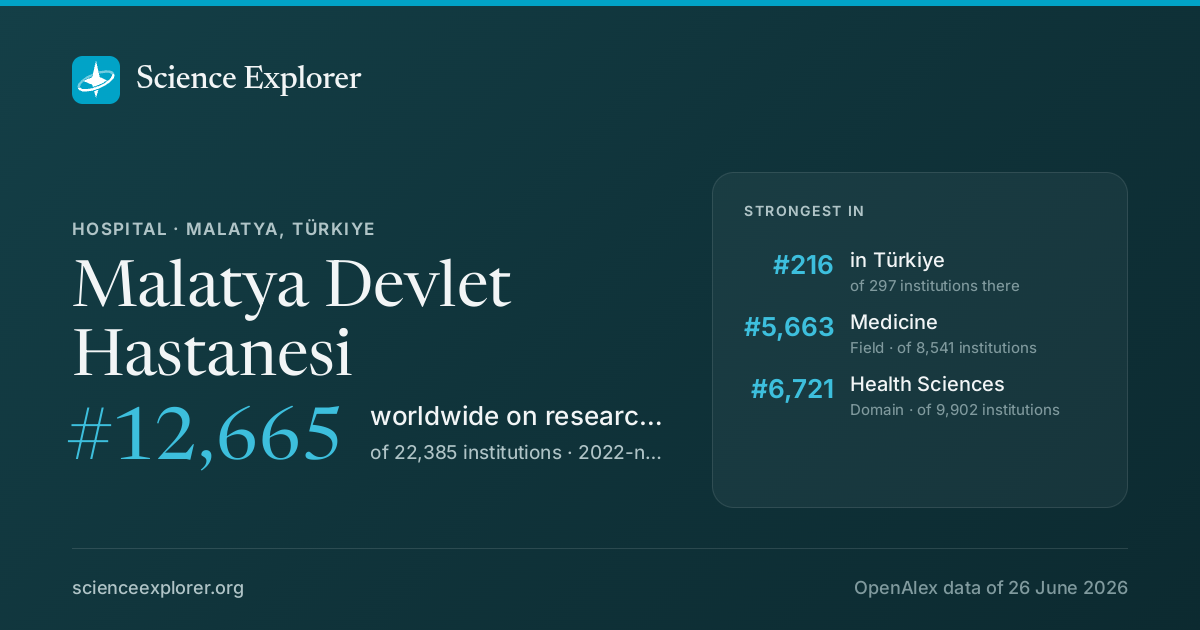
Malatya Devlet Hastanesi on Science Explorer

A card with Malatya Devlet Hastanesi's standing and the fields it leads in, for a post or a slide. A link to this page previews as the same card.

Download the card

1200 × 630 PNG, sized for social posts, drawn from the latest snapshot.

Badges for a website1Each links back here and updates with every snapshot

Research measures only: rankings here say nothing about teaching, admissions or student experience. Comparable institutions and collaboration partners have tabs of their own, above.

Discussion

Ask a question or share a note about Malatya Devlet Hastanesi. Posts are plain text and can be reported.