Science Explorer Back to mapMap
Discussion
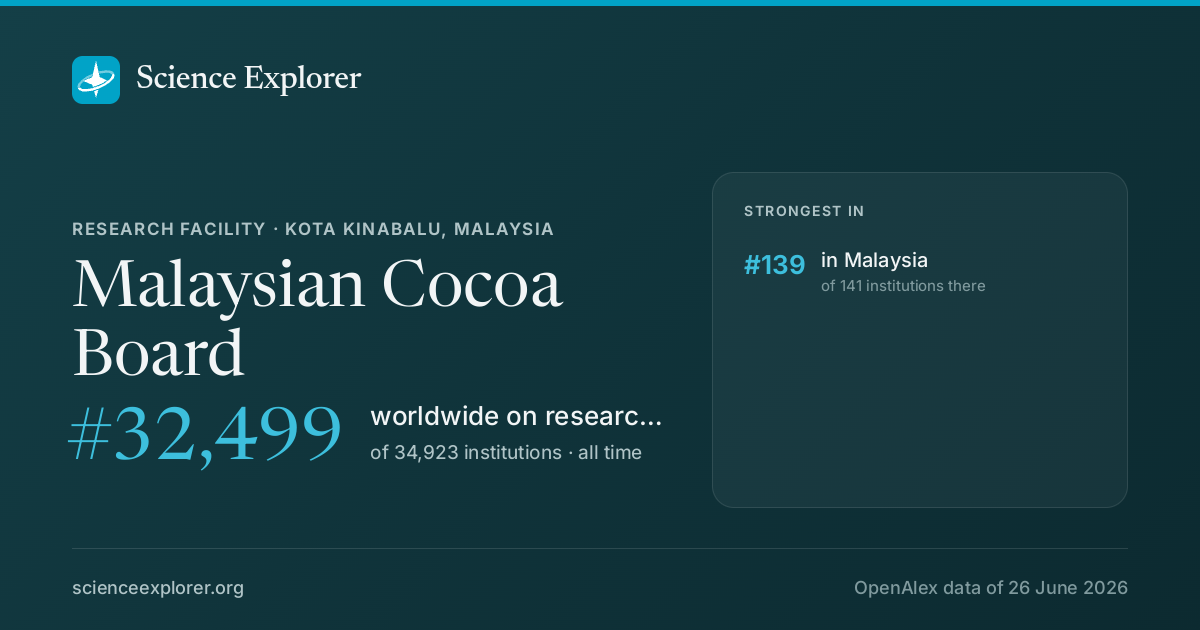
Research facility · Kota Kinabalu · Malaysia

Malaysian Cocoa Board

World rank, all time
#32,499
of 34,923
Rank in Malaysia
#139
of 141
Research works
133
▼ 10% vs 2018-21
Citations
1.6k
12.3 per fractional work
Top-10% rate
7.5%
all institutions 10.0%
vs its own fields
0.89×
1.00× is exactly expected
Open access
63%
world 40%
International
20%
world 18%

Which fields of science does Malaysian Cocoa Board work in?

In 2022-now, 42% of research at Malaysian Cocoa Board is in Life Sciences, 29% in Physical Sciences. Its largest fields are Agricultural and Biological Sciences (35%), Engineering (10%), Business, Management and Accounting (8%). It does 2.4× the world's share of Life Sciences.

Life Sciences: 17 fractional works · 42.1% of its workAgricultural and Biological Sciences: 14 fractional works · 35.2% of its workFood Science: 5 fractional works · 12.2% of its workHorticulture: 3 fractional works · 8.4% of its workPlant Science: 2 fractional works · 4.7% of its workGeneral Agricultural and Biological Sciences: 2 fractional works · 3.7% of its workAgronomy and Crop Science: 1 fractional works · 2.5% of its workInsect Science: 0 fractional works · 1.1% of its workAnimal Science and Zoology: 0 fractional works · 0.8% of its workSoil Science: 0 fractional works · 0.8% of its workAquatic Science: 0 fractional works · 0.4% of its workForestry: 0 fractional works · 0.4% of its workEcology, Evolution, Behavior and Systematics: 0 fractional works · 0.3% of its workBiochemistry, Genetics and Molecular Biology: 2 fractional works · 6.0% of its workMolecular Biology: 1 fractional works · 3.7% of its workMolecular Medicine: 1 fractional works · 1.7% of its workBiotechnology: 0 fractional works · 0.4% of its workCell Biology: 0 fractional works · 0.3% of its workNeuroscience: 0 fractional works · 0.6% of its workCellular and Molecular Neuroscience: 0 fractional works · 0.4% of its workSensory Systems: 0 fractional works · 0.2% of its workPharmacology, Toxicology and Pharmaceutics: 0 fractional works · 0.3% of its workPharmacology: 0 fractional works · 0.3% of its workPhysical Sciences: 12 fractional works · 29.3% of its workEngineering: 4 fractional works · 10.1% of its workBiomedical Engineering: 1 fractional works · 3.4% of its workElectrical and Electronic Engineering: 1 fractional works · 3.4% of its workBuilding and Construction: 0 fractional works · 1.0% of its workIndustrial and Manufacturing Engineering: 0 fractional works · 0.5% of its workAerospace Engineering: 0 fractional works · 0.4% of its workAutomotive Engineering: 0 fractional works · 0.4% of its workMechanics of Materials: 0 fractional works · 0.4% of its workControl and Systems Engineering: 0 fractional works · 0.3% of its workMedia Technology: 0 fractional works · 0.2% of its workEnvironmental Science: 3 fractional works · 7.4% of its workEcology: 1 fractional works · 2.0% of its workPollution: 1 fractional works · 1.7% of its workEnvironmental Engineering: 1 fractional works · 1.6% of its workWater Science and Technology: 0 fractional works · 0.8% of its workEnvironmental Chemistry: 0 fractional works · 0.4% of its workIndustrial and Manufacturing Engineering: 0 fractional works · 0.4% of its workManagement, Monitoring, Policy and Law: 0 fractional works · 0.3% of its workSmaller subfields together: 0 fractional works · 0.1% of its workComputer Science: 2 fractional works · 6.1% of its workArtificial Intelligence: 1 fractional works · 3.5% of its workInformation Systems: 1 fractional works · 2.0% of its workSignal Processing: 0 fractional works · 0.3% of its workComputer Vision and Pattern Recognition: 0 fractional works · 0.2% of its workMaterials Science: 1 fractional works · 2.6% of its workBiomaterials: 1 fractional works · 1.9% of its workMaterials Chemistry: 0 fractional works · 0.4% of its workElectronic, Optical and Magnetic Materials: 0 fractional works · 0.3% of its workChemistry: 1 fractional works · 2.4% of its workAnalytical Chemistry: 0 fractional works · 1.1% of its workInorganic Chemistry: 0 fractional works · 0.8% of its workOrganic Chemistry: 0 fractional works · 0.4% of its workMathematics: 0 fractional works · 0.4% of its workApplied Mathematics: 0 fractional works · 0.4% of its workEnergy: 0 fractional works · 0.4% of its workRenewable Energy, Sustainability and the Environment: 0 fractional works · 0.4% of its workSocial Sciences: 9 fractional works · 21.0% of its workBusiness, Management and Accounting: 3 fractional works · 7.9% of its workStrategy and Management: 1 fractional works · 3.5% of its workOrganizational Behavior and Human Resource Management: 1 fractional works · 1.9% of its workAccounting: 1 fractional works · 1.5% of its workManagement of Technology and Innovation: 0 fractional works · 1.0% of its workSocial Sciences: 3 fractional works · 6.5% of its workEducation: 1 fractional works · 2.6% of its workSociology and Political Science: 1 fractional works · 2.4% of its workPolitical Science and International Relations: 0 fractional works · 0.8% of its workCultural Studies: 0 fractional works · 0.4% of its workHealth: 0 fractional works · 0.3% of its workPsychology: 1 fractional works · 1.9% of its workClinical Psychology: 0 fractional works · 0.6% of its workSocial Psychology: 0 fractional works · 0.6% of its workExperimental and Cognitive Psychology: 0 fractional works · 0.4% of its workDevelopmental and Educational Psychology: 0 fractional works · 0.3% of its workArts and Humanities: 1 fractional works · 1.7% of its workReligious studies: 0 fractional works · 1.1% of its workLanguage and Linguistics: 0 fractional works · 0.3% of its workPhilosophy: 0 fractional works · 0.3% of its workSmaller subfields together: 0 fractional works · 0.0% of its workEconomics, Econometrics and Finance: 1 fractional works · 1.6% of its workFinance: 0 fractional works · 0.8% of its workEconomics and Econometrics: 0 fractional works · 0.6% of its workSmaller subfields together: 0 fractional works · 0.2% of its workDecision Sciences: 1 fractional works · 1.4% of its workManagement Science and Operations Research: 1 fractional works · 1.4% of its workHealth Sciences: 3 fractional works · 7.7% of its workMedicine: 2 fractional works · 5.4% of its workBiochemistry: 1 fractional works · 2.4% of its workEndocrinology, Diabetes and Metabolism: 0 fractional works · 0.8% of its workPulmonary and Respiratory Medicine: 0 fractional works · 0.6% of its workInfectious Diseases: 0 fractional works · 0.4% of its workPathology and Forensic Medicine: 0 fractional works · 0.4% of its workPharmacology: 0 fractional works · 0.4% of its workSmaller subfields together: 0 fractional works · 0.3% of its workNursing: 1 fractional works · 1.3% of its workNutrition and Dietetics: 1 fractional works · 1.3% of its workHealth Professions: 0 fractional works · 0.8% of its workGeneral Health Professions: 0 fractional works · 0.4% of its workEmergency Medical Services: 0 fractional works · 0.3% of its workSmaller subfields together: 0 fractional works · 0.1% of its workDentistry: 0 fractional works · 0.2% of its workPeriodontics: 0 fractional works · 0.2% of its workALL ITS WORKMalaysian CocoaBoard41fractional works, 2022-now
Life Sciences42%Physical Sciences29%Health Sciences8%Social Sciences21%

Each ring splits the one inside it: the four domains of science, their fields, their subfields. Size is fractional works in 2022-now. Every slice is a page; the interactive view zooms down to single topics and colours each by how much more of it this institution does than the world.

Its 4 domains and 21 fields, with their numbers
    1. Agricultural and Biological Sciences1435.2%
    2. Biochemistry, Genetics and Molecular Biology26.0%
    3. Neuroscience00.6%
    4. Pharmacology, Toxicology and Pharmaceutics00.3%
    1. Engineering410.1%
    2. Environmental Science37.4%
    3. Computer Science26.1%
    4. Materials Science12.6%
    5. Chemistry12.4%
    6. Mathematics00.4%
    7. Energy00.4%
    1. Business, Management and Accounting37.9%
    2. Social Sciences36.5%
    3. Psychology11.9%
    4. Arts and Humanities11.7%
    5. Economics, Econometrics and Finance11.6%
    6. Decision Sciences11.4%
    1. Medicine25.4%
    2. Nursing11.3%
    3. Health Professions00.8%
    4. Dentistry00.2%
All of science, and how each field's share has moved since 1950: the Science domain explorer

Field profile

Location quotient across every field it publishes in: outside the ring is more than an institution of this size would be expected to publish, inside it is less.

Agricultural and Biological Sciences: 7.41× its world share, 14 worksAgricultural and Bio…Biochemistry, Genetics and Molecular Biology: 1.12× its world share, 2 worksBiochemistry, Geneti…Neuroscience: 0.38× its world share, 0 worksNeurosciencePharmacology, Toxicology and Pharmaceutics: 0.78× its world share, 0 worksPharmacology, Toxico…Chemistry: 1.51× its world share, 1 worksChemistryComputer Science: 0.78× its world share, 2 worksComputer ScienceEnergy: 0.40× its world share, 0 worksEnergyEngineering: 0.67× its world share, 4 worksEngineeringEnvironmental Science: 1.48× its world share, 3 worksEnvironmental ScienceMaterials Science: 0.74× its world share, 1 worksMaterials ScienceMathematics: 0.35× its world share, 0 worksMathematicsDentistry: 0.42× its world share, 0 worksDentistryHealth Professions: 0.30× its world share, 0 worksHealth ProfessionsMedicine: 0.28× its world share, 2 worksMedicineNursing: 2.57× its world share, 0 worksNursingArts and Humanities: 0.57× its world share, 1 worksArts and HumanitiesBusiness, Management and Accounting: 2.46× its world share, 3 worksBusiness, Management…Decision Sciences: 1.45× its world share, 1 worksDecision SciencesEconomics, Econometrics and Finance: 0.75× its world share, 1 worksEconomics, Econometr…Psychology: 0.63× its world share, 1 worksPsychologySocial Sciences: 0.51× its world share, 3 worksSocial Sciences1×world share
more than its size predictsabout as predictedless

Rings at 0.5×, 1× and 2×. Widest outward: Agricultural and Biological Sciences, 7.4×. Every wedge is a field page.

All 21 fields, with their numbers
  1. Agricultural and Biological Sciences7.41×14 works
  2. Nursing2.57×0 works
  3. Business, Management and Accounting2.46×3 works
  4. Chemistry1.51×1 works
  5. Environmental Science1.48×3 works
  6. Decision Sciences1.45×1 works
  7. Biochemistry, Genetics and Molecular Biology1.12×2 works
  8. Pharmacology, Toxicology and Pharmaceutics0.78×0 works
  9. Computer Science0.78×2 works
  10. Economics, Econometrics and Finance0.75×1 works
  11. Materials Science0.74×1 works
  12. Engineering0.67×4 works
  13. Psychology0.63×1 works
  14. Arts and Humanities0.57×1 works
  15. Social Sciences0.51×3 works
  16. Dentistry0.42×0 works
  17. Energy0.40×0 works
  18. Neuroscience0.38×0 works
  19. Mathematics0.35×0 works
  20. Health Professions0.30×0 works
  21. Medicine0.28×2 works

Who are the top researchers at Malaysian Cocoa Board?

Ranked on the quality score, Badrul Hisyam Zainudin, Choy Yuen Khew and I. Virdiana lead among researchers whose main affiliation is Malaysian Cocoa Board.

  1. 1 Badrul Hisyam Zainudin Malaysia · #1,961,212 worldwide 604 citations · 21 works
  2. 2 Choy Yuen Khew Malaysia · #2,314,152 worldwide 378 citations · 16 works
  3. 3 I. Virdiana Malaysia · #4,405,020 worldwide 80 citations · 16 works
  4. 4 Saripah Binti Bakar Malaysia · #4,682,906 worldwide 16 citations · 15 works
All ranked researchers at Malaysian Cocoa Board

What are the most cited papers from Malaysian Cocoa Board?

The most cited paper from Malaysian Cocoa Board is "Phenolic composition, antioxidant, anti-wrinkles and tyrosinase inhibitory activities of cocoa pod extract" (Azila Abdul Karim, Azrina Azlan, Amin Ismail et al., 2014), with 177 citations. Next come "Thin layer drying kinetics of cocoa and dried product quality" (134) and "Cocoa (Theobroma cacao) shell-based activated carbon by CO2 activation in removing of Cationic dye from aqueous solution: Kinetics and equilibrium studies" (117).

Most cited papers
#PaperReleasedCitations
1 Phenolic composition, antioxidant, anti-wrinkles and tyrosinase inhibitory activities of cocoa pod extract Azila Abdul Karim, Azrina Azlan, Amin Ismail et al. · BMC Complementary and Alternative Medicine Open access 7 Oct 2014 177
2 Thin layer drying kinetics of cocoa and dried product quality Ching Lik Hii, Chung Lim Law, Michael Cloke et al. · Biosystems Engineering 7 Dec 2008 134
3 Cocoa (Theobroma cacao) shell-based activated carbon by CO2 activation in removing of Cationic dye from aqueous solution: Kinetics and equilibrium studies Fisal Ahmad, Wan Mohd Ashri Wan Daud, Mohd Azmier Ahmad et al. · Process Safety and Environmental Protection 6 Feb 2012 117
4 Method validation and determination of heavy metals in cocoa beans and cocoa products by microwave assisted digestion technique with inductively coupled plasma mass spectrometry Rahmat Mohamed, Badrul Hisyam Zainudin, Abdul Syukor Yaakob · Food Chemistry 20 Aug 2019 109
5 In Vitro Antioxidant and Antiproliferative Activities of Methanolic Plant Part Extracts of Theobroma cacao Zainal Baharum, Abdah Md Akim, Yun Hin Taufiq‐Yap et al. · Molecules Open access 10 Nov 2014 102
All 62 most cited papers, with filters and sorting

Which keywords describe research at Malaysian Cocoa Board?

By fractional works in 2022-now, weighted toward what it does more of than the world: Genetic Diversity, Biodiversity Conservation, Agroforestry, Soil Fertility, Ecosystem Services, Cacao, Climate Change Resilience and Polyphenols.

▲ more of its work than of the world's◆ about the world's share▼ less than the world's

Size is fractional works in 2022-now in the topics tagged with each word; colour is the word's share of this institution's work against its share of the world's. The 40 words are chosen for being large and distinctive. Each links to the topic it comes from most.

All 40 words, with their numbers
  1. Genetic Diversity4▲ 21×2 topics
  2. Agroforestry4▲ 131×2 topics
  3. Biodiversity Conservation4▲ 24×3 topics
  4. Soil Fertility4▲ 39×2 topics
  5. Ecosystem Services4▲ 22×2 topics
  6. Cacao3▲ 599×1 topic
  7. Climate Change Resilience3▲ 139×1 topic
  8. Polyphenols3▲ 42×4 topics
  9. Biomedical Applications3▲ 5.8×10 topics
  10. Antioxidant Activity2▲ 9.2×9 topics
  11. Fermentation2▲ 42×2 topics
  12. Chocolate2▲ 266×1 topic
  13. Cocoa2▲ 266×1 topic
  14. Environmental Impact2▲ 2.7×9 topics
  15. Machine Learning2▲ 1.44×5 topics
  16. Antioxidants2▲ 10×5 topics
  17. Health Benefits2▲ 13×7 topics
  18. Supply Chain Management2▲ 4.9×5 topics
  19. Sustainable Agriculture2▲ 14×4 topics
  20. Corporate Governance2▲ 5.4×4 topics
  21. Oxidative Stress2▲ 2.2×4 topics
  22. Hydrocolloids1▲ 45×2 topics
  23. Sustainability1▲ 1.41×10 topics
  24. Rhizosphere Interactions1▲ 36×2 topics
  25. Climate Change1◆ 1.09×7 topics
  26. Customer Satisfaction1▲ 9.0×2 topics
  27. Nitrogen Fixation1▲ 41×2 topics
  28. Risk Management1▲ 6.3×3 topics
  29. Smallholder Farmers1▲ 14×4 topics
  30. Social Capital1▲ 5.5×3 topics
  31. Cancer Prevention1▲ 11×3 topics
  32. Flavonoids1▲ 10×4 topics
  33. Food Security1▲ 5.0×5 topics
  34. Lipid Oxidation1▲ 27×2 topics
  35. Nanoparticles1▲ 2.2×5 topics
  36. Tissue Engineering1▲ 4.5×4 topics
  37. Agricultural Productivity1▲ 91×1 topic
  38. Innovation1▲ 2.4×2 topics
  39. Intercropping1▲ 91×1 topic
  40. Molecular Structure1▲ 24×2 topics

Which research topics does Malaysian Cocoa Board publish most on?

By volume in 2022-now: Cocoa and Sweet Potato Agronomy, Food Chemistry and Fat Analysis, Agronomic Practices and Intercropping Systems and Organizational and Employee Performance.

  1. 1 Cocoa and Sweet Potato Agronomy Horticulture 3 works
  2. 2 Food Chemistry and Fat Analysis Food Science 2 works
  3. 3 Agronomic Practices and Intercropping Systems Agronomy and Crop Science 1 works
  4. 4 Organizational and Employee Performance Artificial Intelligence 1 works
  5. 5 Proteins in Food Systems Food Science 1 works
  6. 6 Family Business Performance and Succession Organizational Behavior and Human Resource Management 1 works
  7. 7 Hydrogels: synthesis, properties, applications Molecular Medicine 1 works
  8. 8 Polysaccharides Composition and Applications Food Science 1 works
  9. 9 Construction Project Management and Performance Management Science and Operations Research 1 works
  10. 10 Oil Palm Production and Sustainability Ecology 1 works

How open and international is its research?

Against the world's own shares: the tick on each track. Both are shares of its output, so they sit on one scale and can be read against each other as well as against the world.

openly available63.0%not open37.0%

World: 40% of research is openly available.

with international co-authors20.4%domestic only79.6%

World: 18% is written across borders.

How has Malaysian Cocoa Board's research output changed?

Output in 2022-2025 was 10% lower than in 2018-2021.

still counting1990200020102020
grewheldshrank

The same series as a ribbon: one cell per year, darker for more. The line above answers how much; this answers when.

Its share of all research

Growing output can still be a shrinking share: all of science grows. This is Malaysian Cocoa Board as a percentage of every work published that year, 0.00016% in 2024.

still counting0.00020%0.00040%Malaysian Cocoa Board0.00019% in 20251990200020102020

Fractional works of Malaysian Cocoa Board over all fractional works that year. How the balance of science has shifted.

Other research institutions in Kota Kinabalu

All research institutions in Kota Kinabalu

Share Malaysian Cocoa Board's ranking

Malaysian Cocoa Board on Science Explorer

A card with Malaysian Cocoa Board's standing and the fields it leads in, for a post or a slide. A link to this page previews as the same card.

Download the card

1200 × 630 PNG, sized for social posts, drawn from the latest snapshot.

Badges for a website1Each links back here and updates with every snapshot

Research measures only: rankings here say nothing about teaching, admissions or student experience. Comparable institutions and collaboration partners have tabs of their own, above.

Discussion

Ask a question or share a note about Malaysian Cocoa Board. Posts are plain text and can be reported.