Science Explorer Back to mapMap
Discussion
Company · Markham · Canada

MD Precision (Canada)

World rank, 2022-now
#17,559
of 22,385 · #28,223 all time
Rank in Canada
#240
of 305
Research works
146
▲ 648% vs 2018-21
Citations
657
4.5 per fractional work
Top-10% rate
9.9%
all institutions 10.0%
vs its own fields
1.02×
1.00× is exactly expected
Open access
49%
world 40%
International
84%
world 18%

Which fields of science does MD Precision (Canada) work in?

In 2022-now, 69% of research at MD Precision (Canada) is in Physical Sciences, 17% in Health Sciences. Its largest fields are Engineering (50%), Medicine (16%), Materials Science (9%). It does 1.7× the world's share of Physical Sciences.

Physical Sciences: 77 fractional works · 69.0% of its workEngineering: 56 fractional works · 50.3% of its workMechanical Engineering: 18 fractional works · 16.1% of its workMechanics of Materials: 7 fractional works · 6.4% of its workElectrical and Electronic Engineering: 7 fractional works · 6.4% of its workControl and Systems Engineering: 6 fractional works · 5.0% of its workBiomedical Engineering: 4 fractional works · 3.6% of its workAerospace Engineering: 4 fractional works · 3.3% of its workCivil and Structural Engineering: 3 fractional works · 2.5% of its workComputational Mechanics: 2 fractional works · 2.1% of its workIndustrial and Manufacturing Engineering: 2 fractional works · 2.0% of its workAutomotive Engineering: 2 fractional works · 1.8% of its workOcean Engineering: 1 fractional works · 0.9% of its workMedia Technology: 0 fractional works · 0.2% of its workMaterials Science: 10 fractional works · 8.9% of its workMaterials Chemistry: 7 fractional works · 6.2% of its workElectronic, Optical and Magnetic Materials: 1 fractional works · 0.9% of its workBiomaterials: 1 fractional works · 0.6% of its workGeneral Materials Science: 0 fractional works · 0.4% of its workPolymers and Plastics: 0 fractional works · 0.4% of its workCeramics and Composites: 0 fractional works · 0.3% of its workSmaller subfields together: 0 fractional works · 0.1% of its workComputer Science: 5 fractional works · 4.8% of its workArtificial Intelligence: 2 fractional works · 1.6% of its workComputer Vision and Pattern Recognition: 1 fractional works · 1.0% of its workInformation Systems: 1 fractional works · 0.9% of its workComputer Networks and Communications: 1 fractional works · 0.6% of its workComputational Theory and Mathematics: 0 fractional works · 0.2% of its workSmaller subfields together: 0 fractional works · 0.4% of its workPhysics and Astronomy: 2 fractional works · 1.9% of its workAtomic and Molecular Physics, and Optics: 1 fractional works · 1.0% of its workAstronomy and Astrophysics: 0 fractional works · 0.4% of its workCondensed Matter Physics: 0 fractional works · 0.3% of its workSmaller subfields together: 0 fractional works · 0.1% of its workChemistry: 1 fractional works · 0.9% of its workOrganic Chemistry: 1 fractional works · 0.6% of its workSmaller subfields together: 0 fractional works · 0.3% of its workMathematics: 1 fractional works · 0.9% of its workStatistics and Probability: 1 fractional works · 0.9% of its workEarth and Planetary Sciences: 1 fractional works · 0.5% of its workOceanography: 0 fractional works · 0.3% of its workGeophysics: 0 fractional works · 0.3% of its workEnvironmental Science: 1 fractional works · 0.5% of its workEcological Modeling: 0 fractional works · 0.3% of its workSmaller subfields together: 0 fractional works · 0.2% of its workChemical Engineering: 0 fractional works · 0.3% of its workEnergy: 0 fractional works · 0.0% of its workHealth Sciences: 19 fractional works · 17.5% of its workMedicine: 18 fractional works · 16.4% of its workEpidemiology: 3 fractional works · 2.9% of its workOncology: 3 fractional works · 2.3% of its workHematology: 1 fractional works · 1.2% of its workRadiology, Nuclear Medicine and Imaging: 1 fractional works · 1.2% of its workOphthalmology: 1 fractional works · 1.1% of its workGenetics: 1 fractional works · 0.9% of its workOtorhinolaryngology: 1 fractional works · 0.8% of its workSurgery: 1 fractional works · 0.8% of its workPulmonary and Respiratory Medicine: 1 fractional works · 0.6% of its workPathology and Forensic Medicine: 1 fractional works · 0.6% of its workObstetrics and Gynecology: 1 fractional works · 0.6% of its workPharmacology: 0 fractional works · 0.4% of its workInfectious Diseases: 0 fractional works · 0.4% of its workCardiology and Cardiovascular Medicine: 0 fractional works · 0.4% of its workPhysiology: 0 fractional works · 0.3% of its workDermatology: 0 fractional works · 0.3% of its workNephrology: 0 fractional works · 0.3% of its workGastroenterology: 0 fractional works · 0.2% of its workSmaller subfields together: 1 fractional works · 1.1% of its workHealth Professions: 1 fractional works · 0.5% of its workHealth Information Management: 0 fractional works · 0.2% of its workSmaller subfields together: 0 fractional works · 0.2% of its workDentistry: 0 fractional works · 0.4% of its workVeterinary: 0 fractional works · 0.1% of its workLife Sciences: 9 fractional works · 8.5% of its workBiochemistry, Genetics and Molecular Biology: 4 fractional works · 4.0% of its workMolecular Biology: 3 fractional works · 2.5% of its workCancer Research: 1 fractional works · 0.5% of its workGenetics: 0 fractional works · 0.3% of its workBiotechnology: 0 fractional works · 0.2% of its workMolecular Medicine: 0 fractional works · 0.2% of its workSmaller subfields together: 0 fractional works · 0.3% of its workImmunology and Microbiology: 3 fractional works · 2.9% of its workImmunology: 3 fractional works · 2.6% of its workMicrobiology: 0 fractional works · 0.2% of its workSmaller subfields together: 0 fractional works · 0.1% of its workAgricultural and Biological Sciences: 1 fractional works · 1.0% of its workFood Science: 1 fractional works · 0.7% of its workPlant Science: 0 fractional works · 0.4% of its workNeuroscience: 1 fractional works · 0.5% of its workNeurology: 0 fractional works · 0.3% of its workSmaller subfields together: 0 fractional works · 0.2% of its workPharmacology, Toxicology and Pharmaceutics: 0 fractional works · 0.1% of its workSocial Sciences: 6 fractional works · 5.1% of its workEconomics, Econometrics and Finance: 2 fractional works · 2.0% of its workEconomics and Econometrics: 2 fractional works · 2.0% of its workSocial Sciences: 1 fractional works · 1.1% of its workHealth: 0 fractional works · 0.3% of its workGeneral Social Sciences: 0 fractional works · 0.3% of its workSociology and Political Science: 0 fractional works · 0.3% of its workSmaller subfields together: 0 fractional works · 0.2% of its workBusiness, Management and Accounting: 1 fractional works · 1.0% of its workManagement of Technology and Innovation: 0 fractional works · 0.4% of its workStrategy and Management: 0 fractional works · 0.4% of its workSmaller subfields together: 0 fractional works · 0.2% of its workDecision Sciences: 1 fractional works · 0.5% of its workStatistics, Probability and Uncertainty: 0 fractional works · 0.4% of its workSmaller subfields together: 0 fractional works · 0.2% of its workArts and Humanities: 0 fractional works · 0.3% of its workMuseology: 0 fractional works · 0.3% of its workPsychology: 0 fractional works · 0.2% of its workALL ITS WORKMD Precision(Canada)112fractional works, 2022-now
Life Sciences9%Physical Sciences69%Health Sciences17%Social Sciences5%

Each ring splits the one inside it: the four domains of science, their fields, their subfields. Size is fractional works in 2022-now. Every slice is a page; the interactive view zooms down to single topics and colours each by how much more of it this institution does than the world.

Its 4 domains and 25 fields, with their numbers
    1. Engineering5650.3%
    2. Materials Science108.9%
    3. Computer Science54.8%
    4. Physics and Astronomy21.9%
    5. Chemistry10.9%
    6. Mathematics10.9%
    7. Earth and Planetary Sciences10.5%
    8. Environmental Science10.5%
    9. Chemical Engineering00.3%
    10. Energy00.0%
    1. Medicine1816.4%
    2. Health Professions10.5%
    3. Dentistry00.4%
    4. Veterinary00.1%
    1. Biochemistry, Genetics and Molecular Biology44.0%
    2. Immunology and Microbiology32.9%
    3. Agricultural and Biological Sciences11.0%
    4. Neuroscience10.5%
    5. Pharmacology, Toxicology and Pharmaceutics00.1%
    1. Economics, Econometrics and Finance22.0%
    2. Social Sciences11.1%
    3. Business, Management and Accounting11.0%
    4. Decision Sciences10.5%
    5. Arts and Humanities00.3%
    6. Psychology00.2%
All of science, and how each field's share has moved since 1950: the Science domain explorer

Field profile

Location quotient across every field it publishes in: outside the ring is more than an institution of this size would be expected to publish, inside it is less.

Agricultural and Biological Sciences: 0.22× its world share, 1 worksAgricultural and Bio…Biochemistry, Genetics and Molecular Biology: 0.75× its world share, 4 worksBiochemistry, Geneti…Immunology and Microbiology: 2.89× its world share, 3 worksImmunology and Micro…Neuroscience: 0.29× its world share, 0 worksNeurosciencePharmacology, Toxicology and Pharmaceutics: 0.33× its world share, 0 worksPharmacology, Toxico…Chemical Engineering: 0.78× its world share, 0 worksChemical EngineeringChemistry: 0.57× its world share, 1 worksChemistryComputer Science: 0.62× its world share, 5 worksComputer ScienceEarth and Planetary Sciences: 0.33× its world share, 1 worksEarth and Planetary …Energy: 0.04× its world share, 0 worksEnergyEngineering: 3.35× its world share, 56 worksEngineeringEnvironmental Science: 0.09× its world share, 0 worksEnvironmental ScienceMaterials Science: 2.55× its world share, 10 worksMaterials ScienceMathematics: 0.75× its world share, 1 worksMathematicsPhysics and Astronomy: 0.84× its world share, 2 worksPhysics and AstronomyDentistry: 0.92× its world share, 0 worksDentistryHealth Professions: 0.18× its world share, 0 worksHealth ProfessionsMedicine: 0.86× its world share, 18 worksMedicineVeterinary: 0.73× its world share, 0 worksVeterinaryArts and Humanities: 0.10× its world share, 0 worksArts and HumanitiesBusiness, Management and Accounting: 0.32× its world share, 1 worksBusiness, Management…Decision Sciences: 0.56× its world share, 1 worksDecision SciencesEconomics, Econometrics and Finance: 0.92× its world share, 2 worksEconomics, Econometr…Psychology: 0.05× its world share, 0 worksPsychologySocial Sciences: 0.08× its world share, 1 worksSocial Sciences1×world share
more than its size predictsabout as predictedless

Rings at 0.5×, 1× and 2×. Widest outward: Engineering, 3.4×. Every wedge is a field page.

All 25 fields, with their numbers
  1. Engineering3.35×56 works
  2. Immunology and Microbiology2.89×3 works
  3. Materials Science2.55×10 works
  4. Dentistry0.92×0 works
  5. Economics, Econometrics and Finance0.92×2 works
  6. Medicine0.86×18 works
  7. Physics and Astronomy0.84×2 works
  8. Chemical Engineering0.78×0 works
  9. Biochemistry, Genetics and Molecular Biology0.75×4 works
  10. Mathematics0.75×1 works
  11. Veterinary0.73×0 works
  12. Computer Science0.62×5 works
  13. Chemistry0.57×1 works
  14. Decision Sciences0.56×1 works
  15. Pharmacology, Toxicology and Pharmaceutics0.33×0 works
  16. Earth and Planetary Sciences0.33×1 works
  17. Business, Management and Accounting0.32×1 works
  18. Neuroscience0.29×0 works
  19. Agricultural and Biological Sciences0.22×1 works
  20. Health Professions0.18×0 works
  21. Arts and Humanities0.10×0 works
  22. Environmental Science0.09×0 works
  23. Social Sciences0.08×1 works
  24. Psychology0.05×0 works
  25. Energy0.04×0 works

Who are the top researchers at MD Precision (Canada)?

Ranked on the quality score, Takao Itō lead among researchers whose main affiliation is MD Precision (Canada).

  1. 1 Takao Itō Canada · #4,239,153 worldwide 4 citations · 16 works
All ranked researchers at MD Precision (Canada)

What are the most cited papers from MD Precision (Canada)?

The most cited paper from MD Precision (Canada) is "Effects of Field of View and Visual Complexity on Virtual Reality Training Effectiveness for a Visual Scanning Task" (Eric D. Ragan, Doug A. Bowman, Régis Kopper et al., 2015), with 254 citations. Next come "Cardiovascular events and all‐cause mortality associated with sulphonylureas compared with other antihyperglycaemic drugs: A B ayesian meta‐analysis of survival data" (133) and "Effects of Confounding Bias in Coronavirus Disease 2019 (COVID-19) and Influenza Vaccine Effectiveness Test-Negative Designs Due to Correlated Influenza and COVID-19 Vaccination Behaviors" (126).

Most cited papers
#PaperReleasedCitations
1 Effects of Field of View and Visual Complexity on Virtual Reality Training Effectiveness for a Visual Scanning Task Eric D. Ragan, Doug A. Bowman, Régis Kopper et al. · IEEE Transactions on Visualization and Computer Graphics Open access 13 Feb 2015 254
2 Cardiovascular events and all‐cause mortality associated with sulphonylureas compared with other antihyperglycaemic drugs: A B ayesian meta‐analysis of survival data Steve Bain, Eric Druyts, Chakrapani Balijepalli et al. · Diabetes Obesity and Metabolism Open access 16 Nov 2016 133
3 Effects of Confounding Bias in Coronavirus Disease 2019 (COVID-19) and Influenza Vaccine Effectiveness Test-Negative Designs Due to Correlated Influenza and COVID-19 Vaccination Behaviors Margaret K. Doll, Stacy Pettigrew, Julia Ma et al. · Clinical Infectious Diseases Open access 23 Mar 2022 126
4 Strength Tracking Using the OMNI Resistance Exercise Scale in Older Men and Women Randall F. Gearhart, Kristen M. Lagally, Steven E. Riechman et al. · The Journal of Strength and Conditioning Research May 2009 114
5 Design and modeling of a novel three dimensional auxetic reentrant honeycomb structure for energy absorption Suian Wang, Chuang Deng, Olanrewaju Akanbi Ojo et al. · Composite Structures 28 Oct 2021 97
All 67 most cited papers, with filters and sorting

Which keywords describe research at MD Precision (Canada)?

By fractional works in 2022-now, weighted toward what it does more of than the world: Mechanical Properties, Microstructure, Microstructural Evolution, Constitutive Modeling, Vibration Analysis, Additive Manufacturing, Phase Stability and Thermal Decomposition.

▲ more of its work than of the world's◆ about the world's share▼ less than the world's

Size is fractional works in 2022-now in the topics tagged with each word; colour is the word's share of this institution's work against its share of the world's. The 40 words are chosen for being large and distinctive. Each links to the topic it comes from most.

All 40 words, with their numbers
  1. Mechanical Properties10▲ 8.8×17 topics
  2. Microstructure8▲ 14×11 topics
  3. Deep Learning5▲ 1.23×21 topics
  4. Microstructural Evolution4▲ 26×4 topics
  5. Constitutive Modeling3▲ 46×2 topics
  6. Vibration Analysis3▲ 11×5 topics
  7. Additive Manufacturing3▲ 8.3×6 topics
  8. Phase Stability3▲ 37×2 topics
  9. Thermal Decomposition2▲ 51×2 topics
  10. Artificial Neural Networks2▲ 4.7×4 topics
  11. Tool Wear2▲ 17×3 topics
  12. Metamaterials2▲ 14×3 topics
  13. High-Entropy Alloys2▲ 39×1 topic
  14. Metal Nanoparticles2▲ 13×3 topics
  15. Multi-Component Alloys2▲ 39×1 topic
  16. Ionic Liquids2▲ 6.6×3 topics
  17. Material Characterization2▲ 16×2 topics
  18. Nonlinear Dynamics2▲ 8.5×3 topics
  19. Energetic Salts2▲ 69×1 topic
  20. ReaxFF2▲ 69×1 topic
  21. Thin Films2▲ 8.8×6 topics
  22. Cancer Immunotherapy2▲ 11×3 topics
  23. Composite Materials2▲ 7.7×4 topics
  24. Dynamic Recrystallization2▲ 42×1 topic
  25. Hot Deformation2▲ 42×1 topic
  26. Process Parameters2▲ 15×3 topics
  27. Gear Dynamics2▲ 49×1 topic
  28. Mesh Stiffness2▲ 49×1 topic
  29. Sintering2▲ 12×4 topics
  30. Corrosion Resistance2▲ 20×4 topics
  31. Dynamic Deformation2▲ 53×1 topic
  32. Finite Element Analysis2▲ 6.5×2 topics
  33. High Strain Rate2▲ 53×1 topic
  34. Metallic Components2▲ 22×1 topic
  35. Microstructure Evolution2▲ 19×4 topics
  36. Neural Network2▲ 8.0×4 topics
  37. Selective Laser Melting2▲ 22×1 topic
  38. Grain Refinement2▲ 11×4 topics
  39. Virtual Prototyping2▲ 16×2 topics
  40. Surface Roughness1▲ 9.6×3 topics

Which research topics does MD Precision (Canada) publish most on?

By volume in 2022-now: High Entropy Alloys Studies, Energetic Materials and Combustion, Metallurgy and Material Forming and Gear and Bearing Dynamics Analysis.

  1. 1 High Entropy Alloys Studies Mechanical Engineering 2 works
  2. 2 Energetic Materials and Combustion Mechanics of Materials 2 works
  3. 3 Metallurgy and Material Forming Mechanics of Materials 2 works
  4. 4 Gear and Bearing Dynamics Analysis Mechanical Engineering 2 works
  5. 5 Additive Manufacturing Materials and Processes Mechanical Engineering 2 works
  6. 6 High-Velocity Impact and Material Behavior Materials Chemistry 2 works
  7. 7 Terahertz technology and applications Electrical and Electronic Engineering 1 works
  8. 8 Health Systems, Economic Evaluations, Quality of Life Economics and Econometrics 1 works
  9. 9 Respiratory viral infections research Epidemiology 1 works
  10. 10 Mechanical Failure Analysis and Simulation Mechanical Engineering 1 works

How open and international is its research?

Against the world's own shares: the tick on each track. Both are shares of its output, so they sit on one scale and can be read against each other as well as against the world.

openly available49.2%not open50.8%

World: 40% of research is openly available.

with international co-authors84.1%domestic only15.9%

World: 18% is written across borders.

How has MD Precision (Canada)'s research output changed?

Output in 2022-2025 was 648% higher than in 2018-2021.

still counting1990200020102020
grewheldshrank

The same series as a ribbon: one cell per year, darker for more. The line above answers how much; this answers when.

Its share of all research

Growing output can still be a shrinking share: all of science grows. This is MD Precision (Canada) as a percentage of every work published that year, 0.00041% in 2024.

still counting0.00050%0.0010%MD Precision (Canada)0.00075% in 202519801990200020102020

Fractional works of MD Precision (Canada) over all fractional works that year. How the balance of science has shifted.

Other research institutions in Markham

All research institutions in Markham

Share MD Precision (Canada)'s ranking

MD Precision (Canada) on Science Explorer

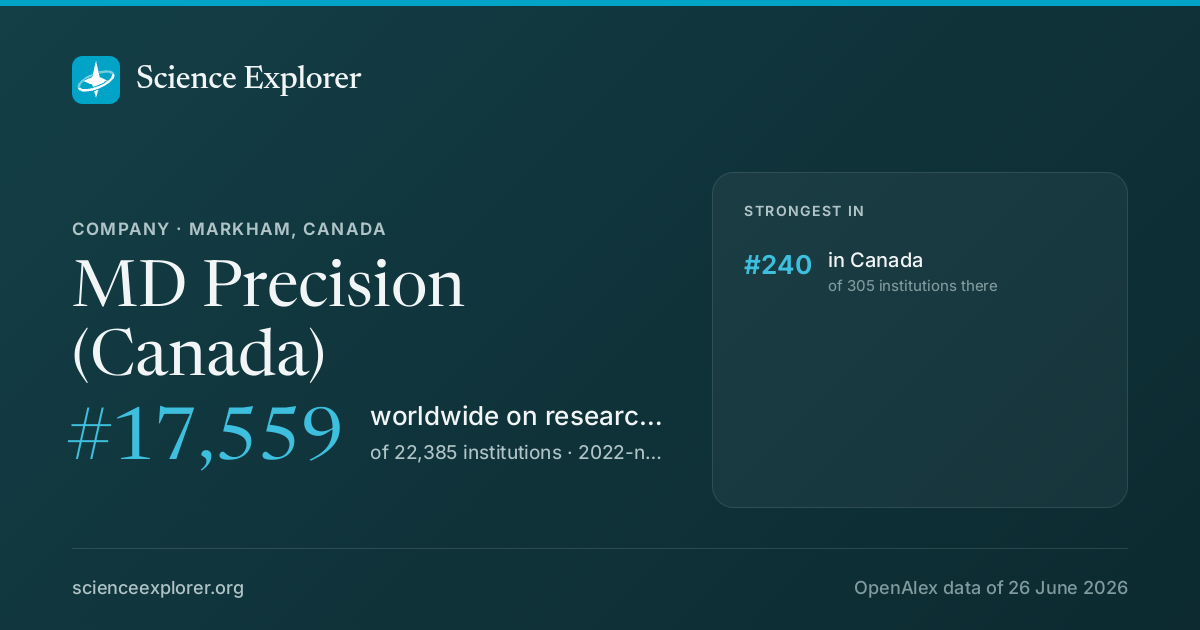
A card with MD Precision (Canada)'s standing and the fields it leads in, for a post or a slide. A link to this page previews as the same card.

Download the card

1200 × 630 PNG, sized for social posts, drawn from the latest snapshot.

Badges for a website1Each links back here and updates with every snapshot

Research measures only: rankings here say nothing about teaching, admissions or student experience. Comparable institutions and collaboration partners have tabs of their own, above.

Discussion

Ask a question or share a note about MD Precision (Canada). Posts are plain text and can be reported.