Science Explorer Back to mapMap
Institution · Szczecin · Poland

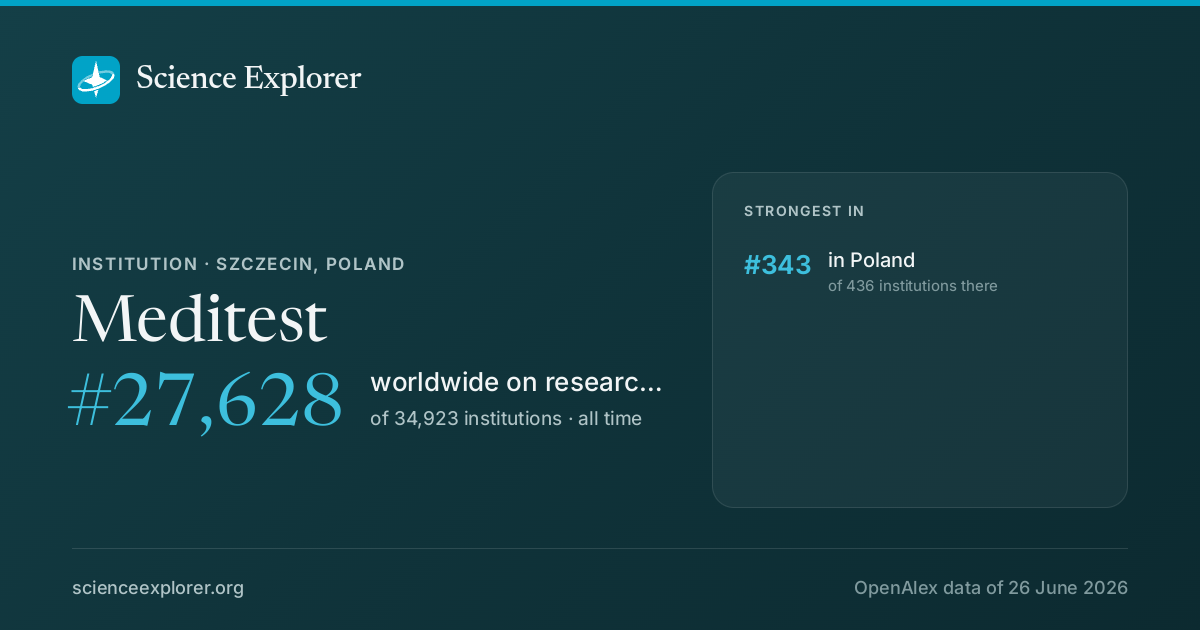
Meditest

World rank, all time
#27,628
of 34,923
Rank in Poland
#343
of 436
Research works
202
▼ 34% vs 2018-21
Citations
618
3.1 per fractional work
Top-10% rate
4.8%
all institutions 10.0%
vs its own fields
0.84×
1.00× is exactly expected
Open access
49%
world 40%
International
18%
world 18%

Which fields of science does Meditest work in?

In 2022-now, 62% of research at Meditest is in Health Sciences, 14% in Life Sciences. Its largest fields are Medicine (54%), Health Professions (8%), Biochemistry, Genetics and Molecular Biology (7%). It does 2.2× the world's share of Health Sciences.

Health Sciences: 18 fractional works · 62.2% of its workMedicine: 15 fractional works · 53.9% of its workRadiology, Nuclear Medicine and Imaging: 2 fractional works · 6.2% of its workPhysiology: 2 fractional works · 5.4% of its workSurgery: 2 fractional works · 5.4% of its workPharmacology: 1 fractional works · 4.3% of its workPediatrics, Perinatology and Child Health: 1 fractional works · 3.8% of its workCardiology and Cardiovascular Medicine: 1 fractional works · 3.6% of its workPublic Health, Environmental and Occupational Health: 1 fractional works · 3.5% of its workRheumatology: 1 fractional works · 3.4% of its workEndocrinology, Diabetes and Metabolism: 1 fractional works · 2.7% of its workDermatology: 1 fractional works · 2.1% of its workInfectious Diseases: 1 fractional works · 1.9% of its workEpidemiology: 1 fractional works · 1.8% of its workPulmonary and Respiratory Medicine: 0 fractional works · 1.6% of its workOncology: 0 fractional works · 1.2% of its workOrthopedics and Sports Medicine: 0 fractional works · 1.2% of its workHematology: 0 fractional works · 0.7% of its workOphthalmology: 0 fractional works · 0.6% of its workReproductive Medicine: 0 fractional works · 0.6% of its workNeurology: 0 fractional works · 0.6% of its workUrology: 0 fractional works · 0.5% of its workGenetics: 0 fractional works · 0.5% of its workObstetrics and Gynecology: 0 fractional works · 0.5% of its workNephrology: 0 fractional works · 0.4% of its workRehabilitation: 0 fractional works · 0.4% of its workComplementary and alternative medicine: 0 fractional works · 0.3% of its workEmergency Medicine: 0 fractional works · 0.3% of its workAnesthesiology and Pain Medicine: 0 fractional works · 0.2% of its workSmaller subfields together: 0 fractional works · 0.4% of its workHealth Professions: 2 fractional works · 7.8% of its workGeneral Health Professions: 1 fractional works · 2.6% of its workOccupational Therapy: 1 fractional works · 2.1% of its workSpeech and Hearing: 0 fractional works · 1.8% of its workPharmacy: 0 fractional works · 0.7% of its workPhysical Therapy, Sports Therapy and Rehabilitation: 0 fractional works · 0.2% of its workSmaller subfields together: 0 fractional works · 0.4% of its workDentistry: 0 fractional works · 0.6% of its workGeneral Dentistry: 0 fractional works · 0.3% of its workSmaller subfields together: 0 fractional works · 0.3% of its workLife Sciences: 4 fractional works · 14.5% of its workBiochemistry, Genetics and Molecular Biology: 2 fractional works · 7.5% of its workGenetics: 1 fractional works · 3.4% of its workCancer Research: 0 fractional works · 1.4% of its workMolecular Biology: 0 fractional works · 1.0% of its workBiochemistry: 0 fractional works · 0.6% of its workClinical Biochemistry: 0 fractional works · 0.6% of its workAging: 0 fractional works · 0.3% of its workCell Biology: 0 fractional works · 0.2% of its workNeuroscience: 1 fractional works · 2.8% of its workEndocrine and Autonomic Systems: 0 fractional works · 1.5% of its workNeurology: 0 fractional works · 0.6% of its workDevelopmental Neuroscience: 0 fractional works · 0.3% of its workSmaller subfields together: 0 fractional works · 0.4% of its workImmunology and Microbiology: 1 fractional works · 2.6% of its workImmunology: 1 fractional works · 2.4% of its workSmaller subfields together: 0 fractional works · 0.2% of its workAgricultural and Biological Sciences: 0 fractional works · 1.7% of its workPlant Science: 0 fractional works · 1.3% of its workGeneral Agricultural and Biological Sciences: 0 fractional works · 0.4% of its workSocial Sciences: 4 fractional works · 14.2% of its workSocial Sciences: 2 fractional works · 5.4% of its workSociology and Political Science: 1 fractional works · 2.1% of its workDemography: 0 fractional works · 1.2% of its workHealth: 0 fractional works · 0.9% of its workPolitical Science and International Relations: 0 fractional works · 0.6% of its workCultural Studies: 0 fractional works · 0.4% of its workSafety Research: 0 fractional works · 0.2% of its workPsychology: 1 fractional works · 4.7% of its workClinical Psychology: 1 fractional works · 2.3% of its workSocial Psychology: 0 fractional works · 1.5% of its workDevelopmental and Educational Psychology: 0 fractional works · 0.6% of its workSmaller subfields together: 0 fractional works · 0.2% of its workBusiness, Management and Accounting: 1 fractional works · 3.5% of its workStrategy and Management: 1 fractional works · 3.5% of its workArts and Humanities: 0 fractional works · 0.5% of its workArcheology: 0 fractional works · 0.5% of its workEconomics, Econometrics and Finance: 0 fractional works · 0.2% of its workPhysical Sciences: 3 fractional works · 9.1% of its workEngineering: 2 fractional works · 6.2% of its workBiomedical Engineering: 1 fractional works · 2.2% of its workAutomotive Engineering: 0 fractional works · 1.2% of its workMedia Technology: 0 fractional works · 1.0% of its workControl and Systems Engineering: 0 fractional works · 0.6% of its workMechanics of Materials: 0 fractional works · 0.6% of its workIndustrial and Manufacturing Engineering: 0 fractional works · 0.4% of its workElectrical and Electronic Engineering: 0 fractional works · 0.2% of its workComputer Science: 1 fractional works · 1.8% of its workComputer Vision and Pattern Recognition: 1 fractional works · 1.8% of its workMaterials Science: 0 fractional works · 1.0% of its workMaterials Chemistry: 0 fractional works · 1.0% of its workMathematics: 0 fractional works · 0.1% of its workChemistry: 0 fractional works · 0.0% of its workALL ITS WORKMeditest29fractional works, 2022-now
Life Sciences14%Physical Sciences9%Health Sciences62%Social Sciences14%

Each ring splits the one inside it: the four domains of science, their fields, their subfields. Size is fractional works in 2022-now. Every slice is a page; the interactive view zooms down to single topics and colours each by how much more of it this institution does than the world.

Its 4 domains and 17 fields, with their numbers
    1. Medicine1553.9%
    2. Health Professions27.8%
    3. Dentistry00.6%
    1. Biochemistry, Genetics and Molecular Biology27.5%
    2. Neuroscience12.8%
    3. Immunology and Microbiology12.6%
    4. Agricultural and Biological Sciences01.7%
    1. Social Sciences25.4%
    2. Psychology14.7%
    3. Business, Management and Accounting13.5%
    4. Arts and Humanities00.5%
    5. Economics, Econometrics and Finance00.2%
    1. Engineering26.2%
    2. Computer Science11.8%
    3. Materials Science01.0%
    4. Mathematics00.1%
    5. Chemistry00.0%
All of science, and how each field's share has moved since 1950: the Science domain explorer

Field profile

Location quotient across every field it publishes in: outside the ring is more than an institution of this size would be expected to publish, inside it is less.

Agricultural and Biological Sciences: 0.36× its world share, 0 worksAgricultural and Bio…Biochemistry, Genetics and Molecular Biology: 1.40× its world share, 2 worksBiochemistry, Geneti…Immunology and Microbiology: 2.55× its world share, 1 worksImmunology and Micro…Neuroscience: 1.70× its world share, 1 worksNeuroscienceChemistry: 0.02× its world share, 0 worksChemistryComputer Science: 0.23× its world share, 0 worksComputer ScienceEngineering: 0.41× its world share, 2 worksEngineeringMaterials Science: 0.28× its world share, 0 worksMaterials ScienceMathematics: 0.08× its world share, 0 worksMathematicsDentistry: 1.20× its world share, 0 worksDentistryHealth Professions: 2.95× its world share, 2 worksHealth ProfessionsMedicine: 2.80× its world share, 15 worksMedicineArts and Humanities: 0.16× its world share, 0 worksArts and HumanitiesBusiness, Management and Accounting: 1.09× its world share, 1 worksBusiness, Management…Economics, Econometrics and Finance: 0.09× its world share, 0 worksEconomics, Econometr…Psychology: 1.52× its world share, 1 worksPsychologySocial Sciences: 0.43× its world share, 2 worksSocial Sciences1×world share
more than its size predictsabout as predictedless

Rings at 0.5×, 1× and 2×. Widest outward: Health Professions, 3.0×. Every wedge is a field page.

All 17 fields, with their numbers
  1. Health Professions2.95×2 works
  2. Medicine2.80×15 works
  3. Immunology and Microbiology2.55×1 works
  4. Neuroscience1.70×1 works
  5. Psychology1.52×1 works
  6. Biochemistry, Genetics and Molecular Biology1.40×2 works
  7. Dentistry1.20×0 works
  8. Business, Management and Accounting1.09×1 works
  9. Social Sciences0.43×2 works
  10. Engineering0.41×2 works
  11. Agricultural and Biological Sciences0.36×0 works
  12. Materials Science0.28×0 works
  13. Computer Science0.23×0 works
  14. Arts and Humanities0.16×0 works
  15. Economics, Econometrics and Finance0.09×0 works
  16. Mathematics0.08×0 works
  17. Chemistry0.02×0 works

What are the most cited papers from Meditest?

The most cited paper from Meditest is "Randomized phase 2 study of adjunctive cenobamate in patients with uncontrolled focal seizures" (Steve S. Chung, Jacqueline A. French, Jacek Kowalski et al., 2020), with 249 citations. Next come "Inflammation and ovarian cancer – current views" (84) and "Intraarticular Injection of a Cross-Linked Sodium Hyaluronate Combined with Triamcinolone Hexacetonide (Cingal) to Provide Symptomatic Relief of Osteoarthritis of the Knee: A Randomized, Double-Blind, Placebo-Controlled Multicenter Clinical Trial" (82).

Most cited papers
#PaperReleasedCitations
1 Randomized phase 2 study of adjunctive cenobamate in patients with uncontrolled focal seizures Steve S. Chung, Jacqueline A. French, Jacek Kowalski et al. · Neurology Open access 14 May 2020 249
2 Inflammation and ovarian cancer – current views Rafał Kisielewski, Andrzej Mazurek, Piotr Laudański et al. · Ginekologia Polska Open access 2013 84
3 Intraarticular Injection of a Cross-Linked Sodium Hyaluronate Combined with Triamcinolone Hexacetonide (Cingal) to Provide Symptomatic Relief of Osteoarthritis of the Knee: A Randomized, Double-Blind, Placebo-Controlled Multicenter Clinical Trial László Rudolf Hangody, Róbert Sződy, Piotr Łukasik et al. · Cartilage Open access 23 May 2017 82
4 Ten‐year immune persistence and safety of the HPV ‐16/18 AS 04‐adjuvanted vaccine in females vaccinated at 15–55 years of age Tino F. Schwarz, Andrzej Gałaj, Marek Spaczyński et al. · Cancer Medicine Open access 5 Oct 2017 70
5 A randomized, double‐blind, placebo‐controlled trial to evaluate the efficacy, safety, and tolerability of long‐term treatment with prucalopride Hubert Piessevaux, Enrico Stefano Corazziari, Enrique Rey et al. · Neurogastroenterology & Motility Open access 25 Mar 2015 60
All 64 most cited papers, with filters and sorting

Which keywords describe research at Meditest?

By fractional works in 2022-now, weighted toward what it does more of than the world: Wound Healing, Inflammation, Obesity, Chronic Diseases, Complications, Low-Level Laser Therapy, Photobiomodulation and Oxidative Stress.

▲ more of its work than of the world's◆ about the world's share▼ less than the world's

Size is fractional works in 2022-now in the topics tagged with each word; colour is the word's share of this institution's work against its share of the world's. The 17 words are chosen for being large and distinctive. Each links to the topic it comes from most.

All 17 words, with their numbers
  1. Inflammation2▲ 3.4×7 topics
  2. Wound Healing2▲ 24×4 topics
  3. Epidemiology2▲ 1.44×20 topics
  4. Obesity2▲ 6.6×10 topics
  5. Oxidative Stress2▲ 3.3×7 topics
  6. Chronic Diseases1▲ 17×5 topics
  7. Complications1▲ 8.4×6 topics
  8. Public Health1▲ 2.9×6 topics
  9. Clinical Trials1▲ 5.8×4 topics
  10. Low-Level Laser Therapy1▲ 157×1 topic
  11. Photobiomodulation1▲ 157×1 topic
  12. Quality of Life1▲ 2.6×10 topics
  13. Enzyme Replacement Therapy1▲ 187×1 topic
  14. Lysosomal Storage Disorders1▲ 231×1 topic
  15. Quality Management1▲ 25×1 topic
  16. Risk Factors1▲ 3.2×8 topics
  17. Work Environment1▲ 198×1 topic

Which research topics does Meditest publish most on?

By volume in 2022-now: Laser Applications in Dentistry and Medicine, Lysosomal Storage Disorders Research, Management Systems and Quality Improvement and Nutrition, Genetics, and Disease.

  1. 1 Laser Applications in Dentistry and Medicine Radiology, Nuclear Medicine and Imaging 1 works
  2. 2 Lysosomal Storage Disorders Research Physiology 1 works
  3. 3 Management Systems and Quality Improvement Strategy and Management 1 works
  4. 4 Nutrition, Genetics, and Disease Genetics 1 works
  5. 5 Pediatric Pain Management Techniques Pediatrics, Perinatology and Child Health 0 works
  6. 6 Medical and Biological Ozone Research Pharmacology 0 works
  7. 7 Oral and Craniofacial Lesions Speech and Hearing 0 works
  8. 8 Pharmaceutical studies and practices Pediatrics, Perinatology and Child Health 0 works
  9. 9 Misinformation and Its Impacts Sociology and Political Science 0 works
  10. 10 Rheumatoid Arthritis Research and Therapies Rheumatology 0 works

How open and international is its research?

Against the world's own shares: the tick on each track. Both are shares of its output, so they sit on one scale and can be read against each other as well as against the world.

openly available49.0%not open51.0%

World: 40% of research is openly available.

with international co-authors17.6%domestic only82.4%

World: 18% is written across borders.

How has Meditest's research output changed?

Output in 2022-2025 was 34% lower than in 2018-2021.

still counting1990200020102020
grewheldshrank

The same series as a ribbon: one cell per year, darker for more. The line above answers how much; this answers when.

Its share of all research

Growing output can still be a shrinking share: all of science grows. This is Meditest as a percentage of every work published that year, 0.00016% in 2024.

still counting0.00025%0.00050%0.00075%Meditest0.000067% in 20251990200020102020

Fractional works of Meditest over all fractional works that year. How the balance of science has shifted.

Other research institutions in Szczecin

All research institutions in Szczecin

Share Meditest's ranking

Meditest on Science Explorer

A card with Meditest's standing and the fields it leads in, for a post or a slide. A link to this page previews as the same card.

Download the card

1200 × 630 PNG, sized for social posts, drawn from the latest snapshot.

Badges for a website1Each links back here and updates with every snapshot

Research measures only: rankings here say nothing about teaching, admissions or student experience. Comparable institutions and collaboration partners have tabs of their own, above.

Discussion

Ask a question or share a note about Meditest. Posts are plain text and can be reported.