Science Explorer Back to mapMap
Discussion
University · Tokyo · Japan

Meisei University

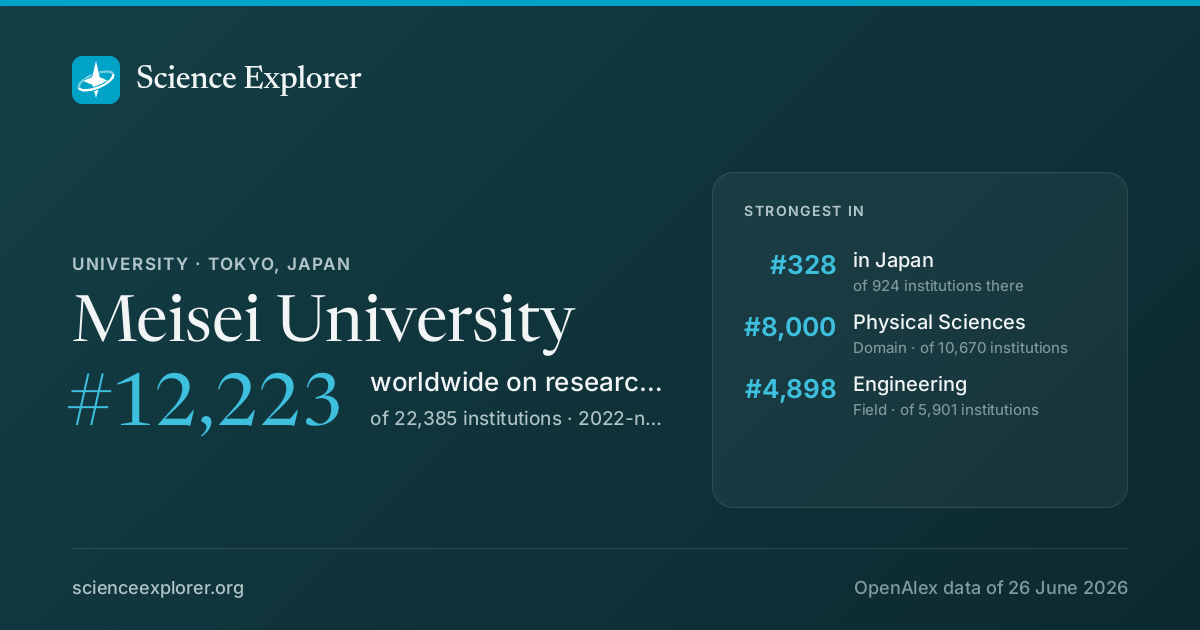
In research, Meisei University stands highest in Physical Sciences (#8,000 of 10,670 worldwide) and Engineering (#4,898 of 5,901 worldwide), 2022-now.

World rank, 2022-now
#12,223
of 22,385 · #28,653 all time
Rank in Japan
#328
of 924
Research works
1.7k
▼ 20% vs 2018-21
Citations
18k
10.7 per fractional work
Top-10% rate
4.3%
all institutions 10.0%
vs its own fields
0.82×
1.00× is exactly expected
Open access
43%
world 40%
International
13%
world 18%

What is Meisei University known for in research?

The fields where it stands highest, 2022-now, ranked among every institution above the floor in each field.

FieldWorld rankWhere that sitsTop-10% rateWorksAll time
Physical SciencesDomain #8,000 of 10,670 4.8%127 #16545
EngineeringField #4,898 of 5,901 6.1%67 #6690

Each strip is that field's whole ranked pool, with the notch where Meisei University sits in it, in the colour of the band that rank falls in. The track under the rate is the rate itself: it carries no average mark, because the average differs by field (from about 6% in Dentistry to 21% in Economics).

Which fields of science does Meisei University work in?

In 2022-now, 68% of research at Meisei University is in Physical Sciences, 22% in Social Sciences. Its largest fields are Engineering (35%), Computer Science (13%), Social Sciences (10%). It does 1.7× the world's share of Physical Sciences.

Physical Sciences: 139 fractional works · 67.5% of its workEngineering: 73 fractional works · 35.4% of its workElectrical and Electronic Engineering: 18 fractional works · 8.7% of its workMechanical Engineering: 12 fractional works · 5.7% of its workCivil and Structural Engineering: 10 fractional works · 4.6% of its workAerospace Engineering: 8 fractional works · 3.9% of its workMechanics of Materials: 6 fractional works · 2.9% of its workBiomedical Engineering: 4 fractional works · 2.2% of its workControl and Systems Engineering: 4 fractional works · 1.7% of its workBuilding and Construction: 3 fractional works · 1.3% of its workAutomotive Engineering: 3 fractional works · 1.3% of its workComputational Mechanics: 2 fractional works · 0.9% of its workOcean Engineering: 2 fractional works · 0.9% of its workIndustrial and Manufacturing Engineering: 1 fractional works · 0.4% of its workArchitecture: 1 fractional works · 0.3% of its workSafety, Risk, Reliability and Quality: 0 fractional works · 0.2% of its workSmaller subfields together: 0 fractional works · 0.2% of its workComputer Science: 27 fractional works · 13.0% of its workComputer Vision and Pattern Recognition: 10 fractional works · 4.8% of its workComputer Networks and Communications: 6 fractional works · 2.9% of its workArtificial Intelligence: 5 fractional works · 2.3% of its workHuman-Computer Interaction: 2 fractional works · 1.1% of its workInformation Systems: 1 fractional works · 0.7% of its workSignal Processing: 1 fractional works · 0.6% of its workComputer Science Applications: 0 fractional works · 0.2% of its workSmaller subfields together: 1 fractional works · 0.4% of its workMaterials Science: 11 fractional works · 5.2% of its workMaterials Chemistry: 4 fractional works · 2.0% of its workPolymers and Plastics: 4 fractional works · 1.9% of its workElectronic, Optical and Magnetic Materials: 1 fractional works · 0.6% of its workBiomaterials: 1 fractional works · 0.4% of its workCeramics and Composites: 0 fractional works · 0.2% of its workSmaller subfields together: 0 fractional works · 0.1% of its workEnvironmental Science: 9 fractional works · 4.2% of its workGlobal and Planetary Change: 2 fractional works · 1.2% of its workPollution: 1 fractional works · 0.6% of its workEnvironmental Engineering: 1 fractional works · 0.5% of its workWater Science and Technology: 1 fractional works · 0.5% of its workManagement, Monitoring, Policy and Law: 1 fractional works · 0.4% of its workHealth, Toxicology and Mutagenesis: 1 fractional works · 0.4% of its workEcology: 1 fractional works · 0.3% of its workNature and Landscape Conservation: 1 fractional works · 0.3% of its workSmaller subfields together: 0 fractional works · 0.1% of its workPhysics and Astronomy: 8 fractional works · 3.9% of its workAstronomy and Astrophysics: 3 fractional works · 1.4% of its workAtomic and Molecular Physics, and Optics: 3 fractional works · 1.3% of its workNuclear and High Energy Physics: 1 fractional works · 0.4% of its workCondensed Matter Physics: 1 fractional works · 0.4% of its workStatistical and Nonlinear Physics: 1 fractional works · 0.3% of its workSmaller subfields together: 0 fractional works · 0.1% of its workMathematics: 7 fractional works · 3.6% of its workStatistics and Probability: 7 fractional works · 3.2% of its workModeling and Simulation: 1 fractional works · 0.3% of its workSmaller subfields together: 0 fractional works · 0.2% of its workEarth and Planetary Sciences: 2 fractional works · 1.0% of its workAtmospheric Science: 1 fractional works · 0.4% of its workSmaller subfields together: 1 fractional works · 0.5% of its workEnergy: 1 fractional works · 0.6% of its workEnergy Engineering and Power Technology: 1 fractional works · 0.4% of its workRenewable Energy, Sustainability and the Environment: 0 fractional works · 0.2% of its workChemistry: 1 fractional works · 0.6% of its workSpectroscopy: 1 fractional works · 0.4% of its workSmaller subfields together: 0 fractional works · 0.1% of its workSocial Sciences: 46 fractional works · 22.3% of its workSocial Sciences: 21 fractional works · 10.1% of its workEducation: 6 fractional works · 2.7% of its workSociology and Political Science: 5 fractional works · 2.2% of its workTransportation: 2 fractional works · 1.2% of its workPolitical Science and International Relations: 2 fractional works · 1.1% of its workSafety Research: 2 fractional works · 0.7% of its workLaw: 1 fractional works · 0.5% of its workCultural Studies: 1 fractional works · 0.4% of its workDemography: 1 fractional works · 0.3% of its workSmaller subfields together: 2 fractional works · 0.9% of its workPsychology: 11 fractional works · 5.4% of its workDevelopmental and Educational Psychology: 4 fractional works · 2.2% of its workSocial Psychology: 3 fractional works · 1.6% of its workClinical Psychology: 2 fractional works · 0.8% of its workExperimental and Cognitive Psychology: 1 fractional works · 0.7% of its workSmaller subfields together: 0 fractional works · 0.2% of its workEconomics, Econometrics and Finance: 5 fractional works · 2.3% of its workEconomics and Econometrics: 3 fractional works · 1.4% of its workGeneral Economics, Econometrics and Finance: 1 fractional works · 0.5% of its workFinance: 1 fractional works · 0.4% of its workArts and Humanities: 4 fractional works · 1.8% of its workLanguage and Linguistics: 2 fractional works · 0.9% of its workLiterature and Literary Theory: 1 fractional works · 0.3% of its workMusic: 1 fractional works · 0.3% of its workPhilosophy: 0 fractional works · 0.2% of its workSmaller subfields together: 0 fractional works · 0.2% of its workBusiness, Management and Accounting: 3 fractional works · 1.7% of its workMarketing: 2 fractional works · 0.8% of its workOrganizational Behavior and Human Resource Management: 1 fractional works · 0.3% of its workSmaller subfields together: 1 fractional works · 0.6% of its workDecision Sciences: 2 fractional works · 1.0% of its workManagement Science and Operations Research: 1 fractional works · 0.6% of its workStatistics, Probability and Uncertainty: 1 fractional works · 0.3% of its workSmaller subfields together: 0 fractional works · 0.1% of its workHealth Sciences: 11 fractional works · 5.5% of its workMedicine: 6 fractional works · 3.1% of its workOrthopedics and Sports Medicine: 1 fractional works · 0.5% of its workRehabilitation: 1 fractional works · 0.3% of its workPublic Health, Environmental and Occupational Health: 1 fractional works · 0.3% of its workSurgery: 1 fractional works · 0.3% of its workPathology and Forensic Medicine: 0 fractional works · 0.2% of its workRheumatology: 0 fractional works · 0.2% of its workPulmonary and Respiratory Medicine: 0 fractional works · 0.2% of its workSmaller subfields together: 2 fractional works · 1.0% of its workHealth Professions: 3 fractional works · 1.6% of its workSpeech and Hearing: 2 fractional works · 0.9% of its workPhysical Therapy, Sports Therapy and Rehabilitation: 1 fractional works · 0.4% of its workSmaller subfields together: 1 fractional works · 0.4% of its workNursing: 1 fractional works · 0.7% of its workLeadership and Management: 1 fractional works · 0.6% of its workSmaller subfields together: 0 fractional works · 0.1% of its workVeterinary: 0 fractional works · 0.2% of its workLife Sciences: 10 fractional works · 4.7% of its workBiochemistry, Genetics and Molecular Biology: 4 fractional works · 1.8% of its workMolecular Biology: 3 fractional works · 1.4% of its workSmaller subfields together: 1 fractional works · 0.4% of its workNeuroscience: 4 fractional works · 1.7% of its workCognitive Neuroscience: 3 fractional works · 1.7% of its workSmaller subfields together: 0 fractional works · 0.1% of its workAgricultural and Biological Sciences: 2 fractional works · 1.1% of its workFood Science: 1 fractional works · 0.3% of its workPlant Science: 1 fractional works · 0.3% of its workSmaller subfields together: 1 fractional works · 0.5% of its workPharmacology, Toxicology and Pharmaceutics: 0 fractional works · 0.0% of its workALL ITS WORKMeisei University206fractional works, 2022-now
Life Sciences5%Physical Sciences68%Health Sciences6%Social Sciences22%

Each ring splits the one inside it: the four domains of science, their fields, their subfields. Size is fractional works in 2022-now. Every slice is a page; the interactive view zooms down to single topics and colours each by how much more of it this institution does than the world.

Its 4 domains and 23 fields, with their numbers
    1. Engineering7335.4%
    2. Computer Science2713.0%
    3. Materials Science115.2%
    4. Environmental Science94.2%
    5. Physics and Astronomy83.9%
    6. Mathematics73.6%
    7. Earth and Planetary Sciences21.0%
    8. Energy10.6%
    9. Chemistry10.6%
    1. Social Sciences2110.1%
    2. Psychology115.4%
    3. Economics, Econometrics and Finance52.3%
    4. Arts and Humanities41.8%
    5. Business, Management and Accounting31.7%
    6. Decision Sciences21.0%
    1. Medicine63.1%
    2. Health Professions31.6%
    3. Nursing10.7%
    4. Veterinary00.2%
    1. Biochemistry, Genetics and Molecular Biology41.8%
    2. Neuroscience41.7%
    3. Agricultural and Biological Sciences21.1%
    4. Pharmacology, Toxicology and Pharmaceutics00.0%
All of science, and how each field's share has moved since 1950: the Science domain explorer

Field profile

Location quotient across every field it publishes in: outside the ring is more than an institution of this size would be expected to publish, inside it is less.

Agricultural and Biological Sciences: 0.23× its world share, 2 worksAgricultural and Bio…Biochemistry, Genetics and Molecular Biology: 0.34× its world share, 4 worksBiochemistry, Geneti…Neuroscience: 1.07× its world share, 4 worksNeurosciencePharmacology, Toxicology and Pharmaceutics: 0.14× its world share, 0 worksPharmacology, Toxico…Chemistry: 0.36× its world share, 1 worksChemistryComputer Science: 1.67× its world share, 27 worksComputer ScienceEarth and Planetary Sciences: 0.61× its world share, 2 worksEarth and Planetary …Energy: 0.64× its world share, 1 worksEnergyEngineering: 2.36× its world share, 73 worksEngineeringEnvironmental Science: 0.84× its world share, 9 worksEnvironmental ScienceMaterials Science: 1.49× its world share, 11 worksMaterials ScienceMathematics: 3.08× its world share, 8 worksMathematicsPhysics and Astronomy: 1.77× its world share, 8 worksPhysics and AstronomyHealth Professions: 0.62× its world share, 3 worksHealth ProfessionsMedicine: 0.16× its world share, 6 worksMedicineNursing: 1.36× its world share, 1 worksNursingVeterinary: 1.19× its world share, 0 worksVeterinaryArts and Humanities: 0.64× its world share, 4 worksArts and HumanitiesBusiness, Management and Accounting: 0.52× its world share, 4 worksBusiness, Management…Decision Sciences: 1.01× its world share, 2 worksDecision SciencesEconomics, Econometrics and Finance: 1.08× its world share, 5 worksEconomics, Econometr…Psychology: 1.76× its world share, 11 worksPsychologySocial Sciences: 0.80× its world share, 21 worksSocial Sciences1×world share
more than its size predictsabout as predictedless

Rings at 0.5×, 1× and 2×. Widest outward: Mathematics, 3.1×. Every wedge is a field page.

All 23 fields, with their numbers
  1. Mathematics3.08×8 works
  2. Engineering2.36×73 works
  3. Physics and Astronomy1.77×8 works
  4. Psychology1.76×11 works
  5. Computer Science1.67×27 works
  6. Materials Science1.49×11 works
  7. Nursing1.36×1 works
  8. Veterinary1.19×0 works
  9. Economics, Econometrics and Finance1.08×5 works
  10. Neuroscience1.07×4 works
  11. Decision Sciences1.01×2 works
  12. Environmental Science0.84×9 works
  13. Social Sciences0.80×21 works
  14. Energy0.64×1 works
  15. Arts and Humanities0.64×4 works
  16. Health Professions0.62×3 works
  17. Earth and Planetary Sciences0.61×2 works
  18. Business, Management and Accounting0.52×4 works
  19. Chemistry0.36×1 works
  20. Biochemistry, Genetics and Molecular Biology0.34×4 works
  21. Agricultural and Biological Sciences0.23×2 works
  22. Medicine0.16×6 works
  23. Pharmacology, Toxicology and Pharmaceutics0.14×0 works

Who are the top researchers at Meisei University?

Ranked on the quality score, Yukihiro Kikegawa, Hisao Hidaka and Shuzo Tanaka lead among researchers whose main affiliation is Meisei University.

  1. 1 Yukihiro Kikegawa Japan · #826,478 worldwide 3.7k citations · 77 works
  2. 2 Hisao Hidaka Japan · #978,266 worldwide 12k citations · 176 works
  3. 3 Shuzo Tanaka Japan · #3,674,034 worldwide 2.8k citations · 41 works
  4. 4 Kayo Nohara Japan · #4,039,851 worldwide 755 citations · 18 works
  5. 5 Toyotoshi Ueda Japan · #4,101,235 worldwide 1.4k citations · 70 works
  6. 6 John E. Ingulsrud Japan · #4,132,130 worldwide 213 citations · 34 works
  7. 7 Koichi Ushizawa Japan · #4,434,366 worldwide 1k citations · 28 works
  8. 8 Kenji Iba Japan · #4,435,097 worldwide 1.4k citations · 54 works
  9. 9 Mitsuhiro Shimizu Japan · #4,558,897 worldwide 2.7k citations · 79 works
  10. 10 Hayato Nakata Japan · #4,646,790 worldwide 154 citations · 24 works
All ranked researchers at Meisei University

What are the most cited papers from Meisei University?

The most cited paper from Meisei University is "Ethanol fermentation from biomass resources: current state and prospects" (Yan Lin, Shuzo Tanaka, 2005), with 1,623 citations. Next come "Photoassisted Degradation of Dye Pollutants. V. Self-Photosensitized Oxidative Transformation of Rhodamine B under Visible Light Irradiation in Aqueous TiO2 Dispersions" (1,009) and "Specific interactions between silver(i) ions and cytosine–cytosine pairs in DNA duplexes" (771).

Most cited papers
#PaperReleasedCitations
1 Ethanol fermentation from biomass resources: current state and prospects Yan Lin, Shuzo Tanaka · Applied Microbiology and Biotechnology 5 Dec 2005 1,623
2 Photoassisted Degradation of Dye Pollutants. V. Self-Photosensitized Oxidative Transformation of Rhodamine B under Visible Light Irradiation in Aqueous TiO2 Dispersions Taixing Wu, Guangming Liu, Jincai Zhao et al. · The Journal of Physical Chemistry B Jul 1998 1,009
3 Specific interactions between silver(i) ions and cytosine–cytosine pairs in DNA duplexes Akira Mei Ono, Shiqi Cao, Humika Togashi et al. · Chemical Communications 2008 771
4 Exploiting the interparticle electron transfer process in the photocatalysed oxidation of phenol, 2-chlorophenol and pentachlorophenol: chemical evidence for electron and hole transfer between coupled semiconductors Nick Serpone, Pichai Maruthamuthu, Pierre Pichat et al. · Journal of Photochemistry and Photobiology A Chemistry 1995 658
5 Photooxidative N-demethylation of methylene blue in aqueous TiO2 dispersions under UV irradiation Tianyong Zhang, Toshiyuki Ōyama, Akio Aoshima et al. · Journal of Photochemistry and Photobiology A Chemistry May 2001 613
All 59 most cited papers, with filters and sorting

Which keywords describe research at Meisei University?

By fractional works in 2022-now, weighted toward what it does more of than the world: Thermal Management, Interconnect, Through-Silicon Via, Electromigration, Failure Analysis, Numerical Simulation, Material Properties and Polymer Composites.

▲ more of its work than of the world's◆ about the world's share▼ less than the world's

Size is fractional works in 2022-now in the topics tagged with each word; colour is the word's share of this institution's work against its share of the world's. The 40 words are chosen for being large and distinctive. Each links to the topic it comes from most.

All 40 words, with their numbers
  1. Deep Learning7◆ 0.97×15 topics
  2. Environmental Impact7▲ 1.89×19 topics
  3. Thermal Management6▲ 9.4×5 topics
  4. Artificial Intelligence6▲ 1.92×9 topics
  5. Interconnect5▲ 155×1 topic
  6. Through-Silicon Via5▲ 155×1 topic
  7. Remote Sensing5▲ 1.90×14 topics
  8. Virtual Reality4▲ 4.5×6 topics
  9. Numerical Simulation4▲ 7.2×5 topics
  10. Electromigration4▲ 73×2 topics
  11. Failure Analysis4▲ 22×5 topics
  12. Material Properties4▲ 21×4 topics
  13. Polymer Composites4▲ 7.1×4 topics
  14. High-Temperature Electronics4▲ 29×2 topics
  15. Interfacial Reactions3▲ 91×1 topic
  16. Lead-free Solders3▲ 91×1 topic
  17. Finite Element Method3▲ 17×2 topics
  18. Design Optimization3▲ 42×1 topic
  19. Fluid Dynamics3▲ 11×2 topics
  20. Gesture Recognition3▲ 20×2 topics
  21. Structural Analysis3▲ 17×1 topic
  22. High-Speed Trains3▲ 22×3 topics
  23. Statistical Methods3▲ 41×2 topics
  24. Sensitivity Analysis3▲ 14×3 topics
  25. Dynamic Interaction3▲ 21×2 topics
  26. Finite Element Analysis3▲ 5.8×5 topics
  27. Structural Equation Modeling3▲ 6.7×3 topics
  28. Thermodynamic Analysis3▲ 20×3 topics
  29. Bayesian Modeling2▲ 61×1 topic
  30. Multiple Imputation2▲ 61×1 topic
  31. Rolling Contact Fatigue2▲ 20×2 topics
  32. Ground Vibration2▲ 39×1 topic
  33. Human-Robot Interaction2▲ 9.1×2 topics
  34. Railway Dynamics2▲ 39×1 topic
  35. Service Robots2▲ 11×2 topics
  36. Atomic Layer Deposition2▲ 16×1 topic
  37. Cloud Robotics2▲ 38×1 topic
  38. High-k Dielectrics2▲ 16×1 topic
  39. Internet of Robotic Things2▲ 38×1 topic
  40. Local Binary Patterns2▲ 15×2 topics

Which research topics does Meisei University publish most on?

By volume in 2022-now: 3D IC and TSV technologies, Electronic Packaging and Soldering Technologies, Engineering Applied Research and Statistical Methods and Bayesian Inference.

  1. 1 3D IC and TSV technologies Electrical and Electronic Engineering 5 works
  2. 2 Electronic Packaging and Soldering Technologies Electrical and Electronic Engineering 3 works
  3. 3 Engineering Applied Research Civil and Structural Engineering 3 works
  4. 4 Statistical Methods and Bayesian Inference Statistics and Probability 2 works
  5. 5 Railway Engineering and Dynamics Mechanical Engineering 2 works
  6. 6 Semiconductor materials and devices Electrical and Electronic Engineering 2 works
  7. 7 Robotics and Automated Systems Control and Systems Engineering 2 works
  8. 8 Music Technology and Sound Studies Computer Vision and Pattern Recognition 2 works
  9. 9 Flame retardant materials and properties Polymers and Plastics 2 works
  10. 10 Additive Manufacturing and 3D Printing Technologies Automotive Engineering 2 works

How open and international is its research?

Against the world's own shares: the tick on each track. Both are shares of its output, so they sit on one scale and can be read against each other as well as against the world.

openly available43.4%not open56.6%

World: 40% of research is openly available.

with international co-authors13.3%domestic only86.7%

World: 18% is written across borders.

How has Meisei University's research output changed?

Output in 2022-2025 was 20% lower than in 2018-2021.

still counting1990200020102020
grewheldshrank

The same series as a ribbon: one cell per year, darker for more. The line above answers how much; this answers when.

Its share of all research

Growing output can still be a shrinking share: all of science grows. This is Meisei University as a percentage of every work published that year, 0.00085% in 2024.

still counting0.0020%0.0040%Meisei University0.00068% in 202519801990200020102020

Fractional works of Meisei University over all fractional works that year. How the balance of science has shifted.

How much of it reaches the world top 10%

Year by year, against all institutions in the same year.

still counting5%10%15%all institutions10.0% in 2025Meisei University6.7% in 2025200020102020

Of each year's output, the share that reached the world's 10% most cited for its field and year. Peak 10.6% in 1999.

Other research institutions in Tokyo

All research institutions in Tokyo

Share Meisei University's ranking

Meisei University on Science Explorer

A card with Meisei University's standing and the fields it leads in, for a post or a slide. A link to this page previews as the same card.

Download the card

1200 × 630 PNG, sized for social posts, drawn from the latest snapshot.

Badges for a website1Each links back here and updates with every snapshot

Research measures only: rankings here say nothing about teaching, admissions or student experience. Comparable institutions and collaboration partners have tabs of their own, above.

Discussion

Ask a question or share a note about Meisei University. Keep it to the research: no personal attacks, advertising or links. Any reader can report a post, which collapses it for everyone until it is opened.