Merrill (United States)
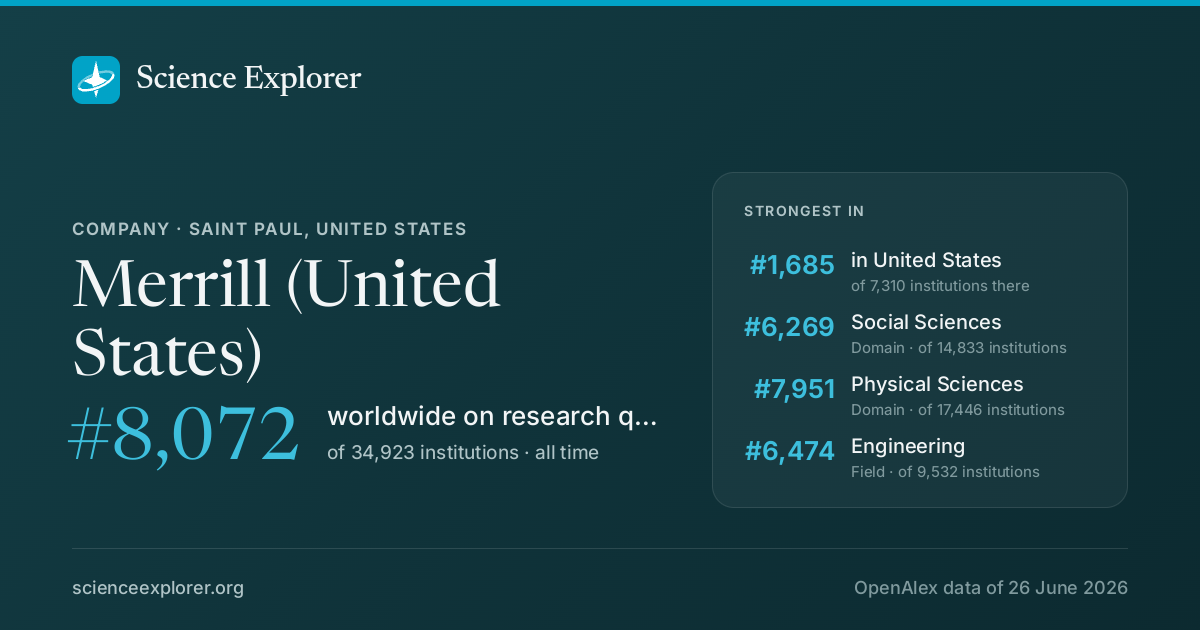
In research, Merrill (United States) stands highest in Social Sciences (#6,269 of 14,833 worldwide), Physical Sciences (#7,951 of 17,446 worldwide) and Engineering (#6,474 of 9,532 worldwide), over all time.
- World rank, all time
- #8,072 of 34,923
- Rank in United States
- #1,685 of 7,310
- Research works
- 565 ▼ 26% vs 2018-21
- Citations
- 10k 17.8 per fractional work
- Top-10% rate
- 8.8% all institutions 10.0%
- vs its own fields
- 0.97× 1.00× is exactly expected
- Open access
- 20% world 40%
- International
- 15% world 18%
What is Merrill (United States) known for in research?
The fields where it stands highest, over all time, ranked among every institution above the floor in each field.
| Field | World rank | Where that sits | Top-10% rate | Works |
|---|---|---|---|---|
| Social SciencesDomain | #6,269 of 14,833 | 11.2% | 229 | |
| Physical SciencesDomain | #7,951 of 17,446 | 8.5% | 223 | |
| EngineeringField | #6,474 of 9,532 | 8.3% | 160 |
Each strip is that field's whole ranked pool, with the notch where Merrill (United States) sits in it, in the colour of the band that rank falls in. The track under the rate is the rate itself: it carries no average mark, because the average differs by field (from about 6% in Dentistry to 21% in Economics).
Which fields of science does Merrill (United States) work in?
In 2022-now, 38% of research at Merrill (United States) is in Physical Sciences, 36% in Health Sciences. Its largest fields are Medicine (33%), Engineering (28%), Social Sciences (10%). It does 1.4× the world's share of Health Sciences.
Each ring splits the one inside it: the four domains of science, their fields, their subfields. Size is fractional works in 2022-now. Every slice is a page; the interactive view zooms down to single topics and colours each by how much more of it this institution does than the world.
Its 4 domains and 18 fields, with their numbers
- Physical Sciences1938.5%
- Engineering1427.9%
- Environmental Science12.7%
- Physics and Astronomy12.2%
- Computer Science12.0%
- Materials Science12.0%
- Earth and Planetary Sciences11.7%
- Health Sciences1835.7%
- Medicine1633.0%
- Health Professions12.5%
- Nursing00.1%
- Social Sciences1121.6%
- Life Sciences24.3%
Field profile
Location quotient across every field it publishes in: outside the ring is more than an institution of this size would be expected to publish, inside it is less.
Rings at 0.5×, 1× and 2×. Widest outward: Engineering, 1.9×. Every wedge is a field page.
All 18 fields, with their numbers
- Engineering1.86×14 works
- Medicine1.72×16 works
- Economics, Econometrics and Finance1.68×2 works
- Psychology1.40×2 works
- Neuroscience1.22×1 works
- Earth and Planetary Sciences1.07×1 works
- Physics and Astronomy0.99×1 works
- Health Professions0.96×1 works
- Social Sciences0.75×5 works
- Business, Management and Accounting0.72×1 works
- Materials Science0.57×1 works
- Environmental Science0.54×1 works
- Arts and Humanities0.51×1 works
- Immunology and Microbiology0.45×0 works
- Decision Sciences0.41×0 works
- Biochemistry, Genetics and Molecular Biology0.35×1 works
- Computer Science0.26×1 works
- Nursing0.21×0 works
- Engineering 1.9×
- Medicine 1.7×
- Economics, Econometrics and Finance 1.7×
- Psychology 1.4×
- Neuroscience 1.2×
- Earth and Planetary Sciences 1.1×
- Physics and Astronomy 1.0×
- Health Professions 1.0×
- Social Sciences 0.8×
- Business, Management and Accounting 0.7×
- Materials Science 0.6×
- Environmental Science 0.5×
- Arts and Humanities 0.5×
- Immunology and Microbiology 0.5×
- Decision Sciences 0.4×
- Biochemistry, Genetics and Molecular Biology 0.3×
- Computer Science 0.3×
- Nursing 0.2×
Who are the top researchers at Merrill (United States)?
Ranked on the quality score, Peter G. Mavrelis, Clark E. Moustakas and William E. Barnes lead among researchers whose main affiliation is Merrill (United States).
- 1
Peter G. Mavrelis
 United States · #653,134 worldwide
1.1k citations · 29 works
- 2
Clark E. Moustakas
United States · #1,033,109 worldwide
18k citations · 74 works
- 3
William E. Barnes
United States · #1,623,882 worldwide
761 citations · 23 works
- 4
Stephen D. Ray
United States · #2,334,995 worldwide
316 citations · 28 works
- 5
D. Keith Osborn
United States · #2,432,183 worldwide
314 citations · 21 works
- 6
David A. Shook
United States · #2,472,514 worldwide
313 citations · 34 works
- 7
William Baker
United States · #2,517,576 worldwide
2.8k citations · 187 works
- 8
Winifred Rand
United States · #2,561,231 worldwide
352 citations · 45 works
- 9
Mark Sarkisian
United States · #2,759,334 worldwide
0 citations · 17 works
- 10
Saba Zamir
United States · #2,886,162 worldwide
154 citations · 24 works
Which keywords describe research at Merrill (United States)?
By fractional works in 2022-now, weighted toward what it does more of than the world: Atherosclerosis, Coronary Artery Disease, Myocardial Infarction, Percutaneous Coronary Intervention, Magnetic Resonance Imaging, Coronary Stents, Myocardial Revascularization and Cardiac Imaging.
- Psychological Resilience
- Adversity
- Tensegrity
- Risk Management
- Form-Finding
- BIM
- Thermal Comfort
- Digital Fabrication
- Vascular Function
- Dynamic Interaction
- Hypertension
- Structural Optimization
- Heart Failure
- Energy Efficiency
- Cardiovascular Disease
- Myocardial Perfusion
- Cardiac Imaging
- Magnetic Resonance Imaging
- Percutaneous Coronary Intervention
- Coronary Artery Disease
- Atherosclerosis
- Myocardial Infarction
- Coronary Stents
- Myocardial Revascularization
- Computed Tomography Angiography
- Social Media
- Sustainability
- Dynamic Behavior
- Obesity
- Mental Health
- Cardiovascular Events
- Risk Factors
- Building Energy Consumption
- Footbridges
- Vibration Serviceability
- Construction
- Positive Emotions
- Stress
- Urban Morphology
- News Media
Size is fractional works in 2022-now in the topics tagged with each word; colour is the word's share of this institution's work against its share of the world's. The 40 words are chosen for being large and distinctive. Each links to the topic it comes from most.
All 40 words, with their numbers
- Atherosclerosis3▲ 23×5 topics
- Coronary Artery Disease3▲ 53×3 topics
- Myocardial Infarction3▲ 23×4 topics
- Percutaneous Coronary Intervention3▲ 39×3 topics
- Coronary Stents2▲ 106×1 topic
- Magnetic Resonance Imaging2▲ 19×2 topics
- Myocardial Revascularization2▲ 106×1 topic
- Cardiac Imaging2▲ 37×2 topics
- Computed Tomography Angiography2▲ 68×1 topic
- Myocardial Perfusion2▲ 68×1 topic
- Social Media2▲ 3.3×8 topics
- Cardiovascular Disease2▲ 3.5×13 topics
- Sustainability2▲ 1.62×3 topics
- Energy Efficiency2▲ 4.0×2 topics
- Dynamic Behavior2▲ 30×2 topics
- Heart Failure2▲ 7.6×7 topics
- Obesity2▲ 4.5×6 topics
- Structural Optimization2▲ 105×2 topics
- Mental Health2▲ 2.3×7 topics
- Hypertension2▲ 11×6 topics
- Cardiovascular Events1▲ 23×3 topics
- Dynamic Interaction1▲ 43×2 topics
- Risk Factors1▲ 2.6×9 topics
- Vascular Function1▲ 28×2 topics
- Building Energy Consumption1▲ 35×1 topic
- Digital Fabrication1▲ 35×2 topics
- Footbridges1▲ 73×1 topic
- Thermal Comfort1▲ 21×1 topic
- Vibration Serviceability1▲ 73×1 topic
- BIM1▲ 36×1 topic
- Construction1▲ 16×1 topic
- Form-Finding1▲ 80×1 topic
- Positive Emotions1▲ 19×2 topics
- Risk Management1▲ 4.9×2 topics
- Stress1▲ 6.0×3 topics
- Tensegrity1▲ 80×1 topic
- Urban Morphology1▲ 53×2 topics
- Adversity1▲ 30×1 topic
- News Media1▲ 45×2 topics
- Psychological Resilience1▲ 23×1 topic
Which research topics does Merrill (United States) publish most on?
By volume in 2022-now: Coronary Interventions and Diagnostics, Cardiac Imaging and Diagnostics, Building Energy and Comfort Optimization and Structural Engineering and Vibration Analysis.
Area is fractional works; colour is the subfield each topic belongs to.
- 1 Coronary Interventions and Diagnostics Surgery 2 works
- 2 Cardiac Imaging and Diagnostics Radiology, Nuclear Medicine and Imaging 2 works
- 3 Building Energy and Comfort Optimization Building and Construction 1 works
- 4 Structural Engineering and Vibration Analysis Civil and Structural Engineering 1 works
- 5 Structural Analysis and Optimization Civil and Structural Engineering 1 works
- 6 BIM and Construction Integration Building and Construction 1 works
- 7 Resilience and Mental Health Clinical Psychology 1 works
- 8 Misinformation and Its Impacts Sociology and Political Science 1 works
- 9 Planetary Science and Exploration Astronomy and Astrophysics 1 works
- 10 Architecture and Computational Design Architecture 1 works
How open and international is its research?
Against the world's own shares: the tick on each track. Both are shares of its output, so they sit on one scale and can be read against each other as well as against the world.
World: 40% of research is openly available.
World: 18% is written across borders.
How has Merrill (United States)'s research output changed?
Output in 2022-2025 was 26% lower than in 2018-2021.
The same series as a ribbon: one cell per year, darker for more. The line above answers how much; this answers when.
Its share of all research
Growing output can still be a shrinking share: all of science grows. This is Merrill (United States) as a percentage of every work published that year, 0.00012% in 2024.
Fractional works of Merrill (United States) over all fractional works that year. How the balance of science has shifted.
Other research institutions in Saint Paul
- University of St. Thomas - Minnesota
- Macalester College
- 3M (United States)
- Minnesota Department of Health
- Minnesota Department of Natural Resources
- St. Catherine University
- Hamline University
- Ecolab (United States)


Share Merrill (United States)'s ranking
Badges for a website1Each links back here and updates with every snapshot

Research measures only: rankings here say nothing about teaching, admissions or student experience. Comparable institutions and collaboration partners have tabs of their own, above.
Discussion
Ask a question or share a note about Merrill (United States). Keep it to the research: no personal attacks, advertising or links. Any reader can report a post, which collapses it for everyone until it is opened.