Microelectronics Research Development (United States)
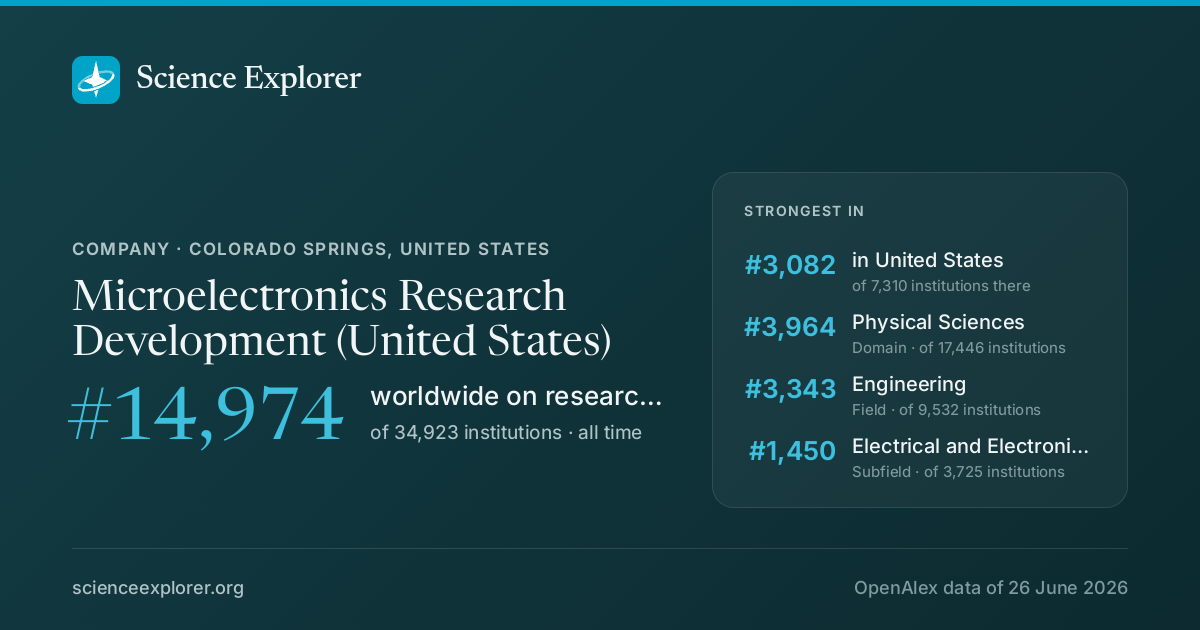
In research, Microelectronics Research Development (United States) stands highest in Physical Sciences (#3,964 of 17,446 worldwide), Engineering (#3,343 of 9,532 worldwide) and Electrical and Electronic Engineering (#1,450 of 3,725 worldwide), over all time.
- World rank, all time
- #14,974 of 34,923
- Rank in United States
- #3,082 of 7,310
- Research works
- 437 ▲ 64% vs 2018-21
- Citations
- 8.6k 19.7 per fractional work
- Top-10% rate
- 5.1% all institutions 10.0%
- vs its own fields
- 1.22× 1.00× is exactly expected
- Open access
- 9% world 40%
- International
- 5% world 18%
What is Microelectronics Research Development (United States) known for in research?
The fields where it stands highest, over all time, ranked among every institution above the floor in each field.
| Field | World rank | Where that sits | Top-10% rate | Works |
|---|---|---|---|---|
| Physical SciencesDomain | #3,964 of 17,446 | 12.2% | 424 | |
| EngineeringField | #3,343 of 9,532 | 12.6% | 263 | |
| Electrical and Electronic EngineeringSubfield | #1,450 of 3,725 | 13.1% | 155 |
Each strip is that field's whole ranked pool, with the notch where Microelectronics Research Development (United States) sits in it, in the colour of the band that rank falls in. The track under the rate is the rate itself: it carries no average mark, because the average differs by field (from about 6% in Dentistry to 21% in Economics).
Which fields of science does Microelectronics Research Development (United States) work in?
In all years, 97% of research at Microelectronics Research Development (United States) is in Physical Sciences, 1% in Social Sciences. Its largest fields are Engineering (60%), Physics and Astronomy (22%), Computer Science (7%). It does 2.4× the world's share of Physical Sciences.
Each ring splits the one inside it: the four domains of science, their fields, their subfields. Size is fractional works in all years. Every slice is a page; the interactive view zooms down to single topics and colours each by how much more of it this institution does than the world.
Its 4 domains and 17 fields, with their numbers
- Physical Sciences42497.1%
- Engineering26360.1%
- Physics and Astronomy9521.7%
- Computer Science307.0%
- Earth and Planetary Sciences184.2%
- Materials Science133.1%
- Chemistry20.4%
- Mathematics10.3%
- Environmental Science10.3%
- Energy00.1%
- Social Sciences61.4%
- Health Sciences51.1%
- Life Sciences20.4%
Field profile
Location quotient across every field it publishes in: outside the ring is more than an institution of this size would be expected to publish, inside it is less.
Who are the top researchers at Microelectronics Research Development (United States)?
Ranked on the quality score, Joseph M. Benedetto, Paul H. Eaton and David G. Mavis lead among researchers whose main affiliation is Microelectronics Research Development (United States).
- 1
Joseph M. Benedetto
 United States · #372,983 worldwide
3.4k citations · 58 works
- 2
Paul H. Eaton
United States · #450,689 worldwide
1.9k citations · 42 works
- 3
David G. Mavis
United States · #625,831 worldwide
1.3k citations · 19 works
- 4
Richard Holland
United States · #931,771 worldwide
1.7k citations · 62 works
- 5
C.L. Lau
United States · #1,760,765 worldwide
2k citations · 45 works
- 6
Ravi K. Gulati
United States · #1,853,689 worldwide
1.1k citations · 48 works
- 7
Michael A. Mostrom
United States · #2,995,354 worldwide
492 citations · 38 works
- 8
J. W. Williams
United States · #3,240,938 worldwide
278 citations · 18 works
- 9
R. M. Turfler
United States · #3,492,362 worldwide
118 citations · 15 works
- 10
D. J. Sullivan
United States · #3,683,856 worldwide
344 citations · 35 works
Which keywords describe research at Microelectronics Research Development (United States)?
By fractional works in all years, weighted toward what it does more of than the world: Nanoelectronics, CMOS Technology, Negative Ion Sources, Superconducting Cavities, Atomic Layer Deposition, High-k Dielectrics, Integrated Circuits and High Power Terahertz Sources.
- Full-Waveform Tomography
- Embedded Cores
- Tunnel Field-Effect Transistors
- Free-Electron Lasers
- Soft Errors
- SCR Devices
- Nanowires
- Radiation Effects
- Distribution
- Semiconductor Industry
- Process Variation
- Simulation
- Electron Beams
- Failure Analysis
- Electron Beam
- Pulsed Power
- High Power Terahertz Sources
- High-k Dielectrics
- Superconducting Cavities
- CMOS Technology
- Nanoelectronics
- Negative Ion Sources
- Atomic Layer Deposition
- Integrated Circuits
- Vacuum Electronics
- Surface Modification
- High Current
- Photon Emission Microscopy
- Laser-Plasma Accelerators
- Electron Acceleration
- Plasma Etching
- Fault Tolerance
- Lightning
- Maxwell's Equations
- ESD Protection
- Error Detection
- Synchrotron Radiation
- Nanowire Transistors
- X-Ray
- Test Data Compression
Size is fractional works in all years in the topics tagged with each word; colour is the word's share of this institution's work against its share of the world's. The 40 words are chosen for being large and distinctive. Each links to the topic it comes from most.
All 40 words, with their numbers
- Nanoelectronics33▲ 49×2 topics
- CMOS Technology26▲ 50×4 topics
- Negative Ion Sources24▲ 118×1 topic
- Superconducting Cavities24▲ 118×1 topic
- Atomic Layer Deposition22▲ 38×1 topic
- High-k Dielectrics22▲ 38×1 topic
- Integrated Circuits22▲ 21×3 topics
- High Power Terahertz Sources20▲ 154×1 topic
- Vacuum Electronics20▲ 154×1 topic
- Pulsed Power20▲ 178×2 topics
- Surface Modification17▲ 23×3 topics
- Electron Beam16▲ 368×1 topic
- High Current16▲ 368×1 topic
- Failure Analysis14▲ 24×1 topic
- Photon Emission Microscopy14▲ 64×1 topic
- Electron Beams14▲ 100×1 topic
- Laser-Plasma Accelerators14▲ 100×1 topic
- Simulation13▲ 9.0×3 topics
- Electron Acceleration13▲ 30×2 topics
- Process Variation13▲ 30×2 topics
- Plasma Etching12▲ 63×1 topic
- Semiconductor Industry12▲ 63×1 topic
- Fault Tolerance12▲ 14×3 topics
- Distribution12▲ 97×1 topic
- Lightning12▲ 124×1 topic
- Radiation Effects12▲ 57×2 topics
- Maxwell's Equations12▲ 46×2 topics
- Nanowires11▲ 11×4 topics
- ESD Protection11▲ 136×1 topic
- SCR Devices11▲ 136×1 topic
- Error Detection11▲ 117×1 topic
- Soft Errors11▲ 117×1 topic
- Synchrotron Radiation10▲ 33×2 topics
- Free-Electron Lasers10▲ 80×1 topic
- Nanowire Transistors10▲ 35×1 topic
- Tunnel Field-Effect Transistors10▲ 35×1 topic
- X-Ray10▲ 80×1 topic
- Embedded Cores10▲ 78×1 topic
- Test Data Compression10▲ 78×1 topic
- Full-Waveform Tomography9▲ 45×1 topic
Which research topics does Microelectronics Research Development (United States) publish most on?
By volume in 2022-now: Hydrocarbon exploration and reservoir analysis, Antenna Design and Analysis, Microwave Engineering and Waveguides and Integrated Circuits and Semiconductor Failure Analysis.
Area is fractional works; colour is the subfield each topic belongs to.
- 1 Hydrocarbon exploration and reservoir analysis Mechanics of Materials 2 works
- 2 Antenna Design and Analysis Aerospace Engineering 0 works
- 3 Microwave Engineering and Waveguides Electrical and Electronic Engineering 0 works
- 4 Integrated Circuits and Semiconductor Failure Analysis Electrical and Electronic Engineering 0 works
- 5 Antenna Design and Optimization Aerospace Engineering 0 works
- 6 Semiconductor materials and devices Electrical and Electronic Engineering 0 works
- 7 Silicon and Solar Cell Technologies Electrical and Electronic Engineering 0 works
- 8 Radio Frequency Integrated Circuit Design Electrical and Electronic Engineering 0 works
- 9 Additive Manufacturing Materials and Processes Mechanical Engineering 0 works
- 10 Additive Manufacturing and 3D Printing Technologies Automotive Engineering 0 works
How open and international is its research?
Against the world's own shares: the tick on each track. Both are shares of its output, so they sit on one scale and can be read against each other as well as against the world.
World: 40% of research is openly available.
World: 18% is written across borders.
How has Microelectronics Research Development (United States)'s research output changed?
Output in 2022-2025 was 64% higher than in 2018-2021.
The same series as a ribbon: one cell per year, darker for more. The line above answers how much; this answers when.
Its share of all research
Growing output can still be a shrinking share: all of science grows. This is Microelectronics Research Development (United States) as a percentage of every work published that year, 0.000026% in 2022.
Fractional works of Microelectronics Research Development (United States) over all fractional works that year. How the balance of science has shifted.
Other research institutions in Colorado Springs
- University of Colorado Colorado Springs
- Colorado College
- Family Research Institute
- U.S. Air Force Space Command
- United States Olympic & Paralympic Committee
- BSCS Science Learning
- Colorado Engineering (United States)
- Penrose Hospital


Share Microelectronics Research Development (United States)'s ranking
Badges for a website1Each links back here and updates with every snapshot

Research measures only: rankings here say nothing about teaching, admissions or student experience. Comparable institutions and collaboration partners have tabs of their own, above.
Discussion
Ask a question or share a note about Microelectronics Research Development (United States). Keep it to the research: no personal attacks, advertising or links. Any reader can report a post, which collapses it for everyone until it is opened.