Science Explorer Back to mapMap
Discussion
Funder · Buenos Aires · Argentina

Ministerio de Educación

In research, Ministerio de Educación stands highest in Social Sciences (#7,609 of 14,833 worldwide) and Social Sciences (#5,888 of 9,330 worldwide), over all time.

World rank, 2022-now
#17,154
of 22,385 · #19,610 all time
Rank in Argentina
#103
of 136
Research works
308
▼ 5% vs 2018-21
Citations
742
2.4 per fractional work
Top-10% rate
6.5%
all institutions 10.0%
vs its own fields
1.01×
1.00× is exactly expected
Open access
74%
world 40%
International
50%
world 18%

What is Ministerio de Educación known for in research?

The fields where it stands highest, over all time, ranked among every institution above the floor in each field.

FieldWorld rankWhere that sitsTop-10% rateWorks
Social SciencesDomain #7,609 of 14,833 9.0%213
Social SciencesField #5,888 of 9,330 9.4%149

Each strip is that field's whole ranked pool, with the notch where Ministerio de Educación sits in it, in the colour of the band that rank falls in. The track under the rate is the rate itself: it carries no average mark, because the average differs by field (from about 6% in Dentistry to 21% in Economics).

Which fields of science does Ministerio de Educación work in?

In 2022-now, 58% of research at Ministerio de Educación is in Social Sciences, 20% in Health Sciences. Its largest fields are Social Sciences (40%), Medicine (11%), Health Professions (8%). It does 2.2× the world's share of Social Sciences.

Social Sciences: 50 fractional works · 57.9% of its workSocial Sciences: 34 fractional works · 39.6% of its workEducation: 12 fractional works · 14.1% of its workSociology and Political Science: 7 fractional works · 8.5% of its workPolitical Science and International Relations: 3 fractional works · 3.5% of its workCultural Studies: 2 fractional works · 2.6% of its workLife-span and Life-course Studies: 2 fractional works · 2.3% of its workGeneral Social Sciences: 2 fractional works · 2.0% of its workLaw: 1 fractional works · 1.5% of its workCommunication: 1 fractional works · 1.4% of its workGender Studies: 1 fractional works · 0.9% of its workSafety Research: 1 fractional works · 0.7% of its workDemography: 0 fractional works · 0.5% of its workGeography, Planning and Development: 0 fractional works · 0.4% of its workUrban Studies: 0 fractional works · 0.4% of its workDevelopment: 0 fractional works · 0.3% of its workLinguistics and Language: 0 fractional works · 0.3% of its workHealth: 0 fractional works · 0.2% of its workPsychology: 6 fractional works · 7.3% of its workSocial Psychology: 2 fractional works · 2.5% of its workClinical Psychology: 2 fractional works · 2.1% of its workDevelopmental and Educational Psychology: 1 fractional works · 1.7% of its workExperimental and Cognitive Psychology: 1 fractional works · 0.8% of its workSmaller subfields together: 0 fractional works · 0.1% of its workArts and Humanities: 4 fractional works · 4.2% of its workHistory and Philosophy of Science: 1 fractional works · 1.2% of its workHistory: 1 fractional works · 1.0% of its workLiterature and Literary Theory: 1 fractional works · 0.8% of its workMusic: 0 fractional works · 0.6% of its workPhilosophy: 0 fractional works · 0.2% of its workSmaller subfields together: 0 fractional works · 0.4% of its workBusiness, Management and Accounting: 4 fractional works · 4.1% of its workAccounting: 1 fractional works · 1.5% of its workOrganizational Behavior and Human Resource Management: 1 fractional works · 1.2% of its workManagement of Technology and Innovation: 0 fractional works · 0.5% of its workManagement Information Systems: 0 fractional works · 0.4% of its workTourism, Leisure and Hospitality Management: 0 fractional works · 0.4% of its workSmaller subfields together: 0 fractional works · 0.1% of its workEconomics, Econometrics and Finance: 2 fractional works · 2.3% of its workEconomics and Econometrics: 2 fractional works · 2.3% of its workDecision Sciences: 0 fractional works · 0.4% of its workStatistics, Probability and Uncertainty: 0 fractional works · 0.4% of its workHealth Sciences: 17 fractional works · 19.7% of its workMedicine: 10 fractional works · 11.4% of its workOrthopedics and Sports Medicine: 4 fractional works · 4.1% of its workSurgery: 2 fractional works · 2.1% of its workPharmacology: 1 fractional works · 1.4% of its workPhysiology: 0 fractional works · 0.6% of its workPublic Health, Environmental and Occupational Health: 0 fractional works · 0.6% of its workRehabilitation: 0 fractional works · 0.5% of its workPulmonary and Respiratory Medicine: 0 fractional works · 0.5% of its workHealth Informatics: 0 fractional works · 0.4% of its workPsychiatry and Mental health: 0 fractional works · 0.4% of its workComplementary and alternative medicine: 0 fractional works · 0.3% of its workSmaller subfields together: 0 fractional works · 0.5% of its workHealth Professions: 7 fractional works · 8.1% of its workGeneral Health Professions: 3 fractional works · 3.6% of its workPhysical Therapy, Sports Therapy and Rehabilitation: 3 fractional works · 3.0% of its workOccupational Therapy: 1 fractional works · 1.4% of its workSmaller subfields together: 0 fractional works · 0.1% of its workDentistry: 0 fractional works · 0.2% of its workPhysical Sciences: 15 fractional works · 17.9% of its workComputer Science: 5 fractional works · 6.0% of its workInformation Systems: 3 fractional works · 3.1% of its workComputer Science Applications: 1 fractional works · 1.4% of its workComputational Theory and Mathematics: 1 fractional works · 0.8% of its workArtificial Intelligence: 0 fractional works · 0.4% of its workComputer Networks and Communications: 0 fractional works · 0.3% of its workEngineering: 5 fractional works · 5.7% of its workControl and Systems Engineering: 2 fractional works · 2.0% of its workElectrical and Electronic Engineering: 1 fractional works · 0.8% of its workIndustrial and Manufacturing Engineering: 1 fractional works · 0.8% of its workMedia Technology: 1 fractional works · 0.6% of its workBiomedical Engineering: 0 fractional works · 0.6% of its workAutomotive Engineering: 0 fractional works · 0.4% of its workBuilding and Construction: 0 fractional works · 0.4% of its workSmaller subfields together: 0 fractional works · 0.2% of its workEnvironmental Science: 2 fractional works · 2.1% of its workManagement, Monitoring, Policy and Law: 0 fractional works · 0.5% of its workWater Science and Technology: 0 fractional works · 0.5% of its workIndustrial and Manufacturing Engineering: 0 fractional works · 0.4% of its workEcology: 0 fractional works · 0.3% of its workGlobal and Planetary Change: 0 fractional works · 0.2% of its workSmaller subfields together: 0 fractional works · 0.2% of its workEarth and Planetary Sciences: 1 fractional works · 1.4% of its workAtmospheric Science: 1 fractional works · 0.9% of its workPaleontology: 0 fractional works · 0.3% of its workSmaller subfields together: 0 fractional works · 0.2% of its workPhysics and Astronomy: 1 fractional works · 1.0% of its workAstronomy and Astrophysics: 1 fractional works · 0.8% of its workSmaller subfields together: 0 fractional works · 0.2% of its workEnergy: 1 fractional works · 0.8% of its workRenewable Energy, Sustainability and the Environment: 1 fractional works · 0.8% of its workMaterials Science: 0 fractional works · 0.6% of its workMaterials Chemistry: 0 fractional works · 0.6% of its workMathematics: 0 fractional works · 0.4% of its workLife Sciences: 4 fractional works · 4.6% of its workAgricultural and Biological Sciences: 3 fractional works · 3.2% of its workGeneral Agricultural and Biological Sciences: 1 fractional works · 1.5% of its workSoil Science: 0 fractional works · 0.6% of its workPlant Science: 0 fractional works · 0.5% of its workFood Science: 0 fractional works · 0.3% of its workSmaller subfields together: 0 fractional works · 0.3% of its workBiochemistry, Genetics and Molecular Biology: 1 fractional works · 0.7% of its workGenetics: 0 fractional works · 0.5% of its workSmaller subfields together: 0 fractional works · 0.3% of its workNeuroscience: 0 fractional works · 0.4% of its workCognitive Neuroscience: 0 fractional works · 0.4% of its workImmunology and Microbiology: 0 fractional works · 0.2% of its workParasitology: 0 fractional works · 0.2% of its workALL ITS WORKMinisterio deEducación86fractional works, 2022-now
Life Sciences5%Physical Sciences18%Health Sciences20%Social Sciences58%

Each ring splits the one inside it: the four domains of science, their fields, their subfields. Size is fractional works in 2022-now. Every slice is a page; the interactive view zooms down to single topics and colours each by how much more of it this institution does than the world.

Its 4 domains and 21 fields, with their numbers
    1. Social Sciences3439.6%
    2. Psychology67.3%
    3. Arts and Humanities44.2%
    4. Business, Management and Accounting44.1%
    5. Economics, Econometrics and Finance22.3%
    6. Decision Sciences00.4%
    1. Medicine1011.4%
    2. Health Professions78.1%
    3. Dentistry00.2%
    1. Computer Science56.0%
    2. Engineering55.7%
    3. Environmental Science22.1%
    4. Earth and Planetary Sciences11.4%
    5. Physics and Astronomy11.0%
    6. Energy10.8%
    7. Materials Science00.6%
    8. Mathematics00.4%
    1. Agricultural and Biological Sciences33.2%
    2. Biochemistry, Genetics and Molecular Biology10.7%
    3. Neuroscience00.4%
    4. Immunology and Microbiology00.2%
All of science, and how each field's share has moved since 1950: the Science domain explorer

Field profile

Location quotient across every field it publishes in: outside the ring is more than an institution of this size would be expected to publish, inside it is less.

Agricultural and Biological Sciences: 0.66× its world share, 3 worksAgricultural and Bio…Biochemistry, Genetics and Molecular Biology: 0.14× its world share, 1 worksBiochemistry, Geneti…Immunology and Microbiology: 0.23× its world share, 0 worksImmunology and Micro…Neuroscience: 0.27× its world share, 0 worksNeuroscienceComputer Science: 0.77× its world share, 5 worksComputer ScienceEarth and Planetary Sciences: 0.89× its world share, 1 worksEarth and Planetary …Energy: 0.85× its world share, 1 worksEnergyEngineering: 0.38× its world share, 5 worksEngineeringEnvironmental Science: 0.43× its world share, 2 worksEnvironmental ScienceMaterials Science: 0.17× its world share, 0 worksMaterials ScienceMathematics: 0.33× its world share, 0 worksMathematicsPhysics and Astronomy: 0.44× its world share, 1 worksPhysics and AstronomyDentistry: 0.40× its world share, 0 worksDentistryHealth Professions: 3.07× its world share, 7 worksHealth ProfessionsMedicine: 0.59× its world share, 10 worksMedicineArts and Humanities: 1.46× its world share, 4 worksArts and HumanitiesBusiness, Management and Accounting: 1.27× its world share, 4 worksBusiness, Management…Decision Sciences: 0.40× its world share, 0 worksDecision SciencesEconomics, Econometrics and Finance: 1.08× its world share, 2 worksEconomics, Econometr…Psychology: 2.39× its world share, 6 worksPsychologySocial Sciences: 3.13× its world share, 34 worksSocial Sciences1×world share
more than its size predictsabout as predictedless

Rings at 0.5×, 1× and 2×. Widest outward: Social Sciences, 3.1×. Every wedge is a field page.

All 21 fields, with their numbers
  1. Social Sciences3.13×34 works
  2. Health Professions3.07×7 works
  3. Psychology2.39×6 works
  4. Arts and Humanities1.46×4 works
  5. Business, Management and Accounting1.27×4 works
  6. Economics, Econometrics and Finance1.08×2 works
  7. Earth and Planetary Sciences0.89×1 works
  8. Energy0.85×1 works
  9. Computer Science0.77×5 works
  10. Agricultural and Biological Sciences0.66×3 works
  11. Medicine0.59×10 works
  12. Physics and Astronomy0.44×1 works
  13. Environmental Science0.43×2 works
  14. Dentistry0.40×0 works
  15. Decision Sciences0.40×0 works
  16. Engineering0.38×5 works
  17. Mathematics0.33×0 works
  18. Neuroscience0.27×0 works
  19. Immunology and Microbiology0.23×0 works
  20. Materials Science0.17×0 works
  21. Biochemistry, Genetics and Molecular Biology0.14×1 works

Who are the top researchers at Ministerio de Educación?

Ranked on the quality score, Carlos A. Marelli, Gloria Bonder and Víctor Durbà Cardó lead among researchers whose main affiliation is Ministerio de Educación.

  1. 1 Carlos A. Marelli Argentina · #2,808,452 worldwide 27 citations · 16 works
  2. 2 Gloria Bonder Argentina · #3,972,350 worldwide 124 citations · 24 works
  3. 3 Víctor Durbà Cardó Argentina · #4,410,591 worldwide 5 citations · 13 works
  4. 4 Luis Jiménez López Argentina · #4,420,825 worldwide 1 citations · 19 works
  5. 5 Raúl Oscar Paglilla Argentina · #4,464,777 worldwide 2 citations · 16 works
  6. 6 Andrés Negro Moncayo Argentina · #4,529,147 worldwide 13 citations · 17 works
  7. 7 Roxana Morduchowicz Argentina · #5,348,189 worldwide 174 citations · 49 works
  8. 8 Gonzalo Asesor Politécnico Colombiano Jaime Isaza Cadavid Jaramillo Hernández Argentina · #5,869,703 worldwide 0 citations · 42 works
All ranked researchers at Ministerio de Educación

What are the most cited papers from Ministerio de Educación?

The most cited paper from Ministerio de Educación is "Teacher professional development through collaborative action research: impact on foreign English-language teaching and learning" (Darío Luis Banegas, Anahí Pavese, Aurelia Velázquez et al., 2013), with 99 citations. Next come "Propiedades psicométricas de la Physical Activity Enjoyment Scale (PACES) en el contexto español" (79) and "Actitudes hacia la práctica físico-deportiva según el sexo del practicante. (Gender and attitudes toward the practice of physical activity and sport.)" (59).

Most cited papers
#PaperReleasedCitations
1 Teacher professional development through collaborative action research: impact on foreign English-language teaching and learning Darío Luis Banegas, Anahí Pavese, Aurelia Velázquez et al. · Educational Action Research 29 May 2013 99
2 Propiedades psicométricas de la Physical Activity Enjoyment Scale (PACES) en el contexto español Juan-Antonio Moreno, David González‐Cutre, Celestina Martínez et al. · Studies in Psychology Estudios de Psicología 2008 79
3 Actitudes hacia la práctica físico-deportiva según el sexo del practicante. (Gender and attitudes toward the practice of physical activity and sport.) Juan Antônio Moreno Murcia, Celestina Martínez-Galindo, Néstor Alonso-Villodre · RICYDE Revista Internacional de Ciencias del Deporte Open access Apr 2006 59
4 IMPORTANCIA DE LA TEORÍA DE LA AUTODETERMINACIÓN EN LA PRÁCTICA FÍSICO-DEPORTIVA: FUNDAMENTOS E IMPLICACIONES PRÁCTICAS Juan Antônio Moreno Murcia, Antonio Martínez-Sykora · Digitum: Institutional Repository of the University of Murcia (University of Murcia) Open access 2006 53
5 Analizando la motivación en el deporte: un estudio a través de la teoría de la autodeterminación Juan Antônio Moreno Murcia, Eduardo Cervelló Gimeno, David GONZÁLEZ-CUTRE COLL · APUNTES DE PSICOLOGÍA Open access Mar 2007 52
All 60 most cited papers, with filters and sorting

Which keywords describe research at Ministerio de Educación?

By fractional works in 2022-now, weighted toward what it does more of than the world: Education, Health Promotion, Latin America, Educational Technology, Inclusive Education, Teacher Training, Globalization and Physical Activity.

▲ more of its work than of the world's◆ about the world's share▼ less than the world's

Size is fractional works in 2022-now in the topics tagged with each word; colour is the word's share of this institution's work against its share of the world's. The 40 words are chosen for being large and distinctive. Each links to the topic it comes from most.

All 40 words, with their numbers
  1. Education12▲ 7.8×27 topics
  2. Globalization7▲ 3.9×19 topics
  3. Educational Technology6▲ 6.5×13 topics
  4. Health Promotion6▲ 24×7 topics
  5. Latin America6▲ 39×12 topics
  6. Epidemiology6▲ 1.75×13 topics
  7. Sustainability6▲ 2.8×20 topics
  8. Inclusive Education6▲ 18×8 topics
  9. Teacher Training5▲ 9.3×12 topics
  10. Physical Activity5▲ 11×7 topics
  11. Public Health5▲ 3.8×16 topics
  12. Teacher Development4▲ 80×2 topics
  13. Pedagogy4▲ 9.7×9 topics
  14. Innovation4▲ 4.7×11 topics
  15. Community Engagement4▲ 13×8 topics
  16. Public Policy4▲ 9.0×6 topics
  17. Gender4▲ 7.8×6 topics
  18. Mental Health4▲ 3.0×9 topics
  19. COVID-194▲ 3.1×5 topics
  20. Health3▲ 9.6×5 topics
  21. E-Learning3▲ 3.9×4 topics
  22. Physical Education3▲ 30×7 topics
  23. Social Movements3▲ 12×7 topics
  24. Distance Learning3▲ 10×4 topics
  25. Knowledge Management3▲ 6.3×7 topics
  26. Social Justice3▲ 5.9×7 topics
  27. Competitiveness3▲ 42×5 topics
  28. Adolescents3▲ 9.0×5 topics
  29. Inequality3▲ 15×3 topics
  30. Rural Education3▲ 90×2 topics
  31. Student Performance2▲ 28×2 topics
  32. High-Intensity Interval Training2▲ 25×2 topics
  33. Educational Leadership2▲ 22×1 topic
  34. Medical Education2▲ 9.8×3 topics
  35. Quality Education2▲ 76×1 topic
  36. Resistance Training2▲ 29×2 topics
  37. Communication2▲ 8.2×6 topics
  38. Performance Analysis2▲ 12×1 topic
  39. School Inclusion2▲ 267×1 topic
  40. Teacher Perceptions2▲ 91×1 topic

Which research topics does Ministerio de Educación publish most on?

By volume in 2022-now: Education and Teacher Training, Education in Rural Contexts, Sports Performance and Training and Sports and Physical Education Studies.

  1. 1 Education and Teacher Training Education 2 works
  2. 2 Education in Rural Contexts Education 2 works
  3. 3 Sports Performance and Training Orthopedics and Sports Medicine 2 works
  4. 4 Sports and Physical Education Studies Life-span and Life-course Studies 2 works
  5. 5 Educational Innovations and Technology Information Systems 2 works
  6. 6 Physical Education and Pedagogy Physical Therapy, Sports Therapy and Rehabilitation 2 works
  7. 7 Health and Medical Education General Health Professions 2 works
  8. 8 Health and Lifestyle Studies General Health Professions 1 works
  9. 9 International Relations in Latin America Political Science and International Relations 1 works
  10. 10 Business, Education, Mathematics Research Accounting 1 works

How open and international is its research?

Against the world's own shares: the tick on each track. Both are shares of its output, so they sit on one scale and can be read against each other as well as against the world.

openly available74.5%not open25.5%

World: 40% of research is openly available.

with international co-authors50.0%domestic only50.0%

World: 18% is written across borders.

How has Ministerio de Educación's research output changed?

Output in 2022-2025 was 5% lower than in 2018-2021.

still counting1990200020102020
grewheldshrank

The same series as a ribbon: one cell per year, darker for more. The line above answers how much; this answers when.

Its share of all research

Growing output can still be a shrinking share: all of science grows. This is Ministerio de Educación as a percentage of every work published that year, 0.00037% in 2024.

still counting0.00025%0.00050%0.00075%Ministerio de Educación0.00037% in 202519801990200020102020

Fractional works of Ministerio de Educación over all fractional works that year. How the balance of science has shifted.

Other research institutions in Buenos Aires

All research institutions in Buenos Aires

Share Ministerio de Educación's ranking
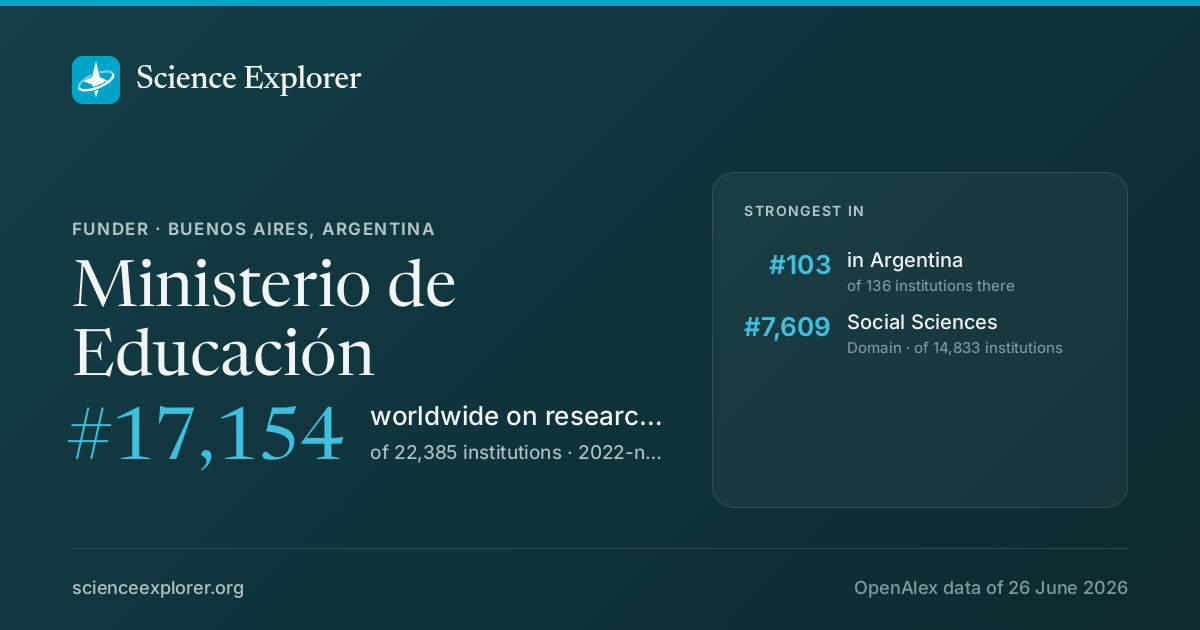
Ministerio de Educación on Science Explorer

A card with Ministerio de Educación's standing and the fields it leads in, for a post or a slide. A link to this page previews as the same card.

Download the card

1200 × 630 PNG, sized for social posts, drawn from the latest snapshot.

Badges for a website1Each links back here and updates with every snapshot

Research measures only: rankings here say nothing about teaching, admissions or student experience. Comparable institutions and collaboration partners have tabs of their own, above.

Discussion

Ask a question or share a note about Ministerio de Educación. Posts are plain text and can be reported.