Science Explorer Back to mapMap
Discussion
University · Constanța · Romania

Mircea cel Batran Naval Academy

In research, Mircea cel Batran Naval Academy stands highest in Physical Sciences (#7,709 of 10,670 worldwide), 2022-now.

World rank, 2022-now
#13,136
of 22,385 · #20,539 all time
Rank in Romania
#62
of 126
Research works
459
▼ 24% vs 2018-21
Citations
987
2.1 per fractional work
Top-10% rate
6.0%
all institutions 10.0%
vs its own fields
0.96×
1.00× is exactly expected
Open access
87%
world 40%
International
8%
world 18%

What is Mircea cel Batran Naval Academy known for in research?

The fields where it stands highest, 2022-now, ranked among every institution above the floor in each field.

FieldWorld rankWhere that sitsTop-10% rateWorksAll time
Physical SciencesDomain #7,709 of 10,670 3.9%93 #13014

Each strip is that field's whole ranked pool, with the notch where Mircea cel Batran Naval Academy sits in it, in the colour of the band that rank falls in. The track under the rate is the rate itself: it carries no average mark, because the average differs by field (from about 6% in Dentistry to 21% in Economics).

Which fields of science does Mircea cel Batran Naval Academy work in?

In 2022-now, 73% of research at Mircea cel Batran Naval Academy is in Physical Sciences, 17% in Social Sciences. Its largest fields are Engineering (35%), Earth and Planetary Sciences (14%), Environmental Science (10%). It does 1.8× the world's share of Physical Sciences.

Physical Sciences: 102 fractional works · 73.1% of its workEngineering: 49 fractional works · 35.1% of its workOcean Engineering: 14 fractional works · 9.9% of its workAerospace Engineering: 7 fractional works · 5.3% of its workMechanical Engineering: 5 fractional works · 3.5% of its workIndustrial and Manufacturing Engineering: 5 fractional works · 3.5% of its workControl and Systems Engineering: 4 fractional works · 2.6% of its workCivil and Structural Engineering: 3 fractional works · 2.2% of its workElectrical and Electronic Engineering: 3 fractional works · 2.1% of its workMechanics of Materials: 3 fractional works · 2.1% of its workAutomotive Engineering: 3 fractional works · 1.9% of its workSafety, Risk, Reliability and Quality: 1 fractional works · 0.9% of its workComputational Mechanics: 1 fractional works · 0.6% of its workBuilding and Construction: 1 fractional works · 0.4% of its workSmaller subfields together: 0 fractional works · 0.2% of its workEarth and Planetary Sciences: 20 fractional works · 14.0% of its workOceanography: 14 fractional works · 10.3% of its workEarth-Surface Processes: 2 fractional works · 1.4% of its workAtmospheric Science: 2 fractional works · 1.1% of its workGeology: 1 fractional works · 0.6% of its workGeophysics: 0 fractional works · 0.4% of its workPaleontology: 0 fractional works · 0.2% of its workEnvironmental Science: 14 fractional works · 10.1% of its workEnvironmental Engineering: 8 fractional works · 5.9% of its workPollution: 2 fractional works · 1.2% of its workWater Science and Technology: 2 fractional works · 1.1% of its workManagement, Monitoring, Policy and Law: 1 fractional works · 0.9% of its workGlobal and Planetary Change: 1 fractional works · 0.5% of its workIndustrial and Manufacturing Engineering: 0 fractional works · 0.4% of its workEnvironmental Chemistry: 0 fractional works · 0.2% of its workComputer Science: 7 fractional works · 5.3% of its workArtificial Intelligence: 3 fractional works · 2.3% of its workInformation Systems: 1 fractional works · 1.0% of its workComputer Graphics and Computer-Aided Design: 1 fractional works · 0.5% of its workComputer Vision and Pattern Recognition: 1 fractional works · 0.5% of its workSoftware: 1 fractional works · 0.5% of its workComputer Networks and Communications: 1 fractional works · 0.4% of its workSmaller subfields together: 0 fractional works · 0.2% of its workMathematics: 5 fractional works · 3.3% of its workDiscrete Mathematics and Combinatorics: 2 fractional works · 1.2% of its workMathematical Physics: 1 fractional works · 0.7% of its workApplied Mathematics: 1 fractional works · 0.6% of its workGeometry and Topology: 1 fractional works · 0.6% of its workSmaller subfields together: 0 fractional works · 0.2% of its workMaterials Science: 4 fractional works · 3.1% of its workMaterials Chemistry: 3 fractional works · 1.8% of its workBiomaterials: 1 fractional works · 0.9% of its workSmaller subfields together: 1 fractional works · 0.4% of its workEnergy: 2 fractional works · 1.7% of its workGeneral Energy: 1 fractional works · 0.8% of its workEnergy Engineering and Power Technology: 1 fractional works · 0.5% of its workRenewable Energy, Sustainability and the Environment: 1 fractional works · 0.4% of its workPhysics and Astronomy: 0 fractional works · 0.2% of its workChemistry: 0 fractional works · 0.1% of its workSocial Sciences: 24 fractional works · 17.3% of its workSocial Sciences: 13 fractional works · 9.1% of its workPolitical Science and International Relations: 3 fractional works · 2.5% of its workTransportation: 3 fractional works · 1.9% of its workEducation: 2 fractional works · 1.7% of its workSociology and Political Science: 2 fractional works · 1.6% of its workGender Studies: 1 fractional works · 1.0% of its workCommunication: 0 fractional works · 0.4% of its workSmaller subfields together: 0 fractional works · 0.2% of its workEconomics, Econometrics and Finance: 3 fractional works · 2.4% of its workEconomics and Econometrics: 2 fractional works · 1.6% of its workGeneral Economics, Econometrics and Finance: 1 fractional works · 0.6% of its workSmaller subfields together: 0 fractional works · 0.2% of its workBusiness, Management and Accounting: 3 fractional works · 2.2% of its workAccounting: 1 fractional works · 0.7% of its workManagement Information Systems: 1 fractional works · 0.4% of its workOrganizational Behavior and Human Resource Management: 0 fractional works · 0.4% of its workManagement of Technology and Innovation: 0 fractional works · 0.3% of its workMarketing: 0 fractional works · 0.2% of its workSmaller subfields together: 0 fractional works · 0.2% of its workPsychology: 2 fractional works · 1.7% of its workDevelopmental and Educational Psychology: 1 fractional works · 1.0% of its workSocial Psychology: 1 fractional works · 0.5% of its workSmaller subfields together: 0 fractional works · 0.2% of its workDecision Sciences: 1 fractional works · 1.0% of its workStatistics, Probability and Uncertainty: 1 fractional works · 0.6% of its workManagement Science and Operations Research: 0 fractional works · 0.3% of its workSmaller subfields together: 0 fractional works · 0.1% of its workArts and Humanities: 1 fractional works · 1.0% of its workLanguage and Linguistics: 1 fractional works · 1.0% of its workHealth Sciences: 10 fractional works · 7.3% of its workMedicine: 8 fractional works · 5.5% of its workOrthopedics and Sports Medicine: 4 fractional works · 2.8% of its workPublic Health, Environmental and Occupational Health: 1 fractional works · 0.8% of its workCardiology and Cardiovascular Medicine: 0 fractional works · 0.4% of its workHealth Informatics: 0 fractional works · 0.2% of its workSmaller subfields together: 2 fractional works · 1.3% of its workHealth Professions: 2 fractional works · 1.8% of its workPhysical Therapy, Sports Therapy and Rehabilitation: 2 fractional works · 1.5% of its workSmaller subfields together: 0 fractional works · 0.2% of its workNursing: 0 fractional works · 0.1% of its workLife Sciences: 3 fractional works · 2.2% of its workAgricultural and Biological Sciences: 2 fractional works · 1.5% of its workSoil Science: 1 fractional works · 0.6% of its workEcology, Evolution, Behavior and Systematics: 0 fractional works · 0.4% of its workFood Science: 0 fractional works · 0.3% of its workSmaller subfields together: 0 fractional works · 0.2% of its workBiochemistry, Genetics and Molecular Biology: 1 fractional works · 0.5% of its workBiotechnology: 0 fractional works · 0.2% of its workSmaller subfields together: 0 fractional works · 0.3% of its workPharmacology, Toxicology and Pharmaceutics: 0 fractional works · 0.1% of its workNeuroscience: 0 fractional works · 0.1% of its workALL ITS WORKMircea cel BatranNaval Academy140fractional works, 2022-now
Life Sciences2%Physical Sciences73%Health Sciences7%Social Sciences17%

Each ring splits the one inside it: the four domains of science, their fields, their subfields. Size is fractional works in 2022-now. Every slice is a page; the interactive view zooms down to single topics and colours each by how much more of it this institution does than the world.

Its 4 domains and 22 fields, with their numbers
    1. Engineering4935.1%
    2. Earth and Planetary Sciences2014.0%
    3. Environmental Science1410.1%
    4. Computer Science75.3%
    5. Mathematics53.3%
    6. Materials Science43.1%
    7. Energy21.7%
    8. Physics and Astronomy00.2%
    9. Chemistry00.1%
    1. Social Sciences139.1%
    2. Economics, Econometrics and Finance32.4%
    3. Business, Management and Accounting32.2%
    4. Psychology21.7%
    5. Decision Sciences11.0%
    6. Arts and Humanities11.0%
    1. Medicine85.5%
    2. Health Professions21.8%
    3. Nursing00.1%
    1. Agricultural and Biological Sciences21.5%
    2. Biochemistry, Genetics and Molecular Biology10.5%
    3. Pharmacology, Toxicology and Pharmaceutics00.1%
    4. Neuroscience00.1%
All of science, and how each field's share has moved since 1950: the Science domain explorer

Field profile

Location quotient across every field it publishes in: outside the ring is more than an institution of this size would be expected to publish, inside it is less.

Agricultural and Biological Sciences: 0.31× its world share, 2 worksAgricultural and Bio…Biochemistry, Genetics and Molecular Biology: 0.10× its world share, 1 worksBiochemistry, Geneti…Neuroscience: 0.07× its world share, 0 worksNeurosciencePharmacology, Toxicology and Pharmaceutics: 0.39× its world share, 0 worksPharmacology, Toxico…Chemistry: 0.09× its world share, 0 worksChemistryComputer Science: 0.68× its world share, 8 worksComputer ScienceEarth and Planetary Sciences: 8.94× its world share, 20 worksEarth and Planetary …Energy: 1.90× its world share, 2 worksEnergyEngineering: 2.34× its world share, 49 worksEngineeringEnvironmental Science: 2.04× its world share, 14 worksEnvironmental ScienceMaterials Science: 0.88× its world share, 4 worksMaterials ScienceMathematics: 2.79× its world share, 5 worksMathematicsPhysics and Astronomy: 0.10× its world share, 0 worksPhysics and AstronomyHealth Professions: 0.66× its world share, 2 worksHealth ProfessionsMedicine: 0.28× its world share, 8 worksMedicineNursing: 0.24× its world share, 0 worksNursingArts and Humanities: 0.33× its world share, 1 worksArts and HumanitiesBusiness, Management and Accounting: 0.67× its world share, 3 worksBusiness, Management…Decision Sciences: 1.07× its world share, 1 worksDecision SciencesEconomics, Econometrics and Finance: 1.10× its world share, 3 worksEconomics, Econometr…Psychology: 0.56× its world share, 2 worksPsychologySocial Sciences: 0.72× its world share, 13 worksSocial Sciences1×world share
more than its size predictsabout as predictedless

Rings at 0.5×, 1× and 2×. Widest outward: Earth and Planetary Sciences, 8.9×. Every wedge is a field page.

All 22 fields, with their numbers
  1. Earth and Planetary Sciences8.94×20 works
  2. Mathematics2.79×5 works
  3. Engineering2.34×49 works
  4. Environmental Science2.04×14 works
  5. Energy1.90×2 works
  6. Economics, Econometrics and Finance1.10×3 works
  7. Decision Sciences1.07×1 works
  8. Materials Science0.88×4 works
  9. Social Sciences0.72×13 works
  10. Computer Science0.68×8 works
  11. Business, Management and Accounting0.67×3 works
  12. Health Professions0.66×2 works
  13. Psychology0.56×2 works
  14. Pharmacology, Toxicology and Pharmaceutics0.39×0 works
  15. Arts and Humanities0.33×1 works
  16. Agricultural and Biological Sciences0.31×2 works
  17. Medicine0.28×8 works
  18. Nursing0.24×0 works
  19. Biochemistry, Genetics and Molecular Biology0.10×1 works
  20. Physics and Astronomy0.10×0 works
  21. Chemistry0.09×0 works
  22. Neuroscience0.07×0 works

Who are the top researchers at Mircea cel Batran Naval Academy?

Ranked on the quality score, Filip Nistor, Adrian Popa and Cătălin Popa lead among researchers whose main affiliation is Mircea cel Batran Naval Academy.

  1. 1 Filip Nistor Romania · #1,902,073 worldwide 100 citations · 22 works
  2. 2 Adrian Popa Romania · #2,166,107 worldwide 124 citations · 27 works
  3. 3 Cătălin Popa Romania · #2,371,723 worldwide 137 citations · 50 works
  4. 4 Florin Postolache Romania · #2,508,285 worldwide 128 citations · 27 works
  5. 5 Sergiu Lupu Romania · #2,655,021 worldwide 121 citations · 34 works
  6. 6 Virgil Ene-Voiculescu Romania · #2,956,432 worldwide 84 citations · 22 works
  7. 7 Eleonora Răpeanu Romania · #3,103,535 worldwide 62 citations · 15 works
  8. 8 Florin Nicolae Romania · #3,320,912 worldwide 133 citations · 20 works
  9. 9 Paul Dan Burlacu Romania · #3,367,206 worldwide 244 citations · 21 works
  10. 10 Alina Balagiu Romania · #3,509,602 worldwide 109 citations · 21 works
All ranked researchers at Mircea cel Batran Naval Academy

What are the most cited papers from Mircea cel Batran Naval Academy?

The most cited paper from Mircea cel Batran Naval Academy is "Digital twin simulation modeling, artificial intelligence-based Internet of Manufacturing Things systems, and virtual machine and cognitive computing algorithms in the Industry 4.0-based Slovak labor market" (Katarína Valášková, Marek Nagy, G Grecu, 2024), with 72 citations. Next come "Digital twin-based cyber-physical manufacturing systems, extended reality metaverse enterprise and production management algorithms, and Internet of Things financial and labor market technologies in generative artificial intelligence economics" (54) and "Visual Aids in Language Education" (52).

Most cited papers
#PaperReleasedCitations
1 Digital twin simulation modeling, artificial intelligence-based Internet of Manufacturing Things systems, and virtual machine and cognitive computing algorithms in the Industry 4.0-based Slovak labor market Katarína Valášková, Marek Nagy, G Grecu · Oeconomia Copernicana Open access 21 Feb 2024 72
2 Digital twin-based cyber-physical manufacturing systems, extended reality metaverse enterprise and production management algorithms, and Internet of Things financial and labor market technologies in generative artificial intelligence economics George Lăzăroiu, Tom Gedeon, Elżbieta Rogalska et al. · Oeconomia Copernicana Open access 30 Sep 2024 54
3 Visual Aids in Language Education Marioara Pateşan, Alina Balagiu, Camelia Alibec · International conference KNOWLEDGE-BASED ORGANIZATION Conference paperOpen access Jun 2018 52
4 Modelling and simulation of oil spills in coastal waters A Pocora, A A Purcarea, F. Nicolae et al. · IOP Conference Series Earth and Environmental Science Conference paperOpen access Jun 2018 47
5 AI-Driven Predictive Maintenance in Modern Maritime Transport—Enhancing Operational Efficiency and Reliability Dragoș Simion, Florin Postolache, Bogdan Fleacă et al. · Applied Sciences Open access 16 Oct 2024 38
All 61 most cited papers, with filters and sorting

Which keywords describe research at Mircea cel Batran Naval Academy?

By fractional works in 2022-now, weighted toward what it does more of than the world: Environmental Impact, Maritime Transportation, Mediterranean, Holocene, Sea Level, Black Sea, paleoceanography and Fuel Consumption.

▲ more of its work than of the world's◆ about the world's share▼ less than the world's

Size is fractional works in 2022-now in the topics tagged with each word; colour is the word's share of this institution's work against its share of the world's. The 40 words are chosen for being large and distinctive. Each links to the topic it comes from most.

All 40 words, with their numbers
  1. Environmental Impact16▲ 6.9×14 topics
  2. Maritime Transportation14▲ 188×2 topics
  3. Mediterranean13▲ 104×2 topics
  4. Holocene13▲ 82×2 topics
  5. Sea Level13▲ 98×2 topics
  6. Climate Change13▲ 3.3×13 topics
  7. Black Sea12▲ 239×1 topic
  8. paleoceanography12▲ 321×1 topic
  9. Fuel Consumption9▲ 85×2 topics
  10. Shipping8▲ 117×2 topics
  11. Air Quality8▲ 30×3 topics
  12. Renewable Energy8▲ 3.9×13 topics
  13. Risk Assessment8▲ 8.5×4 topics
  14. Sustainability8▲ 2.2×12 topics
  15. Collision Avoidance7▲ 29×2 topics
  16. Emissions7▲ 27×1 topic
  17. Path Planning7▲ 42×2 topics
  18. Ship Propulsion7▲ 225×1 topic
  19. Autonomous Ships7▲ 160×1 topic
  20. Unmanned Surface Vehicles7▲ 160×1 topic
  21. Supply Chain Management5▲ 4.1×9 topics
  22. Logistics4▲ 19×3 topics
  23. Geopolitics3▲ 16×5 topics
  24. International Relations3▲ 10.0×6 topics
  25. CFD Simulations3▲ 149×1 topic
  26. Ship Maneuvering3▲ 149×1 topic
  27. Container Terminals2▲ 62×1 topic
  28. Cruise Tourism2▲ 85×1 topic
  29. Economic Contribution2▲ 85×1 topic
  30. High-Performance Computing2▲ 19×2 topics
  31. Natural Gas2▲ 17×2 topics
  32. Operations Research2▲ 9.8×1 topic
  33. Sport Psychology2▲ 16×2 topics
  34. Athletic Training2▲ 16×2 topics
  35. Numerical Modeling2▲ 14×2 topics
  36. Control Strategies2▲ 10×3 topics
  37. High-Intensity Interval Training2▲ 13×2 topics
  38. Hydrodynamic Processes2▲ 140×1 topic
  39. Injury Prevention2▲ 12×3 topics
  40. Resistance Training2▲ 16×2 topics

Which research topics does Mircea cel Batran Naval Academy publish most on?

By volume in 2022-now: Marine and environmental studies, Maritime Transport Emissions and Efficiency, Maritime Navigation and Safety and Ship Hydrodynamics and Maneuverability.

  1. 1 Marine and environmental studies Oceanography 12 works
  2. 2 Maritime Transport Emissions and Efficiency Environmental Engineering 7 works
  3. 3 Maritime Navigation and Safety Ocean Engineering 7 works
  4. 4 Ship Hydrodynamics and Maneuverability Ocean Engineering 3 works
  5. 5 Cruise Tourism Development and Management Transportation 2 works
  6. 6 Maritime Ports and Logistics Industrial and Manufacturing Engineering 2 works
  7. 7 Sports Performance and Training Orthopedics and Sports Medicine 2 works
  8. 8 Aquatic and Environmental Studies Earth-Surface Processes 2 works
  9. 9 Sports and Physical Education Research Physical Therapy, Sports Therapy and Rehabilitation 2 works
  10. 10 Sports injuries and prevention Orthopedics and Sports Medicine 2 works

How open and international is its research?

Against the world's own shares: the tick on each track. Both are shares of its output, so they sit on one scale and can be read against each other as well as against the world.

openly available86.6%not open13.4%

World: 40% of research is openly available.

with international co-authors7.7%domestic only92.3%

World: 18% is written across borders.

How has Mircea cel Batran Naval Academy's research output changed?

Output in 2022-2025 was 24% lower than in 2018-2021.

still counting200020102020
grewheldshrank

The same series as a ribbon: one cell per year, darker for more. The line above answers how much; this answers when.

Its share of all research

Growing output can still be a shrinking share: all of science grows. This is Mircea cel Batran Naval Academy as a percentage of every work published that year, 0.00056% in 2024.

still counting0.0010%0.0020%Mircea cel Batran Naval Academy0.00057% in 2025200020102020

Fractional works of Mircea cel Batran Naval Academy over all fractional works that year. How the balance of science has shifted.

How much of it reaches the world top 10%

Year by year, against all institutions in the same year.

still counting5%10%15%all institutions10.0% in 2025Mircea cel Batran Naval Academy8.6% in 20252020

Of each year's output, the share that reached the world's 10% most cited for its field and year. Peak 8.6% in 2025.

Other research institutions in Constanța

All research institutions in Constanța

Share Mircea cel Batran Naval Academy's ranking
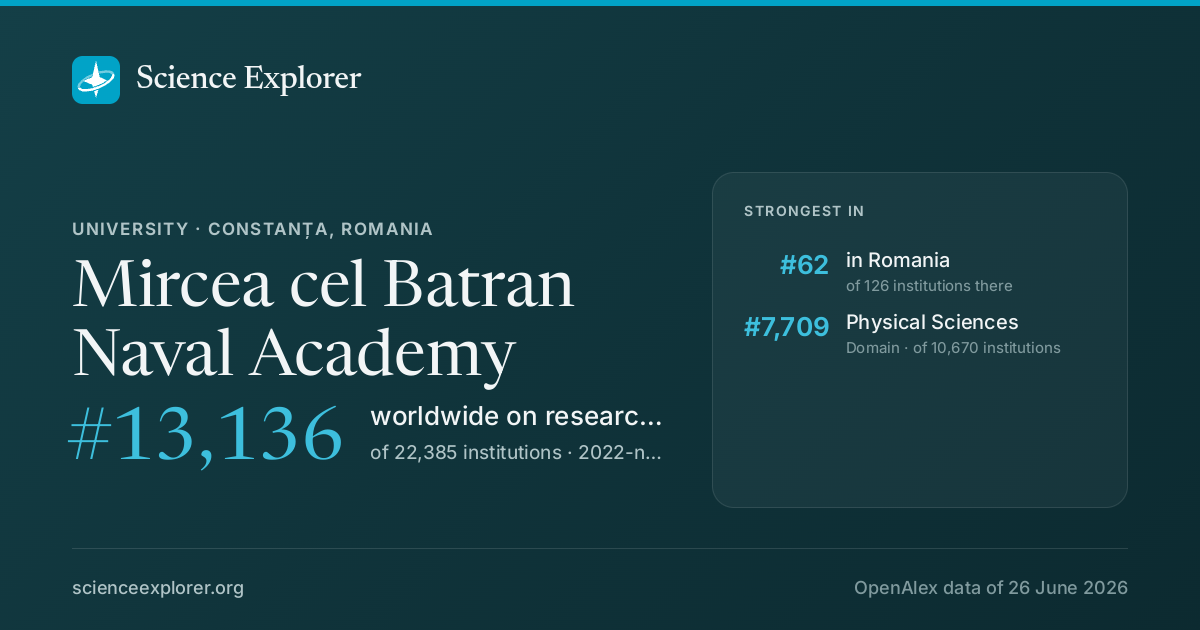
Mircea cel Batran Naval Academy on Science Explorer

A card with Mircea cel Batran Naval Academy's standing and the fields it leads in, for a post or a slide. A link to this page previews as the same card.

Download the card

1200 × 630 PNG, sized for social posts, drawn from the latest snapshot.

Badges for a website1Each links back here and updates with every snapshot

Research measures only: rankings here say nothing about teaching, admissions or student experience. Comparable institutions and collaboration partners have tabs of their own, above.

Discussion

Ask a question or share a note about Mircea cel Batran Naval Academy. Posts are plain text and can be reported.