Mohammed V University

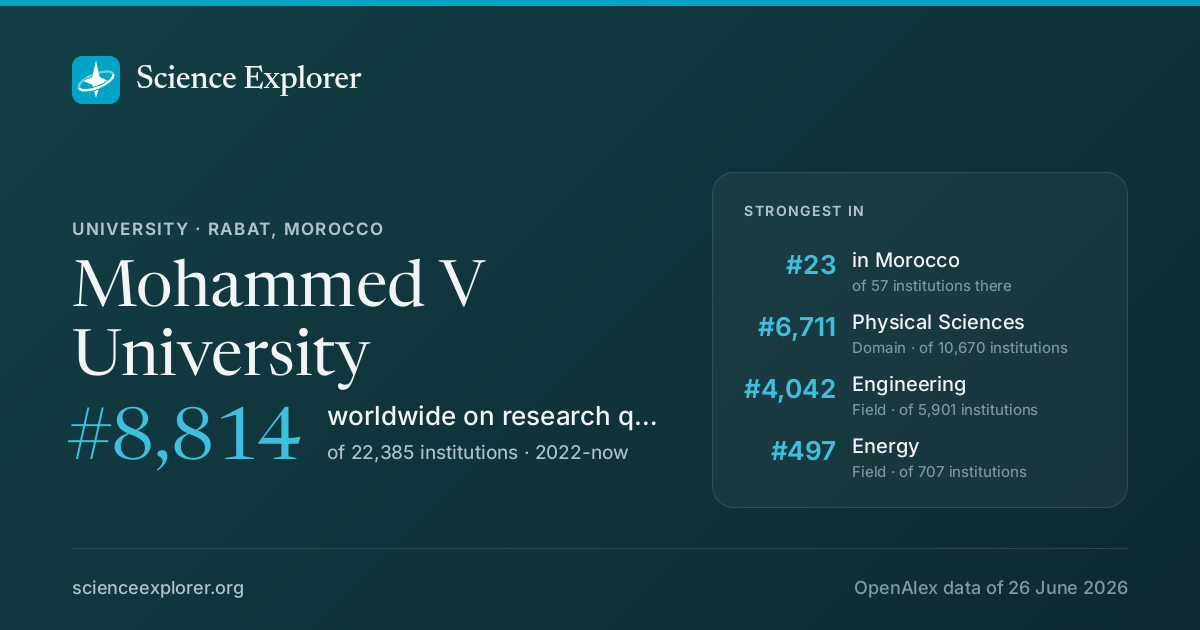
In research, Mohammed V University stands highest in Physical Sciences (#6,711 of 10,670 worldwide), Engineering (#4,042 of 5,901 worldwide) and Energy (#497 of 707 worldwide), 2022-now. Relative to its size it is most specialised in Algebra and Number Theory, Energy Engineering and Power Technology and Rheumatology (Algebra and Number Theory is 3.7× its share of world research).
- World rank, 2022-now
- #8,814 of 22,385 · #10,362 all time
- Rank in Morocco
- #23 of 57
- Research works
- 21k ▲ 36% vs 2018-21
- Citations
- 147k 6.9 per fractional work
- Top-10% rate
- 6.1% all institutions 10.0%
- vs its own fields
- 0.65× 1.00× is exactly expected
- Open access
- 52% world 40%
- International
- 19% world 18%
What is Mohammed V University known for in research?
The fields where it stands highest, 2022-now, ranked among every institution above the floor in each field.
| Field | World rank | Where that sits | Top-10% rate | Works | All time |
|---|---|---|---|---|---|
| Physical SciencesDomain | #6,711 of 10,670 | 8.0% | 3,425 | #8007 | |
| EngineeringField | #4,042 of 5,901 | 7.7% | 1,077 | #5922 | |
| EnergyField | #497 of 707 | 8.8% | 136 | #1015 | |
| Computer ScienceField | #3,196 of 4,417 | 6.8% | 897 | #4049 | |
| Materials ScienceField | #1,682 of 2,276 | 11.4% | 376 | #2470 | |
| Plant ScienceSubfield | #1,097 of 1,317 | 13.1% | 180 | #2002 | |
| Agricultural and Biological SciencesField | #2,699 of 3,157 | 11.7% | 358 | #3788 | |
| Electrical and Electronic EngineeringSubfield | #1,871 of 2,176 | 9.4% | 313 | #3103 | |
| Materials ChemistrySubfield | #1,276 of 1,473 | 11.6% | 238 | #2186 | |
| ChemistryField | #1,137 of 1,299 | 12.1% | 123 | #2473 |
Each strip is that field's whole ranked pool, with the notch where Mohammed V University sits in it, in the colour of the band that rank falls in. The track under the rate is the rate itself: it carries no average mark, because the average differs by field (from about 6% in Dentistry to 21% in Economics).
Which of those standings moved
The same fields on both windows: where it stood over the whole record, and where it stands in 2022-now. The distance is the story, and it is the one thing the two rank columns above cannot show.
- Physical Sciences#8,007 #6,711
- Engineering#5,922 #4,042
- Energy#1,015 #497
- Computer Science#4,049 #3,196
- Materials Science#2,470 #1,682
- Plant Science#2,002 #1,097
- Agricultural and Biological Sciences#3,788 #2,699
- Electrical and Electronic Engineering#3,103 #1,871
- Materials Chemistry#2,186 #1,276
- Chemistry#2,473 #1,137
A dot further right is a better standing. Fields it was not ranked in over the whole record are left out.
Which fields of science does Mohammed V University work in?
In 2022-now, 42% of research at Mohammed V University is in Physical Sciences, 31% in Health Sciences. Its largest fields are Medicine (28%), Engineering (13%), Computer Science (11%). It does 1.4× the world's share of Health Sciences.
Each ring splits the one inside it: the four domains of science, their fields, their subfields. Size is fractional works in 2022-now. Every slice is a page; the interactive view zooms down to single topics and colours each by how much more of it this institution does than the world.
Its 4 domains and 26 fields, with their numbers
- Physical Sciences3,90042.1%
- Engineering1,21113.1%
- Computer Science1,02111.0%
- Materials Science4294.6%
- Environmental Science4044.4%
- Physics and Astronomy2392.6%
- Energy1571.7%
- Mathematics1481.6%
- Chemistry1361.5%
- Earth and Planetary Sciences1361.5%
- Chemical Engineering180.2%
- Health Sciences2,90531.3%
- Medicine2,57627.8%
- Health Professions1912.1%
- Dentistry1101.2%
- Nursing230.2%
- Veterinary50.0%
- Social Sciences1,55716.8%
- Social Sciences6286.8%
- Business, Management and Accounting3513.8%
- Economics, Econometrics and Finance2292.5%
- Psychology1451.6%
- Arts and Humanities1101.2%
- Decision Sciences931.0%
- Life Sciences9089.8%
What does Mohammed V University specialise in?
Where its research is concentrated relative to its size: Algebra and Number Theory takes 3.7× the share of its output that it takes of world research.
- Algebra and Number TheorySubfield · 22.2 works3.7×
- Energy Engineering and Power TechnologySubfield · 32.9 works3.3×
- RheumatologySubfield · 137.1 works3.2×
- GastroenterologySubfield · 34.2 works3.1×
- Oral SurgerySubfield · 55.8 works3.1×
Location quotient, a volume reading rather than an impact one. It surfaces small, lopsided specialities.
Field profile
Location quotient across every field it publishes in: outside the ring is more than an institution of this size would be expected to publish, inside it is less.
Rings at 0.5×, 1× and 2×. Widest outward: Dentistry, 2.5×. Every wedge is a field page.
All 26 fields, with their numbers
- Dentistry2.45×110 works
- Energy1.84×157 works
- Medicine1.45×2,576 works
- Computer Science1.42×1,021 works
- Mathematics1.36×148 works
- Materials Science1.33×429 works
- Business, Management and Accounting1.18×351 works
- Physics and Astronomy1.16×239 works
- Economics, Econometrics and Finance1.15×228 works
- Decision Sciences1.04×93 works
- Chemistry0.94×136 works
- Earth and Planetary Sciences0.94×136 works
- Agricultural and Biological Sciences0.90×397 works
- Environmental Science0.88×404 works
- Engineering0.87×1,211 works
- Pharmacology, Toxicology and Pharmaceutics0.82×27 works
- Health Professions0.78×191 works
- Biochemistry, Genetics and Molecular Biology0.69×342 works
- Immunology and Microbiology0.65×61 works
- Chemical Engineering0.56×18 works
- Neuroscience0.54×81 works
- Social Sciences0.54×628 works
- Nursing0.51×23 works
- Psychology0.51×145 works
- Arts and Humanities0.41×110 works
- Veterinary0.36×5 works
- Dentistry 2.5×
- Energy 1.8×
- Medicine 1.4×
- Computer Science 1.4×
- Mathematics 1.4×
- Materials Science 1.3×
- Business, Management and Accounting 1.2×
- Physics and Astronomy 1.2×
- Economics, Econometrics and Finance 1.1×
- Decision Sciences 1.0×
- Chemistry 0.9×
- Earth and Planetary Sciences 0.9×
- Agricultural and Biological Sciences 0.9×
- Environmental Science 0.9×
- Engineering 0.9×
- Pharmacology, Toxicology and Pharmaceutics 0.8×
- Health Professions 0.8×
- Biochemistry, Genetics and Molecular Biology 0.7×
- Immunology and Microbiology 0.7×
- Chemical Engineering 0.6×
- Neuroscience 0.5×
- Social Sciences 0.5×
- Nursing 0.5×
- Psychology 0.5×
- Arts and Humanities 0.4×
- Veterinary 0.4×
Who are the top researchers at Mohammed V University?
Ranked on the quality score, Nasreddine El Omari, Bilal Lamrani and Amine Ali Zeggwagh lead among researchers whose main affiliation is Mohammed V University.
- 1
Nasreddine El Omari
 Morocco · #1,433,929 worldwide
6.2k citations · 134 works
- 2
Bilal Lamrani
Morocco · #1,464,021 worldwide
2.5k citations · 64 works
- 3
Amine Ali Zeggwagh
Morocco · #1,567,430 worldwide
4.4k citations · 100 works
- 4
Oumaima Outani
Morocco · #1,689,592 worldwide
3.5k citations · 34 works
- 5
Abdelaali Balahbib
Morocco · #1,750,157 worldwide
3.7k citations · 78 works
- 6
Mohammed Kharrich
Morocco · #1,765,800 worldwide
860 citations · 20 works
- 7 Bouabid Badaoui #1,813,369 worldwide 3.4k citations · 168 works
- 8 Ahmed Bouhouche #1,893,634 worldwide 2.6k citations · 78 works
- 9 Moha Cherkaoui #1,911,871 worldwide 543 citations · 34 works
- 10 Rachid Ahl Laamara #1,926,380 worldwide 326 citations · 60 works
Which keywords describe research at Mohammed V University?
By fractional works in 2022-now, weighted toward what it does more of than the world: Deep Learning, Machine Learning, Epidemiology, Surgical Management, Renewable Energy, Diagnosis, Treatment and Neural Networks.
- Family Law
- Territorial Governance
- Spintronics
- Nanocrystals
- Anomaly Detection
- Solar Energy
- Electronic Structure
- Complications
- Convolutional Neural Networks
- Genetic Mutations
- Energy Efficiency
- Internet of Things
- Management
- Quality of Life
- Healthcare
- Surgical Management
- Neural Networks
- Diagnosis
- Renewable Energy
- Deep Learning
- Epidemiology
- Machine Learning
- Sustainability
- Treatment
- Climate Change
- Environmental Impact
- Big Data
- Supply Chain Management
- Chemotherapy
- Prognostic Factors
- Security
- Data Mining
- Clinical Practice Guidelines
- IoT Security
- Efficiency
- Power Electronics
- Islam
- Prenatal Diagnosis
- North Africa
- Local Development
Size is fractional works in 2022-now in the topics tagged with each word; colour is the word's share of this institution's work against its share of the world's. The 40 words are chosen for being large and distinctive. Each links to the topic it comes from most.
All 40 words, with their numbers
- Epidemiology536▲ 1.45×131 topics
- Deep Learning523▲ 1.63×79 topics
- Machine Learning502▲ 1.63×86 topics
- Renewable Energy271▲ 2.0×41 topics
- Sustainability230◆ 1.01×74 topics
- Diagnosis220▲ 2.5×41 topics
- Treatment210▲ 1.87×52 topics
- Neural Networks210▲ 1.47×40 topics
- Climate Change184▼ 0.73×89 topics
- Surgical Management175▲ 4.6×20 topics
- Environmental Impact165◆ 1.04×54 topics
- Healthcare150▲ 1.42×25 topics
- Big Data140▲ 1.57×28 topics
- Quality of Life140◆ 1.04×54 topics
- Supply Chain Management137▲ 1.65×23 topics
- Management131▲ 1.77×35 topics
- Chemotherapy129▲ 1.97×24 topics
- Internet of Things127▲ 1.60×20 topics
- Prognostic Factors120▲ 3.0×14 topics
- Energy Efficiency113▲ 1.32×35 topics
- Security112▲ 1.80×22 topics
- Genetic Mutations111▲ 2.7×23 topics
- Data Mining108▲ 1.58×19 topics
- Convolutional Neural Networks105▲ 1.56×14 topics
- Clinical Practice Guidelines102▲ 2.0×14 topics
- Complications98▲ 2.1×17 topics
- IoT Security88▲ 3.1×3 topics
- Electronic Structure85▲ 5.1×8 topics
- Efficiency81▲ 2.9×6 topics
- Solar Energy75▲ 2.6×5 topics
- Power Electronics74▲ 2.5×8 topics
- Anomaly Detection70▲ 2.6×4 topics
- Islam69▲ 3.6×3 topics
- Nanocrystals68▲ 2.8×5 topics
- Prenatal Diagnosis59▲ 4.4×7 topics
- Spintronics58▲ 4.9×4 topics
- North Africa56▲ 17×2 topics
- Territorial Governance54▲ 5.1×4 topics
- Local Development53▲ 5.5×2 topics
- Family Law41▲ 10×2 topics
Which research topics does Mohammed V University publish most on?
By volume in 2022-now: Multiculturalism, Politics, Migration, Gender, Social Sciences and Governance, Network Security and Intrusion Detection and Perovskite Materials and Applications.
Area is fractional works; colour is the subfield each topic belongs to.
- 1 Multiculturalism, Politics, Migration, Gender Political Science and International Relations 41 works
- 2 Social Sciences and Governance Urban Studies 38 works
- 3 Network Security and Intrusion Detection Computer Networks and Communications 36 works
- 4 Perovskite Materials and Applications Electrical and Electronic Engineering 36 works
- 5 Blockchain Technology Applications and Security Information Systems 34 works
- 6 Microgrid Control and Optimization Control and Systems Engineering 33 works
- 7 Sarcoma Diagnosis and Treatment Pulmonary and Respiratory Medicine 32 works
- 8 Geological and Geophysical Studies Worldwide Geophysics 30 works
- 9 Heusler alloys: electronic and magnetic properties Electronic, Optical and Magnetic Materials 30 works
- 10 Smart Agriculture and AI Plant Science 30 works
How open and international is its research?
Against the world's own shares: the tick on each track. Both are shares of its output, so they sit on one scale and can be read against each other as well as against the world.
World: 40% of research is openly available.
World: 18% is written across borders.
How has Mohammed V University's research output changed?
Output in 2022-2025 was 36% higher than in 2018-2021.
The same series as a ribbon: one cell per year, darker for more. The line above answers how much; this answers when.
Its share of all research
Growing output can still be a shrinking share: all of science grows. This is Mohammed V University as a percentage of every work published that year, 0.037% in 2024.
Fractional works of Mohammed V University over all fractional works that year. How the balance of science has shifted.
How much of it reaches the world top 10%
Year by year, against all institutions in the same year.
Of each year's output, the share that reached the world's 10% most cited for its field and year. Peak 6.8% in 2008.
Other research institutions in Rabat
- Institut National de la Recherche Agronomique
- Centre Hospitalier Ibn Sina
- Centre National pour la Recherche Scientifique et Technique (CNRST)
- Ecole Mohammadia d'Ingénieurs
- Institut Agronomique et Vétérinaire Hassan II
- Institut National des Postes et Télécommunications
- Institut National d'Oncologie
- Instituts Supérieurs des Professions Infirmières et Techniques de Santé

Share Mohammed V University's ranking
Badges for a website1Each links back here and updates with every snapshot

Research measures only: rankings here say nothing about teaching, admissions or student experience. Comparable institutions and collaboration partners have tabs of their own, above.
Discussion
Ask a question or share a note about Mohammed V University. Posts are plain text and can be reported.