Science Explorer Back to mapMap
Discussion
University · Lagos · Nigeria

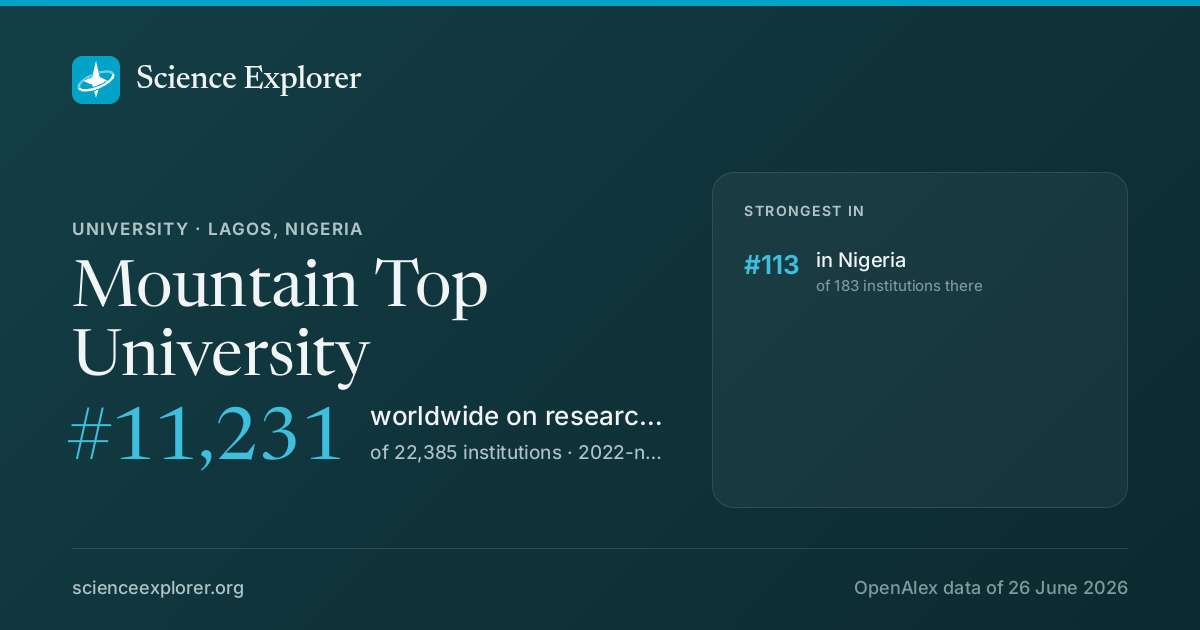
Mountain Top University

World rank, 2022-now
#11,231
of 22,385 · #18,668 all time
Rank in Nigeria
#113
of 183
Research works
302
▲ 91% vs 2018-21
Citations
1.8k
5.9 per fractional work
Top-10% rate
4.5%
all institutions 10.0%
vs its own fields
0.93×
1.00× is exactly expected
Open access
75%
world 40%
International
22%
world 18%

Which fields of science does Mountain Top University work in?

In 2022-now, 35% of research at Mountain Top University is in Social Sciences, 30% in Physical Sciences. Its largest fields are Medicine (11%), Social Sciences (11%), Agricultural and Biological Sciences (10%). It does 1.4× the world's share of Social Sciences.

Social Sciences: 69 fractional works · 35.2% of its workSocial Sciences: 22 fractional works · 11.2% of its workEducation: 7 fractional works · 3.4% of its workSociology and Political Science: 6 fractional works · 2.9% of its workLibrary and Information Sciences: 2 fractional works · 1.1% of its workCommunication: 2 fractional works · 0.8% of its workPublic Administration: 1 fractional works · 0.5% of its workPolitical Science and International Relations: 1 fractional works · 0.4% of its workHealth: 1 fractional works · 0.3% of its workGender Studies: 1 fractional works · 0.3% of its workAnthropology: 0 fractional works · 0.3% of its workHuman Factors and Ergonomics: 0 fractional works · 0.3% of its workLinguistics and Language: 0 fractional works · 0.3% of its workSmaller subfields together: 1 fractional works · 0.6% of its workArts and Humanities: 16 fractional works · 8.3% of its workLiterature and Literary Theory: 5 fractional works · 2.4% of its workReligious studies: 4 fractional works · 2.0% of its workLanguage and Linguistics: 3 fractional works · 1.4% of its workVisual Arts and Performing Arts: 2 fractional works · 0.9% of its workPhilosophy: 1 fractional works · 0.7% of its workMusic: 1 fractional works · 0.6% of its workSmaller subfields together: 1 fractional works · 0.3% of its workEconomics, Econometrics and Finance: 12 fractional works · 6.2% of its workEconomics and Econometrics: 9 fractional works · 4.4% of its workGeneral Economics, Econometrics and Finance: 2 fractional works · 1.1% of its workFinance: 2 fractional works · 0.8% of its workBusiness, Management and Accounting: 12 fractional works · 6.1% of its workStrategy and Management: 6 fractional works · 2.9% of its workAccounting: 2 fractional works · 1.1% of its workMarketing: 1 fractional works · 0.6% of its workManagement Information Systems: 1 fractional works · 0.6% of its workOrganizational Behavior and Human Resource Management: 1 fractional works · 0.4% of its workManagement of Technology and Innovation: 1 fractional works · 0.3% of its workSmaller subfields together: 0 fractional works · 0.1% of its workDecision Sciences: 4 fractional works · 2.2% of its workManagement Science and Operations Research: 3 fractional works · 1.6% of its workInformation Systems and Management: 1 fractional works · 0.5% of its workSmaller subfields together: 0 fractional works · 0.1% of its workPsychology: 2 fractional works · 1.2% of its workSocial Psychology: 1 fractional works · 0.6% of its workClinical Psychology: 1 fractional works · 0.3% of its workDevelopmental and Educational Psychology: 0 fractional works · 0.3% of its workSmaller subfields together: 0 fractional works · 0.2% of its workPhysical Sciences: 58 fractional works · 29.5% of its workEnvironmental Science: 15 fractional works · 7.4% of its workWater Science and Technology: 4 fractional works · 2.0% of its workIndustrial and Manufacturing Engineering: 3 fractional works · 1.4% of its workHealth, Toxicology and Mutagenesis: 3 fractional works · 1.3% of its workManagement, Monitoring, Policy and Law: 1 fractional works · 0.6% of its workEnvironmental Chemistry: 1 fractional works · 0.5% of its workPollution: 1 fractional works · 0.5% of its workEcology: 1 fractional works · 0.4% of its workEnvironmental Engineering: 1 fractional works · 0.4% of its workGlobal and Planetary Change: 1 fractional works · 0.3% of its workEngineering: 13 fractional works · 6.5% of its workOcean Engineering: 3 fractional works · 1.5% of its workBiomedical Engineering: 3 fractional works · 1.4% of its workMechanical Engineering: 2 fractional works · 0.9% of its workIndustrial and Manufacturing Engineering: 1 fractional works · 0.7% of its workBuilding and Construction: 1 fractional works · 0.7% of its workMechanics of Materials: 1 fractional works · 0.4% of its workCivil and Structural Engineering: 1 fractional works · 0.3% of its workSmaller subfields together: 1 fractional works · 0.6% of its workComputer Science: 12 fractional works · 5.9% of its workInformation Systems: 3 fractional works · 1.7% of its workArtificial Intelligence: 3 fractional works · 1.5% of its workComputational Theory and Mathematics: 2 fractional works · 1.1% of its workHuman-Computer Interaction: 2 fractional works · 0.8% of its workComputer Networks and Communications: 1 fractional works · 0.5% of its workComputer Vision and Pattern Recognition: 1 fractional works · 0.4% of its workEarth and Planetary Sciences: 7 fractional works · 3.5% of its workGeophysics: 4 fractional works · 2.2% of its workOceanography: 1 fractional works · 0.5% of its workGeochemistry and Petrology: 1 fractional works · 0.4% of its workSmaller subfields together: 1 fractional works · 0.5% of its workMathematics: 5 fractional works · 2.6% of its workModeling and Simulation: 3 fractional works · 1.6% of its workNumerical Analysis: 1 fractional works · 0.4% of its workMathematical Physics: 1 fractional works · 0.3% of its workSmaller subfields together: 1 fractional works · 0.3% of its workMaterials Science: 3 fractional works · 1.4% of its workMaterials Chemistry: 2 fractional works · 0.9% of its workBiomaterials: 0 fractional works · 0.2% of its workPolymers and Plastics: 0 fractional works · 0.2% of its workSmaller subfields together: 0 fractional works · 0.1% of its workEnergy: 2 fractional works · 1.1% of its workRenewable Energy, Sustainability and the Environment: 2 fractional works · 1.1% of its workChemistry: 1 fractional works · 0.7% of its workInorganic Chemistry: 1 fractional works · 0.4% of its workSmaller subfields together: 1 fractional works · 0.4% of its workPhysics and Astronomy: 1 fractional works · 0.3% of its workAstronomy and Astrophysics: 1 fractional works · 0.3% of its workChemical Engineering: 0 fractional works · 0.1% of its workLife Sciences: 37 fractional works · 18.9% of its workAgricultural and Biological Sciences: 19 fractional works · 9.7% of its workPlant Science: 8 fractional works · 4.1% of its workFood Science: 7 fractional works · 3.5% of its workInsect Science: 1 fractional works · 0.5% of its workForestry: 1 fractional works · 0.5% of its workAgronomy and Crop Science: 1 fractional works · 0.4% of its workAnimal Science and Zoology: 1 fractional works · 0.4% of its workGeneral Agricultural and Biological Sciences: 1 fractional works · 0.3% of its workSmaller subfields together: 0 fractional works · 0.1% of its workBiochemistry, Genetics and Molecular Biology: 14 fractional works · 6.9% of its workMolecular Biology: 5 fractional works · 2.3% of its workGenetics: 3 fractional works · 1.4% of its workEndocrinology: 2 fractional works · 1.0% of its workMolecular Medicine: 1 fractional works · 0.6% of its workBiotechnology: 1 fractional works · 0.6% of its workClinical Biochemistry: 1 fractional works · 0.3% of its workAging: 0 fractional works · 0.3% of its workSmaller subfields together: 1 fractional works · 0.4% of its workImmunology and Microbiology: 3 fractional works · 1.4% of its workImmunology: 1 fractional works · 0.7% of its workApplied Microbiology and Biotechnology: 1 fractional works · 0.3% of its workParasitology: 0 fractional works · 0.2% of its workVirology: 0 fractional works · 0.2% of its workPharmacology, Toxicology and Pharmaceutics: 1 fractional works · 0.6% of its workPharmacology: 1 fractional works · 0.6% of its workSmaller subfields together: 0 fractional works · 0.0% of its workNeuroscience: 0 fractional works · 0.2% of its workHealth Sciences: 32 fractional works · 16.4% of its workMedicine: 22 fractional works · 11.2% of its workPublic Health, Environmental and Occupational Health: 5 fractional works · 2.5% of its workInfectious Diseases: 2 fractional works · 1.2% of its workEndocrinology, Diabetes and Metabolism: 2 fractional works · 0.9% of its workComplementary and alternative medicine: 1 fractional works · 0.6% of its workBiochemistry: 1 fractional works · 0.6% of its workReproductive Medicine: 1 fractional works · 0.6% of its workOncology: 1 fractional works · 0.6% of its workPsychiatry and Mental health: 1 fractional works · 0.5% of its workPhysiology: 1 fractional works · 0.5% of its workEpidemiology: 1 fractional works · 0.5% of its workNeurology: 1 fractional works · 0.3% of its workHematology: 1 fractional works · 0.3% of its workPediatrics, Perinatology and Child Health: 1 fractional works · 0.3% of its workSurgery: 0 fractional works · 0.2% of its workObstetrics and Gynecology: 0 fractional works · 0.2% of its workRadiology, Nuclear Medicine and Imaging: 0 fractional works · 0.2% of its workSmaller subfields together: 2 fractional works · 1.1% of its workNursing: 8 fractional works · 3.9% of its workNutrition and Dietetics: 6 fractional works · 2.9% of its workResearch and Theory: 1 fractional works · 0.7% of its workIssues, ethics and legal aspects: 1 fractional works · 0.3% of its workHealth Professions: 2 fractional works · 1.2% of its workGeneral Health Professions: 2 fractional works · 0.8% of its workHealth Information Management: 1 fractional works · 0.3% of its workSmaller subfields together: 0 fractional works · 0.2% of its workDentistry: 0 fractional works · 0.1% of its workVeterinary: 0 fractional works · 0.1% of its workALL ITS WORKMountain TopUniversity198fractional works, 2022-now
Life Sciences19%Physical Sciences30%Health Sciences16%Social Sciences35%

Each ring splits the one inside it: the four domains of science, their fields, their subfields. Size is fractional works in 2022-now. Every slice is a page; the interactive view zooms down to single topics and colours each by how much more of it this institution does than the world.

Its 4 domains and 26 fields, with their numbers
    1. Social Sciences2211.2%
    2. Arts and Humanities168.3%
    3. Economics, Econometrics and Finance126.2%
    4. Business, Management and Accounting126.1%
    5. Decision Sciences42.2%
    6. Psychology21.2%
    1. Environmental Science157.4%
    2. Engineering136.5%
    3. Computer Science125.9%
    4. Earth and Planetary Sciences73.5%
    5. Mathematics52.6%
    6. Materials Science31.4%
    7. Energy21.1%
    8. Chemistry10.7%
    9. Physics and Astronomy10.3%
    10. Chemical Engineering00.1%
    1. Agricultural and Biological Sciences199.7%
    2. Biochemistry, Genetics and Molecular Biology146.9%
    3. Immunology and Microbiology31.4%
    4. Pharmacology, Toxicology and Pharmaceutics10.6%
    5. Neuroscience00.2%
    1. Medicine2211.2%
    2. Nursing83.9%
    3. Health Professions21.2%
    4. Dentistry00.1%
    5. Veterinary00.1%
All of science, and how each field's share has moved since 1950: the Science domain explorer

Field profile

Location quotient across every field it publishes in: outside the ring is more than an institution of this size would be expected to publish, inside it is less.

Agricultural and Biological Sciences: 2.05× its world share, 19 worksAgricultural and Bio…Biochemistry, Genetics and Molecular Biology: 1.30× its world share, 14 worksBiochemistry, Geneti…Immunology and Microbiology: 1.36× its world share, 3 worksImmunology and Micro…Neuroscience: 0.13× its world share, 0 worksNeurosciencePharmacology, Toxicology and Pharmaceutics: 1.80× its world share, 1 worksPharmacology, Toxico…Chemical Engineering: 0.16× its world share, 0 worksChemical EngineeringChemistry: 0.46× its world share, 1 worksChemistryComputer Science: 0.76× its world share, 12 worksComputer ScienceEarth and Planetary Sciences: 2.22× its world share, 7 worksEarth and Planetary …Energy: 1.22× its world share, 2 worksEnergyEngineering: 0.43× its world share, 13 worksEngineeringEnvironmental Science: 1.49× its world share, 15 worksEnvironmental ScienceMaterials Science: 0.41× its world share, 3 worksMaterials ScienceMathematics: 2.17× its world share, 5 worksMathematicsPhysics and Astronomy: 0.15× its world share, 1 worksPhysics and AstronomyDentistry: 0.26× its world share, 0 worksDentistryHealth Professions: 0.46× its world share, 2 worksHealth ProfessionsMedicine: 0.58× its world share, 22 worksMedicineNursing: 7.90× its world share, 8 worksNursingVeterinary: 0.41× its world share, 0 worksVeterinaryArts and Humanities: 2.87× its world share, 16 worksArts and HumanitiesBusiness, Management and Accounting: 1.89× its world share, 12 worksBusiness, Management…Decision Sciences: 2.25× its world share, 4 worksDecision SciencesEconomics, Econometrics and Finance: 2.89× its world share, 12 worksEconomics, Econometr…Psychology: 0.41× its world share, 2 worksPsychologySocial Sciences: 0.88× its world share, 22 worksSocial Sciences1×world share
more than its size predictsabout as predictedless

Rings at 0.5×, 1× and 2×. Widest outward: Nursing, 7.9×. Every wedge is a field page.

All 26 fields, with their numbers
  1. Nursing7.90×8 works
  2. Economics, Econometrics and Finance2.89×12 works
  3. Arts and Humanities2.87×16 works
  4. Decision Sciences2.25×4 works
  5. Earth and Planetary Sciences2.22×7 works
  6. Mathematics2.17×5 works
  7. Agricultural and Biological Sciences2.05×19 works
  8. Business, Management and Accounting1.89×12 works
  9. Pharmacology, Toxicology and Pharmaceutics1.80×1 works
  10. Environmental Science1.49×15 works
  11. Immunology and Microbiology1.36×3 works
  12. Biochemistry, Genetics and Molecular Biology1.30×14 works
  13. Energy1.22×2 works
  14. Social Sciences0.88×22 works
  15. Computer Science0.76×12 works
  16. Medicine0.58×22 works
  17. Chemistry0.46×1 works
  18. Health Professions0.46×2 works
  19. Engineering0.43×13 works
  20. Materials Science0.41×3 works
  21. Veterinary0.41×0 works
  22. Psychology0.41×2 works
  23. Dentistry0.26×0 works
  24. Chemical Engineering0.16×0 works
  25. Physics and Astronomy0.15×1 works
  26. Neuroscience0.13×0 works

Who are the top researchers at Mountain Top University?

Ranked on the quality score, Olanrewaju Emmanuel Fayemi, Edwin Andrew Ofudje and Akindele Akano Onifade lead among researchers whose main affiliation is Mountain Top University.

  1. 1 Olanrewaju Emmanuel Fayemi Nigeria · #1,648,886 worldwide 604 citations · 27 works
  2. 2 Edwin Andrew Ofudje Nigeria · #1,860,816 worldwide 1.1k citations · 72 works
  3. 3 Akindele Akano Onifade Nigeria · #3,099,954 worldwide 716 citations · 26 works
  4. 4 Mary Omolola Omosebi Nigeria · #3,107,976 worldwide 194 citations · 22 works
  5. 5 Ezekiel Folorunso Sodiya Nigeria · #3,116,962 worldwide 206 citations · 20 works
  6. 6 Gboyega Ebenezer Adebami Nigeria · #3,370,571 worldwide 283 citations · 28 works
  7. 7 Moses Akindele Abiala Nigeria · #3,939,743 worldwide 596 citations · 41 works
  8. 8 Adeyemi Adewale Akinola Nigeria · #4,192,934 worldwide 38 citations · 14 works
  9. 9 Omowumi Titilola Kayode Nigeria · #4,323,803 worldwide 687 citations · 62 works
  10. 10 Mariam Anana Nigeria · #4,345,631 worldwide 5 citations · 16 works
All ranked researchers at Mountain Top University

What are the most cited papers from Mountain Top University?

The most cited paper from Mountain Top University is "Burden of foodborne diseases: think global, act local" (Sara Monteiro Pires, Binyam Negussie Desta, Lapo Mughini‐Gras et al., 2021), with 255 citations. Next come "Synthesis and characterization of Zn-Doped hydroxyapatite: scaffold application, antibacterial and bioactivity studies" (213) and "Frying of Food: A Critical Review" (185).

Most cited papers
#PaperReleasedCitations
1 Burden of foodborne diseases: think global, act local Sara Monteiro Pires, Binyam Negussie Desta, Lapo Mughini‐Gras et al. · Current Opinion in Food Science ReviewOpen access 2 Feb 2021 255
2 Synthesis and characterization of Zn-Doped hydroxyapatite: scaffold application, antibacterial and bioactivity studies Edwin Andrew Ofudje, Abideen Idowu Adeogun, Mopelola Abidemi Idowu et al. · Heliyon Open access May 2019 213
3 Frying of Food: A Critical Review Emmanuel Kehinde Oke, Mopelola Abidemi Idowu, OLAJIDE PHILIP SOBUKOLA et al. · Journal of Culinary Science & Technology 23 Jun 2017 185
4 Orange peel as low-cost adsorbent in the elimination of Cd(II) ion: kinetics, isotherm, thermodynamic and optimization evaluations Temilade Fola Akinhanmi, Edwin Andrew Ofudje, Abideen Idowu Adeogun et al. · Bioresources and Bioprocessing Open access 22 Jun 2020 137
5 Salt stress tolerance mechanisms and potential applications of legumes for sustainable reclamation of salt‐degraded soils Moses Akindele Abiala, Mostafa H. Abdelrahman, David John Burritt et al. · Land Degradation and Development 17 Jul 2018 134
All 59 most cited papers, with filters and sorting

Which keywords describe research at Mountain Top University?

By fractional works in 2022-now, weighted toward what it does more of than the world: Health Benefits, Globalization, Epidemiology, Adsorption, Economic Growth, Social Interaction, Infectious Diseases and Antioxidant.

▲ more of its work than of the world's◆ about the world's share▼ less than the world's

Size is fractional works in 2022-now in the topics tagged with each word; colour is the word's share of this institution's work against its share of the world's. The 40 words are chosen for being large and distinctive. Each links to the topic it comes from most.

All 40 words, with their numbers
  1. Epidemiology11▲ 1.35×24 topics
  2. Globalization8▲ 2.1×21 topics
  3. Sustainability7▲ 1.54×19 topics
  4. Oxidative Stress7▲ 2.0×20 topics
  5. Environmental Impact6▲ 1.87×20 topics
  6. Economic Growth6▲ 3.6×8 topics
  7. COVID-195▲ 2.1×8 topics
  8. Antioxidant5▲ 3.7×22 topics
  9. Health Benefits5▲ 7.7×7 topics
  10. Social Interaction4▲ 5.8×3 topics
  11. Infectious Diseases4▲ 6.5×6 topics
  12. Adsorption4▲ 9.8×5 topics
  13. Antioxidants4▲ 4.5×9 topics
  14. Health Effects4▲ 3.3×12 topics
  15. Financial Performance4▲ 3.5×7 topics
  16. Toxicity4▲ 4.1×11 topics
  17. Dietary Fiber3▲ 16×3 topics
  18. Fiscal Policy3▲ 8.4×4 topics
  19. Biochar3▲ 9.7×2 topics
  20. Modeling3▲ 7.0×2 topics
  21. Food Safety3▲ 5.8×8 topics
  22. Cancer Prevention3▲ 6.0×7 topics
  23. Rheological Properties3▲ 8.9×3 topics
  24. Technology Integration3▲ 5.0×8 topics
  25. Wastewater Treatment3▲ 6.1×4 topics
  26. Heavy Metals3▲ 6.2×3 topics
  27. Institutions3▲ 19×2 topics
  28. Metabolic Health3▲ 7.3×3 topics
  29. Public Health Interventions3▲ 20×1 topic
  30. transmission dynamics3▲ 21×1 topic
  31. Bioavailability3▲ 7.0×5 topics
  32. Human Capital3▲ 8.9×3 topics
  33. Contaminant Removal3▲ 17×1 topic
  34. Glycemic Index3▲ 23×1 topic
  35. Starch3▲ 23×1 topic
  36. Surface Area3▲ 17×1 topic
  37. Institutional Quality2▲ 12×2 topics
  38. Financial Development2▲ 8.3×2 topics
  39. Panel Data Analysis2▲ 8.1×2 topics
  40. R&D2▲ 16×2 topics

Which research topics does Mountain Top University publish most on?

By volume in 2022-now: COVID-19 epidemiological studies, Food composition and properties, Adsorption and biosorption for pollutant removal and Economic Growth and Productivity.

  1. 1 COVID-19 epidemiological studies Modeling and Simulation 3 works
  2. 2 Food composition and properties Nutrition and Dietetics 3 works
  3. 3 Adsorption and biosorption for pollutant removal Water Science and Technology 3 works
  4. 4 Economic Growth and Productivity Economics and Econometrics 2 works
  5. 5 Geophysical and Geoelectrical Methods Geophysics 2 works
  6. 6 Language, Discourse, Communication Strategies Language and Linguistics 2 works
  7. 7 Corporate Social Responsibility Reporting Strategy and Management 2 works
  8. 8 Economic Growth and Development Information Systems 2 works
  9. 9 Geophysical Methods and Applications Ocean Engineering 2 works
  10. 10 Fiscal Policy and Economic Growth Economics and Econometrics 2 works

How open and international is its research?

Against the world's own shares: the tick on each track. Both are shares of its output, so they sit on one scale and can be read against each other as well as against the world.

openly available75.4%not open24.6%

World: 40% of research is openly available.

with international co-authors21.9%domestic only78.1%

World: 18% is written across borders.

How has Mountain Top University's research output changed?

Output in 2022-2025 was 91% higher than in 2018-2021.

still counting201520202025
grewheldshrank

The same series as a ribbon: one cell per year, darker for more. The line above answers how much; this answers when.

Its share of all research

Growing output can still be a shrinking share: all of science grows. This is Mountain Top University as a percentage of every work published that year, 0.00064% in 2024.

still counting0.00050%0.0010%0.0015%Mountain Top University0.0010% in 202519801990200020102020

Fractional works of Mountain Top University over all fractional works that year. How the balance of science has shifted.

How much of it reaches the world top 10%

Year by year, against all institutions in the same year.

still counting5%10%15%all institutions10.0% in 2025Mountain Top University3.3% in 2025

Of each year's output, the share that reached the world's 10% most cited for its field and year. Peak 8.4% in 2023.

Other research institutions in Lagos

All research institutions in Lagos

Share Mountain Top University's ranking

Mountain Top University on Science Explorer

A card with Mountain Top University's standing and the fields it leads in, for a post or a slide. A link to this page previews as the same card.

Download the card

1200 × 630 PNG, sized for social posts, drawn from the latest snapshot.

Badges for a website1Each links back here and updates with every snapshot

Research measures only: rankings here say nothing about teaching, admissions or student experience. Comparable institutions and collaboration partners have tabs of their own, above.

Discussion

Ask a question or share a note about Mountain Top University. Posts are plain text and can be reported.