Science Explorer Back to mapMap
Discussion
Company · Tokyo · Japan

Nihon Kohden (Japan)

World rank, all time
#30,086
of 34,923
Rank in Japan
#1,328
of 1,923
Research works
223
▲ 12% vs 2018-21
Citations
2.6k
11.6 per fractional work
Top-10% rate
6.6%
all institutions 10.0%
vs its own fields
0.82×
1.00× is exactly expected
Open access
42%
world 40%
International
15%
world 18%

Which fields of science does Nihon Kohden (Japan) work in?

In 2022-now, 71% of research at Nihon Kohden (Japan) is in Health Sciences, 14% in Life Sciences. Its largest fields are Medicine (66%), Neuroscience (8%), Engineering (8%). It does 2.4× the world's share of Health Sciences.

Health Sciences: 20 fractional works · 70.6% of its workMedicine: 18 fractional works · 66.0% of its workCardiology and Cardiovascular Medicine: 7 fractional works · 26.1% of its workSurgery: 3 fractional works · 9.8% of its workPulmonary and Respiratory Medicine: 2 fractional works · 7.1% of its workPhysiology: 1 fractional works · 3.6% of its workEpidemiology: 1 fractional works · 3.4% of its workCritical Care and Intensive Care Medicine: 1 fractional works · 2.0% of its workOncology: 0 fractional works · 1.8% of its workEndocrinology, Diabetes and Metabolism: 0 fractional works · 1.5% of its workPsychiatry and Mental health: 0 fractional works · 1.3% of its workNeurology: 0 fractional works · 1.2% of its workPediatrics, Perinatology and Child Health: 0 fractional works · 1.2% of its workNephrology: 0 fractional works · 0.9% of its workGenetics: 0 fractional works · 0.8% of its workBiochemistry: 0 fractional works · 0.6% of its workHematology: 0 fractional works · 0.6% of its workRheumatology: 0 fractional works · 0.6% of its workRadiology, Nuclear Medicine and Imaging: 0 fractional works · 0.6% of its workAnesthesiology and Pain Medicine: 0 fractional works · 0.4% of its workEmergency Medicine: 0 fractional works · 0.4% of its workHealth Informatics: 0 fractional works · 0.4% of its workPharmacology: 0 fractional works · 0.4% of its workInfectious Diseases: 0 fractional works · 0.3% of its workHepatology: 0 fractional works · 0.3% of its workPublic Health, Environmental and Occupational Health: 0 fractional works · 0.3% of its workGastroenterology: 0 fractional works · 0.2% of its workPathology and Forensic Medicine: 0 fractional works · 0.2% of its workHealth Professions: 1 fractional works · 3.0% of its workHealth Information Management: 0 fractional works · 0.8% of its workComplementary and Manual Therapy: 0 fractional works · 0.6% of its workPharmacy: 0 fractional works · 0.6% of its workMedical Laboratory Technology: 0 fractional works · 0.4% of its workEmergency Medical Services: 0 fractional works · 0.3% of its workGeneral Health Professions: 0 fractional works · 0.3% of its workDentistry: 0 fractional works · 1.2% of its workOral Surgery: 0 fractional works · 0.8% of its workOrthodontics: 0 fractional works · 0.4% of its workNursing: 0 fractional works · 0.4% of its workNutrition and Dietetics: 0 fractional works · 0.4% of its workLife Sciences: 4 fractional works · 14.0% of its workNeuroscience: 2 fractional works · 7.9% of its workCognitive Neuroscience: 1 fractional works · 3.4% of its workCellular and Molecular Neuroscience: 1 fractional works · 2.8% of its workNeurology: 0 fractional works · 0.8% of its workBehavioral Neuroscience: 0 fractional works · 0.4% of its workDevelopmental Neuroscience: 0 fractional works · 0.4% of its workBiological Psychiatry: 0 fractional works · 0.2% of its workBiochemistry, Genetics and Molecular Biology: 2 fractional works · 5.4% of its workMolecular Biology: 1 fractional works · 3.8% of its workCell Biology: 0 fractional works · 0.5% of its workBiochemistry: 0 fractional works · 0.4% of its workBiophysics: 0 fractional works · 0.4% of its workCancer Research: 0 fractional works · 0.2% of its workSmaller subfields together: 0 fractional works · 0.1% of its workAgricultural and Biological Sciences: 0 fractional works · 0.6% of its workFood Science: 0 fractional works · 0.6% of its workPhysical Sciences: 3 fractional works · 11.3% of its workEngineering: 2 fractional works · 7.9% of its workBiomedical Engineering: 1 fractional works · 4.4% of its workControl and Systems Engineering: 0 fractional works · 1.2% of its workMechanics of Materials: 0 fractional works · 0.9% of its workElectrical and Electronic Engineering: 0 fractional works · 0.8% of its workAerospace Engineering: 0 fractional works · 0.6% of its workComputer Science: 1 fractional works · 3.2% of its workArtificial Intelligence: 1 fractional works · 3.2% of its workEnvironmental Science: 0 fractional works · 0.1% of its workSocial Sciences: 1 fractional works · 4.1% of its workPsychology: 1 fractional works · 2.3% of its workSocial Psychology: 0 fractional works · 1.2% of its workApplied Psychology: 0 fractional works · 0.6% of its workExperimental and Cognitive Psychology: 0 fractional works · 0.3% of its workClinical Psychology: 0 fractional works · 0.3% of its workDecision Sciences: 0 fractional works · 0.8% of its workInformation Systems and Management: 0 fractional works · 0.4% of its workManagement Science and Operations Research: 0 fractional works · 0.4% of its workBusiness, Management and Accounting: 0 fractional works · 0.4% of its workAccounting: 0 fractional works · 0.4% of its workEconomics, Econometrics and Finance: 0 fractional works · 0.4% of its workEconomics and Econometrics: 0 fractional works · 0.4% of its workSocial Sciences: 0 fractional works · 0.2% of its workDemography: 0 fractional works · 0.2% of its workALL ITS WORKNihon Kohden(Japan)28fractional works, 2022-now
Life Sciences14%Physical Sciences11%Health Sciences71%Social Sciences4%

Each ring splits the one inside it: the four domains of science, their fields, their subfields. Size is fractional works in 2022-now. Every slice is a page; the interactive view zooms down to single topics and colours each by how much more of it this institution does than the world.

Its 4 domains and 15 fields, with their numbers
    1. Medicine1866.0%
    2. Health Professions13.0%
    3. Dentistry01.2%
    4. Nursing00.4%
    1. Neuroscience27.9%
    2. Biochemistry, Genetics and Molecular Biology25.4%
    3. Agricultural and Biological Sciences00.6%
    1. Engineering27.9%
    2. Computer Science13.2%
    3. Environmental Science00.1%
    1. Psychology12.3%
    2. Decision Sciences00.8%
    3. Business, Management and Accounting00.4%
    4. Economics, Econometrics and Finance00.4%
    5. Social Sciences00.2%
All of science, and how each field's share has moved since 1950: the Science domain explorer

Field profile

Location quotient across every field it publishes in: outside the ring is more than an institution of this size would be expected to publish, inside it is less.

Agricultural and Biological Sciences: 0.13× its world share, 0 worksAgricultural and Bio…Biochemistry, Genetics and Molecular Biology: 1.02× its world share, 2 worksBiochemistry, Geneti…Neuroscience: 4.88× its world share, 2 worksNeuroscienceComputer Science: 0.41× its world share, 1 worksComputer ScienceEngineering: 0.53× its world share, 2 worksEngineeringEnvironmental Science: 0.03× its world share, 0 worksEnvironmental ScienceDentistry: 2.48× its world share, 0 worksDentistryHealth Professions: 1.15× its world share, 1 worksHealth ProfessionsMedicine: 3.43× its world share, 18 worksMedicineNursing: 0.86× its world share, 0 worksNursingBusiness, Management and Accounting: 0.12× its world share, 0 worksBusiness, Management…Decision Sciences: 0.83× its world share, 0 worksDecision SciencesEconomics, Econometrics and Finance: 0.19× its world share, 0 worksEconomics, Econometr…Psychology: 0.76× its world share, 1 worksPsychologySocial Sciences: 0.02× its world share, 0 worksSocial Sciences1×world share
more than its size predictsabout as predictedless

Rings at 0.5×, 1× and 2×. Widest outward: Neuroscience, 4.9×. Every wedge is a field page.

All 15 fields, with their numbers
  1. Neuroscience4.88×2 works
  2. Medicine3.43×18 works
  3. Dentistry2.48×0 works
  4. Health Professions1.15×1 works
  5. Biochemistry, Genetics and Molecular Biology1.02×2 works
  6. Nursing0.86×0 works
  7. Decision Sciences0.83×0 works
  8. Psychology0.76×1 works
  9. Engineering0.53×2 works
  10. Computer Science0.41×1 works
  11. Economics, Econometrics and Finance0.19×0 works
  12. Agricultural and Biological Sciences0.13×0 works
  13. Business, Management and Accounting0.12×0 works
  14. Environmental Science0.03×0 works
  15. Social Sciences0.02×0 works

Who are the top researchers at Nihon Kohden (Japan)?

Ranked on the quality score, Akira Hyodo, Takuo Aoyagi and Tsuneo Takayanagi lead among researchers whose main affiliation is Nihon Kohden (Japan).

  1. 1 Akira Hyodo Japan · #1,442,931 worldwide 693 citations · 36 works
  2. 2 Takuo Aoyagi Japan · #1,502,052 worldwide 854 citations · 28 works
  3. 3 Tsuneo Takayanagi Japan · #2,425,742 worldwide 966 citations · 24 works
  4. 4 Hidehiro Hosaka Japan · #3,114,095 worldwide 469 citations · 21 works
  5. 5 Yoshihiro Sugo Japan · #3,521,442 worldwide 421 citations · 15 works
  6. 6 Shunji Yamamori Japan · #3,876,344 worldwide 186 citations · 17 works
  7. 7 Eishi Harasawa Japan · #3,907,156 worldwide 192 citations · 19 works
  8. 8 Masaru Yarita Japan · #4,017,974 worldwide 635 citations · 32 works
  9. 9 Saki Takeda Japan · #4,199,592 worldwide 226 citations · 26 works
  10. 10 Ryosuke Ushijima Japan · #4,223,923 worldwide 241 citations · 26 works
All ranked researchers at Nihon Kohden (Japan)

What are the most cited papers from Nihon Kohden (Japan)?

The most cited paper from Nihon Kohden (Japan) is "A Universal Standard for the Validation of Blood Pressure Measuring Devices" (George S. Stergiou et al., 2018), with 466 citations. Next come "Reporting Guidelines for Health Care Simulation Research" (406) and "Pulse oximetry: its invention, theory, and future" (263).

Most cited papers
#PaperReleasedCitations
1 A Universal Standard for the Validation of Blood Pressure Measuring Devices George S. Stergiou et al. · Hypertension Open access 31 Jan 2018 466
2 Reporting Guidelines for Health Care Simulation Research Adam Cheng, David Oren Kessler, RALPH JAMES MACKINNON et al. · Simulation in Healthcare The Journal of the Society for Simulation in Healthcare Open access 27 Jul 2016 406
3 Pulse oximetry: its invention, theory, and future Takuo Aoyagi · Journal of Anesthesia Nov 2003 263
4 Deconvolution of 40 Hz steady-state fields reveals two overlapping source activities of the human auditory cortex Alexander Gutschalk, Ryuzo Mase, Rainer Roth et al. · Clinical Neurophysiology May 1999 181
5 Optical characteristics of titanium oxide interference film and the film laminated with oxides and their applications for cosmetics. Takahiro Kaida, Kota Kobayashi, Maoya Adachi et al. · PubMed 13 Jul 2004 157
All 59 most cited papers, with filters and sorting

Which keywords describe research at Nihon Kohden (Japan)?

By fractional works in 2022-now, weighted toward what it does more of than the world: Physiological Monitoring, Classification, Arrhythmias, Ion Channels, Signal Processing, Sudden Cardiac Death, Deep Learning and Telemedicine.

▲ more of its work than of the world's◆ about the world's share▼ less than the world's

Size is fractional works in 2022-now in the topics tagged with each word; colour is the word's share of this institution's work against its share of the world's. The 22 words are chosen for being large and distinctive. Each links to the topic it comes from most.

All 22 words, with their numbers
  1. Deep Learning3▲ 3.0×7 topics
  2. Classification2▲ 17×4 topics
  3. Physiological Monitoring2▲ 143×2 topics
  4. Arrhythmias2▲ 82×2 topics
  5. Epidemiology2▲ 1.81×9 topics
  6. Ion Channels2▲ 64×3 topics
  7. Signal Processing2▲ 46×2 topics
  8. Sudden Cardiac Death2▲ 76×2 topics
  9. Telemedicine2▲ 46×2 topics
  10. Arrhythmia Detection2▲ 143×1 topic
  11. Cardiac Electrophysiology2▲ 132×1 topic
  12. Cardiovascular Disease2▲ 5.1×8 topics
  13. ECG Signal2▲ 143×1 topic
  14. Long-QT Syndrome2▲ 132×1 topic
  15. Catheter Ablation1▲ 38×2 topics
  16. Microcirculation1▲ 55×2 topics
  17. Sepsis1▲ 26×3 topics
  18. Critical Care1▲ 18×6 topics
  19. Guidelines1▲ 9.2×4 topics
  20. Heart Rate Variability1▲ 37×2 topics
  21. Management1▲ 5.3×4 topics
  22. Heart Failure1▲ 8.8×6 topics

Which research topics does Nihon Kohden (Japan) publish most on?

By volume in 2022-now: ECG Monitoring and Analysis, Cardiac electrophysiology and arrhythmias, Atrial Fibrillation Management and Outcomes and Sepsis Diagnosis and Treatment.

  1. 1 ECG Monitoring and Analysis Cardiology and Cardiovascular Medicine 2 works
  2. 2 Cardiac electrophysiology and arrhythmias Cardiology and Cardiovascular Medicine 2 works
  3. 3 Atrial Fibrillation Management and Outcomes Cardiology and Cardiovascular Medicine 1 works
  4. 4 Sepsis Diagnosis and Treatment Epidemiology 1 works
  5. 5 Non-Invasive Vital Sign Monitoring Biomedical Engineering 1 works
  6. 6 Neuroscience and Neural Engineering Cellular and Molecular Neuroscience 1 works
  7. 7 Healthcare Technology and Patient Monitoring Surgery 1 works
  8. 8 Heart Rate Variability and Autonomic Control Cardiology and Cardiovascular Medicine 0 works
  9. 9 Cardiac Arrhythmias and Treatments Cardiology and Cardiovascular Medicine 0 works
  10. 10 Respiratory Support and Mechanisms Pulmonary and Respiratory Medicine 0 works

How open and international is its research?

Against the world's own shares: the tick on each track. Both are shares of its output, so they sit on one scale and can be read against each other as well as against the world.

openly available41.7%not open58.3%

World: 40% of research is openly available.

with international co-authors15.1%domestic only84.9%

World: 18% is written across borders.

How has Nihon Kohden (Japan)'s research output changed?

Output in 2022-2025 was 12% higher than in 2018-2021.

still counting1990200020102020
grewheldshrank

The same series as a ribbon: one cell per year, darker for more. The line above answers how much; this answers when.

Its share of all research

Growing output can still be a shrinking share: all of science grows. This is Nihon Kohden (Japan) as a percentage of every work published that year, 0.00012% in 2024.

still counting0.00050%0.0010%0.0015%Nihon Kohden (Japan)0.000094% in 202519801990200020102020

Fractional works of Nihon Kohden (Japan) over all fractional works that year. How the balance of science has shifted.

Other research institutions in Tokyo

All research institutions in Tokyo

Share Nihon Kohden (Japan)'s ranking
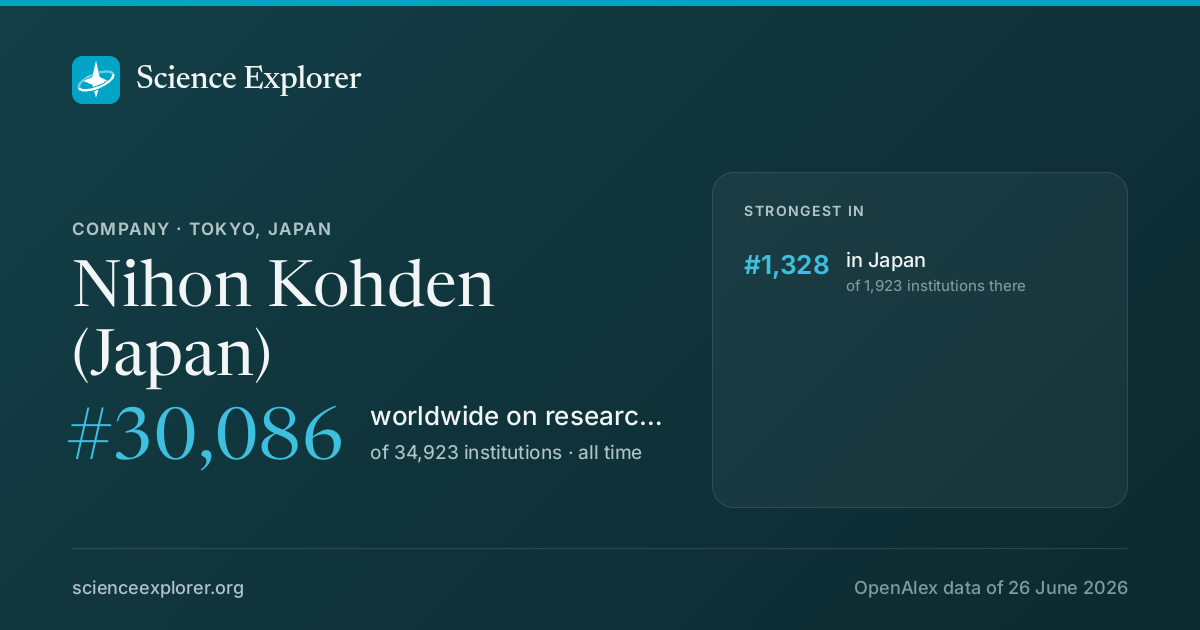
Nihon Kohden (Japan) on Science Explorer

A card with Nihon Kohden (Japan)'s standing and the fields it leads in, for a post or a slide. A link to this page previews as the same card.

Download the card

1200 × 630 PNG, sized for social posts, drawn from the latest snapshot.

Badges for a website1Each links back here and updates with every snapshot

Research measures only: rankings here say nothing about teaching, admissions or student experience. Comparable institutions and collaboration partners have tabs of their own, above.

Discussion

Ask a question or share a note about Nihon Kohden (Japan). Keep it to the research: no personal attacks, advertising or links. Any reader can report a post, which collapses it for everyone until it is opened.