Science Explorer Back to mapMap
Discussion
University · Naha · Japan

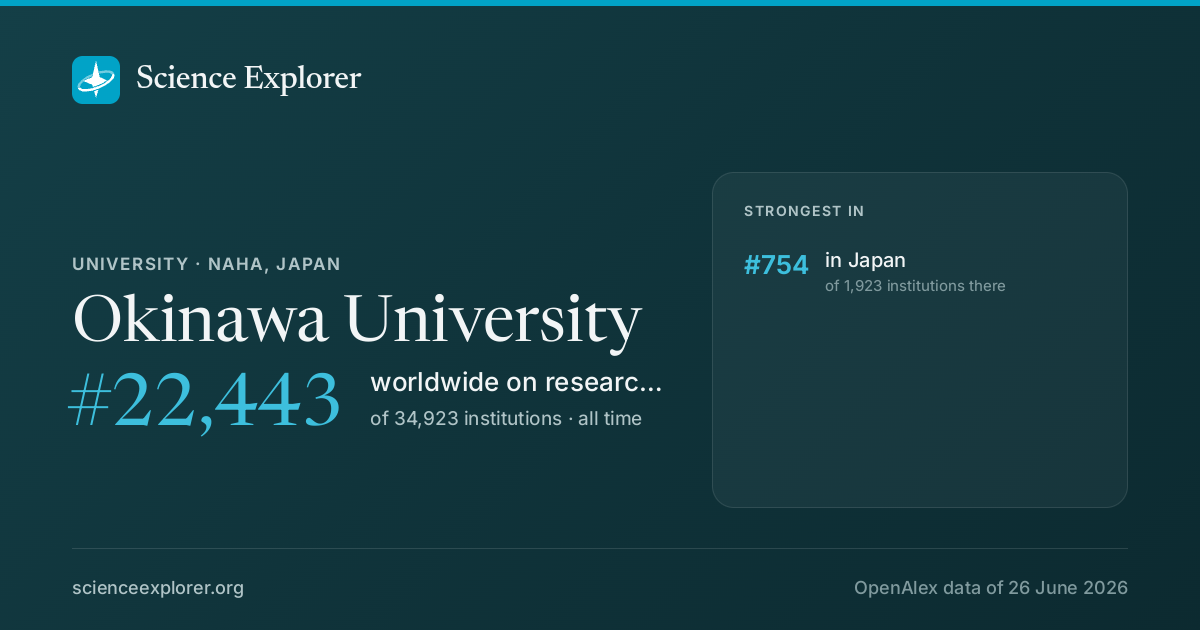
Okinawa University

World rank, all time
#22,443
of 34,923
Rank in Japan
#754
of 1,923
Research works
173
▲ 46% vs 2018-21
Citations
1.8k
10.3 per fractional work
Top-10% rate
5.8%
all institutions 10.0%
vs its own fields
0.86×
1.00× is exactly expected
Open access
50%
world 40%
International
17%
world 18%

Which fields of science does Okinawa University work in?

In 2022-now, 43% of research at Okinawa University is in Social Sciences, 22% in Physical Sciences. Its largest fields are Social Sciences (22%), Medicine (15%), Biochemistry, Genetics and Molecular Biology (9%). It does 1.6× the world's share of Social Sciences.

Social Sciences: 20 fractional works · 42.8% of its workSocial Sciences: 10 fractional works · 21.5% of its workSociology and Political Science: 4 fractional works · 9.0% of its workEducation: 2 fractional works · 4.7% of its workPolitical Science and International Relations: 2 fractional works · 3.6% of its workTransportation: 1 fractional works · 1.4% of its workGender Studies: 0 fractional works · 1.1% of its workDevelopment: 0 fractional works · 0.7% of its workLinguistics and Language: 0 fractional works · 0.7% of its workPublic Administration: 0 fractional works · 0.4% of its workArts and Humanities: 4 fractional works · 8.0% of its workLiterature and Literary Theory: 3 fractional works · 7.0% of its workLanguage and Linguistics: 0 fractional works · 0.9% of its workEconomics, Econometrics and Finance: 4 fractional works · 7.8% of its workEconomics and Econometrics: 3 fractional works · 5.9% of its workFinance: 0 fractional works · 1.1% of its workGeneral Economics, Econometrics and Finance: 0 fractional works · 0.8% of its workDecision Sciences: 1 fractional works · 2.1% of its workStatistics, Probability and Uncertainty: 1 fractional works · 1.8% of its workManagement Science and Operations Research: 0 fractional works · 0.4% of its workPsychology: 1 fractional works · 1.7% of its workClinical Psychology: 0 fractional works · 0.8% of its workSocial Psychology: 0 fractional works · 0.7% of its workExperimental and Cognitive Psychology: 0 fractional works · 0.2% of its workBusiness, Management and Accounting: 1 fractional works · 1.7% of its workStrategy and Management: 0 fractional works · 0.9% of its workAccounting: 0 fractional works · 0.8% of its workPhysical Sciences: 10 fractional works · 21.9% of its workComputer Science: 4 fractional works · 8.0% of its workComputer Vision and Pattern Recognition: 1 fractional works · 3.0% of its workComputational Theory and Mathematics: 1 fractional works · 2.9% of its workInformation Systems: 1 fractional works · 1.2% of its workArtificial Intelligence: 0 fractional works · 0.6% of its workComputer Networks and Communications: 0 fractional works · 0.4% of its workEnvironmental Science: 3 fractional works · 6.0% of its workEcology: 1 fractional works · 3.0% of its workGlobal and Planetary Change: 1 fractional works · 1.3% of its workNature and Landscape Conservation: 0 fractional works · 0.8% of its workHealth, Toxicology and Mutagenesis: 0 fractional works · 0.4% of its workEcological Modeling: 0 fractional works · 0.4% of its workSmaller subfields together: 0 fractional works · 0.1% of its workEngineering: 2 fractional works · 4.9% of its workBiomedical Engineering: 1 fractional works · 2.3% of its workAerospace Engineering: 1 fractional works · 1.4% of its workMechanical Engineering: 0 fractional works · 0.4% of its workOcean Engineering: 0 fractional works · 0.4% of its workSmaller subfields together: 0 fractional works · 0.4% of its workEarth and Planetary Sciences: 0 fractional works · 0.9% of its workOceanography: 0 fractional works · 0.5% of its workPaleontology: 0 fractional works · 0.4% of its workSmaller subfields together: 0 fractional works · 0.0% of its workEnergy: 0 fractional works · 0.9% of its workRenewable Energy, Sustainability and the Environment: 0 fractional works · 0.7% of its workSmaller subfields together: 0 fractional works · 0.2% of its workPhysics and Astronomy: 0 fractional works · 0.7% of its workCondensed Matter Physics: 0 fractional works · 0.4% of its workStatistical and Nonlinear Physics: 0 fractional works · 0.4% of its workMathematics: 0 fractional works · 0.2% of its workModeling and Simulation: 0 fractional works · 0.2% of its workChemical Engineering: 0 fractional works · 0.2% of its workMaterials Science: 0 fractional works · 0.2% of its workLife Sciences: 8 fractional works · 17.8% of its workBiochemistry, Genetics and Molecular Biology: 4 fractional works · 9.4% of its workGenetics: 2 fractional works · 3.9% of its workMolecular Biology: 2 fractional works · 3.3% of its workEndocrinology: 0 fractional works · 0.7% of its workCell Biology: 0 fractional works · 0.7% of its workBiotechnology: 0 fractional works · 0.5% of its workPhysiology: 0 fractional works · 0.2% of its workSmaller subfields together: 0 fractional works · 0.2% of its workAgricultural and Biological Sciences: 2 fractional works · 4.5% of its workEcology, Evolution, Behavior and Systematics: 1 fractional works · 2.0% of its workPlant Science: 1 fractional works · 1.2% of its workInsect Science: 0 fractional works · 0.8% of its workAquatic Science: 0 fractional works · 0.3% of its workSmaller subfields together: 0 fractional works · 0.1% of its workNeuroscience: 2 fractional works · 3.4% of its workCognitive Neuroscience: 1 fractional works · 3.1% of its workSmaller subfields together: 0 fractional works · 0.3% of its workImmunology and Microbiology: 0 fractional works · 0.6% of its workParasitology: 0 fractional works · 0.4% of its workSmaller subfields together: 0 fractional works · 0.1% of its workHealth Sciences: 8 fractional works · 17.5% of its workMedicine: 7 fractional works · 15.5% of its workPharmacology: 1 fractional works · 1.8% of its workOncology: 1 fractional works · 1.5% of its workCardiology and Cardiovascular Medicine: 0 fractional works · 1.0% of its workPhysiology: 0 fractional works · 0.9% of its workPathology and Forensic Medicine: 0 fractional works · 0.8% of its workPublic Health, Environmental and Occupational Health: 0 fractional works · 0.8% of its workOrthopedics and Sports Medicine: 0 fractional works · 0.8% of its workEpidemiology: 0 fractional works · 0.8% of its workDermatology: 0 fractional works · 0.8% of its workSurgery: 0 fractional works · 0.7% of its workGeriatrics and Gerontology: 0 fractional works · 0.7% of its workInfectious Diseases: 0 fractional works · 0.6% of its workObstetrics and Gynecology: 0 fractional works · 0.6% of its workPulmonary and Respiratory Medicine: 0 fractional works · 0.5% of its workComplementary and alternative medicine: 0 fractional works · 0.5% of its workRadiology, Nuclear Medicine and Imaging: 0 fractional works · 0.5% of its workOphthalmology: 0 fractional works · 0.4% of its workPediatrics, Perinatology and Child Health: 0 fractional works · 0.4% of its workReproductive Medicine: 0 fractional works · 0.4% of its workEndocrinology, Diabetes and Metabolism: 0 fractional works · 0.3% of its workUrology: 0 fractional works · 0.2% of its workSmaller subfields together: 0 fractional works · 0.5% of its workHealth Professions: 1 fractional works · 1.8% of its workPhysical Therapy, Sports Therapy and Rehabilitation: 1 fractional works · 1.4% of its workSpeech and Hearing: 0 fractional works · 0.2% of its workSmaller subfields together: 0 fractional works · 0.1% of its workNursing: 0 fractional works · 0.2% of its workALL ITS WORKOkinawaUniversity47fractional works, 2022-now
Life Sciences18%Physical Sciences22%Health Sciences17%Social Sciences43%

Each ring splits the one inside it: the four domains of science, their fields, their subfields. Size is fractional works in 2022-now. Every slice is a page; the interactive view zooms down to single topics and colours each by how much more of it this institution does than the world.

Its 4 domains and 22 fields, with their numbers
    1. Social Sciences1021.5%
    2. Arts and Humanities48.0%
    3. Economics, Econometrics and Finance47.8%
    4. Decision Sciences12.1%
    5. Psychology11.7%
    6. Business, Management and Accounting11.7%
    1. Computer Science48.0%
    2. Environmental Science36.0%
    3. Engineering24.9%
    4. Earth and Planetary Sciences00.9%
    5. Energy00.9%
    6. Physics and Astronomy00.7%
    7. Mathematics00.2%
    8. Chemical Engineering00.2%
    9. Materials Science00.2%
    1. Biochemistry, Genetics and Molecular Biology49.4%
    2. Agricultural and Biological Sciences24.5%
    3. Neuroscience23.4%
    4. Immunology and Microbiology00.6%
    1. Medicine715.5%
    2. Health Professions11.8%
    3. Nursing00.2%
All of science, and how each field's share has moved since 1950: the Science domain explorer

Field profile

Location quotient across every field it publishes in: outside the ring is more than an institution of this size would be expected to publish, inside it is less.

Agricultural and Biological Sciences: 0.94× its world share, 2 worksAgricultural and Bio…Biochemistry, Genetics and Molecular Biology: 1.77× its world share, 4 worksBiochemistry, Geneti…Immunology and Microbiology: 0.56× its world share, 0 worksImmunology and Micro…Neuroscience: 2.08× its world share, 2 worksNeuroscienceChemical Engineering: 0.51× its world share, 0 worksChemical EngineeringComputer Science: 1.03× its world share, 4 worksComputer ScienceEarth and Planetary Sciences: 0.60× its world share, 0 worksEarth and Planetary …Energy: 0.97× its world share, 0 worksEnergyEngineering: 0.32× its world share, 2 worksEngineeringEnvironmental Science: 1.20× its world share, 3 worksEnvironmental ScienceMaterials Science: 0.05× its world share, 0 worksMaterials ScienceMathematics: 0.17× its world share, 0 worksMathematicsPhysics and Astronomy: 0.32× its world share, 0 worksPhysics and AstronomyHealth Professions: 0.67× its world share, 1 worksHealth ProfessionsMedicine: 0.80× its world share, 7 worksMedicineNursing: 0.39× its world share, 0 worksNursingArts and Humanities: 2.77× its world share, 4 worksArts and HumanitiesBusiness, Management and Accounting: 0.52× its world share, 1 worksBusiness, Management…Decision Sciences: 2.22× its world share, 1 worksDecision SciencesEconomics, Econometrics and Finance: 3.65× its world share, 4 worksEconomics, Econometr…Psychology: 0.55× its world share, 1 worksPsychologySocial Sciences: 1.70× its world share, 10 worksSocial Sciences1×world share
more than its size predictsabout as predictedless

Rings at 0.5×, 1× and 2×. Widest outward: Economics, Econometrics and Finance, 3.6×. Every wedge is a field page.

All 22 fields, with their numbers
  1. Economics, Econometrics and Finance3.65×4 works
  2. Arts and Humanities2.77×4 works
  3. Decision Sciences2.22×1 works
  4. Neuroscience2.08×2 works
  5. Biochemistry, Genetics and Molecular Biology1.77×4 works
  6. Social Sciences1.70×10 works
  7. Environmental Science1.20×3 works
  8. Computer Science1.03×4 works
  9. Energy0.97×0 works
  10. Agricultural and Biological Sciences0.94×2 works
  11. Medicine0.80×7 works
  12. Health Professions0.67×1 works
  13. Earth and Planetary Sciences0.60×0 works
  14. Immunology and Microbiology0.56×0 works
  15. Psychology0.55×1 works
  16. Business, Management and Accounting0.52×1 works
  17. Chemical Engineering0.51×0 works
  18. Nursing0.39×0 works
  19. Engineering0.32×2 works
  20. Physics and Astronomy0.32×0 works
  21. Mathematics0.17×0 works
  22. Materials Science0.05×0 works

Who are the top researchers at Okinawa University?

Ranked on the quality score, Kengo Kakazu, Yoshihiko Miyagi and Takamichi Jogahara lead among researchers whose main affiliation is Okinawa University.

  1. 1 Kengo Kakazu Japan · #3,675,486 worldwide 29 citations · 18 works
  2. 2 Yoshihiko Miyagi Japan · #4,066,660 worldwide 1 citations · 15 works
  3. 3 Takamichi Jogahara Japan · #4,102,909 worldwide 401 citations · 53 works
  4. 4 N.R. Jenzen-Jones Japan · #4,121,688 worldwide 4 citations · 22 works
  5. 5 Dileep Chandralal Japan · #4,187,839 worldwide 95 citations · 17 works
  6. 6 Mitsuru Moriguchi Japan · #5,204,806 worldwide 36 citations · 37 works
  7. 7 Kazuo Nakamura Japan · #5,424,696 worldwide 184 citations · 39 works
All ranked researchers at Okinawa University

What are the most cited papers from Okinawa University?

The most cited paper from Okinawa University is "Hypoadiponectinemia Is Closely Linked to Endothelial Dysfunction in Man" (Michio Shimabukuro, Namio Higa, Tomohiro Asahi et al., 2003), with 348 citations. Next come "A Systematic Review of Metal Oxide Applications for Energy and Environmental Sustainability" (232) and "Advantages of genome sequencing by long-read sequencer using SMRT technology in medical area" (200).

Most cited papers
#PaperReleasedCitations
1 Hypoadiponectinemia Is Closely Linked to Endothelial Dysfunction in Man Michio Shimabukuro, Namio Higa, Tomohiro Asahi et al. · The Journal of Clinical Endocrinology & Metabolism Jul 2003 348
2 A Systematic Review of Metal Oxide Applications for Energy and Environmental Sustainability Mir Sayed Shah Danish, Arnab Bhattacharya, Diana Stepanova et al. · Metals ReviewOpen access 29 Nov 2020 232
3 Advantages of genome sequencing by long-read sequencer using SMRT technology in medical area Kazuma Nakano, Akino Shiroma, Makiko Shimoji et al. · Human Cell Open access 31 Mar 2017 200
4 Caloric restriction and human longevity: what can we learn from the Okinawans? D. Craig Willcox, Bradley J. Willcox, Hidemi Todoriki et al. · Biogerontology Jun 2006 154
5 Functional alteration of granulocytes, NK cells, and natural killer T cells in centenarians Chikako Miyaji, Hisami Watanabe, H Toma et al. · Human Immunology Sep 2000 110
All 60 most cited papers, with filters and sorting

Which keywords describe research at Okinawa University?

By fractional works in 2022-now, weighted toward what it does more of than the world: Narrative Theory, Cultural Studies, Children's Literature, Young Adult, Gender Dynamics, Stereotypes, Online Gaming and Video Games.

▲ more of its work than of the world's◆ about the world's share▼ less than the world's

Size is fractional works in 2022-now in the topics tagged with each word; colour is the word's share of this institution's work against its share of the world's. The 34 words are chosen for being large and distinctive. Each links to the topic it comes from most.

All 34 words, with their numbers
  1. Narrative Theory3▲ 222×2 topics
  2. Cultural Studies3▲ 15×2 topics
  3. Children's Literature2▲ 139×1 topic
  4. Young Adult2▲ 452×1 topic
  5. Gender Dynamics2▲ 47×2 topics
  6. Globalization2▲ 2.4×11 topics
  7. Stereotypes2▲ 50×3 topics
  8. Child Development2▲ 8.7×4 topics
  9. Climate Change2▲ 1.34×8 topics
  10. Online Gaming2▲ 95×1 topic
  11. Video Games2▲ 68×1 topic
  12. Machine Learning2◆ 1.03×4 topics
  13. Aesthetic Perception1▲ 184×1 topic
  14. Information Visualization1▲ 137×1 topic
  15. Neuroaesthetics1▲ 184×1 topic
  16. Persistent Homology1▲ 237×1 topic
  17. Physical Education1▲ 23×2 topics
  18. Topological Methods1▲ 237×1 topic
  19. Visual Analytics1▲ 137×1 topic
  20. Epidemiology1▼ 0.66×14 topics
  21. Political Economy1▲ 9.8×4 topics
  22. Self-Regulation1▲ 14×2 topics
  23. Antioxidant Activity1▲ 3.6×2 topics
  24. Biodiversity1▲ 3.2×9 topics
  25. Economic Development1▲ 2.8×4 topics
  26. Polysaccharides1▲ 29×2 topics
  27. Renewable Energy1▲ 1.57×6 topics
  28. British Army1▲ 284×1 topic
  29. Counterinsurgency1▲ 204×1 topic
  30. Culture1▲ 4.1×2 topics
  31. Literature1▲ 3.9×2 topics
  32. Monetary Policy1▲ 9.1×3 topics
  33. School Engagement1▲ 46×1 topic
  34. Student-Teacher Relationships1▲ 46×1 topic

Which research topics does Okinawa University publish most on?

By volume in 2022-now: Themes in Literature Analysis, Digital Games and Media, Topological and Geometric Data Analysis and Aesthetic Perception and Analysis.

  1. 1 Themes in Literature Analysis Literature and Literary Theory 2 works
  2. 2 Digital Games and Media Sociology and Political Science 2 works
  3. 3 Topological and Geometric Data Analysis Computational Theory and Mathematics 1 works
  4. 4 Aesthetic Perception and Analysis Cognitive Neuroscience 1 works
  5. 5 Data Visualization and Analytics Computer Vision and Pattern Recognition 1 works
  6. 6 Military History and Strategy Political Science and International Relations 1 works
  7. 7 Early Childhood Education and Development Education 1 works
  8. 8 Fungal Biology and Applications Pharmacology 1 works
  9. 9 Military Technology and Strategies Aerospace Engineering 1 works
  10. 10 Cinema and Media Studies Economics and Econometrics 1 works

How open and international is its research?

Against the world's own shares: the tick on each track. Both are shares of its output, so they sit on one scale and can be read against each other as well as against the world.

openly available49.7%not open50.3%

World: 40% of research is openly available.

with international co-authors17.2%domestic only82.8%

World: 18% is written across borders.

How has Okinawa University's research output changed?

Output in 2022-2025 was 46% higher than in 2018-2021.

still counting1990200020102020
grewheldshrank

The same series as a ribbon: one cell per year, darker for more. The line above answers how much; this answers when.

Its share of all research

Growing output can still be a shrinking share: all of science grows. This is Okinawa University as a percentage of every work published that year, 0.00012% in 2024.

still counting0.00020%0.00040%Okinawa University0.00027% in 202519801990200020102020

Fractional works of Okinawa University over all fractional works that year. How the balance of science has shifted.

Other research institutions in Naha

All research institutions in Naha

Share Okinawa University's ranking

Okinawa University on Science Explorer

A card with Okinawa University's standing and the fields it leads in, for a post or a slide. A link to this page previews as the same card.

Download the card

1200 × 630 PNG, sized for social posts, drawn from the latest snapshot.

Badges for a website1Each links back here and updates with every snapshot

Research measures only: rankings here say nothing about teaching, admissions or student experience. Comparable institutions and collaboration partners have tabs of their own, above.

Discussion

Ask a question or share a note about Okinawa University. Keep it to the research: no personal attacks, advertising or links. Any reader can report a post, which collapses it for everyone until it is opened.