Ostim Technical University
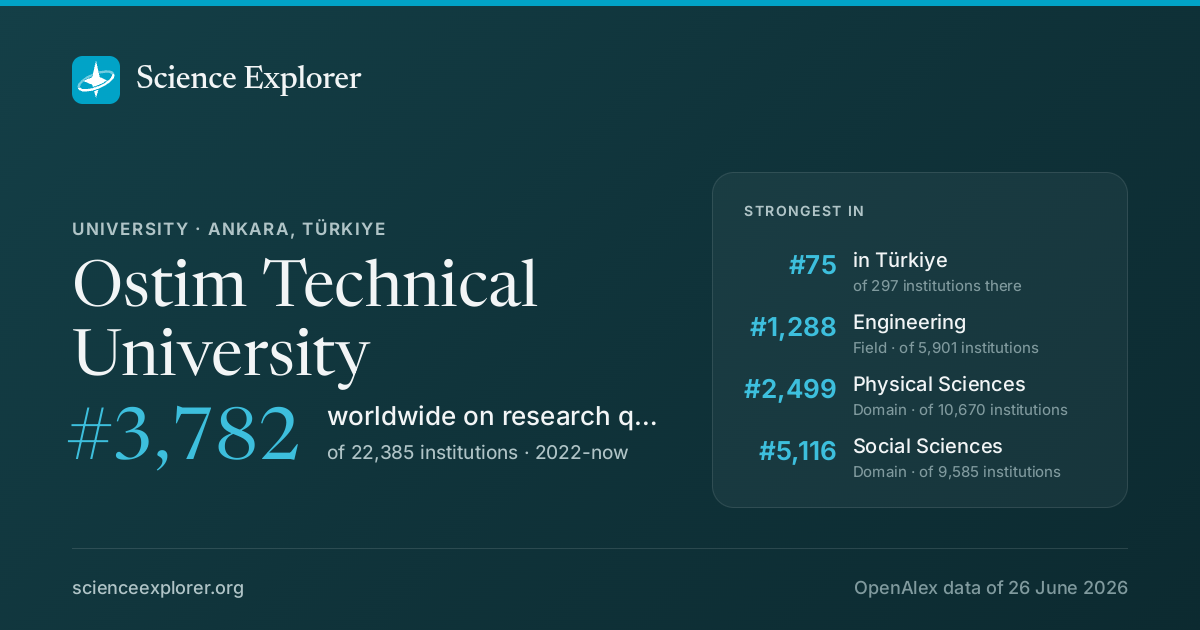
In research, Ostim Technical University stands highest in Engineering (#1,288 of 5,901 worldwide), Physical Sciences (#2,499 of 10,670 worldwide) and Social Sciences (#5,116 of 9,585 worldwide), 2022-now. Relative to its size it is most specialised in Management Science and Operations Research and Mathematics (Management Science and Operations Research is 6.9× its share of world research).
- World rank, 2022-now
- #3,782 of 22,385 · #6,868 all time
- Rank in Türkiye
- #75 of 297
- Research works
- 813 ▲ 575% vs 2018-21
- Citations
- 3.4k 4.2 per fractional work
- Top-10% rate
- 8.9% all institutions 10.0%
- vs its own fields
- 1.05× 1.00× is exactly expected
- Open access
- 61% world 40%
- International
- 16% world 18%
What is Ostim Technical University known for in research?
The fields where it stands highest, 2022-now, ranked among every institution above the floor in each field.
| Field | World rank | Where that sits | Top-10% rate | Works | All time |
|---|---|---|---|---|---|
| EngineeringField | #1,288 of 5,901 | 8.7% | 156 | #2743 | |
| Physical SciencesDomain | #2,499 of 10,670 | 8.7% | 311 | #3653 | |
| Social SciencesDomain | #5,116 of 9,585 | 9.5% | 214 | #9359 |
Each strip is that field's whole ranked pool, with the notch where Ostim Technical University sits in it, in the colour of the band that rank falls in. The track under the rate is the rate itself: it carries no average mark, because the average differs by field (from about 6% in Dentistry to 21% in Economics).
Which of those standings moved
The same fields on both windows: where it stood over the whole record, and where it stands in 2022-now. The distance is the story, and it is the one thing the two rank columns above cannot show.
- Engineering#2,743 #1,288
- Physical Sciences#3,653 #2,499
- Social Sciences#9,359 #5,116
A dot further right is a better standing. Fields it was not ranked in over the whole record are left out.
Which fields of science does Ostim Technical University work in?
In 2022-now, 59% of research at Ostim Technical University is in Physical Sciences, 36% in Social Sciences. Its largest fields are Engineering (28%), Computer Science (11%), Economics, Econometrics and Finance (9%). It does 1.5× the world's share of Physical Sciences.
Each ring splits the one inside it: the four domains of science, their fields, their subfields. Size is fractional works in 2022-now. Every slice is a page; the interactive view zooms down to single topics and colours each by how much more of it this institution does than the world.
Its 4 domains and 23 fields, with their numbers
- Physical Sciences42059.2%
- Engineering19928.0%
- Computer Science7710.8%
- Mathematics537.5%
- Physics and Astronomy263.6%
- Environmental Science243.4%
- Materials Science172.4%
- Energy131.8%
- Earth and Planetary Sciences70.9%
- Chemical Engineering40.5%
- Chemistry20.3%
- Social Sciences25335.7%
- Economics, Econometrics and Finance649.0%
- Business, Management and Accounting638.9%
- Social Sciences618.6%
- Decision Sciences294.0%
- Arts and Humanities263.7%
- Psychology111.5%
- Health Sciences202.8%
- Medicine121.8%
- Health Professions60.8%
- Dentistry10.1%
- Nursing00.1%
- Life Sciences172.4%
What does Ostim Technical University specialise in?
Where its research is concentrated relative to its size: Management Science and Operations Research takes 6.9× the share of its output that it takes of world research.
- Management Science and Operations ResearchSubfield · 24.2 works6.9×
- MathematicsField · 53.0 works6.3×
Location quotient, a volume reading rather than an impact one. It surfaces small, lopsided specialities.
Field profile
Location quotient across every field it publishes in: outside the ring is more than an institution of this size would be expected to publish, inside it is less.
Rings at 0.5×, 1× and 2×. Widest outward: Mathematics, 6.3×. Every wedge is a field page.
All 23 fields, with their numbers
- Mathematics6.35×53 works
- Economics, Econometrics and Finance4.19×64 works
- Decision Sciences4.18×29 works
- Business, Management and Accounting2.76×63 works
- Energy1.98×13 works
- Engineering1.86×199 works
- Physics and Astronomy1.62×26 works
- Chemical Engineering1.50×4 works
- Computer Science1.39×77 works
- Arts and Humanities1.27×26 works
- Environmental Science0.69×24 works
- Materials Science0.69×17 works
- Social Sciences0.68×61 works
- Earth and Planetary Sciences0.59×6 works
- Psychology0.50×11 works
- Health Professions0.32×6 works
- Dentistry0.31×1 works
- Agricultural and Biological Sciences0.30×10 works
- Neuroscience0.26×3 works
- Chemistry0.17×2 works
- Nursing0.13×0 works
- Biochemistry, Genetics and Molecular Biology0.09×4 works
- Medicine0.09×12 works
- Mathematics 6.3×
- Economics, Econometrics and Finance 4.2×
- Decision Sciences 4.2×
- Business, Management and Accounting 2.8×
- Energy 2.0×
- Engineering 1.9×
- Physics and Astronomy 1.6×
- Chemical Engineering 1.5×
- Computer Science 1.4×
- Arts and Humanities 1.3×
- Environmental Science 0.7×
- Materials Science 0.7×
- Social Sciences 0.7×
- Earth and Planetary Sciences 0.6×
- Psychology 0.5×
- Health Professions 0.3×
- Dentistry 0.3×
- Agricultural and Biological Sciences 0.3×
- Neuroscience 0.3×
- Chemistry 0.2×
- Nursing 0.1×
- Biochemistry, Genetics and Molecular Biology 0.1×
- Medicine 0.1×
Who are the top researchers at Ostim Technical University?
Ranked on the quality score, Galip Cihan Yalçın, Büşra Ağan and Serdar Çelik lead among researchers whose main affiliation is Ostim Technical University.
- 1
Galip Cihan Yalçın
 Türkiye · #121,339 worldwide
645 citations · 92 works
- 2
Büşra Ağan
Türkiye · #963,264 worldwide
355 citations · 57 works
- 3
Serdar Çelik
Türkiye · #1,453,287 worldwide
155 citations · 17 works
- 4
Mustafa Polat
Türkiye · #1,704,159 worldwide
255 citations · 32 works
- 5
Çağlayan Aslan
Türkiye · #1,990,054 worldwide
171 citations · 24 works
- 6
Tuğçe Çelik
Türkiye · #2,089,279 worldwide
108 citations · 27 works
- 7
Sercan Edinsel
Türkiye · #2,177,307 worldwide
143 citations · 26 works
- 8
Abdullah Ballı
Türkiye · #2,287,764 worldwide
59 citations · 23 works
- 9
Hamide Özyürek
Türkiye · #2,638,262 worldwide
26 citations · 20 works
- 10
Melike Aktaş Bozkurt
Türkiye · #2,770,456 worldwide
46 citations · 15 works
Which keywords describe research at Ostim Technical University?
By fractional works in 2022-now, weighted toward what it does more of than the world: Renewable Energy, Heat Transfer, Economic Growth, Sustainability, Monetary Policy, Deep Learning, Finite Element Analysis and Panel Data Analysis.
- Wireless Communication
- Economic Policy Uncertainty
- Global Economy
- Robotics
- Energy Transition
- Network Simulation Method
- Thermal Insulation
- Trade Openness
- Fluid Mechanics
- CO2 Emissions
- Thermal Analysis
- Energy Consumption
- Panel Data Analysis
- Urbanization
- Mechanical Properties
- Cultural Heritage
- Heat Transfer
- Climate Change
- Machine Learning
- Deep Learning
- Renewable Energy
- Sustainability
- Economic Growth
- Neural Networks
- Supply Chain Management
- Monetary Policy
- Energy Efficiency
- Finite Element Analysis
- Financial Development
- Economic Development
- Numerical Methods
- Environmental Regulation
- Kuznets Curve
- Differential Equations
- Conduction Heat Transfer
- Stock Market
- Nonlinear Equations
- Hamiltonian Systems
- Financialization
- Oil Price Shocks
Size is fractional works in 2022-now in the topics tagged with each word; colour is the word's share of this institution's work against its share of the world's. The 40 words are chosen for being large and distinctive. Each links to the topic it comes from most.
All 40 words, with their numbers
- Renewable Energy47▲ 4.5×30 topics
- Deep Learning38▲ 1.53×52 topics
- Sustainability36▲ 2.1×38 topics
- Machine Learning33▲ 1.40×46 topics
- Economic Growth27▲ 4.6×18 topics
- Climate Change25▲ 1.27×31 topics
- Neural Networks24▲ 2.2×25 topics
- Heat Transfer24▲ 6.9×14 topics
- Supply Chain Management18▲ 2.8×16 topics
- Cultural Heritage16▲ 4.3×12 topics
- Monetary Policy16▲ 9.7×7 topics
- Mechanical Properties16▲ 2.3×23 topics
- Energy Efficiency16▲ 2.4×21 topics
- Urbanization16▲ 5.5×5 topics
- Finite Element Analysis15▲ 9.3×3 topics
- Panel Data Analysis15▲ 14×3 topics
- Financial Development15▲ 14×3 topics
- Energy Consumption15▲ 9.1×4 topics
- Economic Development14▲ 2.5×15 topics
- Thermal Analysis13▲ 14×6 topics
- Numerical Methods13▲ 22×3 topics
- CO2 Emissions13▲ 10×3 topics
- Environmental Regulation12▲ 12×2 topics
- Fluid Mechanics12▲ 25×2 topics
- Kuznets Curve12▲ 16×1 topic
- Trade Openness12▲ 16×1 topic
- Differential Equations12▲ 72×2 topics
- Thermal Insulation11▲ 59×2 topics
- Conduction Heat Transfer11▲ 338×1 topic
- Network Simulation Method11▲ 338×1 topic
- Stock Market11▲ 6.9×2 topics
- Energy Transition10▲ 9.2×3 topics
- Nonlinear Equations9▲ 10×6 topics
- Robotics9▲ 5.3×6 topics
- Hamiltonian Systems9▲ 41×2 topics
- Global Economy9▲ 9.6×4 topics
- Financialization9▲ 13×2 topics
- Economic Policy Uncertainty8▲ 20×1 topic
- Oil Price Shocks8▲ 20×1 topic
- Wireless Communication8▲ 8.1×4 topics
Which research topics does Ostim Technical University publish most on?
By volume in 2022-now: Energy, Environment, Economic Growth, Heat Transfer and Numerical Methods, Market Dynamics and Volatility and Numerical methods for differential equations.
Area is fractional works; colour is the subfield each topic belongs to.
- 1 Energy, Environment, Economic Growth Economics and Econometrics 12 works
- 2 Heat Transfer and Numerical Methods Computational Mechanics 11 works
- 3 Market Dynamics and Volatility Economics and Econometrics 8 works
- 4 Numerical methods for differential equations Numerical Analysis 7 works
- 5 Scientific Research and Discoveries Statistical and Nonlinear Physics 7 works
- 6 Engineering and Technology Innovations Electrical and Electronic Engineering 6 works
- 7 Optical Wireless Communication Technologies Electrical and Electronic Engineering 6 works
- 8 Fractional Differential Equations Solutions Modeling and Simulation 6 works
- 9 Environmental Sustainability in Business Marketing 5 works
- 10 Multi-Criteria Decision Making Management Science and Operations Research 5 works
How open and international is its research?
Against the world's own shares: the tick on each track. Both are shares of its output, so they sit on one scale and can be read against each other as well as against the world.
World: 40% of research is openly available.
World: 18% is written across borders.
How has Ostim Technical University's research output changed?
Output in 2022-2025 was 575% higher than in 2018-2021.
The same series as a ribbon: one cell per year, darker for more. The line above answers how much; this answers when.
Its share of all research
Growing output can still be a shrinking share: all of science grows. This is Ostim Technical University as a percentage of every work published that year, 0.0022% in 2024.
Fractional works of Ostim Technical University over all fractional works that year. How the balance of science has shifted.
Other research institutions in Ankara
- Hacettepe University
- Ankara University
- Gazi University
- Middle East Technical University
- Başkent University
- Bilkent University
- Ankara Sosyal Bilimler Üniversitesi
- Ankara Yıldırım Beyazıt University







Share Ostim Technical University's ranking
Badges for a website1Each links back here and updates with every snapshot

Research measures only: rankings here say nothing about teaching, admissions or student experience. Comparable institutions and collaboration partners have tabs of their own, above.
Discussion
Ask a question or share a note about Ostim Technical University. Posts are plain text and can be reported.