Science Explorer Back to mapMap
Discussion
Hospital / health system · Frankston · Australia

Peninsula Health

In research, Peninsula Health stands highest in Health Sciences (#1,737 of 9,902 worldwide) and Medicine (#1,744 of 8,541 worldwide), 2022-now.

World rank, 2022-now
#8,438
of 22,385 · #8,465 all time
Rank in Australia
#106
of 270
Research works
714
▲ 31% vs 2018-21
Citations
11k
14.9 per fractional work
Top-10% rate
14.7%
all institutions 10.0%
vs its own fields
1.12×
1.00× is exactly expected
Open access
52%
world 40%
International
22%
world 18%

What is Peninsula Health known for in research?

The fields where it stands highest, 2022-now, ranked among every institution above the floor in each field.

FieldWorld rankWhere that sitsTop-10% rateWorksAll time
Health SciencesDomain #1,737 of 9,902 14.3%178 #2684
MedicineField #1,744 of 8,541 14.7%146 #2620

Each strip is that field's whole ranked pool, with the notch where Peninsula Health sits in it, in the colour of the band that rank falls in. The track under the rate is the rate itself: it carries no average mark, because the average differs by field (from about 6% in Dentistry to 21% in Economics).

Which fields of science does Peninsula Health work in?

In 2022-now, 79% of research at Peninsula Health is in Health Sciences, 10% in Social Sciences. Its largest fields are Medicine (65%), Health Professions (11%), Psychology (5%). It does 3.3× the world's share of Health Sciences.

Health Sciences: 208 fractional works · 78.8% of its workMedicine: 171 fractional works · 65.0% of its workSurgery: 39 fractional works · 14.9% of its workPulmonary and Respiratory Medicine: 12 fractional works · 4.7% of its workEpidemiology: 11 fractional works · 4.2% of its workPublic Health, Environmental and Occupational Health: 11 fractional works · 4.0% of its workCardiology and Cardiovascular Medicine: 10 fractional works · 3.7% of its workOncology: 9 fractional works · 3.4% of its workRadiology, Nuclear Medicine and Imaging: 8 fractional works · 2.9% of its workPsychiatry and Mental health: 7 fractional works · 2.7% of its workHealth Informatics: 7 fractional works · 2.5% of its workPhysiology: 6 fractional works · 2.4% of its workRehabilitation: 5 fractional works · 1.8% of its workRheumatology: 5 fractional works · 1.7% of its workEmergency Medicine: 4 fractional works · 1.6% of its workCritical Care and Intensive Care Medicine: 3 fractional works · 1.3% of its workGeriatrics and Gerontology: 3 fractional works · 1.2% of its workOrthopedics and Sports Medicine: 3 fractional works · 1.1% of its workPediatrics, Perinatology and Child Health: 3 fractional works · 1.1% of its workHematology: 3 fractional works · 1.0% of its workAnesthesiology and Pain Medicine: 2 fractional works · 0.9% of its workNeurology: 2 fractional works · 0.8% of its workPathology and Forensic Medicine: 2 fractional works · 0.8% of its workObstetrics and Gynecology: 2 fractional works · 0.7% of its workEndocrinology, Diabetes and Metabolism: 2 fractional works · 0.7% of its workPharmacology: 2 fractional works · 0.6% of its workDermatology: 2 fractional works · 0.6% of its workFamily Practice: 2 fractional works · 0.6% of its workInfectious Diseases: 2 fractional works · 0.6% of its workGenetics: 1 fractional works · 0.5% of its workInternal Medicine: 1 fractional works · 0.4% of its workNephrology: 1 fractional works · 0.3% of its workComplementary and alternative medicine: 1 fractional works · 0.3% of its workUrology: 1 fractional works · 0.3% of its workSmaller subfields together: 2 fractional works · 0.7% of its workHealth Professions: 30 fractional works · 11.4% of its workGeneral Health Professions: 16 fractional works · 5.9% of its workOccupational Therapy: 4 fractional works · 1.7% of its workPhysical Therapy, Sports Therapy and Rehabilitation: 3 fractional works · 1.0% of its workEmergency Medical Services: 2 fractional works · 0.8% of its workHealth Information Management: 2 fractional works · 0.7% of its workRadiological and Ultrasound Technology: 1 fractional works · 0.5% of its workPharmacy: 1 fractional works · 0.4% of its workSmaller subfields together: 1 fractional works · 0.3% of its workVeterinary: 3 fractional works · 1.2% of its workSmall Animals: 3 fractional works · 1.1% of its workNursing: 2 fractional works · 0.9% of its workNutrition and Dietetics: 1 fractional works · 0.4% of its workResearch and Theory: 1 fractional works · 0.3% of its workSmaller subfields together: 0 fractional works · 0.2% of its workDentistry: 1 fractional works · 0.3% of its workSocial Sciences: 28 fractional works · 10.4% of its workPsychology: 14 fractional works · 5.4% of its workClinical Psychology: 8 fractional works · 3.1% of its workSocial Psychology: 3 fractional works · 1.3% of its workApplied Psychology: 1 fractional works · 0.5% of its workDevelopmental and Educational Psychology: 1 fractional works · 0.4% of its workSmaller subfields together: 0 fractional works · 0.2% of its workSocial Sciences: 9 fractional works · 3.5% of its workSociology and Political Science: 3 fractional works · 1.1% of its workEducation: 2 fractional works · 0.8% of its workHealth: 2 fractional works · 0.6% of its workDemography: 1 fractional works · 0.3% of its workSafety Research: 1 fractional works · 0.2% of its workGender Studies: 1 fractional works · 0.2% of its workSmaller subfields together: 1 fractional works · 0.3% of its workEconomics, Econometrics and Finance: 2 fractional works · 0.7% of its workEconomics and Econometrics: 2 fractional works · 0.7% of its workArts and Humanities: 1 fractional works · 0.3% of its workDecision Sciences: 1 fractional works · 0.3% of its workBusiness, Management and Accounting: 0 fractional works · 0.1% of its workPhysical Sciences: 14 fractional works · 5.4% of its workComputer Science: 6 fractional works · 2.4% of its workArtificial Intelligence: 3 fractional works · 1.0% of its workComputer Vision and Pattern Recognition: 1 fractional works · 0.5% of its workInformation Systems: 1 fractional works · 0.4% of its workHuman-Computer Interaction: 1 fractional works · 0.3% of its workSmaller subfields together: 0 fractional works · 0.2% of its workEngineering: 5 fractional works · 2.0% of its workBiomedical Engineering: 5 fractional works · 1.9% of its workSmaller subfields together: 0 fractional works · 0.1% of its workEnvironmental Science: 1 fractional works · 0.4% of its workHealth, Toxicology and Mutagenesis: 1 fractional works · 0.3% of its workSmaller subfields together: 0 fractional works · 0.1% of its workEarth and Planetary Sciences: 1 fractional works · 0.3% of its workMathematics: 1 fractional works · 0.2% of its workPhysics and Astronomy: 0 fractional works · 0.1% of its workChemistry: 0 fractional works · 0.0% of its workLife Sciences: 14 fractional works · 5.4% of its workBiochemistry, Genetics and Molecular Biology: 7 fractional works · 2.6% of its workMolecular Biology: 3 fractional works · 1.0% of its workGenetics: 1 fractional works · 0.5% of its workCancer Research: 1 fractional works · 0.4% of its workDevelopmental Biology: 1 fractional works · 0.3% of its workSmaller subfields together: 1 fractional works · 0.5% of its workNeuroscience: 4 fractional works · 1.6% of its workCognitive Neuroscience: 3 fractional works · 1.1% of its workNeurology: 1 fractional works · 0.2% of its workSmaller subfields together: 1 fractional works · 0.3% of its workImmunology and Microbiology: 2 fractional works · 0.8% of its workImmunology: 1 fractional works · 0.5% of its workSmaller subfields together: 1 fractional works · 0.3% of its workAgricultural and Biological Sciences: 1 fractional works · 0.3% of its workPharmacology, Toxicology and Pharmaceutics: 0 fractional works · 0.1% of its workALL ITS WORKPeninsula Health264fractional works, 2022-now
Life Sciences5%Physical Sciences5%Health Sciences79%Social Sciences10%

Each ring splits the one inside it: the four domains of science, their fields, their subfields. Size is fractional works in 2022-now. Every slice is a page; the interactive view zooms down to single topics and colours each by how much more of it this institution does than the world.

Its 4 domains and 23 fields, with their numbers
    1. Medicine17165.0%
    2. Health Professions3011.4%
    3. Veterinary31.2%
    4. Nursing20.9%
    5. Dentistry10.3%
    1. Psychology145.4%
    2. Social Sciences93.5%
    3. Economics, Econometrics and Finance20.7%
    4. Arts and Humanities10.3%
    5. Decision Sciences10.3%
    6. Business, Management and Accounting00.1%
    1. Computer Science62.4%
    2. Engineering52.0%
    3. Environmental Science10.4%
    4. Earth and Planetary Sciences10.3%
    5. Mathematics10.2%
    6. Physics and Astronomy00.1%
    7. Chemistry00.0%
    1. Biochemistry, Genetics and Molecular Biology72.6%
    2. Neuroscience41.6%
    3. Immunology and Microbiology20.8%
    4. Agricultural and Biological Sciences10.3%
    5. Pharmacology, Toxicology and Pharmaceutics00.1%
All of science, and how each field's share has moved since 1950: the Science domain explorer

Field profile

Location quotient across every field it publishes in: outside the ring is more than an institution of this size would be expected to publish, inside it is less.

Agricultural and Biological Sciences: 0.05× its world share, 1 worksAgricultural and Bio…Biochemistry, Genetics and Molecular Biology: 0.49× its world share, 7 worksBiochemistry, Geneti…Immunology and Microbiology: 0.80× its world share, 2 worksImmunology and Micro…Neuroscience: 0.99× its world share, 4 worksNeurosciencePharmacology, Toxicology and Pharmaceutics: 0.24× its world share, 0 worksPharmacology, Toxico…Chemistry: 0.02× its world share, 0 worksChemistryComputer Science: 0.31× its world share, 6 worksComputer ScienceEarth and Planetary Sciences: 0.17× its world share, 1 worksEarth and Planetary …Engineering: 0.13× its world share, 5 worksEngineeringEnvironmental Science: 0.08× its world share, 1 worksEnvironmental ScienceMathematics: 0.19× its world share, 1 worksMathematicsPhysics and Astronomy: 0.06× its world share, 0 worksPhysics and AstronomyDentistry: 0.67× its world share, 1 worksDentistryHealth Professions: 4.32× its world share, 30 worksHealth ProfessionsMedicine: 3.38× its world share, 171 worksMedicineNursing: 1.94× its world share, 2 worksNursingVeterinary: 8.49× its world share, 3 worksVeterinaryArts and Humanities: 0.12× its world share, 1 worksArts and HumanitiesBusiness, Management and Accounting: 0.03× its world share, 0 worksBusiness, Management…Decision Sciences: 0.34× its world share, 1 worksDecision SciencesEconomics, Econometrics and Finance: 0.32× its world share, 2 worksEconomics, Econometr…Psychology: 1.78× its world share, 14 worksPsychologySocial Sciences: 0.28× its world share, 9 worksSocial Sciences1×world share
more than its size predictsabout as predictedless

Rings at 0.5×, 1× and 2×. Widest outward: Veterinary, 8.5×. Every wedge is a field page.

All 23 fields, with their numbers
  1. Veterinary8.49×3 works
  2. Health Professions4.32×30 works
  3. Medicine3.38×171 works
  4. Nursing1.94×2 works
  5. Psychology1.78×14 works
  6. Neuroscience0.99×4 works
  7. Immunology and Microbiology0.80×2 works
  8. Dentistry0.67×1 works
  9. Biochemistry, Genetics and Molecular Biology0.49×7 works
  10. Decision Sciences0.34×1 works
  11. Economics, Econometrics and Finance0.32×2 works
  12. Computer Science0.31×6 works
  13. Social Sciences0.28×9 works
  14. Pharmacology, Toxicology and Pharmaceutics0.24×0 works
  15. Mathematics0.19×1 works
  16. Earth and Planetary Sciences0.17×1 works
  17. Engineering0.13×5 works
  18. Arts and Humanities0.12×1 works
  19. Environmental Science0.08×1 works
  20. Physics and Astronomy0.06×0 works
  21. Agricultural and Biological Sciences0.05×1 works
  22. Business, Management and Accounting0.03×0 works
  23. Chemistry0.02×0 works

Who are the top researchers at Peninsula Health?

Ranked on the quality score, Yi Xie, Richard J. Ross and Ishith Seth lead among researchers whose main affiliation is Peninsula Health.

  1. 1 Yi Xie Australia · #481,106 worldwide 998 citations · 30 works
  2. 2 Richard J. Ross Australia · #488,929 worldwide 681 citations · 36 works
  3. 3 Ishith Seth Australia · #708,392 worldwide 2.7k citations · 236 works
  4. 4 Jamie John Layland Australia · #729,753 worldwide 4.7k citations · 185 works
  5. 5 Bryan Lim Australia · #1,078,031 worldwide 589 citations · 47 works
  6. 6 Helen Kolawole Australia · #1,089,671 worldwide 923 citations · 24 works
  7. 7 Michael P. Chae Australia · #1,096,397 worldwide 1.6k citations · 40 works
  8. 8 Emma Jane Bishop Australia · #1,198,208 worldwide 810 citations · 24 works
  9. 9 Peter Kelley Australia · #1,490,649 worldwide 563 citations · 30 works
  10. 10 Jevan Cevik Australia · #1,515,062 worldwide 525 citations · 49 works
All ranked researchers at Peninsula Health

What are the most cited papers from Peninsula Health?

The most cited paper from Peninsula Health is "Omeprazole Compared with Misoprostol for Ulcers Associated with Nonsteroidal Antiinflammatory Drugs" (Christopher J. Hawkey, Jeffrey A. Karrasch, Leszek Szczepanski et al., 1998), with 863 citations. Next come "International Continence Society Good Urodynamic Practices and Terms 2016: Urodynamics, uroflowmetry, cystometry, and pressure‐flow study" (679) and "Acalabrutinib with or without obinutuzumab versus chlorambucil and obinutuzumab for treatment-naive chronic lymphocytic leukaemia (ELEVATE-TN): a randomised, controlled, phase 3 trial" (633).

Most cited papers
#PaperReleasedCitations
1 Omeprazole Compared with Misoprostol for Ulcers Associated with Nonsteroidal Antiinflammatory Drugs Christopher J. Hawkey, Jeffrey A. Karrasch, Leszek Szczepanski et al. · New England Journal of Medicine Open access 12 Mar 1998 863
2 International Continence Society Good Urodynamic Practices and Terms 2016: Urodynamics, uroflowmetry, cystometry, and pressure‐flow study Peter F.W.M. Rosier, Werner Schaefer, Gunnar Lose et al. · Neurourology and Urodynamics Open access 5 Dec 2016 679
3 Acalabrutinib with or without obinutuzumab versus chlorambucil and obinutuzumab for treatment-naive chronic lymphocytic leukaemia (ELEVATE-TN): a randomised, controlled, phase 3 trial Jeff Porter Sharman et al. · The Lancet Open access Apr 2020 633
4 A systematic review of gut microbiota composition in observational studies of major depressive disorder, bipolar disorder and schizophrenia Amelia J. McGuinness, Jessica A. Davis, Samantha L. Dawson et al. · Molecular Psychiatry ReviewOpen access 22 Feb 2022 501
5 Type 2 diabetes and cognitive dysfunction—towards effective management of both comorbidities Velandai K. Srikanth, Alan J. Sinclair, Felicia Hill‐Briggs et al. · The Lancet Diabetes & Endocrinology Open access 20 May 2020 468
All 59 most cited papers, with filters and sorting

Which keywords describe research at Peninsula Health?

By fractional works in 2022-now, weighted toward what it does more of than the world: Epidemiology, Quality of Life, Complications, Medical Imaging, Precision Medicine, Healthcare, Rehabilitation and Patient Satisfaction.

▲ more of its work than of the world's◆ about the world's share▼ less than the world's

Size is fractional works in 2022-now in the topics tagged with each word; colour is the word's share of this institution's work against its share of the world's. The 40 words are chosen for being large and distinctive. Each links to the topic it comes from most.

All 40 words, with their numbers
  1. Epidemiology28▲ 2.7×78 topics
  2. Quality of Life19▲ 5.0×35 topics
  3. Complications14▲ 11×15 topics
  4. Inflammation12▲ 2.2×38 topics
  5. Machine Learning12▲ 1.33×11 topics
  6. Healthcare12▲ 3.8×15 topics
  7. Medical Imaging11▲ 7.7×5 topics
  8. Treatment10▲ 3.0×29 topics
  9. Artificial Intelligence9▲ 2.5×9 topics
  10. Precision Medicine9▲ 7.0×5 topics
  11. Rehabilitation8▲ 7.7×11 topics
  12. Patient Satisfaction8▲ 9.4×9 topics
  13. Risk Factors7▲ 2.5×24 topics
  14. Health Equity7▲ 9.4×4 topics
  15. Breast Reconstruction7▲ 43×2 topics
  16. Big Data7▲ 2.7×2 topics
  17. Aging7▲ 4.7×7 topics
  18. Diagnosis7▲ 2.7×25 topics
  19. Clinical Decision Support7▲ 16×1 topic
  20. Ethical Challenges7▲ 12×1 topic
  21. Mortality6▲ 4.3×10 topics
  22. Evidence-Based Practice6▲ 18×5 topics
  23. Radiotherapy6▲ 6.1×11 topics
  24. Depression6▲ 2.7×15 topics
  25. Elderly Patients6▲ 14×4 topics
  26. Clinical Practice Guidelines6▲ 4.2×14 topics
  27. Medical Education6▲ 8.4×9 topics
  28. Primary Care5▲ 5.6×13 topics
  29. Guidelines5▲ 4.2×9 topics
  30. Anxiety5▲ 4.1×7 topics
  31. Mortality Risk5▲ 8.3×5 topics
  32. Well-being5▲ 4.7×6 topics
  33. Free Flap4▲ 42×1 topic
  34. Microsurgical Reconstruction4▲ 42×1 topic
  35. Critical Care4▲ 6.9×7 topics
  36. Chronic Disease Management4▲ 8.4×5 topics
  37. Physical Performance4▲ 16×2 topics
  38. Intensive Care Unit4▲ 12×4 topics
  39. Occupational Science4▲ 70×1 topic
  40. Therapy Practice4▲ 70×1 topic

Which research topics does Peninsula Health publish most on?

By volume in 2022-now: Artificial Intelligence in Healthcare and Education, Reconstructive Surgery and Microvascular Techniques, Occupational Therapy Practice and Research and Geriatric Care and Nursing Homes.

  1. 1 Artificial Intelligence in Healthcare and Education Health Informatics 7 works
  2. 2 Reconstructive Surgery and Microvascular Techniques Surgery 4 works
  3. 3 Occupational Therapy Practice and Research Occupational Therapy 4 works
  4. 4 Geriatric Care and Nursing Homes General Health Professions 3 works
  5. 5 Frailty in Older Adults Geriatrics and Gerontology 2 works
  6. 6 Dementia and Cognitive Impairment Research Psychiatry and Mental health 2 works
  7. 7 Breast Implant and Reconstruction Surgery 2 works
  8. 8 Orthopedic Surgery and Rehabilitation Surgery 2 works
  9. 9 Cardiac, Anesthesia and Surgical Outcomes Cardiology and Cardiovascular Medicine 2 works
  10. 10 Stroke Rehabilitation and Recovery Rehabilitation 2 works

How open and international is its research?

Against the world's own shares: the tick on each track. Both are shares of its output, so they sit on one scale and can be read against each other as well as against the world.

openly available52.5%not open47.5%

World: 40% of research is openly available.

with international co-authors21.6%domestic only78.4%

World: 18% is written across borders.

How has Peninsula Health's research output changed?

Output in 2022-2025 was 31% higher than in 2018-2021.

still counting1990200020102020
grewheldshrank

The same series as a ribbon: one cell per year, darker for more. The line above answers how much; this answers when.

Its share of all research

Growing output can still be a shrinking share: all of science grows. This is Peninsula Health as a percentage of every work published that year, 0.00095% in 2024.

still counting0.00050%0.0010%0.0015%Peninsula Health0.0013% in 20251990200020102020

Fractional works of Peninsula Health over all fractional works that year. How the balance of science has shifted.

How much of it reaches the world top 10%

Year by year, against all institutions in the same year.

still counting10%20%Peninsula Health17.4% in 2025all institutions10.0% in 20252020

Of each year's output, the share that reached the world's 10% most cited for its field and year. Peak 17.4% in 2025.

Other research institutions in Frankston

All research institutions in Frankston

Share Peninsula Health's ranking
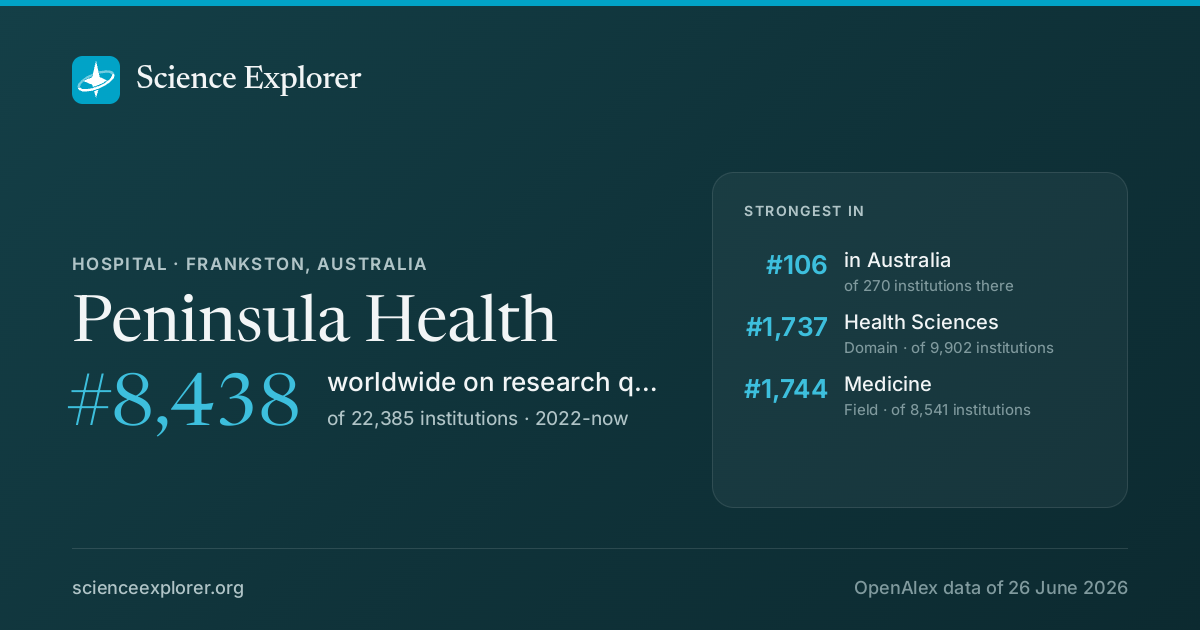
Peninsula Health on Science Explorer

A card with Peninsula Health's standing and the fields it leads in, for a post or a slide. A link to this page previews as the same card.

Download the card

1200 × 630 PNG, sized for social posts, drawn from the latest snapshot.

Badges for a website1Each links back here and updates with every snapshot

Research measures only: rankings here say nothing about teaching, admissions or student experience. Comparable institutions and collaboration partners have tabs of their own, above.

Discussion

Ask a question or share a note about Peninsula Health. Posts are plain text and can be reported.