Pertamina (Indonesia)
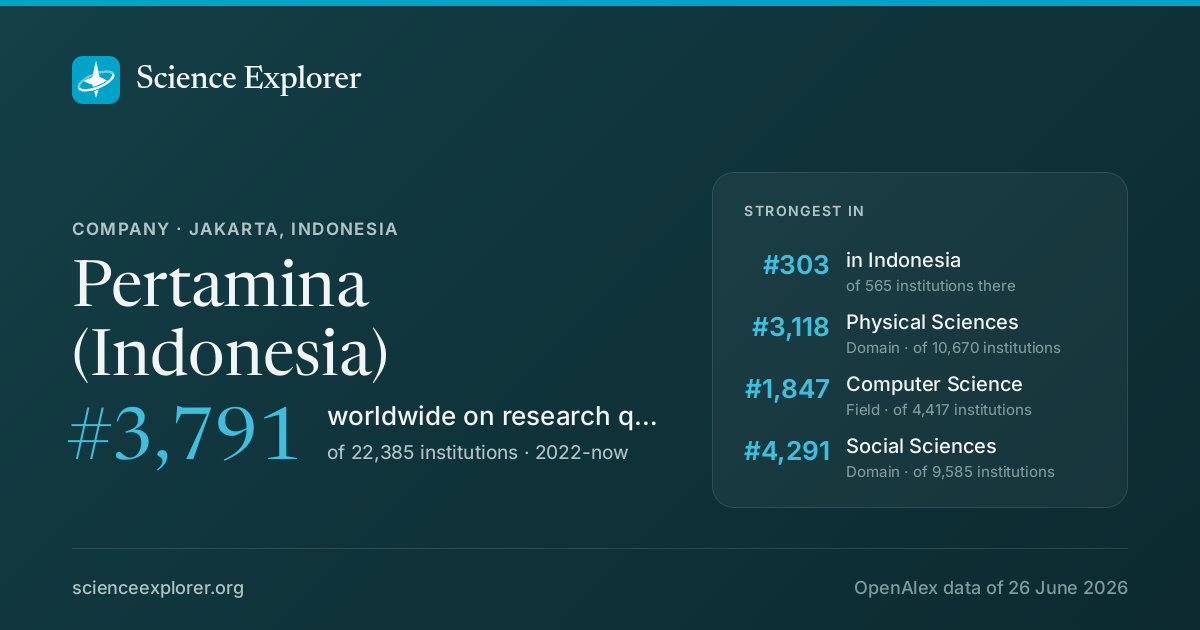
In research, Pertamina (Indonesia) stands highest in Physical Sciences (#3,118 of 10,670 worldwide), Computer Science (#1,847 of 4,417 worldwide) and Social Sciences (#4,291 of 9,585 worldwide), 2022-now. Relative to its size it is most specialised in Geology, Ocean Engineering and Industrial and Manufacturing Engineering (Geology is 25.4× its share of world research).
- World rank, 2022-now
- #3,791 of 22,385 · #5,083 all time
- Rank in Indonesia
- #303 of 565
- Research works
- 3.3k ▲ 112% vs 2018-21
- Citations
- 12k 3.5 per fractional work
- Top-10% rate
- 4.7% all institutions 10.0%
- vs its own fields
- 0.62× 1.00× is exactly expected
- Open access
- 68% world 40%
- International
- 16% world 18%
What is Pertamina (Indonesia) known for in research?
The fields where it stands highest, 2022-now, ranked among every institution above the floor in each field.
| Field | World rank | Where that sits | Top-10% rate | Works | All time |
|---|---|---|---|---|---|
| Physical SciencesDomain | #3,118 of 10,670 | 3.4% | 992 | #4687 | |
| Computer ScienceField | #1,847 of 4,417 | 7.2% | 88 | #3118 | |
| Social SciencesDomain | #4,291 of 9,585 | 6.8% | 470 | #5131 | |
| Social SciencesField | #2,686 of 5,988 | 7.3% | 289 | #3290 | |
| Health SciencesDomain | #7,211 of 9,902 | 5.6% | 160 | #10563 | |
| Agricultural and Biological SciencesField | #2,321 of 3,157 | 5.8% | 126 | #3533 | |
| Environmental ScienceField | #2,464 of 3,334 | 7.5% | 188 | #3959 | |
| Sociology and Political ScienceSubfield | #1,957 of 2,526 | 11.1% | 66 | - | |
| GeologySubfield | #37 of 47 | 0.5% | 63 | #150 | |
| MedicineField | #7,024 of 8,541 | 6.5% | 90 | #10285 |
Each strip is that field's whole ranked pool, with the notch where Pertamina (Indonesia) sits in it, in the colour of the band that rank falls in. The track under the rate is the rate itself: it carries no average mark, because the average differs by field (from about 6% in Dentistry to 21% in Economics).
Which of those standings moved
The same fields on both windows: where it stood over the whole record, and where it stands in 2022-now. The distance is the story, and it is the one thing the two rank columns above cannot show.
- Physical Sciences#4,687 #3,118
- Computer Science#3,118 #1,847
- Social Sciences#5,131 #4,291
- Social Sciences#3,290 #2,686
- Health Sciences#10,563 #7,211
- Agricultural and Biological Sciences#3,533 #2,321
- Environmental Science#3,959 #2,464
- Geology#150 #37
- Medicine#10,285 #7,024
A dot further right is a better standing. Fields it was not ranked in over the whole record are left out.
Which fields of science does Pertamina (Indonesia) work in?
In 2022-now, 56% of research at Pertamina (Indonesia) is in Physical Sciences, 26% in Social Sciences. Its largest fields are Engineering (27%), Social Sciences (16%), Environmental Science (11%). It does 1.4× the world's share of Physical Sciences.
Each ring splits the one inside it: the four domains of science, their fields, their subfields. Size is fractional works in 2022-now. Every slice is a page; the interactive view zooms down to single topics and colours each by how much more of it this institution does than the world.
Its 4 domains and 26 fields, with their numbers
- Physical Sciences1,10156.1%
- Engineering53627.3%
- Environmental Science20810.6%
- Earth and Planetary Sciences1266.4%
- Computer Science964.9%
- Materials Science512.6%
- Energy412.1%
- Chemistry211.1%
- Physics and Astronomy130.7%
- Mathematics50.2%
- Chemical Engineering40.2%
- Social Sciences51926.5%
- Social Sciences31616.1%
- Business, Management and Accounting1095.6%
- Arts and Humanities281.5%
- Economics, Econometrics and Finance281.4%
- Decision Sciences191.0%
- Psychology180.9%
- Health Sciences1769.0%
- Medicine1025.2%
- Health Professions653.3%
- Nursing70.4%
- Dentistry10.1%
- Veterinary10.0%
- Life Sciences1658.4%
What does Pertamina (Indonesia) specialise in?
Where its research is concentrated relative to its size: Geology takes 25.4× the share of its output that it takes of world research.
- GeologySubfield · 67.4 works25×
- Ocean EngineeringSubfield · 202.2 works20×
- Industrial and Manufacturing EngineeringSubfield · 55.9 works8.8×
- General Agricultural and Biological SciencesSubfield · 58.1 works6.7×
- GeophysicsSubfield · 39.8 works5.8×
- DemographySubfield · 67.7 works5.1×
Location quotient, a volume reading rather than an impact one. It surfaces small, lopsided specialities.
Field profile
Location quotient across every field it publishes in: outside the ring is more than an institution of this size would be expected to publish, inside it is less.
Rings at 0.5×, 1× and 2×. Widest outward: Earth and Planetary Sciences, 4.1×. Every wedge is a field page.
All 26 fields, with their numbers
- Earth and Planetary Sciences4.09×126 works
- Energy2.25×41 works
- Environmental Science2.14×208 works
- Engineering1.82×536 works
- Business, Management and Accounting1.73×109 works
- Agricultural and Biological Sciences1.41×132 works
- Health Professions1.27×66 works
- Social Sciences1.27×316 works
- Decision Sciences0.98×19 works
- Materials Science0.75×51 works
- Nursing0.72×7 works
- Economics, Econometrics and Finance0.68×28 works
- Chemistry0.67×21 works
- Chemical Engineering0.66×4 works
- Computer Science0.63×96 works
- Arts and Humanities0.50×28 works
- Neuroscience0.36×11 works
- Psychology0.31×18 works
- Physics and Astronomy0.30×13 works
- Medicine0.27×102 works
- Pharmacology, Toxicology and Pharmaceutics0.21×2 works
- Mathematics0.21×5 works
- Veterinary0.21×1 works
- Biochemistry, Genetics and Molecular Biology0.18×18 works
- Dentistry0.13×1 works
- Immunology and Microbiology0.09×2 works
- Earth and Planetary Sciences 4.1×
- Energy 2.2×
- Environmental Science 2.1×
- Engineering 1.8×
- Business, Management and Accounting 1.7×
- Agricultural and Biological Sciences 1.4×
- Health Professions 1.3×
- Social Sciences 1.3×
- Decision Sciences 1.0×
- Materials Science 0.8×
- Nursing 0.7×
- Economics, Econometrics and Finance 0.7×
- Chemistry 0.7×
- Chemical Engineering 0.7×
- Computer Science 0.6×
- Arts and Humanities 0.5×
- Neuroscience 0.4×
- Psychology 0.3×
- Physics and Astronomy 0.3×
- Medicine 0.3×
- Pharmacology, Toxicology and Pharmaceutics 0.2×
- Mathematics 0.2×
- Veterinary 0.2×
- Biochemistry, Genetics and Molecular Biology 0.2×
- Dentistry 0.1×
- Immunology and Microbiology 0.1×
Who are the top researchers at Pertamina (Indonesia)?
Ranked on the quality score, Evi Siti Sofiyah, Ari Rahman and I Wayan Koko Suryawan lead among researchers whose main affiliation is Pertamina (Indonesia).
- 1
Evi Siti Sofiyah
 Indonesia · #1,248,694 worldwide
186 citations · 64 works
- 2
Ari Rahman
Indonesia · #1,361,652 worldwide
628 citations · 84 works
- 3
I Wayan Koko Suryawan
Indonesia · #1,405,122 worldwide
2.9k citations · 358 works
- 4
Yudi Rahmawan
Indonesia · #2,107,807 worldwide
1k citations · 34 works
- 5
Betanti Ridhosari
Indonesia · #2,211,441 worldwide
190 citations · 37 works
- 6
Raissa Raissa
Indonesia · #2,613,190 worldwide
496 citations · 15 works
- 7
Dita Floresyona
Indonesia · #2,761,446 worldwide
641 citations · 25 works
- 8
Farah Mulyasari
Indonesia · #2,777,401 worldwide
348 citations · 28 works
- 9
Auralius Oberman Manurung
Indonesia · #2,786,663 worldwide
411 citations · 24 works
- 10
Yudita Susanti
Indonesia · #3,231,509 worldwide
79 citations · 23 works
Which keywords describe research at Pertamina (Indonesia)?
By fractional works in 2022-now, weighted toward what it does more of than the world: Environmental Impact, Local Wisdom, Community Empowerment, Sustainable Development, Optimization, Indonesia, Plate Tectonics and Continental Margin.
- Asset Management
- Decision Making
- UMKM
- Performance Measurement
- Information Technology
- Uncertainty Quantification
- Recycling
- Waste Management
- E-commerce
- Artificial Lift Systems
- Community Participation
- Fault Diagnosis
- Cenozoic Evolution
- Crustal Structure
- Plate Tectonics
- Optimization
- Supply Chain Management
- Local Wisdom
- Sustainability
- Machine Learning
- Environmental Impact
- Sustainable Development
- Community Empowerment
- Renewable Energy
- Pandemic
- Indonesia
- Continental Margin
- Predictive Maintenance
- Rifting
- Economic Impact
- Data Analytics
- Electric Submersible Pumps
- Data Assimilation
- Ensemble Kalman Filter
- Closed-Loop Control
- Well Placement
- Operations Research
- SMEs
- Lean Manufacturing
- Composting
Size is fractional works in 2022-now in the topics tagged with each word; colour is the word's share of this institution's work against its share of the world's. The 40 words are chosen for being large and distinctive. Each links to the topic it comes from most.
All 40 words, with their numbers
- Environmental Impact148▲ 4.4×49 topics
- Machine Learning114▲ 1.75×58 topics
- Sustainable Development108▲ 3.5×49 topics
- Sustainability99▲ 2.1×62 topics
- Community Empowerment88▲ 6.2×12 topics
- Local Wisdom83▲ 9.1×9 topics
- Renewable Energy80▲ 2.8×41 topics
- Supply Chain Management80▲ 4.5×18 topics
- Pandemic73▲ 3.8×10 topics
- Optimization72▲ 8.2×18 topics
- Indonesia70▲ 8.2×5 topics
- Plate Tectonics68▲ 23×3 topics
- Continental Margin67▲ 59×2 topics
- Crustal Structure67▲ 59×2 topics
- Predictive Maintenance65▲ 45×5 topics
- Cenozoic Evolution63▲ 91×1 topic
- Rifting63▲ 91×1 topic
- Fault Diagnosis63▲ 22×4 topics
- Economic Impact62▲ 6.0×4 topics
- Community Participation62▲ 8.9×8 topics
- Data Analytics62▲ 70×2 topics
- Artificial Lift Systems62▲ 114×1 topic
- Electric Submersible Pumps62▲ 114×1 topic
- E-commerce60▲ 5.4×8 topics
- Data Assimilation60▲ 19×3 topics
- Waste Management60▲ 7.6×10 topics
- Ensemble Kalman Filter59▲ 30×2 topics
- Recycling59▲ 7.9×10 topics
- Closed-Loop Control59▲ 67×1 topic
- Uncertainty Quantification59▲ 38×2 topics
- Well Placement59▲ 67×1 topic
- Information Technology55▲ 5.9×12 topics
- Operations Research51▲ 16×2 topics
- Performance Measurement50▲ 9.6×5 topics
- SMEs50▲ 7.9×3 topics
- UMKM50▲ 9.4×1 topic
- Lean Manufacturing50▲ 14×2 topics
- Decision Making49▲ 8.5×4 topics
- Composting48▲ 23×3 topics
- Asset Management47▲ 17×2 topics
Which research topics does Pertamina (Indonesia) publish most on?
By volume in 2022-now: Geological and Geophysical Studies, Oil and Gas Production Techniques, Reservoir Engineering and Simulation Methods and SMEs Development and Digital Marketing.
Area is fractional works; colour is the subfield each topic belongs to.
- 1 Geological and Geophysical Studies Geology 63 works
- 2 Oil and Gas Production Techniques Ocean Engineering 62 works
- 3 Reservoir Engineering and Simulation Methods Ocean Engineering 59 works
- 4 SMEs Development and Digital Marketing Demography 50 works
- 5 Management and Optimization Techniques Strategy and Management 47 works
- 6 Hydraulic Fracturing and Reservoir Analysis Mechanical Engineering 41 works
- 7 Waste Management and Recycling Industrial and Manufacturing Engineering 39 works
- 8 Drilling and Well Engineering Ocean Engineering 37 works
- 9 Coastal Management and Development Management, Monitoring, Policy and Law 30 works
- 10 Public Health and Nutrition Pediatrics, Perinatology and Child Health 28 works
How open and international is its research?
Against the world's own shares: the tick on each track. Both are shares of its output, so they sit on one scale and can be read against each other as well as against the world.
World: 40% of research is openly available.
World: 18% is written across borders.
How has Pertamina (Indonesia)'s research output changed?
Output in 2022-2025 was 112% higher than in 2018-2021.
The same series as a ribbon: one cell per year, darker for more. The line above answers how much; this answers when.
Its share of all research
Growing output can still be a shrinking share: all of science grows. This is Pertamina (Indonesia) as a percentage of every work published that year, 0.0078% in 2024.
Fractional works of Pertamina (Indonesia) over all fractional works that year. How the balance of science has shifted.
How much of it reaches the world top 10%
Year by year, against all institutions in the same year.
Of each year's output, the share that reached the world's 10% most cited for its field and year. Peak 15.2% in 2011.
Other research institutions in Jakarta
- Binus University
- State University of Jakarta
- Tarumanagara University
- Universitas Trisakti
- Mercu Buana University
- Universitas Nahdlatul Ulama Indonesia
- Indonesian Institute of Sciences
- Universitas Indraprasta PGRI


Share Pertamina (Indonesia)'s ranking
Badges for a website1Each links back here and updates with every snapshot

Research measures only: rankings here say nothing about teaching, admissions or student experience. Comparable institutions and collaboration partners have tabs of their own, above.
Discussion
Ask a question or share a note about Pertamina (Indonesia). Posts are plain text and can be reported.