Science Explorer Back to mapMap
Discussion
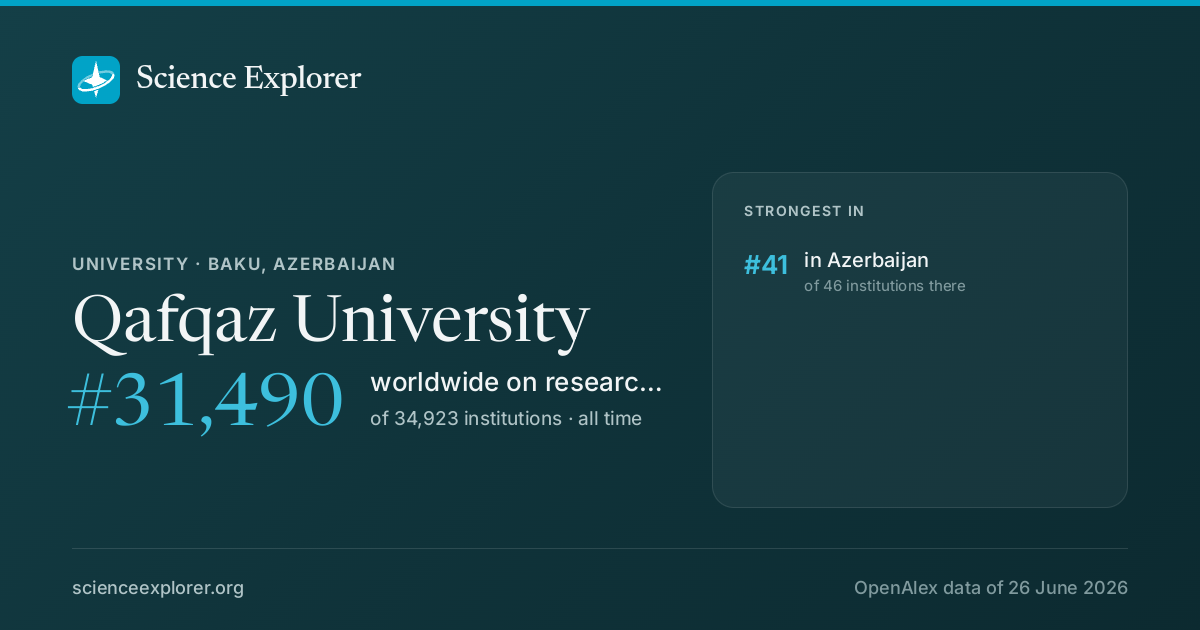
University · Baku · Azerbaijan

Qafqaz University

World rank, all time
#31,490
of 34,923
Rank in Azerbaijan
#41
of 46
Research works
160
▲ 164% vs 2018-21
Citations
727
4.5 per fractional work
Top-10% rate
4.2%
all institutions 10.0%
vs its own fields
0.89×
1.00× is exactly expected
Open access
60%
world 40%
International
25%
world 18%

Which fields of science does Qafqaz University work in?

In all years, 58% of research at Qafqaz University is in Social Sciences, 35% in Physical Sciences. Its largest fields are Social Sciences (22%), Economics, Econometrics and Finance (18%), Computer Science (16%). It does 2.6× the world's share of Social Sciences.

Social Sciences: 93 fractional works · 58.2% of its workSocial Sciences: 35 fractional works · 21.9% of its workPolitical Science and International Relations: 12 fractional works · 7.3% of its workEducation: 8 fractional works · 5.0% of its workSociology and Political Science: 6 fractional works · 3.6% of its workDevelopment: 3 fractional works · 2.1% of its workTransportation: 1 fractional works · 0.9% of its workSafety Research: 1 fractional works · 0.8% of its workCultural Studies: 1 fractional works · 0.5% of its workArcheology: 1 fractional works · 0.4% of its workGeneral Social Sciences: 1 fractional works · 0.4% of its workGeography, Planning and Development: 0 fractional works · 0.3% of its workDemography: 0 fractional works · 0.2% of its workAnthropology: 0 fractional works · 0.2% of its workSmaller subfields together: 0 fractional works · 0.2% of its workEconomics, Econometrics and Finance: 29 fractional works · 18.0% of its workEconomics and Econometrics: 19 fractional works · 11.8% of its workGeneral Economics, Econometrics and Finance: 8 fractional works · 5.0% of its workFinance: 2 fractional works · 1.1% of its workBusiness, Management and Accounting: 14 fractional works · 9.0% of its workStrategy and Management: 7 fractional works · 4.3% of its workManagement Information Systems: 3 fractional works · 2.0% of its workMarketing: 2 fractional works · 1.0% of its workAccounting: 1 fractional works · 0.8% of its workOrganizational Behavior and Human Resource Management: 1 fractional works · 0.6% of its workBusiness and International Management: 0 fractional works · 0.2% of its workSmaller subfields together: 0 fractional works · 0.1% of its workArts and Humanities: 9 fractional works · 5.4% of its workLanguage and Linguistics: 3 fractional works · 1.7% of its workLiterature and Literary Theory: 2 fractional works · 1.5% of its workMuseology: 2 fractional works · 1.3% of its workArcheology: 1 fractional works · 0.6% of its workPhilosophy: 0 fractional works · 0.2% of its workSmaller subfields together: 0 fractional works · 0.1% of its workPsychology: 3 fractional works · 2.0% of its workSocial Psychology: 2 fractional works · 1.4% of its workExperimental and Cognitive Psychology: 1 fractional works · 0.4% of its workDevelopmental and Educational Psychology: 0 fractional works · 0.2% of its workDecision Sciences: 3 fractional works · 1.9% of its workInformation Systems and Management: 2 fractional works · 1.2% of its workManagement Science and Operations Research: 1 fractional works · 0.7% of its workPhysical Sciences: 55 fractional works · 34.5% of its workComputer Science: 25 fractional works · 15.8% of its workInformation Systems: 9 fractional works · 5.8% of its workComputer Networks and Communications: 8 fractional works · 5.2% of its workArtificial Intelligence: 4 fractional works · 2.3% of its workComputational Theory and Mathematics: 1 fractional works · 0.7% of its workComputer Vision and Pattern Recognition: 1 fractional works · 0.6% of its workSignal Processing: 1 fractional works · 0.4% of its workComputer Science Applications: 0 fractional works · 0.3% of its workHuman-Computer Interaction: 0 fractional works · 0.3% of its workHardware and Architecture: 0 fractional works · 0.2% of its workEngineering: 11 fractional works · 6.9% of its workMechanical Engineering: 3 fractional works · 1.6% of its workElectrical and Electronic Engineering: 2 fractional works · 1.5% of its workMedia Technology: 2 fractional works · 1.0% of its workMechanics of Materials: 2 fractional works · 0.9% of its workAerospace Engineering: 1 fractional works · 0.4% of its workBiomedical Engineering: 1 fractional works · 0.3% of its workIndustrial and Manufacturing Engineering: 0 fractional works · 0.3% of its workAutomotive Engineering: 0 fractional works · 0.2% of its workControl and Systems Engineering: 0 fractional works · 0.2% of its workSmaller subfields together: 0 fractional works · 0.3% of its workEnergy: 7 fractional works · 4.3% of its workGeneral Energy: 5 fractional works · 2.8% of its workRenewable Energy, Sustainability and the Environment: 2 fractional works · 1.4% of its workMathematics: 3 fractional works · 1.9% of its workStatistics and Probability: 2 fractional works · 0.9% of its workMathematical Physics: 1 fractional works · 0.4% of its workApplied Mathematics: 0 fractional works · 0.3% of its workSmaller subfields together: 0 fractional works · 0.3% of its workPhysics and Astronomy: 3 fractional works · 1.8% of its workAtomic and Molecular Physics, and Optics: 1 fractional works · 0.8% of its workAstronomy and Astrophysics: 1 fractional works · 0.7% of its workSmaller subfields together: 0 fractional works · 0.3% of its workEnvironmental Science: 2 fractional works · 1.3% of its workManagement, Monitoring, Policy and Law: 1 fractional works · 0.4% of its workPollution: 0 fractional works · 0.3% of its workIndustrial and Manufacturing Engineering: 0 fractional works · 0.3% of its workWater Science and Technology: 0 fractional works · 0.2% of its workSmaller subfields together: 0 fractional works · 0.1% of its workMaterials Science: 2 fractional works · 1.1% of its workMaterials Chemistry: 1 fractional works · 0.8% of its workSmaller subfields together: 1 fractional works · 0.3% of its workChemistry: 2 fractional works · 1.0% of its workOrganic Chemistry: 1 fractional works · 0.7% of its workSpectroscopy: 0 fractional works · 0.2% of its workChemical Engineering: 1 fractional works · 0.3% of its workCatalysis: 0 fractional works · 0.2% of its workSmaller subfields together: 0 fractional works · 0.1% of its workEarth and Planetary Sciences: 0 fractional works · 0.1% of its workLife Sciences: 9 fractional works · 5.3% of its workAgricultural and Biological Sciences: 4 fractional works · 2.6% of its workPlant Science: 2 fractional works · 1.2% of its workAquatic Science: 1 fractional works · 0.5% of its workGeneral Agricultural and Biological Sciences: 0 fractional works · 0.3% of its workAgronomy and Crop Science: 0 fractional works · 0.2% of its workEcology, Evolution, Behavior and Systematics: 0 fractional works · 0.2% of its workSmaller subfields together: 0 fractional works · 0.1% of its workBiochemistry, Genetics and Molecular Biology: 4 fractional works · 2.2% of its workMolecular Biology: 2 fractional works · 1.5% of its workCell Biology: 1 fractional works · 0.4% of its workBiotechnology: 0 fractional works · 0.2% of its workSmaller subfields together: 0 fractional works · 0.1% of its workNeuroscience: 1 fractional works · 0.4% of its workCellular and Molecular Neuroscience: 1 fractional works · 0.4% of its workPharmacology, Toxicology and Pharmaceutics: 0 fractional works · 0.1% of its workImmunology and Microbiology: 0 fractional works · 0.1% of its workHealth Sciences: 3 fractional works · 1.9% of its workHealth Professions: 1 fractional works · 0.8% of its workSpeech and Hearing: 1 fractional works · 0.5% of its workGeneral Health Professions: 0 fractional works · 0.3% of its workMedicine: 1 fractional works · 0.7% of its workNursing: 1 fractional works · 0.4% of its workNutrition and Dietetics: 1 fractional works · 0.4% of its workALL ITS WORKQafqaz University160fractional works, all years
Life Sciences5%Physical Sciences35%Health Sciences2%Social Sciences58%

Each ring splits the one inside it: the four domains of science, their fields, their subfields. Size is fractional works in all years. Every slice is a page; the interactive view zooms down to single topics and colours each by how much more of it this institution does than the world.

Its 4 domains and 24 fields, with their numbers
    1. Social Sciences3521.9%
    2. Economics, Econometrics and Finance2918.0%
    3. Business, Management and Accounting149.0%
    4. Arts and Humanities95.4%
    5. Psychology32.0%
    6. Decision Sciences31.9%
    1. Computer Science2515.8%
    2. Engineering116.9%
    3. Energy74.3%
    4. Mathematics31.9%
    5. Physics and Astronomy31.8%
    6. Environmental Science21.3%
    7. Materials Science21.1%
    8. Chemistry21.0%
    9. Chemical Engineering10.3%
    10. Earth and Planetary Sciences00.1%
    1. Agricultural and Biological Sciences42.6%
    2. Biochemistry, Genetics and Molecular Biology42.2%
    3. Neuroscience10.4%
    4. Pharmacology, Toxicology and Pharmaceutics00.1%
    5. Immunology and Microbiology00.1%
    1. Health Professions10.8%
    2. Medicine10.7%
    3. Nursing10.4%
All of science, and how each field's share has moved since 1950: the Science domain explorer

Field profile

Location quotient across every field it publishes in: outside the ring is more than an institution of this size would be expected to publish, inside it is less.

Agricultural and Biological Sciences: 2.69× its world share, 2 worksAgricultural and Bio…Biochemistry, Genetics and Molecular Biology: 0.47× its world share, 0 worksBiochemistry, Geneti…Computer Science: 0.46× its world share, 1 worksComputer ScienceEarth and Planetary Sciences: 0.68× its world share, 0 worksEarth and Planetary …Engineering: 1.04× its world share, 2 worksEngineeringMaterials Science: 0.61× its world share, 0 worksMaterials ScienceHealth Professions: 0.40× its world share, 0 worksHealth ProfessionsMedicine: 0.21× its world share, 1 worksMedicineNursing: 2.17× its world share, 0 worksNursingArts and Humanities: 2.95× its world share, 1 worksArts and HumanitiesBusiness, Management and Accounting: 2.56× its world share, 1 worksBusiness, Management…Economics, Econometrics and Finance: 2.98× its world share, 1 worksEconomics, Econometr…Psychology: 1.40× its world share, 1 worksPsychologySocial Sciences: 2.28× its world share, 4 worksSocial Sciences1×world share
more than its size predictsabout as predictedless

Rings at 0.5×, 1× and 2×. Widest outward: Economics, Econometrics and Finance, 3.0×. Every wedge is a field page.

All 14 fields, with their numbers
  1. Economics, Econometrics and Finance2.98×1 works
  2. Arts and Humanities2.95×1 works
  3. Agricultural and Biological Sciences2.69×2 works
  4. Business, Management and Accounting2.56×1 works
  5. Social Sciences2.28×4 works
  6. Nursing2.17×0 works
  7. Psychology1.40×1 works
  8. Engineering1.04×2 works
  9. Earth and Planetary Sciences0.68×0 works
  10. Materials Science0.61×0 works
  11. Biochemistry, Genetics and Molecular Biology0.47×0 works
  12. Computer Science0.46×1 works
  13. Health Professions0.40×0 works
  14. Medicine0.21×1 works

Who are the top researchers at Qafqaz University?

Ranked on the quality score, Sahin Durmaz, Cihan Bulut and Hasanov Fakhri lead among researchers whose main affiliation is Qafqaz University.

  1. 1 Sahin Durmaz Azerbaijan · #2,163,162 worldwide 68 citations · 20 works
  2. 2 Cihan Bulut Azerbaijan · #2,599,998 worldwide 422 citations · 47 works
  3. 3 Hasanov Fakhri Azerbaijan · #2,627,587 worldwide 177 citations · 26 works
  4. 4 Rufat Mammadov Azerbaijan · #2,666,814 worldwide 176 citations · 24 works
  5. 5 Rasim Abutalibov Azerbaijan · #3,129,249 worldwide 9 citations · 22 works
  6. 6 Abzetdin Z. Adamov Azerbaijan · #3,848,866 worldwide 171 citations · 27 works
  7. 7 Bilal Dedeyev Azerbaijan · #4,528,797 worldwide 7 citations · 15 works
All ranked researchers at Qafqaz University

What are the most cited papers from Qafqaz University?

The most cited paper from Qafqaz University is "Review of energy-growth nexus: A panel analysis for ten Eurasian oil exporting countries" (Fakhri Hasanov, Cihan Bulut, Elchin Suleymanov, 2017), with 99 citations. Next come "Skew cyclic codes of arbitrary length" (98) and "Production, remanufacturing and waste disposal models for the cases of pure and partial backordering" (72).

Most cited papers
#PaperReleasedCitations
1 Review of energy-growth nexus: A panel analysis for ten Eurasian oil exporting countries Fakhri Hasanov, Cihan Bulut, Elchin Suleymanov · Renewable and Sustainable Energy Reviews Open access 31 Jan 2017 99
2 Skew cyclic codes of arbitrary length İrfan Şiap, Taher Abualrub, Nuh Aydın et al. · International Journal of Information and Coding Theory 2011 98
3 Production, remanufacturing and waste disposal models for the cases of pure and partial backordering Parviz Hasanov, Mohamad Y. Jaber, Saeed Zolfaghari · Applied Mathematical Modelling Open access 8 Dec 2011 72
4 Effective RED: An algorithm to improve RED's performance by reducing packet loss rate Babak Abbasov, Serdar Korukoğlu · Journal of Network and Computer Applications 11 Jul 2008 71
5 Design and Synthesis of Pyrrolotriazepine Derivatives: An Experimental and Computational Study Nurettin Mengeş, Özlem Sarı, Yusif Abdullayev et al. · The Journal of Organic Chemistry Open access 6 May 2013 70
All 62 most cited papers, with filters and sorting

Which keywords describe research at Qafqaz University?

By fractional works in all years, weighted toward what it does more of than the world: Economic Development, Globalization, Innovation, Sustainable Development, Sustainability, Climate Change, Renewable Energy and Economic Growth.

▲ more of its work than of the world's◆ about the world's share▼ less than the world's

Size is fractional works in all years in the topics tagged with each word; colour is the word's share of this institution's work against its share of the world's. The 40 words are chosen for being large and distinctive. Each links to the topic it comes from most.

All 40 words, with their numbers
  1. Globalization17▲ 5.7×19 topics
  2. Economic Development15▲ 14×14 topics
  3. Climate Change14▲ 3.4×9 topics
  4. Sustainability14▲ 4.8×13 topics
  5. Sustainable Development12▲ 6.7×13 topics
  6. Innovation12▲ 8.1×13 topics
  7. Renewable Energy10▲ 6.1×7 topics
  8. Economic Growth8▲ 7.2×12 topics
  9. Global Economy7▲ 46×3 topics
  10. Monetary Policy7▲ 16×5 topics
  11. Political Economy7▲ 16×5 topics
  12. Regional Development6▲ 15×5 topics
  13. Cultural Heritage6▲ 8.5×4 topics
  14. Digital Transformation6▲ 13×7 topics
  15. Geopolitics6▲ 32×6 topics
  16. Human Capital6▲ 26×5 topics
  17. Energy Efficiency5▲ 4.3×8 topics
  18. Global Governance5▲ 14×3 topics
  19. Energy Security5▲ 129×2 topics
  20. Natural Gas5▲ 31×1 topic
  21. Supply Diversity5▲ 156×1 topic
  22. Higher Education4▲ 7.0×5 topics
  23. Financial Crisis4▲ 18×6 topics
  24. Teacher Training4▲ 6.4×4 topics
  25. Cloud Computing4▲ 9.3×3 topics
  26. Economy4▲ 26×2 topics
  27. International Trade4▲ 17×4 topics
  28. Panel Data Analysis4▲ 22×3 topics
  29. Fiscal Policy4▲ 11×4 topics
  30. Russia4▲ 64×3 topics
  31. Economic Policy Uncertainty3▲ 47×1 topic
  32. Institutions3▲ 25×2 topics
  33. Language Teaching3▲ 12×3 topics
  34. Oil Price Shocks3▲ 47×1 topic
  35. Capitalism3▲ 26×1 topic
  36. Knowledge Clusters3▲ 84×1 topic
  37. Russian Economy3▲ 91×1 topic
  38. Transition3▲ 22×1 topic
  39. Financial Development3▲ 20×2 topics
  40. Labor Market3▲ 8.1×6 topics

Which research topics does Qafqaz University publish most on?

By volume in 2022-now: Polish Historical and Cultural Studies, Ancient and Medieval Archaeology Studies, Engineering and Agricultural Innovations and Education, Innovation and Language Studies.

  1. 1 Polish Historical and Cultural Studies Political Science and International Relations 1 works
  2. 2 Ancient and Medieval Archaeology Studies Archeology 1 works
  3. 3 Engineering and Agricultural Innovations Aquatic Science 1 works
  4. 4 Education, Innovation and Language Studies Education 1 works
  5. 5 Economic and Industrial Development Economics and Econometrics 1 works
  6. 6 Russia and Soviet political economy Political Science and International Relations 1 works
  7. 7 African history and culture analysis Political Science and International Relations 0 works
  8. 8 Genetic and Environmental Crop Studies Plant Science 0 works
  9. 9 Historical Geography and Cartography Geography, Planning and Development 0 works
  10. 10 Economic and Technological Developments in Russia Development 0 works

How open and international is its research?

Against the world's own shares: the tick on each track. Both are shares of its output, so they sit on one scale and can be read against each other as well as against the world.

openly available60.3%not open39.7%

World: 40% of research is openly available.

with international co-authors25.3%domestic only74.7%

World: 18% is written across borders.

How has Qafqaz University's research output changed?

Output in 2022-2025 was 164% higher than in 2018-2021.

still counting200020102020
grewheldshrank

The same series as a ribbon: one cell per year, darker for more. The line above answers how much; this answers when.

Its share of all research

Growing output can still be a shrinking share: all of science grows. This is Qafqaz University as a percentage of every work published that year, 0.000029% in 2024.

still counting0.00025%0.00050%0.00075%Qafqaz University0.00010% in 2025200020102020

Fractional works of Qafqaz University over all fractional works that year. How the balance of science has shifted.

Other research institutions in Baku

All research institutions in Baku

Share Qafqaz University's ranking

Qafqaz University on Science Explorer

A card with Qafqaz University's standing and the fields it leads in, for a post or a slide. A link to this page previews as the same card.

Download the card

1200 × 630 PNG, sized for social posts, drawn from the latest snapshot.

Badges for a website1Each links back here and updates with every snapshot

Research measures only: rankings here say nothing about teaching, admissions or student experience. Comparable institutions and collaboration partners have tabs of their own, above.

Discussion

Ask a question or share a note about Qafqaz University. Keep it to the research: no personal attacks, advertising or links. Any reader can report a post, which collapses it for everyone until it is opened.