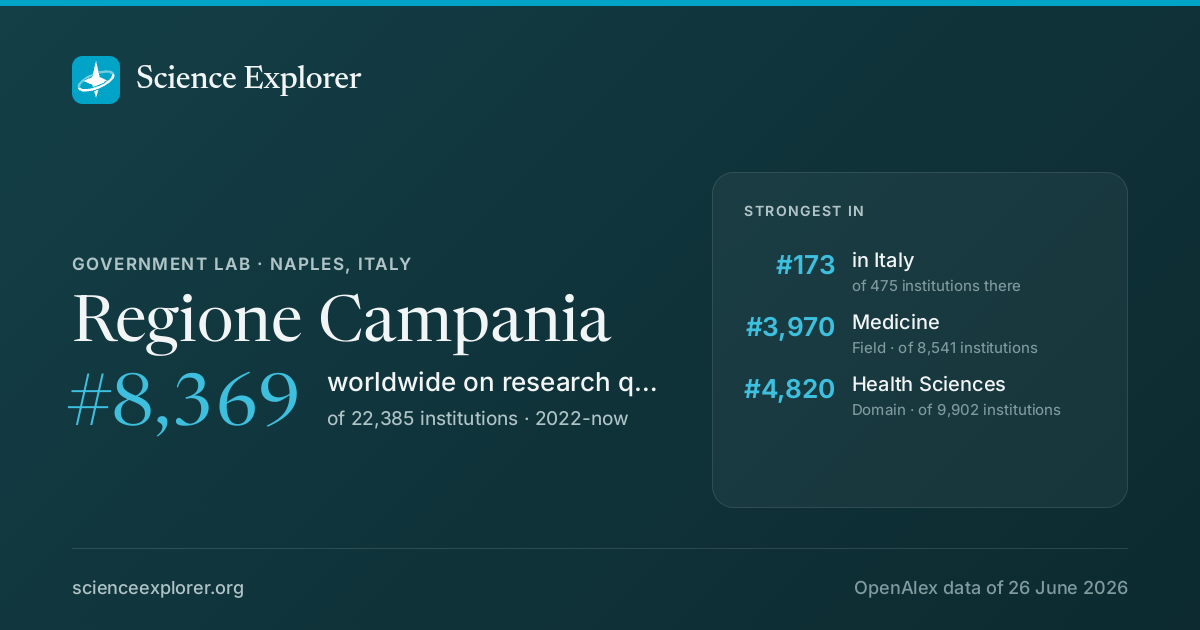
World rank, 2022-now #8,369
of 22,385 · #10,354 all time
Rank in Italy #173
of 475 Research works 1.2k
▲ 26% vs 2018-21
Citations 16k 13.5 per fractional work
Top-10% rate 12.4%
all institutions 10.0%
vs its own fields 1.05×
1.00× is exactly expected
Open access 47%
world 40%
International 19%
world 18%
What is Regione Campania known for in research?
The fields where it stands highest, 2022-now, ranked among every institution above the floor in each field.
Field World rank Where that sits Top-10% rate Works All time Field #3,970 of 8,541 13.3% 99
#6983 Domain #4,820 of 9,902 13.2% 107
#8329
Which fields of science does Regione Campania work in?
In 2022-now, 45% of research at Regione Campania is in Health Sciences , 23% in Social Sciences. Its largest fields are Medicine (41%), Social Sciences (12%), Engineering (7%). It does 1.9× the world's share of Health Sciences.
Health Sciences: 124 fractional works · 44.7% of its work Medicine: 115 fractional works · 41.4% of its work Neurology: 11 fractional works · 3.9% of its work Surgery: 10 fractional works · 3.8% of its work Epidemiology: 9 fractional works · 3.4% of its work Oncology: 9 fractional works · 3.3% of its work Infectious Diseases: 8 fractional works · 2.9% of its work Endocrinology, Diabetes and Metabolism: 7 fractional works · 2.4% of its work Pulmonary and Respiratory Medicine: 6 fractional works · 2.2% of its work Cardiology and Cardiovascular Medicine: 5 fractional works · 1.9% of its work Psychiatry and Mental health: 5 fractional works · 1.9% of its work Public Health, Environmental and Occupational Health: 5 fractional works · 1.9% of its work Physiology: 5 fractional works · 1.7% of its work Radiology, Nuclear Medicine and Imaging: 4 fractional works · 1.6% of its work Pharmacology: 4 fractional works · 1.4% of its work Pathology and Forensic Medicine: 3 fractional works · 1.1% of its work Hematology: 2 fractional works · 0.9% of its work Hepatology: 2 fractional works · 0.9% of its work Pediatrics, Perinatology and Child Health: 2 fractional works · 0.7% of its work Obstetrics and Gynecology: 2 fractional works · 0.7% of its work Dermatology: 2 fractional works · 0.6% of its work Rheumatology: 1 fractional works · 0.5% of its work Ophthalmology: 1 fractional works · 0.4% of its work Genetics: 1 fractional works · 0.4% of its work Reproductive Medicine: 1 fractional works · 0.3% of its work Emergency Medicine: 1 fractional works · 0.3% of its work Critical Care and Intensive Care Medicine: 1 fractional works · 0.3% of its work Anesthesiology and Pain Medicine: 1 fractional works · 0.3% of its work Family Practice: 1 fractional works · 0.3% of its work Nephrology: 1 fractional works · 0.2% of its work Urology: 1 fractional works · 0.2% of its work Smaller subfields together: 4 fractional works · 1.3% of its work Health Professions: 6 fractional works · 2.1% of its work General Health Professions: 3 fractional works · 0.9% of its work Speech and Hearing: 1 fractional works · 0.2% of its work Health Information Management: 1 fractional works · 0.2% of its work Occupational Therapy: 1 fractional works · 0.2% of its work Smaller subfields together: 1 fractional works · 0.5% of its work Veterinary: 1 fractional works · 0.5% of its work Small Animals: 1 fractional works · 0.5% of its work Nursing: 1 fractional works · 0.4% of its work Nutrition and Dietetics: 1 fractional works · 0.3% of its work Smaller subfields together: 0 fractional works · 0.1% of its work Dentistry: 1 fractional works · 0.3% of its work Social Sciences: 64 fractional works · 23.2% of its work Social Sciences: 33 fractional works · 11.9% of its work Sociology and Political Science: 15 fractional works · 5.3% of its work Education: 4 fractional works · 1.4% of its work Political Science and International Relations: 4 fractional works · 1.3% of its work Safety Research: 2 fractional works · 0.8% of its work Health: 2 fractional works · 0.7% of its work Law: 1 fractional works · 0.4% of its work Urban Studies: 1 fractional works · 0.4% of its work Cultural Studies: 1 fractional works · 0.3% of its work Linguistics and Language: 1 fractional works · 0.3% of its work Gender Studies: 1 fractional works · 0.2% of its work Anthropology: 1 fractional works · 0.2% of its work Smaller subfields together: 1 fractional works · 0.4% of its work Arts and Humanities: 11 fractional works · 3.9% of its work Archeology: 2 fractional works · 0.6% of its work Literature and Literary Theory: 2 fractional works · 0.6% of its work Philosophy: 1 fractional works · 0.5% of its work General Arts and Humanities: 1 fractional works · 0.4% of its work Classics: 1 fractional works · 0.3% of its work Religious studies: 1 fractional works · 0.3% of its work Language and Linguistics: 1 fractional works · 0.3% of its work History and Philosophy of Science: 1 fractional works · 0.2% of its work History: 1 fractional works · 0.2% of its work Smaller subfields together: 1 fractional works · 0.4% of its work Psychology: 11 fractional works · 3.8% of its work Clinical Psychology: 6 fractional works · 2.3% of its work Experimental and Cognitive Psychology: 2 fractional works · 0.9% of its work Social Psychology: 1 fractional works · 0.3% of its work Smaller subfields together: 1 fractional works · 0.4% of its work Economics, Econometrics and Finance: 6 fractional works · 2.1% of its work Economics and Econometrics: 5 fractional works · 1.9% of its work Smaller subfields together: 0 fractional works · 0.1% of its work Business, Management and Accounting: 4 fractional works · 1.4% of its work Marketing: 1 fractional works · 0.5% of its work Industrial relations: 1 fractional works · 0.5% of its work Smaller subfields together: 1 fractional works · 0.4% of its work Decision Sciences: 0 fractional works · 0.1% of its work Physical Sciences: 46 fractional works · 16.7% of its work Engineering: 19 fractional works · 7.0% of its work Electrical and Electronic Engineering: 4 fractional works · 1.5% of its work Biomedical Engineering: 4 fractional works · 1.4% of its work Aerospace Engineering: 2 fractional works · 0.7% of its work Industrial and Manufacturing Engineering: 2 fractional works · 0.7% of its work Civil and Structural Engineering: 2 fractional works · 0.6% of its work Mechanical Engineering: 2 fractional works · 0.6% of its work Ocean Engineering: 1 fractional works · 0.5% of its work Mechanics of Materials: 1 fractional works · 0.4% of its work Smaller subfields together: 2 fractional works · 0.7% of its work Environmental Science: 10 fractional works · 3.6% of its work Health, Toxicology and Mutagenesis: 3 fractional works · 1.2% of its work Management, Monitoring, Policy and Law: 2 fractional works · 0.6% of its work Ecology: 1 fractional works · 0.5% of its work Environmental Engineering: 1 fractional works · 0.4% of its work Pollution: 1 fractional works · 0.3% of its work Global and Planetary Change: 1 fractional works · 0.2% of its work Smaller subfields together: 1 fractional works · 0.4% of its work Computer Science: 7 fractional works · 2.4% of its work Artificial Intelligence: 3 fractional works · 1.1% of its work Computer Vision and Pattern Recognition: 1 fractional works · 0.5% of its work Information Systems: 1 fractional works · 0.3% of its work Computer Networks and Communications: 1 fractional works · 0.2% of its work Smaller subfields together: 1 fractional works · 0.3% of its work Earth and Planetary Sciences: 3 fractional works · 1.2% of its work Geology: 1 fractional works · 0.4% of its work Geochemistry and Petrology: 1 fractional works · 0.2% of its work Smaller subfields together: 2 fractional works · 0.6% of its work Materials Science: 2 fractional works · 0.7% of its work Materials Chemistry: 2 fractional works · 0.6% of its work Smaller subfields together: 0 fractional works · 0.2% of its work Physics and Astronomy: 1 fractional works · 0.5% of its work Radiation: 1 fractional works · 0.3% of its work Smaller subfields together: 1 fractional works · 0.2% of its work Energy: 1 fractional works · 0.4% of its work Renewable Energy, Sustainability and the Environment: 1 fractional works · 0.3% of its work Smaller subfields together: 0 fractional works · 0.1% of its work Chemistry: 1 fractional works · 0.4% of its work Organic Chemistry: 1 fractional works · 0.2% of its work Smaller subfields together: 0 fractional works · 0.1% of its work Mathematics: 1 fractional works · 0.3% of its work Modeling and Simulation: 1 fractional works · 0.2% of its work Smaller subfields together: 0 fractional works · 0.1% of its work Chemical Engineering: 1 fractional works · 0.2% of its work Life Sciences: 43 fractional works · 15.5% of its work Biochemistry, Genetics and Molecular Biology: 18 fractional works · 6.5% of its work Molecular Biology: 7 fractional works · 2.5% of its work Genetics: 4 fractional works · 1.6% of its work Cancer Research: 3 fractional works · 0.9% of its work Biotechnology: 1 fractional works · 0.3% of its work Cell Biology: 1 fractional works · 0.3% of its work Molecular Medicine: 1 fractional works · 0.3% of its work Endocrinology: 1 fractional works · 0.2% of its work Biophysics: 1 fractional works · 0.2% of its work Smaller subfields together: 1 fractional works · 0.3% of its work Agricultural and Biological Sciences: 9 fractional works · 3.2% of its work Plant Science: 2 fractional works · 0.8% of its work Food Science: 2 fractional works · 0.7% of its work Insect Science: 1 fractional works · 0.5% of its work General Agricultural and Biological Sciences: 1 fractional works · 0.3% of its work Agronomy and Crop Science: 1 fractional works · 0.3% of its work Ecology, Evolution, Behavior and Systematics: 1 fractional works · 0.2% of its work Animal Science and Zoology: 1 fractional works · 0.2% of its work Smaller subfields together: 1 fractional works · 0.3% of its work Immunology and Microbiology: 8 fractional works · 2.9% of its work Immunology: 4 fractional works · 1.4% of its work Parasitology: 1 fractional works · 0.5% of its work Applied Microbiology and Biotechnology: 1 fractional works · 0.4% of its work Microbiology: 1 fractional works · 0.4% of its work Virology: 1 fractional works · 0.2% of its work Neuroscience: 6 fractional works · 2.0% of its work Cognitive Neuroscience: 3 fractional works · 0.9% of its work Cellular and Molecular Neuroscience: 2 fractional works · 0.6% of its work Neurology: 1 fractional works · 0.3% of its work Smaller subfields together: 1 fractional works · 0.2% of its work Pharmacology, Toxicology and Pharmaceutics: 2 fractional works · 0.9% of its work Toxicology: 2 fractional works · 0.6% of its work Smaller subfields together: 1 fractional works · 0.2% of its work Health Sciences Medicine Health Pr… Social Sciences Social Sciences Arts and… Psychology Economics Physical Sciences Engineering Environme… Computer… Life Sciences Biochemis… Agricultu… Immunolog… Neuroscie… ALL ITS WORK Regione Campania 277 fractional works, 2022-now 15% 17% 45% 23%
Each ring splits the one inside it: the four domains of science, their fields, their subfields. Size is fractional works in 2022-now. Every slice is a page; the interactive view zooms down to single topics and colours each by how much more of it this institution does than the world.
Its 4 domains and 26 fields, with their numbers 115 41.4% 6 2.1% 1 0.5% 1 0.4% 1 0.3% 33 11.9% 11 3.9% 11 3.8% 6 2.1% 4 1.4% 0 0.1% 19 7.0% 10 3.6% 7 2.4% 3 1.2% 2 0.7% 1 0.5% 1 0.4% 1 0.4% 1 0.3% 1 0.2% 18 6.5% 9 3.2% 8 2.9% 6 2.0% 2 0.9% All of science, and how each field's share has moved since 1950: the Science domain explorer
Field profile
Location quotient across every field it publishes in: outside the ring is more than an institution of this size would be expected to publish, inside it is less.
Agricultural and Biological Sciences: 0.68× its world share, 9 works Agricultural and Bio… Biochemistry, Genetics and Molecular Biology: 1.23× its world share, 18 works Biochemistry, Geneti… Immunology and Microbiology: 2.83× its world share, 8 works Immunology and Micro… Neuroscience: 1.23× its world share, 6 works Neuroscience Pharmacology, Toxicology and Pharmaceutics: 2.42× its world share, 2 works Pharmacology, Toxico… Chemical Engineering: 0.69× its world share, 1 works Chemical Engineering Chemistry: 0.22× its world share, 1 works Chemistry Computer Science: 0.31× its world share, 7 works Computer Science Earth and Planetary Sciences: 0.78× its world share, 3 works Earth and Planetary … Energy: 0.40× its world share, 1 works Energy Engineering: 0.46× its world share, 19 works Engineering Environmental Science: 0.73× its world share, 10 works Environmental Science Materials Science: 0.20× its world share, 2 works Materials Science Mathematics: 0.23× its world share, 1 works Mathematics Physics and Astronomy: 0.23× its world share, 1 works Physics and Astronomy Dentistry: 0.55× its world share, 1 works Dentistry Health Professions: 0.79× its world share, 6 works Health Professions Medicine: 2.15× its world share, 115 works Medicine Nursing: 0.90× its world share, 1 works Nursing Veterinary: 3.65× its world share, 1 works Veterinary Arts and Humanities: 1.36× its world share, 11 works Arts and Humanities Business, Management and Accounting: 0.43× its world share, 4 works Business, Management… Decision Sciences: 0.11× its world share, 0 works Decision Sciences Economics, Econometrics and Finance: 0.96× its world share, 6 works Economics, Econometr… Psychology: 1.26× its world share, 11 works Psychology Social Sciences: 0.94× its world share, 33 works Social Sciences 1× world share
Rings at 0.5×, 1× and 2×. Widest outward: Veterinary , 3.6×. Every wedge is a field page.
All 26 fields, with their numbers Veterinary 3.65× 1 works Immunology and Microbiology 2.83× 8 works Pharmacology, Toxicology and Pharmaceutics 2.42× 2 works Medicine 2.15× 115 works Arts and Humanities 1.36× 11 works Psychology 1.26× 11 works Biochemistry, Genetics and Molecular Biology 1.23× 18 works Neuroscience 1.23× 6 works Economics, Econometrics and Finance 0.96× 6 works Social Sciences 0.94× 33 works Nursing 0.90× 1 works Health Professions 0.79× 6 works Earth and Planetary Sciences 0.78× 3 works Environmental Science 0.73× 10 works Chemical Engineering 0.69× 1 works Agricultural and Biological Sciences 0.68× 9 works Dentistry 0.55× 1 works Engineering 0.46× 19 works Business, Management and Accounting 0.43× 4 works Energy 0.40× 1 works Computer Science 0.31× 7 works Mathematics 0.23× 1 works Physics and Astronomy 0.23× 1 works Chemistry 0.22× 1 works Materials Science 0.20× 2 works Decision Sciences 0.11× 0 works
Who are the top researchers at Regione Campania?
Ranked on the quality score, Vassilis Martiadis , F. Raffone and Angelo D’Argenzio lead among researchers whose main affiliation is Regione Campania.
1
Vassilis Martiadis
Italy · #320,151 worldwide3.2k citations · 109 works
2
F. Raffone
Italy · #558,789 worldwide422 citations · 57 works
3
Angelo D’Argenzio
Italy · #1,397,982 worldwide7.1k citations · 39 works
4
Maurilio Giuseppe Maria Tavormina
Italy · #3,250,096 worldwide274 citations · 20 works
5
Rocco P. Morra
Italy · #3,888,816 worldwide291 citations · 47 works
6
Pietro Buono
Italy · #4,128,219 worldwide86 citations · 18 works
7
Roberta Giordana
Italy · #4,130,938 worldwide214 citations · 19 works
8
Renato Pizzuti
Italy · #4,616,252 worldwide940 citations · 38 works
9
Francesca Futura Bernardi
Italy · #4,729,300 worldwide39 citations · 17 works
10
Arianna Polo
Italy · #4,998,197 worldwide329 citations · 21 works
All ranked researchers at Regione Campania
What are the most cited papers from Regione Campania?
The most cited paper from Regione Campania is "Human interleukin 17–producing cells originate from a CD161+CD4+ T cell precursor" (Lorenzo Cosmi, Raffaele De Palma, Veronica Santarlasci et al., 2008), with 712 citations. Next come "Meteorological conditions, climate change, new emerging factors, and asthma and related allergic disorders. A statement of the World Allergy Organization" (593) and "Human mandible bone defect repair by the grafting of dental pulp stem/progenitor cells and collagen sponge biocomplexes" (562).
Most cited papers
# Paper Released Citations 1
Human interleukin 17–producing cells originate from a CD161+CD4+ T cell precursor
Lorenzo Cosmi, Raffaele De Palma, Veronica Santarlasci et al. · The Journal of Experimental Medicine
Open access 28 Jul 2008
712 2
Meteorological conditions, climate change, new emerging factors, and asthma and related allergic disorders. A statement of the World Allergy Organization
Gennaro D’Amato et al. · World Allergy Organization Journal
Open access 2015
593 3
Human mandible bone defect repair by the grafting of dental pulp stem/progenitor cells and collagen sponge biocomplexes
Riccardo d’Aquino, Alfredo De Rosa, V. Lanza et al. · European Cells and Materials
Open access 12 Nov 2009
562 4
FLOTAC: new multivalent techniques for qualitative and quantitative copromicroscopic diagnosis of parasites in animals and humans
Giuseppe Cringoli, Laura Rinaldi, Maria Paola Maurelli et al. · Nature Protocols
24 Feb 2010
529 5
Dental Pulp Stem Cells: A Promising Tool for Bone Regeneration
Riccardo d’Aquino, Gianpaolo Papaccio, Gregorio Laino et al. · Stem Cell Reviews and Reports
25 Feb 2008
314
All 61 most cited papers, with filters and sorting
Which keywords describe research at Regione Campania?
By fractional works in 2022-now, weighted toward what it does more of than the world: Epidemiology , Immunotherapy, Prognosis, SARS-CoV-2, Treatment, Gender, Identity and Autoantibodies.
Size is fractional works in 2022-now in the topics tagged with each word; colour is the word's share of this institution's work against its share of the world's. The 40 words are chosen for being large and distinctive. Each links to the topic it comes from most.
All 40 words, with their numbers Epidemiology 33 ▲ 3.0× 97 topics Treatment 10 ▲ 2.9× 36 topics Immunotherapy 10 ▲ 4.8× 16 topics Inflammation 9 ▲ 1.57× 44 topics Pandemic 9 ▲ 3.1× 8 topics Identity 8 ▲ 4.0× 9 topics Diagnosis 8 ▲ 3.0× 34 topics Prognosis 8 ▲ 8.2× 9 topics Public Health 8 ▲ 1.86× 31 topics Gender 7 ▲ 5.0× 10 topics Immune Response 7 ▲ 4.6× 14 topics Cultural Heritage 7 ▲ 4.6× 12 topics SARS-CoV-2 6 ▲ 7.7× 6 topics Religion 6 ▲ 5.0× 6 topics Genetics 6 ▲ 3.2× 18 topics Metabolic Syndrome 6 ▲ 2.7× 17 topics Clinical Trials 6 ▲ 3.2× 16 topics Colonialism 6 ▲ 4.5× 4 topics Autoantibodies 6 ▲ 9.0× 8 topics Nationalism 6 ▲ 4.6× 3 topics ACE2 Receptor 6 ▲ 8.9× 3 topics Memory 6 ▲ 8.3× 3 topics Fascism 5 ▲ 93× 1 topic Totalitarianism 5 ▲ 73× 1 topic Mortality 5 ▲ 3.1× 9 topics Neuromuscular Junction 5 ▲ 43× 2 topics Thrombosis 5 ▲ 6.3× 6 topics Vaccine 5 ▲ 4.3× 7 topics Myasthenia Gravis 5 ▲ 87× 1 topic Thymic Tumors 5 ▲ 87× 1 topic Clinical Guidelines 4 ▲ 5.5× 6 topics Genetic Mutations 4 ▲ 3.6× 16 topics Cognitive Impairment 4 ▲ 5.7× 4 topics Pathophysiology 4 ▲ 4.9× 8 topics Glycemic Control 4 ▲ 8.3× 4 topics European Union 4 ▲ 5.7× 5 topics Stroke 3 ▲ 6.9× 3 topics Insulin Therapy 3 ▲ 9.4× 3 topics Clinical Characteristics 3 ▲ 9.2× 2 topics Viral Transmission 3 ▲ 8.1× 3 topics
How open and international is its research?
Against the world's own shares: the tick on each track. Both are shares of its output, so they
sit on one scale and can be read against each other as well as against the world.
47% 53%
47.3% 52.7%
World: 40% of research is openly available.
19% 81%
18.6% 81.4%
World: 18% is written across borders.
How has Regione Campania's research output changed?
Output in 2022-2025 was 26% higher than in 2018-2021.
still counting 1990 2000 2010 2020
The same series as a ribbon: one cell per year, darker for more. The line above answers how much ; this answers when .
Its share of all research
still counting 0.0020% 0.0040% Regione Campania 0.0011% in 2025 1980 1990 2000 2010 2020 Fractional works of Regione Campania over all fractional works that year. How the balance of science has shifted .
How much of it reaches the world top 10%
still counting 5% 10% 15% Regione Campania 12.0% in 2025 all institutions 10.0% in 2025 2000 2010 2020 Of each year's output, the share that reached the world's 10% most cited for its field and year. Peak 13.6% in 2008.
Share Regione Campania's ranking
A card with Regione Campania's standing and the fields it leads in, for a post or a slide. A link to this page previews as the same card.
Badges for a website 1 Each links back here and updates with every snapshot
 Italy · #320,151 worldwide
3.2k citations · 109 works